
CRM Statistics 2027 reveal a CRM market moving beyond contact management into an intelligent operating layer for sales, marketing, customer service, customer data and AI-driven workflows.
CRM Statistics 2027: Key Numbers
- $128 billion — Gartner’s worldwide customer experience and relationship management software market in 2024, up 13.4%.
- 15.1% CAGR — Gartner’s forecast for CRM spending through 2027 on a constant-currency basis.
- 89% — Gartner’s forecast for large North American enterprises adopting CRM software by 2027.
- 92% — forecast adoption of CRM sales software among large North American enterprises by 2027.
- 85% — forecast adoption of CRM marketing software among large North American enterprises by 2027.
- $25.7 billion — CRM sales software revenue in 2024, up 12.2%.
- $29 billion — CRM marketing software revenue in 2024.
- $3.10 — average return for every $1 invested in CRM, according to Nucleus Research.
- 51% — share of CRM ROI attributed to individual productivity gains and process efficiency in Nucleus Research’s 2023 analysis.
- 54% — sellers in Salesforce’s 2026 State of Sales survey who had used AI agents.
- 84% — sales teams planning to simplify their technology stack, according to Salesforce.
- 91% — Indian sales professionals surveyed by Salesforce who said AI agents were mission-critical to business success.
1. The CRM Market Is Still Growing at Double-Digit Rates
Gartner reported that worldwide customer experience and relationship management software reached $128 billion in 2024, growing 13.4% in current U.S. dollars. Gartner’s earlier forecast projected CRM spending to grow at a 15.1% constant-currency CAGR through 2027.
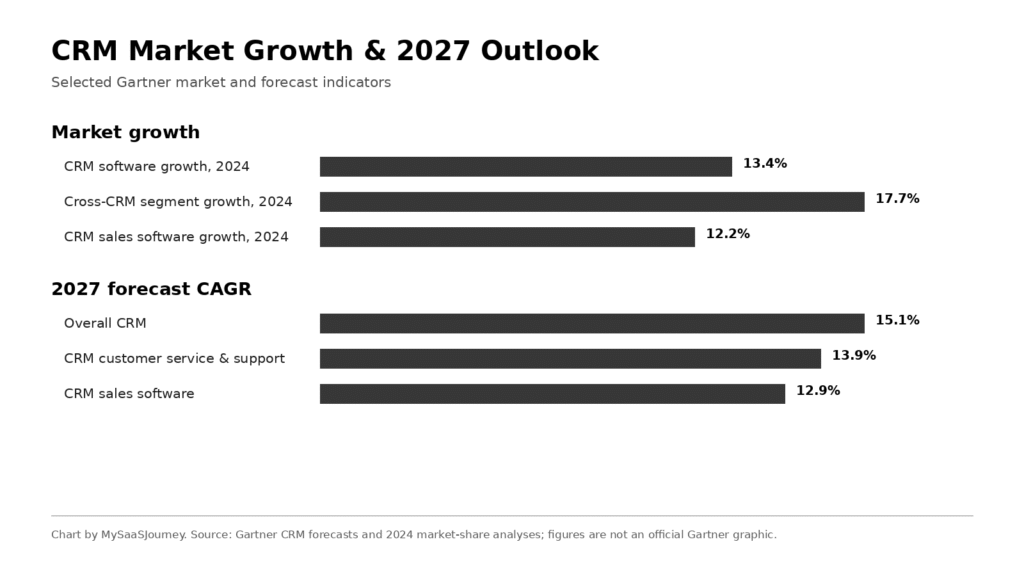
This does not mean every CRM company or segment will grow at 15.1%. Gartner’s CRM taxonomy covers sales, marketing, customer service and cross-CRM technologies, and the segments have different growth rates. The broader message is that CRM remains a structurally strong software category as businesses invest in customer data, cloud applications, automation and AI.
For buyers, this makes CRM an infrastructure decision rather than simply a software purchase. The strongest implementations connect customer information to measurable revenue and service workflows.
Gartner — Customer Experience and Relationship Management Forecast
2. CRM Adoption Is Approaching Enterprise Saturation
Gartner forecasts that 89% of large North American enterprises will have adopted CRM software by 2027, compared with 80% in 2023. The strategic question is therefore shifting from whether an enterprise should have CRM to whether its CRM architecture is effective enough.
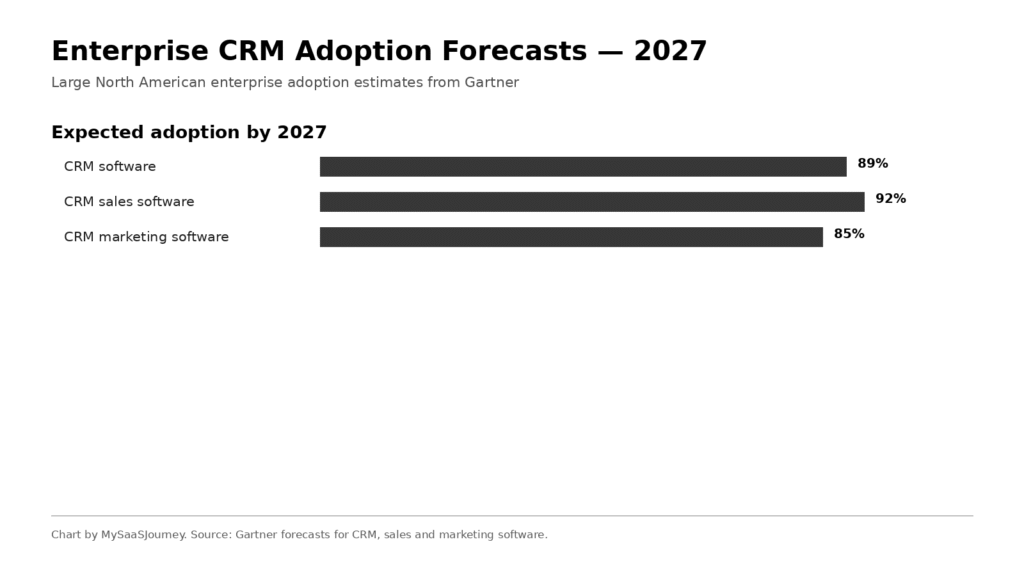
Functional adoption is also high. Gartner forecasts 92% adoption for CRM sales software and 85% adoption for CRM marketing software among large North American enterprises by 2027. CRM is increasingly shared across departments rather than remaining a sales-only system.
High adoption does not automatically create value. Poor data, weak integration, low user adoption and badly designed workflows can leave an expensive CRM underused. Businesses should therefore evaluate CRM maturity, not merely CRM ownership.
Gartner — CRM Sales Forecast · Gartner — CRM Marketing and Cross-CRM Forecast
3. CRM Sales Software Is Becoming a Productivity Platform
Worldwide CRM sales software revenue reached $25.7 billion in 2024, up 12.2%, according to Gartner. Growth has been supported by functional expansion, wider adoption, pricing and the value of AI-powered tools that improve seller efficiency.
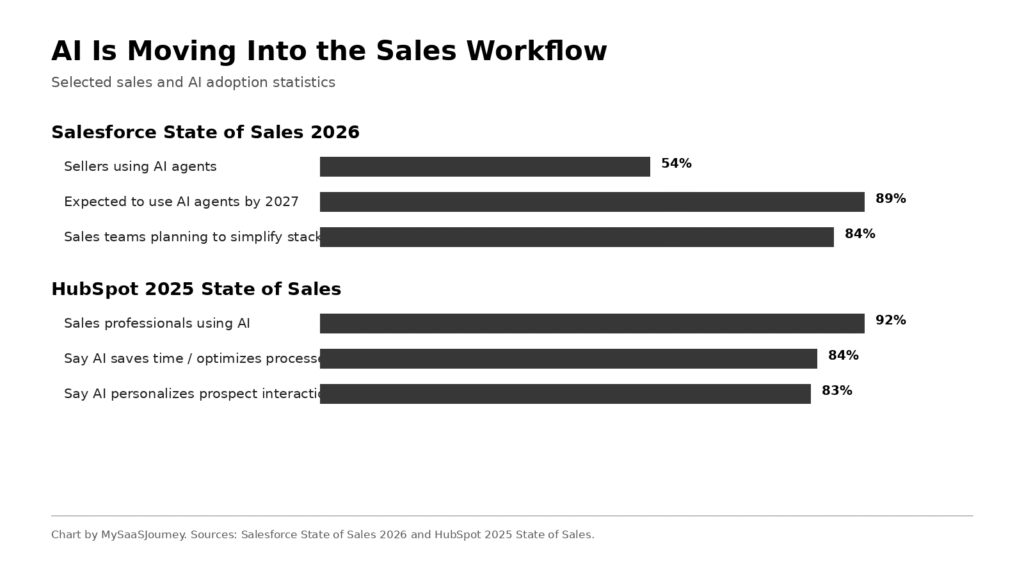
Salesforce’s 2026 State of Sales research adds an important productivity dimension. Its double-anonymous survey of 4,050 sales professionals across 22 countries found that 54% of sellers had used AI agents, while nearly nine in ten sales teams use agents or expect to within two years. Sellers expected agents to reduce prospect research time by 34% and email drafting time by 36% once fully implemented.
This changes how CRM should be evaluated. The strongest question is no longer simply how many pipeline features a CRM contains. It is how much repetitive work it removes while maintaining accuracy, human control and customer trust.
Gartner — CRM Sales Market Share Analysis · Salesforce — State of Sales 2026
4. CRM ROI Remains Strong, but Measurement Matters
Nucleus Research found an average CRM return of $3.10 for every $1 invested, based on 63 CRM case studies reviewed over the preceding decade. Nucleus also found that average CRM ROI had declined from $4.90 to $3.10 over that period.
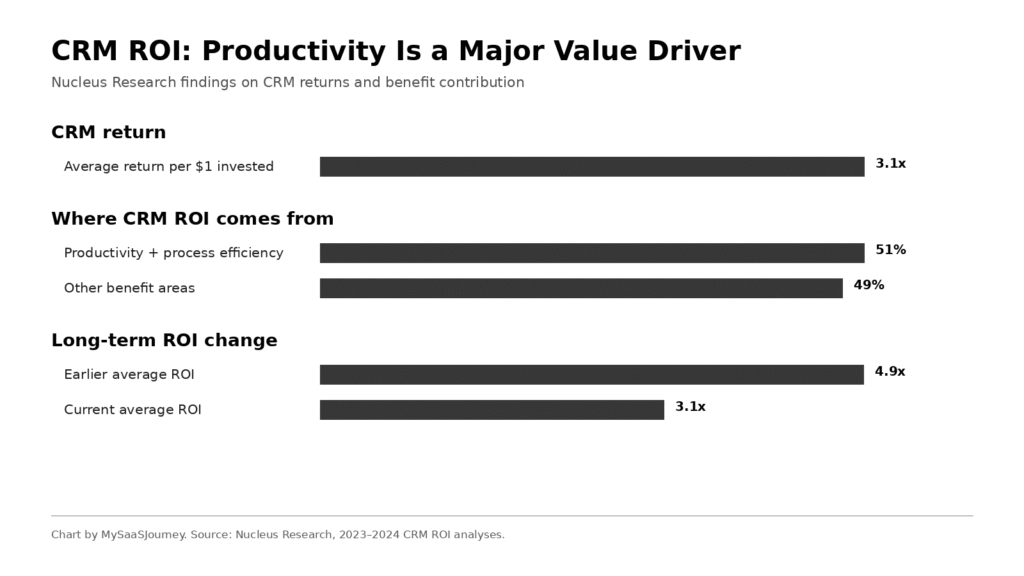
The decline does not mean CRM has stopped creating value. It suggests that basic CRM adoption is less differentiating than it once was. Organizations increasingly need strong implementation, process redesign, better data and targeted automation to generate incremental returns.
Nucleus Research’s benefit analysis found that individual productivity gains and overall process efficiency accounted for 51% of total ROI across 11 CRM case-study calculations from 2023. This is important because CRM value does not always appear as directly attributable new revenue.
Businesses should therefore measure sales-cycle duration, conversion, revenue influenced, employee time saved, forecast accuracy, service resolution, data quality and user adoption alongside direct revenue.
Nucleus Research — CRM Returns $3.10 per Dollar · Nucleus Research — CRM Benefit Areas
5. AI Is Becoming Part of the CRM Operating Model
Gartner forecasts that by 2027, AI-influenced software is expected to represent 8.5% of total CRM spending, with about 60% of AI-influenced spend related to generative AI.
Customer service is another major AI opportunity. Gartner forecasts CRM customer service and support software to grow at a 13.9% constant-currency CAGR through 2027. By 2027, AI-influenced CSS spending is expected to reach 10.1% of total CSS spending, with 65% of that AI-influenced spending related to generative AI.
The next stage is agentic CRM. Instead of waiting for a user to request an account summary or follow-up task, an agent can monitor activity, assemble customer context, recommend the next action and, where authorized, execute routine work.
That also raises the importance of data quality. AI can amplify good CRM data, but it can also amplify bad data. The more autonomous the workflow becomes, the more important governance and validation become.
Gartner — CRM Forecast · Gartner — CRM Customer Service and Support Forecast
6. Data Quality Is Becoming the Hidden CRM KPI
AI-agent adoption is making customer-data quality more important. Salesforce’s 2026 State of Sales research found that sales teams are prioritizing data hygiene to improve AI outcomes. Globally, 74% of sales teams with AI prioritize data hygiene.
The trend is especially visible in India. Salesforce reported that 82% of Indian sales professionals were focusing on data cleansing, while 66% of Indian sales leaders with AI said disconnected systems were slowing their AI initiatives.
Organizations should treat data quality as a measurable operational KPI. Useful metrics include duplicate rate, missing-field rate, stale-record rate, account matching accuracy, contactability and time since last verification.
In 2027, an “AI-ready CRM” should increasingly mean a CRM with trusted, connected and governed customer data.
Salesforce — State of Sales 2026 · Salesforce India — State of Sales 2026
7. Cloud CRM Is Becoming the Default Delivery Model
Gartner forecasts that by 2027, 91% of CRM customer service and support software spending will be cloud-based, compared with 84% in 2022. Gartner also forecasts that 90% of new CRM marketing software spending will be cloud-based by 2027.
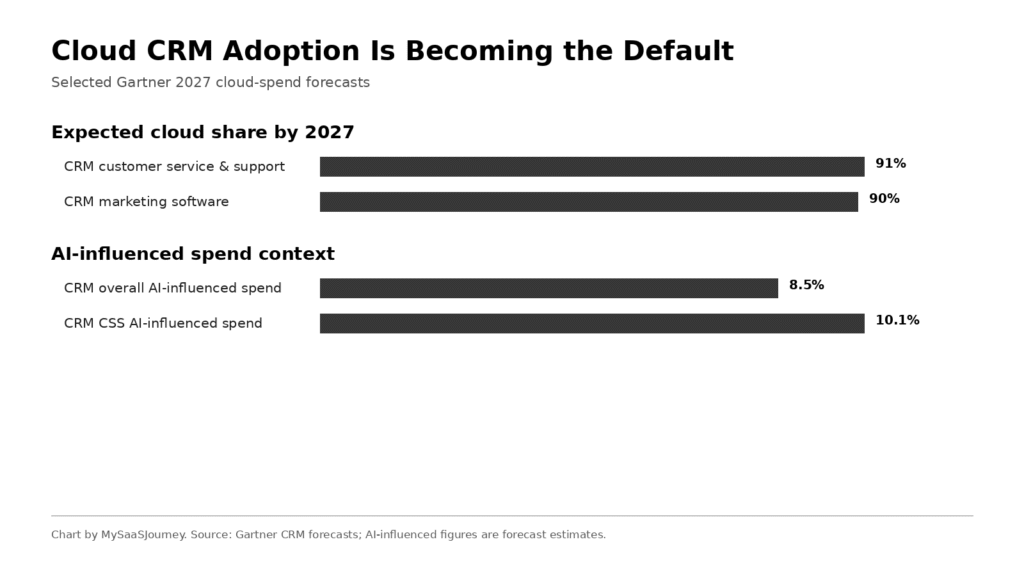
Cloud CRM supports easier integration with analytics, marketing automation, collaboration platforms, customer data systems and AI services. It also enables vendors to update capabilities continuously.
The trade-off is greater ecosystem dependency. Buyers should evaluate APIs, security, identity management, data portability, integration limits, governance and exit costs—not just feature lists.
Gartner — CRM Customer Service and Support Forecast
8. Marketing CRM Is Expanding Around Customer Data and Personalization
Gartner forecast CRM marketing software revenue to grow from approximately $23 billion to $46.4 billion by 2027, representing a 15.3% five-year CAGR in that forecast. Gartner also expected 85% of large North American enterprises to adopt CRM marketing software by 2027.
Marketing CRM increasingly combines customer profiles, behavioral signals, segmentation, campaign orchestration, personalization and AI-assisted execution. The objective is not simply sending more messages; it is coordinating relevant experiences across the customer lifecycle.
Personalization, however, depends on reliable data. Marketers should therefore connect CRM strategy with identity resolution, consent management, data governance and measurable business outcomes such as qualified pipeline, conversion, retention and customer lifetime value.
Gartner — CRM Marketing and Cross-CRM Forecast
9. Sales Organizations Are Simplifying Their Technology Stacks
Salesforce’s 2026 State of Sales research found that 84% of sales teams plan to simplify their technology stack. This is significant because AI performs best when customer context is accessible and consistent.
Stack simplification does not mean every company needs one giant suite. Specialized applications can remain valuable when they solve a problem substantially better. The objective is to remove duplicated functionality, disconnected databases and unnecessary manual handoffs.
A useful CRM-stack audit should document every system touching customer data, which system owns each record, how data is synchronized, which workflows depend on the integration and what happens when an integration fails.
Salesforce — State of Sales, 7th Edition
10. India Is a Major AI-Agent and CRM Growth Story
Salesforce’s 2026 India State of Sales research surveyed 250 Indian sales professionals as part of its global study. It found that 91% of Indian sales professionals surveyed said AI agents were mission-critical to business success.
The same research reported that 54% of Indian sales professionals were using AI for prospecting, with another 41% planning to do so. Indian sellers also reported substantial bandwidth and administrative challenges.
For Indian SaaS and technology businesses, CRM strategy should therefore include integrations, customer-data quality, automation, local operating processes and total cost of ownership. The opportunity is not merely to adopt AI, but to redesign customer-facing workflows around it.
Salesforce India — State of Sales 2026
11. CRM Customer Service Is Moving Toward AI-Assisted Resolution
Customer service CRM is increasingly focused on reducing the amount of time representatives spend searching for context, summarizing cases and performing repetitive actions. AI can support knowledge retrieval, case summaries, suggested responses, routing, intent detection and eventually more autonomous resolution.
Businesses should judge these capabilities through outcomes: first-response time, resolution time, repeat contacts, self-service containment, customer satisfaction and agent productivity. Automation volume by itself is not a useful measure if customer experience deteriorates.
12. The New CRM KPI: Time Returned to Employees
Traditional CRM reporting focuses on revenue, pipeline and activity. In an AI-enabled CRM environment, another KPI is becoming increasingly important: time returned to employees.
Businesses can calculate this by measuring the time previously spent on account research, data entry, meeting preparation, reporting, follow-up drafting and routine service tasks, then comparing it with the time required after automation.
This metric connects software investment directly to organizational capacity. If a CRM returns thousands of hours annually, those hours can be redirected toward customer relationships, strategic selling, product work and higher-value decision making.
13. What CRM Buyers Should Measure in 2027
- Adoption: active users, workflow completion and feature utilization.
- Data: duplicate rate, completeness, freshness and accuracy.
- Revenue: pipeline velocity, win rate, sales-cycle duration, expansion and retention.
- Productivity: administrative time, research time, reporting time and time returned to employees.
- Customer experience: response time, resolution time, repeat contacts and satisfaction.
- AI quality: automation rate, human override rate, error rate and agent success rate.
Methodology and Source Notes
This report prioritizes primary research and established research firms. Gartner is used for market size, segment forecasts, enterprise adoption and cloud/AI forecasts. Nucleus Research is used for CRM ROI. Salesforce is used for sales AI and agent adoption. Microsoft and HubSpot provide additional workplace and sales context.
Historical figures are presented as actuals. Forward-looking numbers are labeled as forecasts or expectations. Survey findings are not population-wide census data. CRM market estimates can differ because research firms use different definitions, so figures from incompatible taxonomies should not be added together.
Gartner — CRM Market Share 2024 · Nucleus Research — CRM ROI · Microsoft Work Trend Index · HubSpot — 2025 State of Sales
Final Takeaway
CRM in 2027 will be defined less by the number of records stored and more by the amount of useful work the platform can coordinate. Market growth remains strong, enterprise adoption is high, cloud delivery is becoming standard and AI agents are moving into everyday sales and service workflows.
The winning strategy is clear: build trusted customer data, simplify unnecessary technology complexity, automate high-value workflows, measure time returned to employees and govern AI carefully. CRM is becoming less of a database and more of an intelligent operating layer for customer relationships.