
Cloud computing is the delivery of computing services over the internet. Instead of buying and maintaining every server, storage device, database, and software platform yourself, you can access technology resources from a cloud provider when you need them. Those resources may include online storage, virtual servers, databases, networking, development platforms, analytics, and complete applications.
You probably already use cloud computing. Web-based email, online file storage, video streaming, collaboration software, and many business applications rely on cloud infrastructure. Businesses use it to host websites, run applications, back up data, support remote teams, and handle demand that changes throughout the day.
This guide explains what cloud computing means, how it works, the main service and deployment models, common examples, advantages, risks, and how organizations can choose a practical cloud strategy.
What is cloud computing?
Cloud computing is a way to access computing resources such as servers, storage, networks, applications, and services over a network, usually the internet. The resources are provided on demand and can often be scaled up or down without the customer buying new physical hardware.
The National Institute of Standards and Technology (NIST) describes cloud computing as on-demand network access to a shared pool of configurable computing resources that can be rapidly provisioned and released with minimal management effort. Its definition identifies five essential characteristics, three service models, and four deployment models. Read the NIST cloud computing definition for the formal framework.
In simple terms, think of cloud computing as renting technology capabilities instead of owning and operating all of the equipment yourself. A company can rent computing power to run its website, store customer records in a managed database, or subscribe to software that employees access through a browser.
The word “cloud” does not mean that data floats somewhere intangible. Cloud services run on physical servers, storage devices, networking equipment, and facilities in data centers. The cloud provider operates much of that infrastructure and exposes services through dashboards, APIs, and applications.
How does cloud computing work?
Cloud computing connects a user or application to computing resources hosted in a provider’s infrastructure. The exact path depends on the service. A browser-based application might send a request to a web server, which reads or updates a database and returns a response. A cloud storage app might upload a file to distributed storage and synchronize it across devices.
A simple cloud computing workflow
Browser, phone, app, or computer
Internet or private connection
Application, API, database, or storage
Servers, virtual machines, networks, and storage
Page loads, file syncs, or result appears
Example: When you open a cloud document, your device sends a request to the service. The provider checks your identity and permissions, retrieves the document, and sends the relevant content to your app. When you edit and save it, the service processes the changes and stores them. Collaboration features may then distribute the updates to other authorized users.
What makes the cloud different from a single remote server?
A remote server is not automatically a cloud service. Cloud computing generally includes on-demand access, pooled resources, rapid provisioning, network access, and some way to measure or manage usage. These features let a provider serve many customers efficiently while giving each customer a defined set of resources and controls.
Providers use technologies such as virtualization, containers, orchestration software, automated provisioning, distributed storage, and monitoring to deliver services at scale. Customers do not need to understand every layer to use a cloud application, but these systems help explain how capacity can be assigned and adjusted quickly.
The five key characteristics of cloud computing
NIST’s framework identifies five characteristics that help distinguish cloud computing from other ways of delivering IT services.
- On-demand self-service: Customers can provision supported resources, such as storage or virtual servers, when needed without having to ask a provider’s staff to manually set up each request.
- Broad network access: Services are available over a network and can be accessed from supported devices, including laptops, phones, tablets, and workstations.
- Resource pooling: The provider uses shared infrastructure to serve multiple customers while logically separating their resources and data.
- Rapid elasticity: Capacity can often increase or decrease to match demand. The amount and speed of scaling depend on the service design and configuration.
- Measured service: Usage can be monitored and measured, allowing customers to see consumption and providers to bill according to the applicable pricing model.
These characteristics are useful when evaluating a vendor’s claims. A service can be hosted remotely without offering all the flexibility, automation, or metering normally associated with cloud computing.
The three main cloud service models: IaaS, PaaS, and SaaS
Cloud service models describe how much of the technology stack the provider manages and how much remains your responsibility. The three traditional models are Infrastructure as a Service (IaaS), Platform as a Service (PaaS), and Software as a Service (SaaS). The boundaries can vary by product, so check the provider’s documentation for a specific service.
Cloud service models at a glance
IaaS
Rent infrastructure
Virtual servers, storage, and networks. You manage more of the operating system and applications.
Example: virtual machines in AWS or Azure.
PaaS
Build and deploy
A managed platform for running application code without managing every underlying server component.
Example: a managed application hosting platform.
SaaS
Use the application
The provider operates the application and underlying infrastructure. You configure the product and manage your data and users.
Example: online email or collaboration software.
1. Infrastructure as a Service (IaaS)
IaaS provides fundamental computing resources such as virtual machines, storage, and networking. Rather than purchasing physical servers, an organization provisions infrastructure from a cloud provider and installs or configures the software it needs.
IaaS offers flexibility and control. A business can choose operating systems, configure networking, install applications, and adjust resources to meet workload needs. However, the customer remains responsible for more tasks, including operating system updates, application configuration, access controls, and workload security.
Common use cases: hosting a custom application, moving an existing server workload, creating test environments, running specialized software, and extending capacity during busy periods.
Example providers: Amazon Web Services (AWS), Microsoft Azure, and Google Cloud offer infrastructure services. See AWS’s IaaS explanation for an overview of the model.
2. Platform as a Service (PaaS)
PaaS provides a managed environment for developing, deploying, and running applications. The provider handles much of the underlying infrastructure and runtime platform, allowing developers to focus more on code, data, and application behavior.
For example, a development team may push application code to a managed platform that handles supported runtime components, deployment, and scaling options. The team still needs to write secure code, manage credentials, understand service limits, and design the application properly.
Common use cases: web applications, APIs, prototypes, internal business apps, and services that need a repeatable deployment process without extensive server administration.
Trade-off: PaaS can reduce operational work, but it may constrain supported runtimes or configurations. Moving an application later can require changes if it depends heavily on provider-specific features.
3. Software as a Service (SaaS)
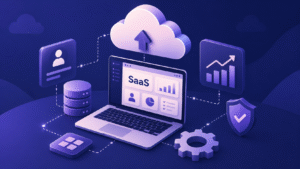
SaaS delivers a complete software application over the internet. Users generally access it through a browser or app, while the provider operates the application and its underlying infrastructure. Customers configure settings, manage users and permissions, and remain responsible for using the product appropriately and protecting their accounts and data.
Examples include online email, video meetings, customer relationship management (CRM), project management, accounting, file sharing, and design applications. SaaS can help a business avoid installing and maintaining separate copies of an application on every device.
If you want a more detailed explanation of the model, read our guide to what SaaS means and how it works.
Common use cases: employee collaboration, sales tracking, customer support, finance, marketing, and project coordination.
IaaS vs PaaS vs SaaS: who manages what?
| Responsibility | IaaS | PaaS | SaaS |
|---|---|---|---|
| Physical data center and hardware | Provider | Provider | Provider |
| Core networking and virtualization | Provider | Provider | Provider |
| Operating system and runtime | Usually customer-managed OS | Mostly provider-managed | Provider-managed |
| Application code | Customer | Customer | Provider |
| Data, user access, and configuration | Customer responsibility | Shared, depending on service | Customer responsibilities remain for data and account use |
This table is a simplified guide, not a contract. Responsibility can differ between services, and the customer always needs to understand its obligations for data, identity, configuration, and regulatory requirements.
Types of cloud deployment
Deployment models describe who can use the cloud environment and how it is organized. NIST defines public, private, community, and hybrid cloud models. Businesses also commonly discuss multicloud, which means using services from more than one cloud provider.
Public cloud
A public cloud provider operates infrastructure and delivers services to multiple customers. Each customer uses its own accounts, access controls, and logically separated resources. Public cloud services are often attractive because organizations can start without building a private data center and can access a wide range of managed services.
Good fit for: web applications, development and testing, data analytics, SaaS workloads, and organizations that want to provision capacity quickly.
Consider: ongoing usage charges, identity and access configuration, data location requirements, network design, and how easily the workload can move elsewhere.
Private cloud
A private cloud environment is dedicated to one organization. It may be operated by the organization itself or by a third party, and it can exist on or off the organization’s premises. A private cloud can provide more control over configuration and governance, but it still requires management, capacity planning, and security oversight.
Good fit for: workloads with specialized requirements, organizations with existing infrastructure investments, and cases where governance or isolation needs influence the design.
Consider: the cost and skills required to operate the environment. A private environment is not automatically more secure; configuration and operational discipline still matter.
Hybrid cloud
Hybrid cloud combines a private environment or on-premises infrastructure with public cloud services. An organization may keep a system in its own data center while using public cloud storage, backup, analytics, or extra capacity for another workload.
Hybrid approaches can support gradual migration and allow businesses to place workloads where they make the most sense. They can also create integration and security complexity because identity, networking, data movement, monitoring, and policies must work across environments.
Multicloud
Multicloud means using services from multiple cloud providers. For example, a company might use one provider for its main application, another for analytics, and a separate SaaS platform for collaboration. Some organizations use multicloud to access specific capabilities, support geographic requirements, or reduce reliance on a single provider.
However, multicloud does not automatically reduce risk or cost. Teams need the skills and tools to manage multiple billing systems, security models, monitoring approaches, and service architectures. It is best used to meet a clear business or technical need rather than as a goal on its own.
Real-world examples of cloud computing
Cloud computing can be invisible in everyday use. The following examples show how it appears in consumer and business settings.
Online storage and file synchronization
Cloud storage services keep files on provider-managed infrastructure and make them available to authorized devices. A user can upload a document from a laptop, view it on a phone, and share it with colleagues. The provider handles storage systems and service availability, while users need to manage sharing permissions and keep appropriate backups for important data.
To compare options for this kind of task, see our roundup of cloud storage apps and our guide to free cloud storage services.
Email and collaboration software
Cloud-based email, calendars, video meetings, chat, and document editing let teams collaborate without operating every application server themselves. Administrators still need to manage user access, account security, retention, and sharing policies.
Website and application hosting
A business can run its website on cloud infrastructure rather than buying a physical server. It may use virtual machines, managed application hosting, a content delivery network, a managed database, and monitoring services. The design can scale as traffic changes, but poor configuration or unbounded resource usage can still cause outages or high bills.
E-commerce and seasonal traffic
An online store may experience a sharp increase in traffic during a promotion or holiday. Cloud resources can be configured to add capacity when demand increases and reduce it later. This flexibility can help avoid purchasing enough physical hardware for the busiest hour of the year, though scaling requires testing and proper application architecture.
Backups and disaster recovery
Cloud storage can hold backup copies away from primary systems. Organizations may also maintain recovery environments that can be activated after a serious outage. A backup is only useful if it can be restored, so teams should define recovery targets, protect backup credentials, and test restoration regularly.
See our guide to backup software for tools that can support data protection workflows.
Data analytics and artificial intelligence
Cloud platforms provide storage, compute, data processing, analytics, and AI services that organizations can access without building every component themselves. A team may process sales data, run reports, train a model, or use a managed AI API. These workloads can consume substantial resources, so budgets, privacy rules, access policies, and data retention need to be planned from the start.
Benefits of cloud computing
1. Lower upfront infrastructure spending
Cloud services can reduce the need to purchase physical servers, storage arrays, and networking equipment before a project begins. Instead, an organization pays for the services it uses under the provider’s pricing model. This can make experimentation and initial deployment easier, particularly for smaller businesses.
However, cloud is not always cheaper over the long term. Continuous high utilization, data transfer charges, premium support, licensing, and poorly managed resources can make costs exceed expectations. Compare total cost of ownership rather than only the initial price.
2. Flexible capacity and scalability
Cloud resources can often be increased when workloads grow and reduced when demand falls. This is helpful for seasonal businesses, new products, testing environments, and services with unpredictable traffic. The application must still be designed to scale, and not every service scales instantly or automatically.
3. Faster deployment
Teams can provision a supported database, server, development environment, or application platform in minutes instead of waiting for procurement and physical installation. This can shorten project setup time and help teams test ideas before making larger commitments.
4. Access from different locations
Cloud services can let authorized people work from offices, homes, or while traveling, provided they have connectivity and the appropriate permissions. Remote access must be paired with secure authentication, device controls, and clear sharing policies.
5. Access to managed services
Cloud providers offer managed databases, monitoring, analytics, identity tools, application platforms, and many other services. Using a managed service can reduce the operational burden of patching and maintaining underlying components, although customers still need to configure the service properly.
6. Backup and resilience options
Cloud platforms can support replication, backup, availability zones, and disaster recovery designs. These capabilities help organizations plan for failures, but they do not automatically guarantee recovery. Resilience depends on architecture, configuration, recovery objectives, and testing.
7. Easier experimentation
Developers and business teams can create temporary environments, test a feature, or analyze a dataset without purchasing a permanent fleet of equipment. Temporary resources should be shut down or removed when they are no longer needed to avoid waste.
Risks and limitations of cloud computing
Security misconfiguration
Cloud providers protect their underlying infrastructure, but customers can still expose data by using overly broad permissions, leaving storage public, leaking credentials, or failing to patch customer-managed systems. Security should include strong identity controls, least-privilege access, logging, encryption where appropriate, secure configuration, and regular reviews.
Shared responsibility
Cloud security is shared. The provider is responsible for some parts of the service, such as physical facilities and underlying infrastructure, while the customer remains responsible for tasks such as user access, data handling, application code, and configuration. The split changes between IaaS, PaaS, and SaaS. Read the specific provider’s shared responsibility guidance rather than assuming the provider manages everything.
Unexpected or rising costs
Cloud invoices may include compute, storage, database usage, network egress, API calls, logs, backups, licenses, and support. Teams can reduce surprises by setting budgets and alerts, tagging resources by team or project, reviewing usage, deleting unused assets, and testing cost estimates before launching a new workload.
Internet dependency and latency
Cloud services generally need network access. Poor connectivity can interrupt work, and applications that send data to a distant region may experience latency. Businesses should assess connection reliability, regional placement, caching, offline requirements, and whether some processing should happen closer to the user or device.
Provider outages
Cloud providers can experience service interruptions. A service-level agreement describes specific commitments and remedies, not a guarantee that outages will never occur. Critical systems need an availability design that matches business needs, plus tested backup and recovery procedures.
Vendor lock-in and portability
An application that relies heavily on proprietary databases, APIs, or deployment tools may be harder to move to another provider. Portability can be improved through documented architecture, open standards where appropriate, export and restore testing, and a realistic exit plan. Avoid adding portability complexity unless the business benefit justifies it.
Privacy and compliance
Organizations must understand where data is stored and processed, who can access it, how it is retained, and which legal or contractual obligations apply. A cloud provider’s certifications do not automatically make every workload compliant. Responsibility remains with the organization to select suitable services and configure them correctly.
Cloud computing vs traditional on-premises IT
Traditional on-premises IT means an organization owns or directly operates its own computing hardware and related infrastructure. Cloud computing shifts some or all of that operation to a provider. The best option depends on workload patterns, compliance requirements, existing investment, skills, and the cost over the system’s life.
| Factor | Cloud computing | On-premises IT |
|---|---|---|
| Initial investment | Often lower upfront cost; service charges recur | Hardware and facility costs may be substantial upfront |
| Capacity changes | Often provisioned more quickly | May require purchasing and installing hardware |
| Maintenance | Provider manages some layers; customer still has responsibilities | Organization manages more hardware and infrastructure operations |
| Control | Depends on service model and provider | Direct control over owned equipment and configuration |
| Connectivity | Network access is usually essential | Local systems may continue to operate on a local network |
| Scaling cost | Usage-based charges can grow quickly without controls | Capacity is constrained by installed equipment until expanded |
| Best fit | Variable workloads, managed services, rapid provisioning | Specialized requirements, existing investment, or particular control needs |
Many organizations use a mix of both. The decision should be based on workload requirements and measurable costs, not on the assumption that cloud is always modern or on-premises is always safer.
How to choose a cloud provider or service
AWS, Microsoft Azure, and Google Cloud are major cloud platforms, but a business should compare services rather than choose based on brand recognition alone. Also consider SaaS vendors if the requirement is to use a complete application rather than build or operate one.
- Define the workload. Identify what the service must do, how much data it handles, its expected traffic, performance needs, and the consequences of downtime.
- Choose the service model. Use SaaS when an existing application meets the need; consider PaaS when you want to deploy code without managing most infrastructure; choose IaaS when you need more control over servers and operating systems.
- Check security and compliance. Review identity controls, encryption options, audit logs, data residency, retention, recovery, and relevant contractual commitments.
- Estimate total cost. Include compute, storage, network traffic, backups, support, licenses, observability, and the people required to manage the service.
- Review portability and integration. Confirm that the service works with your existing identity, monitoring, data, and development tools. Understand how you would export data if you leave.
- Run a small proof of concept. Test realistic traffic, user access, backup and restore, performance, and billing before migrating a critical workload.
- Plan operations. Assign owners for security, cost reviews, updates, incident response, and recovery testing.
A practical cloud adoption workflow
Cloud adoption should be treated as an ongoing operating model, not a one-time server move. Teams need to monitor performance, access, incidents, cost, and service changes after launch. A workload that works in a small test may behave differently under production traffic or real data volumes.
Common cloud computing terms explained
- Data center: A physical facility that houses servers, storage, networking, power, cooling, and related systems.
- Virtual machine (VM): A software-defined computer that runs on physical hardware and has its own allocated resources.
- Container: A packaged application environment that shares the host operating system kernel and helps applications run consistently across supported environments.
- Cloud storage: Storage services that keep data on provider-managed infrastructure and make it accessible through defined interfaces.
- Database as a service: A managed database offering where the provider handles some infrastructure and operational tasks.
- Serverless computing: A cloud model where the provider manages much of the server infrastructure and executes code or services in response to events or requests. Servers still exist behind the scenes.
- Elasticity: The ability to add or release resources as demand changes.
- Region and availability zone: Geographic and infrastructure groupings used by providers to deploy services and design for availability. Definitions and capabilities vary by provider.
- Cloud migration: Moving applications, data, or IT processes from one environment to another, often from on-premises infrastructure to cloud services.
- FinOps: A collaborative approach to understanding and managing cloud spending while balancing cost, speed, and business value.
Frequently asked questions about cloud computing
What is cloud computing in simple words?
Cloud computing means using computing services over the internet instead of operating all the required hardware and software yourself. Examples include online file storage, web email, business apps, and rented virtual servers.
What are the main types of cloud computing?
The three main service models are IaaS, PaaS, and SaaS. Common deployment models are public, private, hybrid, and community cloud. Multicloud describes using services from more than one cloud provider.
What are examples of cloud computing?
Examples include cloud file storage, online email, video conferencing, SaaS CRM systems, website hosting, managed databases, online backups, analytics platforms, and AI services delivered over APIs.
Is cloud computing the same as cloud storage?
No. Cloud storage is one type of cloud service. Cloud computing also includes processing, virtual servers, databases, networking, application platforms, analytics, and complete software applications.
Is cloud computing secure?
Cloud services can be secured effectively, but security depends on the provider, service configuration, access controls, data handling, and customer responsibilities. No deployment model is automatically secure simply because it is in the cloud.
Is cloud computing cheaper than traditional IT?
It can reduce upfront spending and make variable workloads more economical, but total cost depends on usage, data transfer, licenses, support, operations, and architecture. Compare the full cost over the expected life of the workload.
Who uses cloud computing?
Individuals, startups, enterprises, educational institutions, nonprofits, and government organizations use cloud services for communication, storage, application hosting, collaboration, analytics, backup, and many other tasks.
What is the difference between IaaS, PaaS, and SaaS?
IaaS provides infrastructure such as virtual servers and networks. PaaS provides a managed platform for deploying applications. SaaS provides a complete application for users. As you move from IaaS to SaaS, the provider generally manages more of the underlying technology stack.
Can a small business use cloud computing?
Yes. A small business can start with SaaS tools for email, accounting, customer management, file sharing, and project tracking. It may use cloud hosting later if it needs to run a custom website or application. Start with the simplest service that meets the business requirement.
Conclusion: What is cloud computing and why does it matter?
Cloud computing provides on-demand access to computing resources, from simple online applications to infrastructure for large business systems. It can help organizations deploy faster, scale resources, access managed services, and support people working from different locations. The three common service models, IaaS, PaaS, and SaaS, differ mainly in how much of the technology stack the provider manages. Public, private, hybrid, and multicloud approaches describe different deployment choices.
The cloud is not automatically cheaper, safer, or easier. Organizations still need to manage identity, data, configuration, costs, compliance, and recovery. The best starting point is to define the business problem, choose the simplest service model that solves it, test a realistic workload, and review performance and spending after launch.
Official sources and further reading
- NIST: The Definition of Cloud Computing (SP 800-145)
- AWS: What Is Infrastructure as a Service?
- Microsoft Azure: Types of Cloud Computing
- Google Cloud: What Is Cloud Computing?
This guide is for general educational purposes. Specific service features, prices, security responsibilities, and compliance commitments vary by provider and product. Check the current official documentation before making purchasing or architecture decisions.