

DevOps is a way for software development and IT operations teams to work together across the full lifecycle of an application, from planning and coding to testing, release, monitoring, and improvement. Instead of treating development and operations as separate handoffs, DevOps encourages shared responsibility, automation, fast feedback, and reliable delivery.
In practical terms, DevOps helps a team turn a code change into a tested, released, monitored product update through a repeatable process. It is not a single tool, job title, or technology. It combines culture, working practices, and tools. Microsoft and AWS both describe DevOps as a combination of collaboration, practices, and technology across the application lifecycle. Microsoft Learn’s DevOps overview and AWS’s explanation of DevOps provide useful starting points.
In this guide: DevOps meaning · Lifecycle · Core practices · Architecture · CI/CD pipeline · Deployment strategies · Security · Reliability · Tools · Getting started · FAQs
\n
What does DevOps mean?
The word DevOps combines development and operations. Development teams build and change software. Operations teams help keep applications, infrastructure, and services available, secure, and reliable. DevOps brings these responsibilities closer together so teams can deliver changes with fewer avoidable delays and better visibility into production performance.
DevOps does not mean every developer must become a systems administrator or that an organization must eliminate specialist teams. It means the people involved collaborate, automate repeatable work, share responsibility for outcomes, and use feedback to improve how software is built and operated.
How does DevOps work?
A DevOps workflow connects the steps that move a change from an idea to a running service. The exact tools and stages vary by organization, but a typical workflow looks like this:
- Plan: Define the user need, prioritize work, and agree on acceptance criteria.
- Code: Developers make small changes and store them in version control such as Git.
- Build and test: Automated processes compile or package the software and run checks to catch problems early.
- Integrate: Changes are regularly merged into a shared codebase and validated through continuous integration.
- Deliver or deploy: A release pipeline prepares the change and moves it through test and production environments according to the team’s controls.
- Operate and monitor: The team observes availability, errors, performance, security signals, and user experience.
- Learn and improve: Feedback, incidents, and usage data inform the next set of changes.
This is a loop rather than a one-way conveyor belt. Monitoring can reveal a problem that sends the team back to planning or development. Automated tests and small releases help teams identify problems earlier, while monitoring helps them understand the real-world effect after release. See Microsoft’s guide to continuous integration for more detail on automated builds and tests.
DevOps lifecycle at a glance
| Stage | Typical work | Example output |
|---|---|---|
| Plan | Requirements, backlog, prioritization | Reviewed work item |
| Develop | Code, peer review, version control | Committed change |
| Build and test | Automated build, unit tests, security checks | Validated build artifact |
| Release | Release approvals and deployment pipeline | Version ready for deployment |
| Deploy | Rollout to staging or production | Running application version |
| Operate | Support, incident response, reliability work | Stable service and resolved incidents |
| Monitor and learn | Metrics, logs, traces, feedback | Improvement actions |
Core DevOps practices
Continuous integration (CI)
Continuous integration means frequently combining code changes in a shared repository and automatically building and testing them. The goal is to discover integration errors while changes are still small, rather than waiting until a large release. CI is most useful when tests are trustworthy, failures are visible, and teams act on broken builds quickly.
Continuous delivery and continuous deployment (CD)
Continuous delivery automates the steps needed to build, test, and prepare software for release, keeping it in a deployable state. A release may still require a human approval. Continuous deployment goes further by automatically releasing changes that pass the pipeline’s required checks. Teams should choose the level of automation that fits their risk, compliance, testing, and operational maturity. These terms are related but are not interchangeable. Microsoft’s DevOps architecture guide explains the distinction.
Infrastructure as code (IaC)
Infrastructure as code uses machine-readable definitions and version control to provision and manage infrastructure. Instead of relying entirely on manual setup, teams can review, repeat, test, and track infrastructure changes. IaC can reduce configuration drift, but it still requires access controls, reviews, secrets management, and safeguards against destructive changes.
Automated testing
Automated tests check software behavior as part of the delivery process. Teams may use unit tests, integration tests, end-to-end tests, performance tests, and security checks. Automation improves consistency, but it does not eliminate the need for thoughtful test design, exploratory testing, or review of user experience.
Monitoring and observability
After release, teams need to know whether the application is working as expected. Monitoring tracks defined signals such as latency, error rates, resource use, and availability. Observability combines telemetry such as metrics, logs, and traces to help teams investigate unfamiliar behavior. Our guide to the best observability tools explores platforms that can support this work.
Security throughout the lifecycle
Security checks should be integrated into planning, code review, builds, deployment, and operations rather than postponed until the end. This approach is often called DevSecOps. Examples include dependency scanning, secret detection, access controls, infrastructure policy checks, and vulnerability management. Automated findings still need triage and remediation ownership.
DevOps tools and what they do
DevOps is not defined by a particular vendor stack. Teams select tools based on their environment, skills, security requirements, budget, and existing workflows. Common categories include:
| Category | Purpose | Examples |
|---|---|---|
| Version control | Track code changes and support collaboration | Git, GitHub, GitLab |
| CI/CD automation | Build, test, and deploy software | GitHub Actions, GitLab CI/CD, Jenkins, Azure Pipelines |
| Containers | Package applications and dependencies consistently | Docker |
| Container orchestration | Schedule and manage containerized workloads | Kubernetes |
| Infrastructure as code | Define infrastructure in repeatable files | Terraform, cloud-native templates |
| Configuration management | Apply and maintain system configuration | Ansible, Puppet, Chef |
| Monitoring and observability | Detect failures and investigate system behavior | Prometheus, Grafana, OpenTelemetry-based tools, commercial platforms |
| Planning and collaboration | Track work, reviews, incidents, and releases | Jira, Azure Boards, GitHub Issues |
These are examples, not a required shopping list. A small team can begin with version control, a basic automated test pipeline, a safe deployment process, and useful monitoring. Adding more tools before the team has clear practices can increase complexity instead of improving delivery.
What are the benefits of DevOps?
- Shorter feedback cycles: Automated checks and smaller changes can reveal defects sooner.
- More repeatable releases: Pipelines reduce reliance on undocumented manual steps.
- Shared ownership: Developers and operations staff can work together on deployability, reliability, and support.
- Improved visibility: Version history, pipeline results, and production telemetry make changes easier to trace.
- Faster recovery: Monitoring, rollback plans, and practiced incident response can help teams reduce the impact of failures.
- Continuous learning: Teams can use user feedback and incident reviews to improve the product and process.
These benefits are not automatic. They depend on good engineering practices, reliable tests, appropriate architecture, clear ownership, and a culture where teams can report problems and learn from them.
DevOps challenges and common mistakes
- Automating a broken process: First simplify the workflow, then automate repeatable steps.
- Measuring success only by deployment speed: Track quality, reliability, recovery, and user outcomes alongside delivery frequency.
- Building a fragile CI/CD pipeline: Treat pipeline code, credentials, permissions, and dependencies as production-critical systems.
- Ignoring monitoring: A successful deployment does not prove the user experience is healthy. Define useful service indicators and alerts.
- Creating separate DevOps silos: A specialist team can help enable other teams, but it should not become a new handoff that removes shared responsibility.
- Adopting too many tools: Start with the smallest toolset that supports the workflow and expand when a real need appears.
- Skipping security and recovery planning: Include least-privilege access, secrets handling, backups, rollback strategies, and incident practice in the delivery design.
DevOps vs. Agile vs. SRE
| Approach | Main focus | How it relates to DevOps |
|---|---|---|
| Agile | Iterative product development, collaboration, and feedback | Often helps teams plan and deliver work in small increments. |
| DevOps | Collaboration and practices across software delivery and operations | Connects development, release, and running the service. |
| Site reliability engineering (SRE) | Applying engineering methods to reliability and operations | Can complement DevOps through service-level objectives, automation, and incident learning. |
| DevSecOps | Integrating security throughout delivery and operations | Extends shared responsibility to security controls and response. |
These approaches can overlap. An organization may use Agile planning, DevOps delivery practices, and SRE methods for reliability at the same time. They are not mutually exclusive frameworks.
DevOps example: releasing a SaaS feature
Imagine a SaaS company adding a new reporting filter. The product team defines the behavior and acceptance criteria. A developer creates a small code change and submits it for review. The CI pipeline builds the change and runs automated tests. After the checks pass, the team deploys it to a test environment for validation. The release pipeline then promotes the approved version to production, perhaps gradually or behind a feature flag.
Once released, monitoring tracks error rates, latency, and the relevant user behavior. If the change causes problems, the team can disable the feature, roll back the release, or deploy a fix according to its incident procedures. The team then reviews what happened and updates tests or alerts if needed.
The point is not that every release must be fully automatic. The point is that the steps are repeatable, changes are traceable, feedback is available, and teams have a plan for failure as well as success.
How to get started with DevOps
- Map the current delivery process. Identify delays, manual steps, recurring failures, and unclear handoffs.
- Use version control consistently. Keep application code and relevant configuration changes reviewed and traceable.
- Automate one valuable check. Start with a fast test or build that catches a common problem.
- Create a repeatable release path. Use a test environment, clear approvals where needed, and a documented rollback approach.
- Add actionable monitoring. Track a small set of service health signals and ensure alerts have owners and runbooks.
- Build security into the workflow. Protect credentials, restrict permissions, and add automated checks based on your risk.
- Review outcomes and improve. Learn from failed deployments and incidents without blame, then prioritize a small number of changes.
Teams can use delivery and reliability measures to see whether changes are helping. Common measures include deployment frequency, change lead time, change failure rate, and time to restore service. Interpret metrics in context and use them to improve systems, not to rank individuals or encourage unsafe shortcuts. Google Cloud’s DevOps resource center provides further material on delivery and operational capabilities.
DevOps architecture: how the pieces fit together
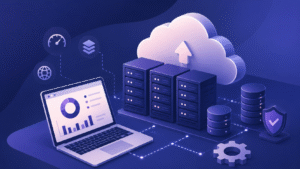
A useful DevOps architecture connects source control, automated validation, artifact storage, deployment, infrastructure management, security controls, and production feedback. The pipeline is the delivery path, but it depends on supporting systems and operating practices around it.
| Layer | Responsibility | Important design questions |
|---|---|---|
| Source and change management | Store code, configuration, reviews, and change history | Are changes reviewed? Can a release be traced to a commit? |
| Build and validation | Compile or package code and run automated checks | Are builds repeatable? Are tests fast, reliable, and meaningful? |
| Artifact repository | Store versioned packages, container images, and release artifacts | Can the exact tested artifact be promoted between environments? |
| Release orchestration | Coordinate approvals, deployment steps, rollout, and rollback | Are permissions controlled? Can a failed rollout stop safely? |
| Infrastructure and configuration | Provision compute, networking, identity, and runtime settings | Are changes versioned, reviewed, and reproducible? |
| Security and governance | Manage identities, secrets, policies, dependencies, and audit records | Are controls built into the workflow and findings assigned owners? |
| Operations and telemetry | Monitor service health, handle incidents, and collect feedback | Can teams detect impact and identify the cause quickly? |
A key principle is to build an artifact once and promote that same artifact through the required environments where possible. Rebuilding separately for production can introduce differences between what was tested and what is released. Environment-specific settings should be supplied securely at deploy or runtime, not baked into source code or exposed in logs.
Designing a practical CI/CD pipeline
A continuous integration and delivery pipeline should give fast feedback early and apply stronger controls as a change approaches production. A typical sequence is:
- Change submitted: A developer opens a pull or merge request linked to a work item.
- Fast checks: Formatting, linting, secret detection, and unit tests run first to reject obvious problems quickly.
- Build and package: The pipeline creates a versioned artifact and records its source commit and build metadata.
- Deeper validation: Integration tests, API tests, dependency and image scans, and other relevant checks run.
- Artifact publication: A successful artifact is stored in a controlled registry or repository.
- Test deployment: The artifact is deployed to a representative environment and tested against configuration and integration dependencies.
- Release decision: Automated policy or an authorized approval determines whether the release can proceed.
- Production rollout: The team deploys gradually or uses an appropriate release strategy, then checks health signals.
- Verification and recovery: Automated checks confirm the service is healthy. If not, the pipeline halts, rolls back, or triggers the documented recovery process.
Not every pipeline needs every test stage. Choose checks based on the application’s risks, architecture, and failure history. A pipeline should be secure and observable itself: restrict who can modify release definitions, protect credentials, record deployments, alert on repeated failures, and keep a tested recovery path.
Branching, code review, and release management
Teams need a way to coordinate changes without making integration painful. Long-lived branches can drift from the main codebase and create difficult merges. Trunk-based development keeps changes close to the main branch, usually with small commits, frequent integration, and feature flags for unfinished capabilities. Other branching strategies can work when release, compliance, or product constraints require them, but teams should understand the cost of delayed integration.
Code review should focus on correctness, maintainability, security, tests, and operational impact. It should not be an arbitrary queue that slows every change. Keep changes reviewable, automate mechanical checks, and make ownership clear for sensitive components. Feature flags can separate deployment from user exposure, but stale flags create complexity and should have owners and removal dates.
Deployment strategies and safe releases
| Strategy | How it works | Useful when | Trade-off |
|---|---|---|---|
| Rolling deployment | Replace instances or pods in batches | The platform supports gradual replacement and health checks | Old and new versions may run together temporarily |
| Blue-green deployment | Keep two environments and switch traffic to the new one | Fast switching and a prepared fallback are valuable | May require duplicate capacity and compatible data changes |
| Canary release | Expose a small portion of traffic to the new version, then expand | Production signals can be compared during rollout | Requires traffic control and meaningful monitoring |
| Feature flags | Deploy code while controlling whether a feature is enabled | Product exposure needs to be separated from deployment | Flags need governance, testing, and cleanup |
| Recreate / all-at-once | Replace the running version in one operation | Downtime is acceptable or the service has another availability mechanism | Can cause an outage if the new version fails |
Safe deployment also depends on database and API compatibility. Prefer changes that allow old and new application versions to coexist during a rollout. A common database migration pattern is expand-and-contract: add a backward-compatible field or structure, deploy code that supports both states, migrate data, and remove the old structure only after the previous version is no longer needed. Test rollback assumptions, because rolling back application code does not automatically reverse a data migration safely.
Infrastructure as code, configuration, and environments
Infrastructure as code describes infrastructure in version-controlled definitions. It supports review, repeatability, and drift detection, but it does not make every infrastructure change safe by itself. Teams should review plans before applying them, restrict production permissions, protect state files, and separate secrets from ordinary configuration.
Keep development, test, staging, and production environments as consistent as practical while accounting for differences in scale, access, data, and cost. Use configuration management or platform tooling to reduce manual differences. Do not copy sensitive production data into lower environments without appropriate masking, authorization, and retention controls.
Secrets such as API keys, certificates, database passwords, and tokens should be stored in a dedicated secret-management system or approved platform facility. Avoid committing secrets to repositories or printing them in pipeline logs. Rotate credentials when exposure is suspected, and use short-lived or narrowly scoped credentials where supported.
Containers, orchestration, and cloud platforms
Containers package an application with its runtime dependencies into a consistent deployable unit. They can reduce differences between development and production, but they do not remove the need to patch base images, scan dependencies, set resource limits, manage secrets, and configure networking. Container orchestration platforms such as Kubernetes help schedule workloads, manage service discovery, and support controlled rollouts, but they add operational complexity and are not required for every application.
Cloud services can provide managed build runners, container registries, identity systems, databases, monitoring, and deployment services. The right design depends on portability requirements, existing skills, workload shape, data residency, security obligations, and total operating cost. See our guide to what cloud computing is and how it works for cloud service models and deployment options.
Reliability engineering: SLI, SLO, SLA, and error budgets
DevOps needs a clear definition of “working well.” A service-level indicator (SLI) is a measured signal, such as the proportion of valid requests completed successfully or request latency. A service-level objective (SLO) is the target for that indicator over a defined period. A service-level agreement (SLA) is an external commitment that may include consequences if the commitment is missed. These terms are related but have different purposes.
An error budget is the amount of unreliability allowed by an SLO over its measurement window. If a service targets 99.9% availability over a 30-day period, the theoretical unavailability budget is about 43 minutes, assuming the measurement and availability definition match that calculation. The practical budget depends on how the service defines eligible requests, maintenance, regions, and measurement windows. Teams can use error-budget policies to balance feature delivery with reliability work, rather than treating every release as equally safe regardless of current service health.
Choose indicators that reflect user experience. CPU utilization alone does not tell you whether a customer can complete a transaction. Useful signals may include request success, latency percentiles, queue age, job completion, data freshness, and successful user journeys. Alerts should be actionable, routed to an owner, and tied to a runbook or diagnostic path.
Observability, incident response, and learning
Metrics show numerical trends, logs capture event details, and traces show how a request moves across services. Together, these signals help teams detect and investigate failures. Instrumentation should use consistent service names, useful context, sensible sampling, and privacy-aware data handling. Avoid putting secrets or unnecessary personal information into telemetry.
An incident process should define severity, roles, communication channels, customer updates, escalation, mitigation, and recovery verification. During an incident, prioritize reducing customer impact over proving who caused the problem. Afterward, conduct a blameless review that records the timeline, contributing factors, what worked, and concrete follow-up actions with owners. Blameless does not mean consequence-free; it means the review focuses on improving the system instead of hiding problems or blaming individuals.
DevSecOps: security controls across delivery
DevSecOps brings security into the same feedback loop as development and operations. Depending on the application, controls may include threat modeling, secure coding standards, dependency and license checks, static analysis, dynamic testing, container scanning, infrastructure policy checks, software artifact signing, and access reviews. Apply controls in proportion to risk and make findings actionable rather than generating large volumes of ignored alerts.
Use least privilege for source repositories, build runners, cloud accounts, and deployment identities. Separate duties for high-risk changes where required. Protect the pipeline itself because an attacker who can alter a workflow or steal a deployment credential may be able to ship malicious code. Establish a process for vulnerability triage, patching, exception approval, and verifying remediation.
DevOps metrics: measure outcomes, not activity alone
| Metric | What it indicates | How to use it carefully |
|---|---|---|
| Deployment frequency | How often changes reach production | Interpret alongside service criticality and release quality |
| Change lead time | Time from a change being committed or accepted to production, depending on the chosen definition | Document the start and end events so teams compare like with like |
| Change failure rate | Share of deployments that require remediation or cause a failure, based on the team’s definition | Include rollbacks, hotfixes, or incidents consistently |
| Time to restore service | Time required to recover from a production failure | Separate detection, mitigation, and full recovery where useful |
| Pipeline duration and failure rate | Feedback speed and reliability of automation | Use to find bottlenecks, flaky tests, and infrastructure problems |
| Reliability and user outcomes | Availability, latency, successful workflows, or data freshness | Prefer user-relevant indicators and agreed service objectives |
Metrics should help teams improve the system, not incentivize gaming. A high deployment count is not valuable if it creates more incidents, and a low incident count can be misleading if failures are not reported. Establish definitions, review trends, and combine quantitative data with incident learning and customer feedback.
DevOps team structures and shared ownership
There is no single team structure that fits every organization. Some teams own a service from code through production. A platform team may provide reusable pipelines, infrastructure patterns, deployment tooling, and self-service capabilities. A specialist operations or security team may provide expertise and guardrails. These models work best when responsibilities are explicit and the platform reduces friction rather than creating another approval bottleneck.
Document who owns service health, pipeline maintenance, production access, security remediation, incident response, and cost management. A platform team can make the safe path the easy path, while product teams retain responsibility for their service outcomes. Avoid making “DevOps” a catch-all team that is expected to fix every deployment, infrastructure, and reliability problem for everyone else.
DevOps maturity roadmap for teams
- Establish foundations: Put code in version control, define code review practices, identify service owners, and document how releases happen today.
- Automate repeatable checks: Add build and test automation, make failures visible, and remove flaky checks that erode trust.
- Standardize delivery: Create a versioned pipeline, reusable environments, artifact tracking, and controlled deployment permissions.
- Improve production feedback: Add service-level indicators, actionable alerts, runbooks, incident roles, and rollback or mitigation procedures.
- Integrate security and governance: Manage secrets safely, scan dependencies, protect the pipeline, and define approval and audit requirements.
- Optimize using evidence: Review delivery, reliability, and customer outcomes, then prioritize the bottleneck with the highest impact.
Do not measure maturity by the number of tools installed or whether the organization has adopted Kubernetes. Progress means the team can deliver changes safely and predictably, learn from failures, and improve outcomes without unnecessary manual work.
DevOps glossary
- Artifact: A versioned output of a build, such as a package or container image.
- CI/CD: Continuous integration and continuous delivery or deployment practices that automate validation and release steps.
- Deployment: Installing or activating a software version in an environment.
- Feature flag: A control that changes whether a capability is enabled, often without redeploying the application.
- Infrastructure as code: Managing infrastructure through versioned machine-readable definitions.
- Observability: Using telemetry to understand internal system behavior from its outputs.
- Rollback: Returning to a previous version or state when a release causes problems, where safe and supported.
- Runbook: Documented steps for operating a service or responding to a known condition.
- SLI / SLO / SLA: A service-level indicator, objective, and agreement, respectively.
- Shift left: Moving checks such as testing or security earlier in the development lifecycle so feedback arrives sooner.
Frequently asked questions
Is DevOps a tool or a job title?
DevOps is primarily a set of cultural principles and practices supported by tools. “DevOps engineer” is a common job title for people who build or maintain automation, infrastructure, pipelines, and operational tooling, but responsibilities vary by organization.
Do you need coding skills to learn DevOps?
Some scripting and coding skills are very useful, especially for automation and infrastructure as code. Beginners can start by learning Git, command-line basics, networking, operating systems, and a simple CI pipeline, then build skills through small projects.
What is the difference between continuous delivery and continuous deployment?
Continuous delivery keeps software tested and ready to release, with a release decision or approval potentially remaining manual. Continuous deployment automatically releases changes that pass the required checks. Organizations choose based on risk and controls.
Is DevOps only for cloud applications?
No. DevOps practices can be used for cloud, on-premises, hybrid, and many types of software. Cloud platforms may make some infrastructure automation easier, but collaboration, version control, testing, and monitoring are useful in many environments.
How is DevOps related to SaaS?
SaaS providers operate software that customers access as a service. DevOps practices can help these providers release improvements, maintain availability, respond to incidents, and manage infrastructure changes. Learn more in our guide to what SaaS is and how it works.
Where should a beginner start?
Start with version control, basic command-line skills, automated testing, and a simple CI pipeline. Add deployment automation and monitoring next. Learn each step by building and safely releasing a small application rather than trying to master every tool at once.
Conclusion
DevOps connects the people, processes, and tools involved in planning, building, releasing, and operating software. Its value comes from shared responsibility, automation, fast feedback, reliable delivery, and continuous improvement. Start with the delivery problems your team actually faces, improve one step at a time, and measure whether those changes improve both software quality and the experience of the people who use it.