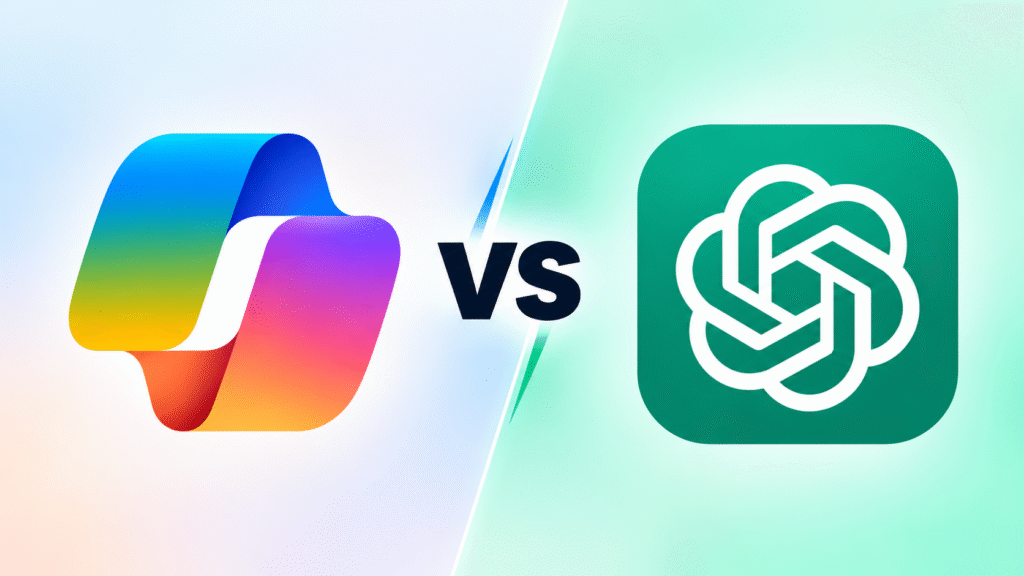

If you are comparing Copilot vs ChatGPT, the right choice depends on where you work and what you expect an AI assistant to do. Microsoft Copilot is especially useful when AI needs to work inside Microsoft 365 apps and organizational workflows. ChatGPT is a flexible general-purpose assistant for writing, research, analysis, coding, brainstorming, and working with files.
Neither tool is automatically better for every task. Microsoft offers several Copilot experiences, including consumer Copilot and Microsoft 365 Copilot for work. ChatGPT also has different plans for individual users, teams, and enterprises. Features, usage limits, and prices can change by plan and region, so compare the specific versions you would actually use.
This guide compares Copilot and ChatGPT across features, productivity, writing, research, coding, integrations, privacy, pricing, strengths, limitations, and real-world use cases.
Copilot vs ChatGPT at a glance
| Area | Microsoft Copilot | ChatGPT |
|---|---|---|
| Best fit | People and organizations working heavily in Microsoft products | People who want a flexible assistant across many types of tasks |
| Core advantage | Integration with Microsoft 365 apps and work context in eligible plans | Broad conversational workflows for writing, analysis, research, coding, and creation |
| Documents and email | Particularly convenient in Word, Excel, PowerPoint, Outlook, and Teams with the right license | Can draft, revise, summarize, and analyze provided content; integrations vary by plan |
| Research | Web-grounded chat and work-data grounding in supported Microsoft plans | Web search and deeper research tools are available according to plan and limits |
| Coding | Useful for general coding help; GitHub Copilot is a separate, coding-focused product | Useful for explaining, generating, debugging, and reviewing code; tools and limits vary |
| Business data | Microsoft 365 Copilot can ground responses in permitted work data when configured and licensed | Business plans offer workspace controls and supported connectors; access depends on configuration |
| Pricing | Some Copilot Chat access may be included with eligible accounts; Microsoft 365 Copilot work features may require qualifying licenses and add-ons | Free and paid individual and business plans; prices and limits depend on plan and region |
| Best reason to choose | Reduce friction inside an existing Microsoft 365 workflow | Use one assistant for a wide range of independent tasks and workflows |
Important: “Copilot” refers to multiple products. This article primarily compares the general Microsoft Copilot and Microsoft 365 Copilot experiences with ChatGPT. GitHub Copilot is a separate developer product and is not interchangeable with Microsoft 365 Copilot.
What is Microsoft Copilot?
Microsoft Copilot is Microsoft’s family of AI assistant experiences. The consumer assistant can help with questions, writing, ideas, and web-based tasks. Microsoft 365 Copilot adds AI experiences inside work applications such as Word, Excel, PowerPoint, Outlook, and Teams, subject to the relevant plan and license.
For work, the important distinction is its relationship with the Microsoft ecosystem. With an eligible Microsoft 365 Copilot license and appropriate permissions, Copilot can help users work with supported business content and perform tasks in the applications they already use. Organizational access and protection depend on the tenant setup, permissions, and applicable policies.
Where Copilot stands out
- Microsoft 365 workflow: Help with documents, presentations, spreadsheets, emails, and meetings in supported applications.
- Work-context assistance: Eligible plans can ground answers in permitted work data rather than relying only on a prompt.
- Familiar environment: Teams already using Microsoft 365 may have less workflow disruption.
- Enterprise administration: Microsoft provides organizational controls and enterprise data protection features for eligible work offerings.
Where Copilot may be less suitable
Copilot’s value depends on which version and license you have. A basic chat experience is not the same as a fully licensed Microsoft 365 Copilot experience connected to work data and apps. If your team uses Google Workspace or a mix of tools, Microsoft-specific integrations may be less valuable. Always verify app availability, licensing, and data access before assuming a feature is included.
What is ChatGPT?
ChatGPT is OpenAI’s conversational AI assistant. It can support tasks such as writing, summarization, brainstorming, explanation, coding, data analysis, research, and working with uploaded files. Depending on the plan and current availability, it may also provide web search, advanced research tools, image generation, voice features, projects, and connections to external services.
ChatGPT is not limited to a single office productivity suite. Users can shape a conversation around a goal, provide context or files, iterate on the output, and use it for many different types of work. Business and enterprise plans add workspace-oriented features and administrative controls, with exact options varying by plan.
Where ChatGPT stands out
- Flexible task coverage: Move between drafting, explaining, planning, coding, analysis, and creative work in one conversation.
- Iterative writing: Refine tone, structure, audience, examples, and length through follow-up prompts.
- File and data work: Supported plans can analyze uploaded documents and data files.
- Research support: Search and research capabilities can help gather and synthesize information, depending on the plan and usage limits.
- Custom workflows: Projects, custom GPTs, and supported connectors can help organize repeated tasks where available.
Where ChatGPT may be less suitable
ChatGPT may not feel as seamless as Copilot when your main goal is to work directly inside Microsoft Word, Excel, Outlook, PowerPoint, or Teams. Some integrations depend on the plan and configuration, and users may need to move content between ChatGPT and other applications. Responses can also be incorrect or incomplete, so important claims and calculations still need verification.
Copilot vs ChatGPT for writing and content creation
Both assistants can help create first drafts, rewrite paragraphs, summarize material, outline articles, and adjust tone. The better choice depends on where the source material lives and how you want to work.
Choose Copilot when the writing happens inside Microsoft 365
If your work begins with a Word document, Outlook email, or Teams discussion, Copilot may be convenient because its supported features are available in the Microsoft workflow. It can help summarize content, draft communications, and work with supported organizational context, depending on the license.
Choose ChatGPT when you need iterative content development
ChatGPT is useful when you want to build a piece of content through several stages: research questions, outline, draft, critique, revision, examples, and final editing. You can define a target audience and style, provide source material, and ask for specific revisions in the same conversation.
Which is better for bloggers and marketers?
For a blogger or content marketer who wants help with outlines, topic clusters, content briefs, headline variations, and detailed revisions, ChatGPT is a strong general-purpose option. Copilot is attractive when the workflow is centered on Microsoft 365 documents, spreadsheets, and collaboration. Neither tool replaces fact-checking, original expertise, or editorial review.
Copilot vs ChatGPT for research and web search
Both products can assist with research, but the quality of the result depends on the research mode, available sources, prompt, and verification process. A fluent answer is not proof that a claim is accurate.
Copilot for web and work-context questions
Copilot Chat can provide web-grounded responses. Microsoft 365 Copilot can also work with permitted organizational information in eligible configurations. This can be valuable when a question requires context from work documents or the Microsoft environment.
ChatGPT for multi-step research
ChatGPT offers search and research capabilities according to plan and availability. It can help turn a broad question into a research plan, synthesize findings, compare evidence, and organize a report. You should inspect the cited sources, check publication dates, and distinguish primary evidence from commentary.
Research recommendation
For questions about internal Microsoft 365 work content, Copilot may be the more direct route when the correct license and permissions are in place. For a general research project that needs repeated analysis, drafting, and structured synthesis, ChatGPT is a flexible option. For high-stakes decisions, verify critical facts against original sources regardless of the assistant.
Copilot vs ChatGPT for coding
Both general-purpose assistants can explain code, generate examples, help diagnose errors, and suggest tests. Performance depends on the programming language, task complexity, model, context provided, and how the result is tested.
Copilot is not the same as GitHub Copilot
This distinction matters. Microsoft Copilot and Microsoft 365 Copilot are general assistant experiences. GitHub Copilot is a separate developer-focused product designed for coding workflows, including supported IDE experiences. If your main requirement is in-editor code completion and developer tooling, compare GitHub Copilot directly with coding-focused alternatives rather than treating Microsoft 365 Copilot as the same product.
ChatGPT for coding assistance
ChatGPT can help explain unfamiliar code, generate functions, propose debugging steps, review approaches, create tests, and discuss architecture. For larger tasks, give it the relevant files, constraints, error messages, and expected behavior. Review all generated code for correctness, security, licensing, and maintainability before using it.
Which should developers choose?
For broad coding questions, learning, debugging discussions, and code review through conversation, ChatGPT can be useful. For an integrated coding workflow, evaluate GitHub Copilot as a separate product. Choose based on your IDE, repository workflow, team policies, and the kind of assistance you need.
Copilot vs ChatGPT for Excel, Word, Outlook, and Teams
| Task | Likely fit | Why |
|---|---|---|
| Draft or revise a Word document | Copilot for in-app workflow; ChatGPT for iterative drafting | Copilot works in supported Microsoft apps; ChatGPT supports flexible drafting and revision |
| Summarize Outlook email and meeting context | Microsoft 365 Copilot | Direct integration can reduce copying between tools when licensed and configured |
| Analyze a spreadsheet | Depends on workflow | Copilot can help inside supported Excel experiences; ChatGPT can analyze uploaded data on supported plans |
| Create a presentation | Depends on source and workflow | Copilot may assist in PowerPoint; ChatGPT can help develop storylines and slide content |
| Summarize Teams meeting content | Microsoft 365 Copilot | Availability depends on meeting setup, licensing, and organizational settings |
| Build a cross-topic research brief | ChatGPT or Copilot Chat | Compare the research tools, sources, and work-context requirements you need |
Do not assume every feature is available in every subscription. Test your exact workflow with the plan you intend to buy.
Copilot vs ChatGPT pricing: What should you compare?
Pricing changes by region, plan, billing term, and bundle. It is more useful to compare the actual package you need than to compare two headline prices without considering what is included.
Microsoft Copilot pricing
Microsoft offers different Copilot experiences. Copilot Chat may be available at no additional charge for eligible work accounts, while Microsoft 365 Copilot for work requires a qualifying Microsoft 365 subscription and a Copilot license or eligible bundled plan. As one current reference point, Microsoft’s India enterprise pricing page lists Microsoft 365 Copilot at ₹2,495 per user per month on annual billing, with GST extra and a qualifying Microsoft 365 license required. Business bundles and other billing arrangements have different prices. Verify the current official page before purchasing.
Official source: Microsoft 365 Copilot enterprise pricing in India and Microsoft 365 Copilot business pricing.
ChatGPT pricing
ChatGPT has free and paid plans for individuals, plus business and enterprise offerings. Plans differ in usage limits, model access, research tools, file handling, collaboration, connectors, and administrative controls. Pricing and availability can differ by country and billing arrangement.
Official source: ChatGPT plans and pricing.
How to compare total value
- Check whether you already pay for Microsoft 365 and whether the Copilot feature you need is included or requires an add-on.
- Compare monthly versus annual billing and any minimum license requirements.
- Check usage limits, file size limits, and which models or tools are available.
- For business use, evaluate admin controls, data handling, access management, and procurement requirements.
- Estimate time saved on a repeatable task instead of judging value by the number of features advertised.
Privacy and security: Which is better for business?
There is no responsible one-line answer without knowing the product tier, configuration, data type, and company policy. Consumer plans and business or enterprise plans can have different data protections, controls, and contractual terms.
Microsoft provides enterprise data protection and administrative controls for eligible Microsoft 365 Copilot offerings. ChatGPT’s business and enterprise plans provide workspace-oriented controls and data handling terms that differ from individual offerings. Review the official terms for the exact plan you will use.
Before putting confidential information into either assistant, check:
- Whether prompts and uploaded content may be used to improve models under the applicable plan and settings
- Retention and deletion options
- Data residency and compliance requirements
- Single sign-on, identity management, access controls, and audit needs
- How connectors and application permissions limit access to company data
- Your organization’s policy on customer data, source code, regulated information, and personal data
Enterprise protection does not mean an AI assistant can never produce a wrong answer or expose information through a misconfigured permission. Keep access controls and review processes in place.
Pros and cons: Copilot vs ChatGPT
Microsoft Copilot pros
- Strong fit for organizations that already work in Microsoft 365.
- Can bring AI assistance into supported Word, Excel, PowerPoint, Outlook, and Teams workflows.
- Eligible business plans can ground answers in permitted work content.
- Enterprise administration and data protection options are available for eligible offerings.
Microsoft Copilot cons
- Capabilities differ across consumer Copilot, Copilot Chat, and Microsoft 365 Copilot.
- Some work features require additional licensing or a qualifying subscription.
- Its integration advantage is smaller for teams that do not rely on Microsoft 365.
ChatGPT pros
- Flexible for writing, learning, coding, research, brainstorming, and data analysis.
- Supports iterative conversations that can develop a task from outline to final output.
- File, search, research, image, and other tools are available depending on plan and limits.
- Business and enterprise options support organizational use cases.
ChatGPT cons
- May require extra steps when work is centered inside Microsoft 365 apps.
- Features and usage limits vary by plan and can change.
- Outputs need review, particularly for factual, financial, legal, security, and technical work.
Which should you choose?
Choose Microsoft Copilot if…
- Your daily work happens in Word, Excel, PowerPoint, Outlook, and Teams.
- You want AI assistance close to your Microsoft 365 documents, email, meetings, and work data.
- Your organization already uses Microsoft 365 and can manage the required licenses and permissions.
- You value integration with an existing workplace more than a standalone chat workflow.
Choose ChatGPT if…
- You want one general assistant for writing, research, analysis, learning, planning, and coding questions.
- You frequently iterate on a task through follow-up prompts and structured feedback.
- You need to work with varied topics and files outside a single office suite.
- You want to explore research, data, or creative tools available in your chosen ChatGPT plan.
Consider using both if…
Your organization relies on Microsoft 365 for documents and collaboration but also needs a general assistant for research, drafting, analysis, and problem-solving. A dual-tool approach can work, but it should be based on clear use cases, cost, privacy rules, and employee guidance. Avoid paying for overlapping subscriptions without a reason to keep both.
How to test both tools before deciding
Use the same five tasks in each product so you compare outcomes rather than impressions:
- Writing: Ask both to draft an email for the same audience and purpose.
- Research: Give both the same question and verify the sources they use.
- Spreadsheet work: Use the same non-sensitive sample data and check the calculations.
- Work context: Test a realistic document or meeting workflow in the Microsoft environment if you have the right license.
- Revision: Ask both to critique and improve their first answer using the same feedback.
Score accuracy, completeness, time to finish, ease of use, integration, and the amount of human correction required. Use synthetic or approved data when testing sensitive workflows.
Final verdict: Copilot vs ChatGPT
Microsoft Copilot is often the more practical choice for Microsoft 365-centered work. Its advantage is bringing AI assistance into familiar applications and, with eligible licensing and permissions, using work context.
ChatGPT is often the more flexible choice for general-purpose AI work. It supports a wide variety of tasks through conversation, with research, file, data, and creative tools depending on plan and availability.
For individuals, choose based on your most frequent tasks. For organizations, compare the precise licenses, data protections, integration requirements, and administrative controls. For developers, compare GitHub Copilot separately if the need is an in-editor coding assistant.
The most reliable way to decide is to run both through the same real-world tasks, verify the results, and measure the total cost and review effort. Choose the tool that improves your workflow, not the one with the longest feature list.
Frequently asked questions
Is Copilot better than ChatGPT?
Copilot may be better for workflows centered on Microsoft 365 apps and permitted work data. ChatGPT may be better for flexible tasks such as writing, research, analysis, learning, and coding discussions. The best fit depends on your needs and plan.
Is ChatGPT the same as Microsoft Copilot?
No. They are separate AI assistant products from OpenAI and Microsoft. Microsoft uses models from OpenAI and other providers in some Copilot experiences, but the products differ in integrations, interfaces, plans, tools, and administration.
Is Microsoft Copilot free?
Some Copilot chat experiences are available at no additional charge for eligible users, but advanced Microsoft 365 work features may require a qualifying Microsoft 365 subscription and a separate Copilot license. Check Microsoft’s current regional pricing and eligibility.
Is ChatGPT free?
ChatGPT offers a free plan as well as paid individual and business options. Limits and feature access vary by plan and can change over time. Check the official pricing page for current details.
Which is better for coding, Copilot or ChatGPT?
ChatGPT is useful for conversational coding help, explanations, debugging, and code review. If you want IDE-based code completion and developer workflow integration, compare GitHub Copilot as a separate product.
Which is better for students?
Either can help explain concepts, brainstorm, summarize allowed materials, and support writing. Students should follow school policies, verify factual claims, and use the assistant to learn rather than submit unchecked output as their own work.
Which is better for businesses?
Businesses that use Microsoft 365 heavily may benefit from Microsoft 365 Copilot integration. Teams needing a general assistant for varied workflows may prefer ChatGPT Business or Enterprise. Security, access controls, data terms, integration, and total cost should drive the decision.
Can I use Copilot and ChatGPT together?
Yes. Some teams use Copilot for Microsoft 365 workflows and ChatGPT for broader research, content creation, analysis, or coding discussions. Define which tasks belong in each tool and establish clear rules for sensitive data.