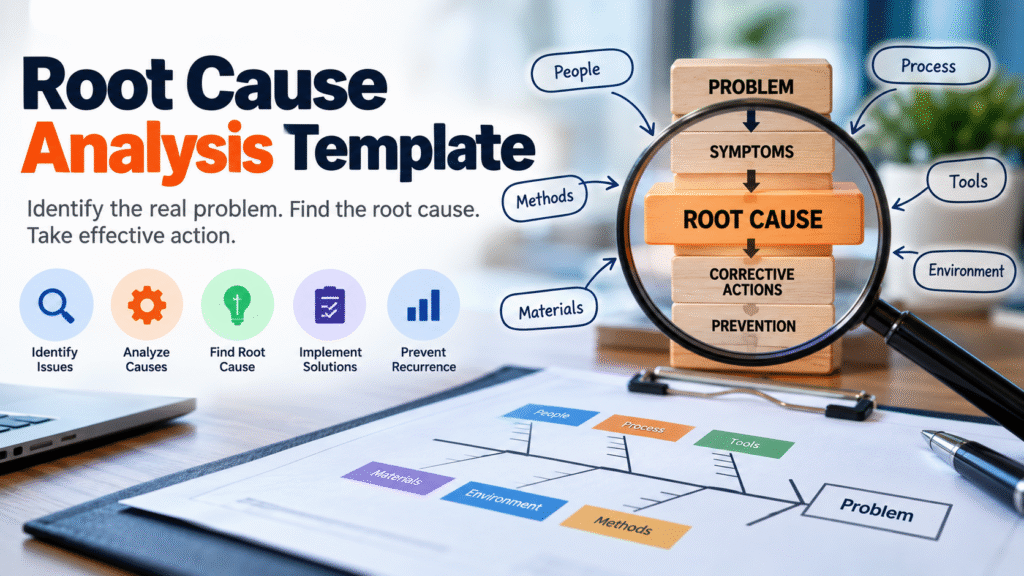

A root cause analysis (RCA) template helps your team document what happened, test possible causes against evidence, and assign actions that reduce the chance of the problem returning. The right template depends on the problem: a short 5 Whys worksheet is useful for a straightforward issue, while a formal RCA report, incident timeline, FMEA or corrective action tracker may be better for a wider investigation.
This guide includes 15 editable templates for investigations, software incidents, quality issues, risk prioritization and follow-up. Choose the format that fits your work, then adapt it to your internal process and any applicable requirements.
What should a root cause analysis template include?
A useful RCA record usually captures the problem in measurable terms, the impact and scope, evidence gathered, the analysis method, verified root causes, contributing factors, corrective actions, owners, due dates and a check that the actions worked. Keep observations separate from assumptions, and do not treat the first plausible explanation as a confirmed cause.
- Problem statement: What happened, where, when, how often and with what impact?
- Evidence: Which logs, records, interviews, measurements or observations support the investigation?
- Cause analysis: Which method was used, and what evidence confirms or rules out each cause?
- Actions: What will change, who owns it and when is it due?
- Effectiveness: What result will prove the action worked, and over what review period?
15 root cause analysis templates you can use
Each template below is designed for a different investigation task. The download links will be attached to each matching section after the files are added to the WordPress media library.
1. Root Cause Analysis Report Template
Best for: A complete record of a significant operational problem, recurring defect or internal incident. Use it when stakeholders need to see the problem, evidence, verified cause, action plan and closure decision in one document.
Download the Root Cause Analysis Report Template
Editable Word document covering the investigation from problem statement to effectiveness review.
2. Five Whys Analysis Template
Best for: A relatively focused problem where one causal chain can be explored. Ask why repeatedly, but stop only when the explanation is supported by evidence. Five questions are a prompt, not a rule, and multiple causes may exist.
Download the Five Whys Analysis Template
Use the why-chain, evidence checks and action plan to move beyond symptoms.
3. Fishbone (Ishikawa) Analysis Template
Best for: Team investigations with several possible contributing factors. Consider people, process, technology or equipment, inputs, measurement and environment. The categories help organize brainstorming, but each candidate cause still needs to be checked.
Download the Fishbone Analysis Template
Capture possible causes, evidence for and against them, and tests to verify each cause.
4. Corrective and Preventive Action (CAPA) Template
Best for: Issues that require a formal action record, such as audit findings, complaints, nonconformities or repeat defects. Separate immediate correction from action that removes the cause and prevention that addresses similar risks elsewhere.
Download the CAPA Template
Record containment, cause, corrective and preventive actions, verification and approval.
5. Incident Root Cause Analysis Template
Best for: Service interruptions, operational incidents and other events where timing, response and impact matter. Build a reliable timeline and distinguish the trigger from conditions that allowed the incident to occur or made it harder to detect.
Download the Incident RCA Template
Document incident details, timeline, detection, response, causal findings and follow-up.
6. IT and Software Bug RCA Template
Best for: Software defects, configuration errors, production bugs or reliability problems. Include reproduction steps, environment, logs, recent changes, tests and why existing controls did not catch the issue sooner.
Download the IT / Software Bug RCA Template
Trace a defect through technical evidence, cause analysis, regression testing and release validation.
7. Project Delay or Failure RCA Template
Best for: Missed milestones, unexpected rework, scope changes or delivery problems. Review estimates, dependencies, approvals, resource constraints and governance rather than assuming a single person caused the outcome.
Download the Project RCA Template
Compare planned and actual events, identify supported causes and assign recovery actions.
8. Service or Quality Defect RCA Template
Best for: Customer complaints, process defects, service errors or failures to meet a defined standard. Record the requirement, observed result, scope, process controls and the evidence used to verify the cause.
Download the Service / Quality Defect Template
Investigate defect categories and document containment, corrective action and effectiveness.
9. 5W2H Problem Definition Template
Best for: The beginning of an investigation when the problem is still vague. Define what, why it matters, where, when, who or what is affected, how it was detected and how much it occurs before choosing a cause-analysis method.
Download the 5W2H Template
Clarify the problem, compare where it is and is not present, and list evidence gaps.
10. Root Cause Evidence Log (Excel)
Best for: Investigations with multiple logs, interviews, tickets, measurements or documents. An evidence log makes it easier to trace a claim back to its source and record evidence that challenges an early theory.
Download the Root Cause Evidence Log
Use the spreadsheet to organize evidence, sources, reliability and follow-up questions.
11. Corrective Action Tracker (Excel)
Best for: Teams managing several actions across an investigation or multiple RCA cases. Track owners, due dates, status, completion evidence and the measure that will show whether each action worked.
Download the Corrective Action Tracker
Keep actions accountable and make overdue or unverified work easier to spot.
12. Failure Mode and Effects Analysis (FMEA) Template
Best for: Proactively assessing how a process, product or service could fail before an incident occurs. Record potential failure modes, effects, causes, existing controls and your organization’s approved risk scores. Scoring systems vary, so follow your internal standard.
Download the FMEA Template
Prioritize potential failure modes and document actions to reduce risk.
13. Pareto Cause Frequency Worksheet (Excel)
Best for: Problems with many recorded defect types or incident categories. Count occurrences over a defined period and sort categories to see which account for the largest share. Frequency helps prioritize investigation, but does not by itself prove root cause or severity.
Download the Pareto Worksheet
Organize cause counts and calculate percentage and cumulative percentage.
14. Incident Timeline and Event Log (Excel)
Best for: Incidents involving multiple systems, people, decisions or handoffs. Normalize timestamps, include time zones where needed, and link each event to its source rather than relying on memory alone.
Download the Incident Timeline
Build a time-ordered view of observations, decisions, actions and results.
15. RCA Effectiveness Check Template (Excel)
Best for: Verifying that corrective actions changed the outcome and the issue did not recur. Define a baseline, a measurable target, the data source, owner and review period before declaring success.
Download the RCA Effectiveness Check
Record the metric, target, observed result, recurrence check and next action.
How to choose the right RCA template
| Your situation | Start with |
|---|---|
| A clear, focused problem | Five Whys |
| Several possible causes across a team | Fishbone analysis |
| A formal investigation record is needed | Root Cause Analysis Report |
| Incident response and timing are central | Incident RCA and Timeline |
| Software defect or production bug | IT / Software Bug RCA |
| Actions need owners and follow-up | CAPA and Corrective Action Tracker |
| Prioritize recurring categories | Pareto worksheet |
| Assess possible failures before they happen | FMEA |
| Prove the fix worked | Effectiveness Check |
How to complete a root cause analysis
- Define the problem. Describe observable facts and quantify the impact where possible.
- Contain immediate risk. Protect customers, users or operations while the investigation continues.
- Collect evidence. Preserve relevant records, logs, measurements and timelines.
- Choose a suitable method. Use Five Whys for a focused causal chain, fishbone for broad brainstorming, and FMEA for proactive risk analysis.
- Verify the cause. Test explanations against evidence and document uncertainty or alternative causes.
- Assign actions. Give each action an owner, deadline and measurable acceptance criteria.
- Check effectiveness. Review results over a defined period and record whether recurrence was observed.
Common root cause analysis mistakes
- Writing a symptom as the root cause: “The server went down” describes an event, not the conditions that caused it.
- Blaming an individual too early: Examine process design, workload, instructions, controls and the work environment.
- Skipping evidence: A plausible story is a hypothesis until records or tests support it.
- Confusing correction with prevention: Restoring service fixes the immediate issue; prevention addresses why it happened.
- Closing without verification: An action marked complete is not proof that the problem is solved.
Frequently asked questions
What is the best root cause analysis template?
There is no single best template for every problem. Use a general RCA report for a documented investigation, Five Whys for a focused cause chain, fishbone for exploring several possible causes, and an action tracker for follow-through.
Should I use Word or Excel for root cause analysis?
Word is usually better for narrative findings, context and sign-off. Excel is useful when you need to sort evidence, track multiple actions, compare categories or record effectiveness measures. Many investigations benefit from using both.
What is the difference between root cause and corrective action?
The root cause explains the underlying condition supported by evidence. A corrective action changes that condition. The team should then verify whether the action produced the intended result.
Does a root cause analysis always require five whys?
No. Five Whys is one method. Complex problems may need a fishbone diagram, timeline analysis, fault tree, data analysis or more than one method. Select the method based on the evidence and the problem.
Final checklist before closing an RCA
- The problem and impact are stated clearly.
- Evidence sources are recorded and traceable.
- Verified causes are separated from assumptions.
- Actions have owners, due dates and success criteria.
- Effectiveness will be checked over a defined period.
- The findings are shared with the people who need to update the process or controls.
For more practical guides, visit the My SaaS Journey blog and explore our SaaS guide.