
Every time you check the weather on your phone, pay for something online, or sign in to a website with your Google account, applications are talking to each other through APIs. They are the connectors of modern software. Cloudflare reported in 2024 that 60% of the dynamic, non-cacheable traffic it handles is API-related.
API, defined: An API (application programming interface) is a defined set of rules that lets one piece of software request data or services from another. It specifies what requests can be made, how to format them, what responses come back, and what rules apply, so two systems can work together without knowing how the other is built inside.
This guide explains what API stands for, how API requests work, endpoints and API keys, authentication, the main API types and styles, REST, gateways, security risks, API testing, and commonly used testing tools. Technical claims are supported by standards and references at the end.
What Does API Stand For?
API stands for application programming interface. Each word carries meaning:
- Application refers to software with a distinct function, from a mobile app to a database or operating system.
- Programming means the interface is used by code, not directly by people clicking buttons.
- Interface means a boundary with agreed rules, like a contract between two systems. One side promises to accept certain requests and return certain responses. The other side agrees to ask in the expected format.
A useful way to think about an API is as a service counter. You do not walk into a restaurant kitchen; you place an order using the menu, and the kitchen returns a dish. The menu defines what you can ask for, and you never need to know how the kitchen works. An API plays the role of the menu and counter.
Where Did APIs Come From?
The idea predates the internet. In the late 1940s, Maurice Wilkes and David Wheeler built a library of reusable subroutines for the EDSAC computer, with a catalog describing how to call each one, an early form of an API. The term “application program interface” was first recorded in a 1968 paper by Ira Cotton and Frank Greatorex on remote computer graphics. In 1990, Carl Malamud defined an API as a set of services available to a programmer for performing certain tasks.
The modern web API took shape around 2000. That year, Roy Fielding’s doctoral dissertation described REST (Representational State Transfer), an architectural style for networked systems that became a common way to design web APIs. Since then, APIs have shifted from internal programming tools to products in their own right, with companies building businesses on payments, messaging, maps, and AI delivered through APIs.
How Does an API Work?
Most APIs on the web follow a request-and-response pattern over HTTP, the same protocol browsers use to load web pages.
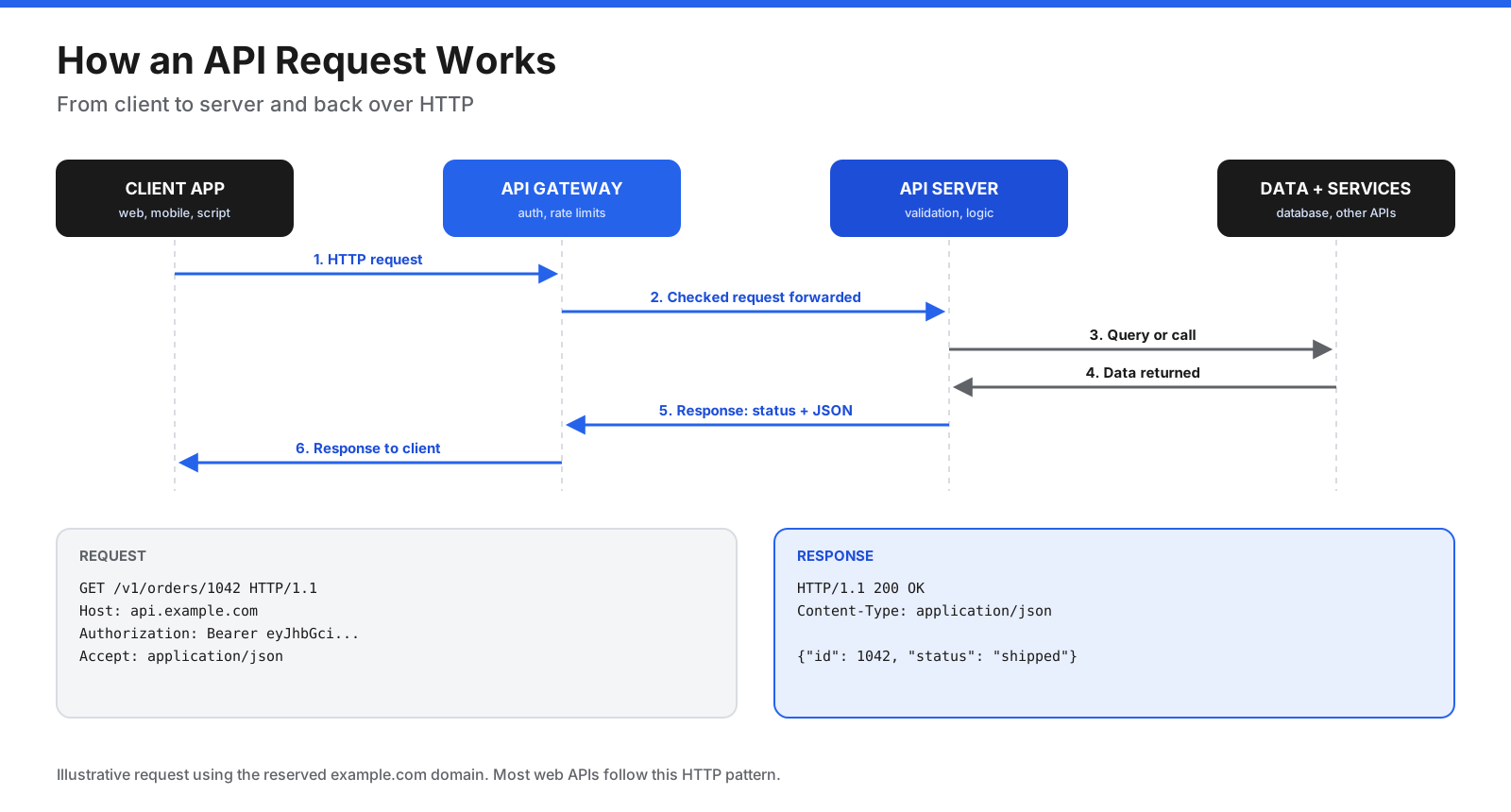
The client never touches the database directly. The API decides what it can ask for and what it gets back.
- The client builds a request. A mobile app, website, server, or script decides it needs data or wants to perform an action.
- The request is sent to an endpoint. It goes to a specific URL, using an HTTP method that states the intent, with headers and sometimes a body.
- Infrastructure checks the request. An API gateway or server checks authentication, permissions, and rate limits.
- The server processes it. Business logic runs, often querying databases or calling other internal APIs.
- The server returns a response. It includes a status code, headers, and usually a body containing data, most often in JSON format.
- The client uses the response. The app shows the data, confirms the action, or handles an error.
What Does an API Request Look Like?
A simple HTTP request to read an order might look like this:
GET /v1/orders/1042?include=items HTTP/1.1
Host: api.example.com
Authorization: Bearer <access-token>
Accept: application/json
It has four parts: the method (GET), the path and query parameters (/v1/orders/1042?include=items), headers that carry credentials and content preferences, and an optional body. A read request often does not need a body; requests that create or update data usually include one.
A successful response might look like this:
HTTP/1.1 200 OK
Content-Type: application/json

{
  "id": 1042,
  "status": "shipped",
  "items": [{ "sku": "A-17", "quantity": 2 }]
}
What Are HTTP Methods?
HTTP methods tell the server what kind of action the client wants. RFC 9110 defines core methods and two important properties: safe methods do not change server state, and idempotent methods have the same effect whether sent once or several times.
| Method | Typical API use | Safe | Idempotent |
|---|---|---|---|
| GET | Read a resource or list | Yes | Yes |
| HEAD | Read headers only | Yes | Yes |
| OPTIONS | Ask which methods are allowed | Yes | Yes |
| POST | Create a resource or trigger an action | No | No |
| PUT | Replace a resource completely | No | Yes |
| PATCH | Update part of a resource | No | Depends on design |
| DELETE | Remove a resource | No | Yes |
Idempotency matters because networks fail. If a client times out after sending a PUT, it can safely retry. Retrying a POST might create a duplicate order, so many payment APIs accept an idempotency-key header to make retries safe.
What Do API Status Codes Mean?
Every HTTP response includes a three-digit status code. RFC 9110 groups them into five classes:
| Class | Meaning | Common examples |
|---|---|---|
| 1xx | Informational | 101 Switching Protocols |
| 2xx | Success | 200 OK, 201 Created, 204 No Content |
| 3xx | Redirection | 301 Moved Permanently, 304 Not Modified |
| 4xx | Client error | 400 Bad Request, 401 Unauthorized, 403 Forbidden, 404 Not Found, 429 Too Many Requests |
| 5xx | Server error | 500 Internal Server Error, 502 Bad Gateway, 503 Service Unavailable |
A 401 means the client is not authenticated, while a 403 means it is authenticated but not allowed to perform the action. A 429 tells the client it has exceeded a rate limit and should slow down. RFC 9457 defines a standard problem-detail format for API errors using the media type application/problem+json.
What Is an API Endpoint?
An endpoint is a specific URL where an API receives requests for a particular resource or action. In https://api.example.com/v1/orders/1042, the base URL identifies the server, v1 identifies the API version, and /orders/1042 identifies the specific order.
An API is usually a collection of endpoints, such as /orders, /orders/{id}, /customers, and /payments, each supporting certain methods. Together, the endpoints, methods, parameters, and response formats make up the API contract.
What Is an API Key?
An API key is a unique string that a client includes with requests so the API can identify the calling application or project. Providers can use keys to associate requests with a project, apply quotas, and track billing.
- Keys identify an application, not a user. A key tells the API which project is calling, not which person is behind the request.
- Keys are bearer secrets. Anyone who copies a key may be able to use it. Do not embed API keys directly in public code or client-side apps.
- Keys need restrictions and rotation. Restrict keys to the intended APIs and environments, remove unused keys, and rotate them periodically.
API keys suit public data, usage tracking, and some server-to-server calls. For access to user data or sensitive operations, APIs typically need stronger authentication and explicit authorization.
How Do APIs Handle Authentication and Authorization?
Authentication proves who or what is calling. Authorization decides what that caller is allowed to do. APIs use several mechanisms, often in combination.
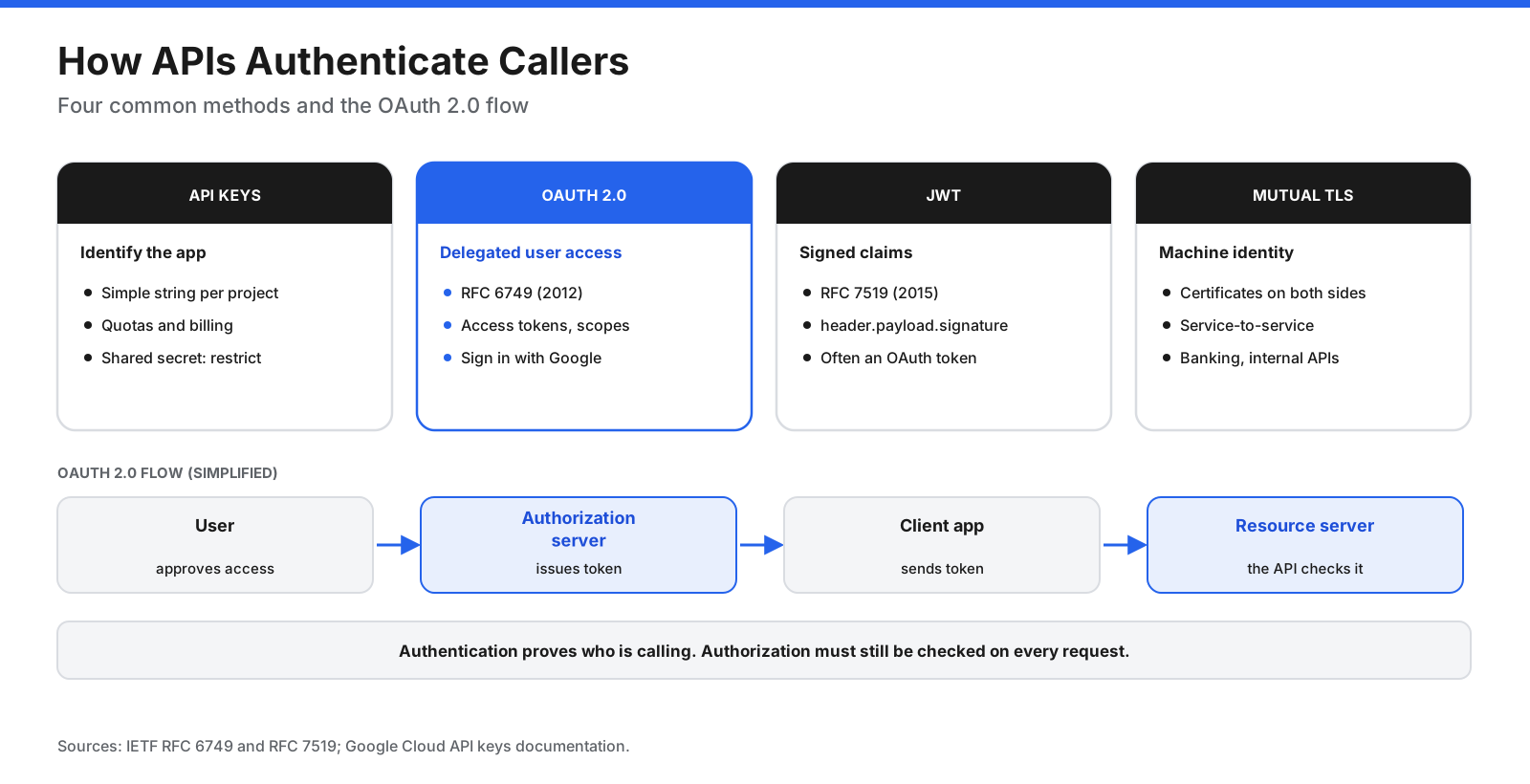
- API keys: Useful for identifying applications and tracking usage.
- OAuth 2.0: Lets a third-party application obtain limited access to an HTTP service. A user approves access, an authorization server issues tokens, and the client presents a token to the API.
- JSON Web Tokens (JWT): A compact, URL-safe format for claims such as a user ID and expiry, protected by a signature. APIs may use JWTs as access tokens.
- Mutual TLS (mTLS): Both client and server present certificates, proving identity at the connection level. It is common for service-to-service APIs and regulated environments.
Authorization still has to happen on every request. A valid token proves who is calling; the API must then check whether that caller may access the specific record or action requested.
What Are the Types of APIs?
APIs can be classified by who can access them and by the architectural style or protocol they use.
Types of APIs by Access
| Type | Who can use it | Examples |
|---|---|---|
| Public (open) APIs | Any developer, often after registering for a key | Weather data, maps, payment platforms |
| Partner APIs | Approved business partners under an agreement | Supplier inventory feeds, travel booking integrations |
| Private (internal) APIs | Teams within one organization | Microservices calling each other |
| Composite APIs | Clients that need several operations in one call | One operation that creates an order, charges payment, and books shipping |
Types of APIs by Architectural Style
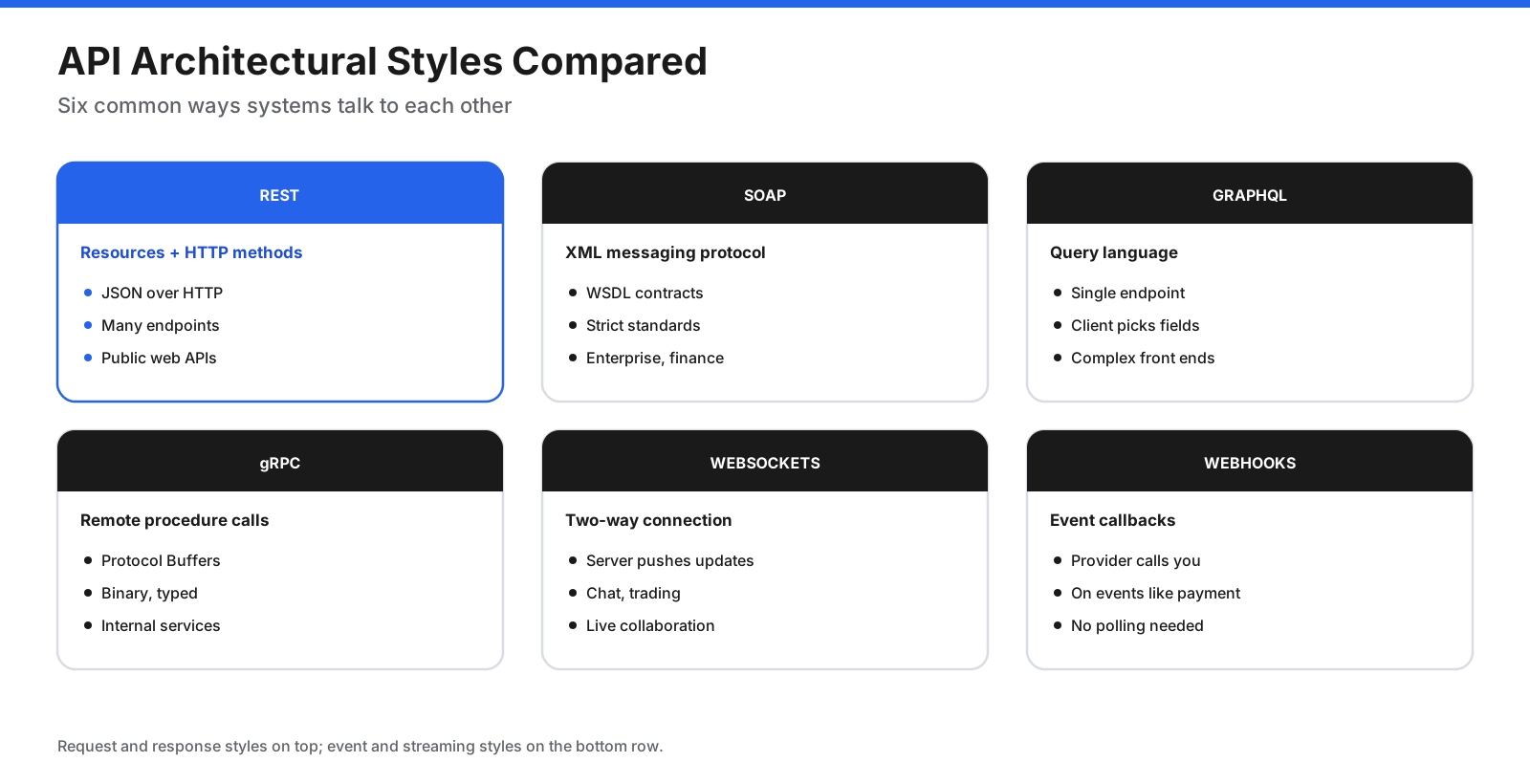
- REST: Resource-oriented APIs over HTTP, usually returning JSON. A common style for public web APIs.
- SOAP: An XML-based messaging protocol with strict contracts defined in WSDL files. It remains in some banking, telecom, and enterprise systems.
- GraphQL: A query language for APIs. Clients send a query to a single endpoint and receive the fields they request.
- gRPC: A remote procedure call framework that uses Protocol Buffers as its interface definition language and default message format.
- WebSockets: A protocol that keeps a two-way connection open so servers can push live updates, used for chat, trading, and collaboration.
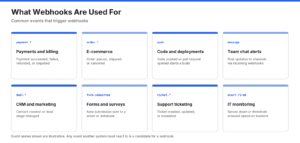
- Webhooks: Event notifications sent by a provider to a registered URL when something happens, such as a completed payment.
The term also covers library and operating system APIs, such as programming-language functions, and browser APIs such as JavaScript’s Geolocation or Fetch APIs.
What Is a REST API?
A REST API follows the constraints of Representational State Transfer, described by Roy Fielding in his 2000 dissertation. The six constraints are:
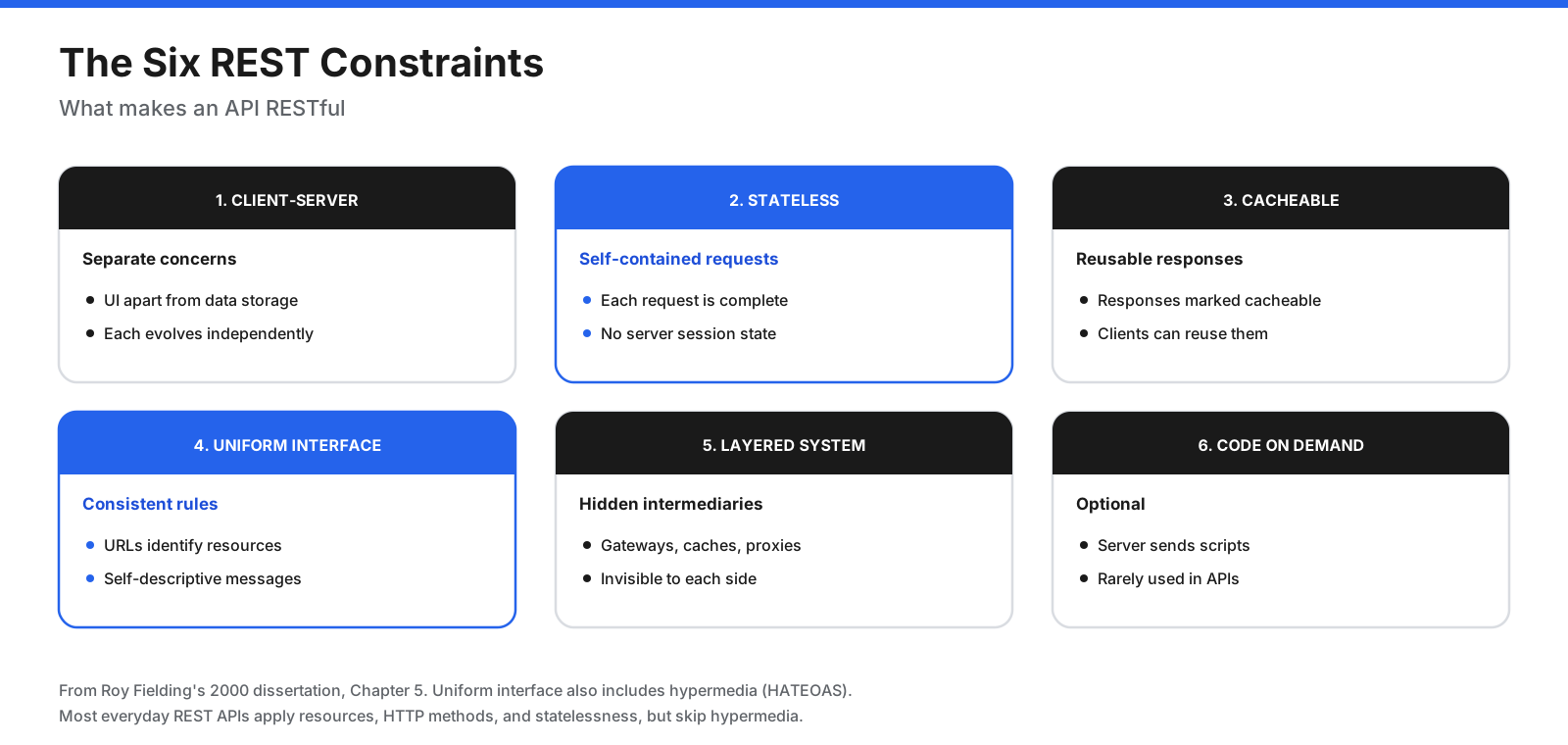
- Client-server: User-interface concerns are separated from data storage, so each can evolve independently.
- Stateless: Each request carries the information needed to understand it. The server does not keep session state between requests.
- Cacheable: Responses are labeled as cacheable or not, so clients and intermediaries can reuse them.
- Uniform interface: Resources are identified by URLs and manipulated through representations such as JSON, with self-descriptive messages and hypermedia links.
- Layered system: Components such as load balancers, gateways, and caches can sit between client and server.
- Code on demand (optional): Servers can extend clients by sending executable code.
In everyday usage, a REST API usually means an HTTP API organized around resources such as /orders and standard HTTP methods such as GET and POST, often returning JSON. Many APIs do not implement hypermedia, which Fielding considered essential, so some specialists call them HTTP APIs instead.
What Is the Difference Between an API and a REST API?
“API” is the broad concept: any defined interface between software components. “REST API” is one specific style of web API. Every REST API is an API, but APIs using GraphQL, gRPC, SOAP, or operating-system interfaces are not REST APIs.
REST vs GraphQL vs gRPC vs SOAP
| Factor | REST | GraphQL | gRPC | SOAP |
|---|---|---|---|---|
| Style | Resources and HTTP methods | Query language, single endpoint | Remote procedure calls | XML messaging protocol |
| Typical format | JSON | JSON | Protocol Buffers (binary) | XML |
| Contract | OpenAPI, optional | Schema required | .proto files required | WSDL required |
| Strength | Simple, cacheable, widely supported | Clients fetch the fields they need | Fast, strongly typed service calls | Formal enterprise messaging standards |
| Trade-off | May over-fetch or under-fetch data | Caching and query-cost controls are harder | Binary payloads are less browser-friendly | Verbose and heavier to work with |
| Common use | Public web APIs | Front ends with complex data needs | Internal microservices | Enterprise and legacy systems |
How Are APIs Described and Documented?
Machine-readable API descriptions let teams generate documentation, client libraries, mock servers, and tests from a shared source of truth.
- OpenAPI: A language-agnostic interface description for HTTP APIs. It describes endpoints, parameters, request and response schemas, authentication, and examples in YAML or JSON.
- GraphQL schemas: Define the types and fields an API exposes and are required by design.
- Protocol Buffers:
.protofiles define gRPC services and messages, from which code can be generated. - WSDL: Describes SOAP services.
Good documentation adds explanations, tutorials, authentication guides, rate limits, error handling, and changelogs. Postman’s 2025 State of the API report found that 55% of respondents struggled with inconsistent documentation and 34% could not find existing APIs.
What Is an API Gateway?
An API gateway sits between clients and backend services and handles cross-cutting tasks so each service does not have to.
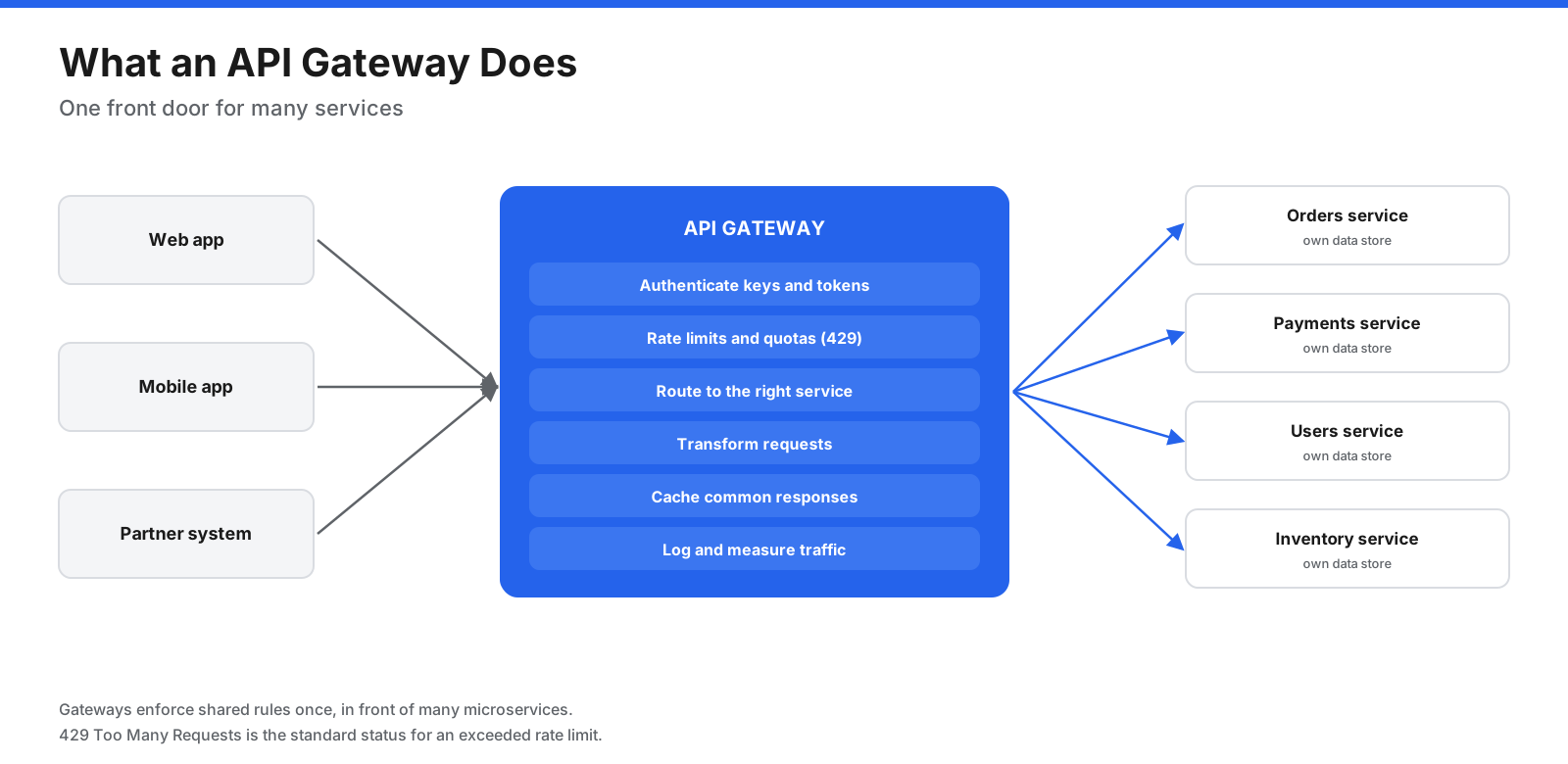
- Routing: Sends each request to the correct backend service.
- Authentication and authorization: Validates API keys, OAuth tokens, or JWTs before requests reach services.
- Rate limiting and quotas: Restricts requests per client and can return 429 Too Many Requests when a limit is exceeded.
- Transformation: Converts between formats or protocols.
- Caching: Stores common responses to reduce load and latency.
- Observability: Logs requests and collects metrics such as latency and error rates.
Gateways are common in microservice architectures, where one application may depend on dozens of internal APIs.
What Is API Integration?
API integration connects two or more applications through their APIs so they can share data and trigger actions automatically. Examples include:
- Payments: An online store calls a payment provider to charge a card and receives a webhook when payment settles.
- Sign-in: A website uses OAuth so users can log in with an existing Google, Microsoft, or Apple account.
- Maps and location: A delivery app calls a mapping API for routes and estimated arrival times.
- Messaging: A business sends order updates through SMS or messaging platform APIs.
- Business systems: A CRM syncs contacts with an email marketing platform, or an ITSM tool opens tickets from monitoring alerts.
- AI: Applications send text or images to an AI model provider’s API and receive generated responses.
Integrations can be built in code, through integration platforms, or with no-code automation tools that wrap APIs in visual workflows.
How Big Is the API Economy?
Two reports show how central APIs have become. Cloudflare’s 2024 application security report found that 60% of dynamic, non-cacheable traffic on its network was API-related. It also reported that organizations had a median of 33% more public-facing API endpoints than they knew about, sometimes called shadow APIs.
Postman’s 2025 State of the API report, based on more than 5,700 developers, architects, and executives, found that 82% of organizations had adopted some level of an API-first approach and 25% were fully API-first. It also found that 24% of respondents already designed APIs with AI agents in mind, while unauthorized or excessive API calls from AI agents were the top security concern for 51%.
AI is increasing API usage in both directions. AI models are delivered through APIs, and AI agents act by calling other APIs, which raises the stakes for documentation, rate limiting, and authorization.
What Are the Biggest API Security Risks?
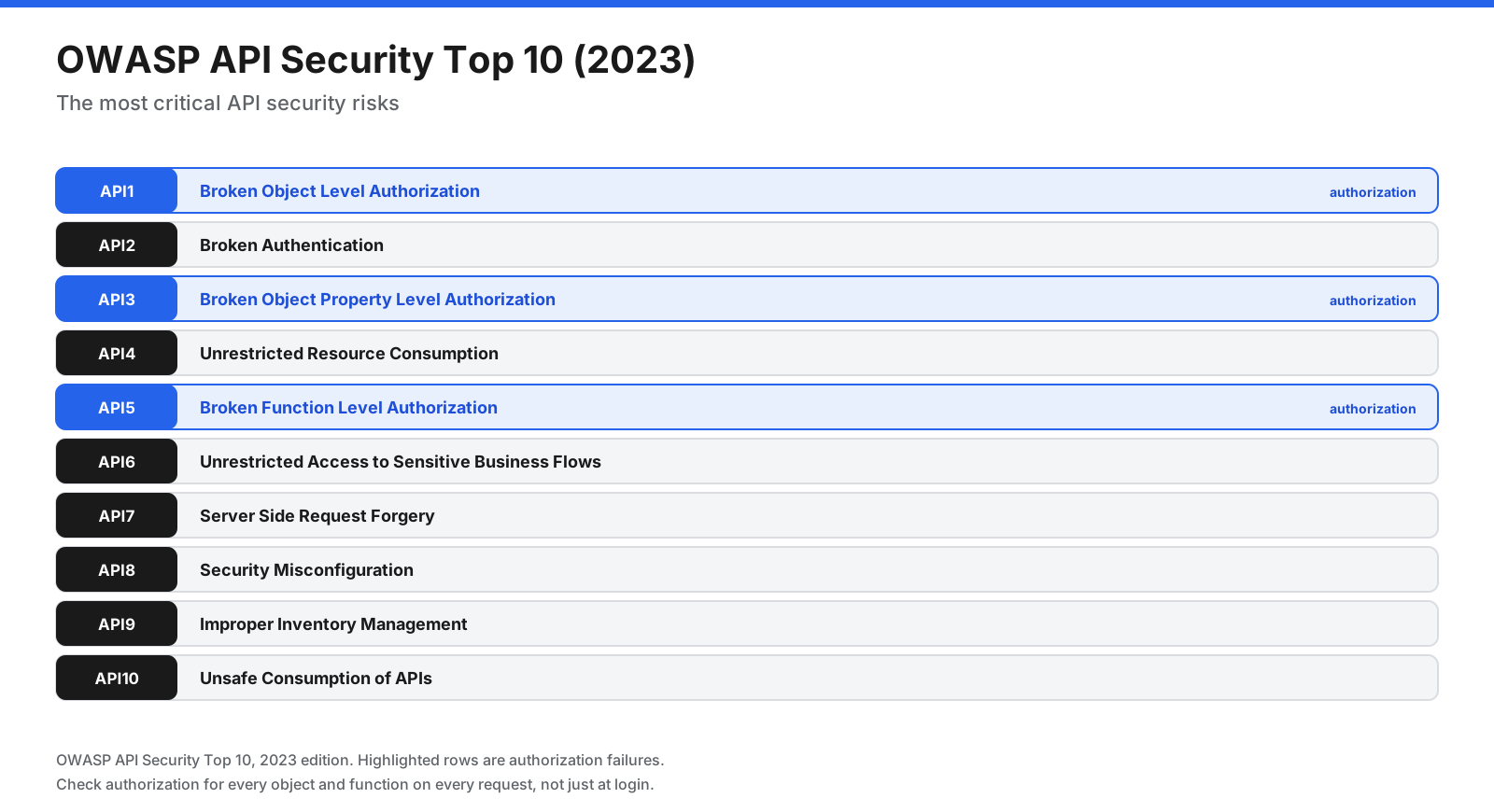
Because APIs expose data and business logic directly, they are a frequent target. The OWASP API Security Top 10, updated in 2023, lists critical risks.
| Rank | Risk | What it means |
|---|---|---|
| API1:2023 | Broken Object Level Authorization | A user can access another user’s records by changing an ID in a request. |
| API2:2023 | Broken Authentication | Weak or flawed authentication lets attackers impersonate users. |
| API3:2023 | Broken Object Property Level Authorization | The API exposes or lets users change fields they should not, such as an isAdmin flag. |
| API4:2023 | Unrestricted Resource Consumption | No limits on requests, payload sizes, or costly operations can cause outages or unexpected bills. |
| API5:2023 | Broken Function Level Authorization | Regular users can call admin-only functions. |
| API6:2023 | Unrestricted Access to Sensitive Business Flows | Automated abuse of flows such as purchasing or account creation. |
| API7:2023 | Server Side Request Forgery | The API fetches a user-supplied URL, potentially reaching internal systems. |
| API8:2023 | Security Misconfiguration | Insecure defaults, verbose errors, missing headers, or open CORS policies. |
| API9:2023 | Improper Inventory Management | Old, undocumented, or forgotten API versions remain exposed. |
| API10:2023 | Unsafe Consumption of APIs | Third-party API data is trusted without validation. |
Core practices that address these risks include:
- Check authorization on every request for every object and function, not just at login.
- Use strong authentication, such as OAuth 2.0 with short-lived tokens, and protect API keys like passwords.
- Return only the fields clients need, and validate every input against a schema.
- Apply rate limits, quotas, and payload-size limits to prevent abuse and runaway costs.
- Keep an inventory of every API and version, and retire old ones.
- Encrypt traffic with TLS and avoid sending secrets in URLs, where they can end up in logs.
- Log and monitor API activity to detect scraping, credential stuffing, and unusual access patterns.
- Test security continuously as part of the release process.
What Is API Testing?
API testing checks that an API behaves correctly, reliably, quickly, and securely by sending requests directly to it and verifying responses, without going through a user interface. Because APIs sit underneath web and mobile apps, testing at this layer can catch problems earlier and run faster than UI tests.
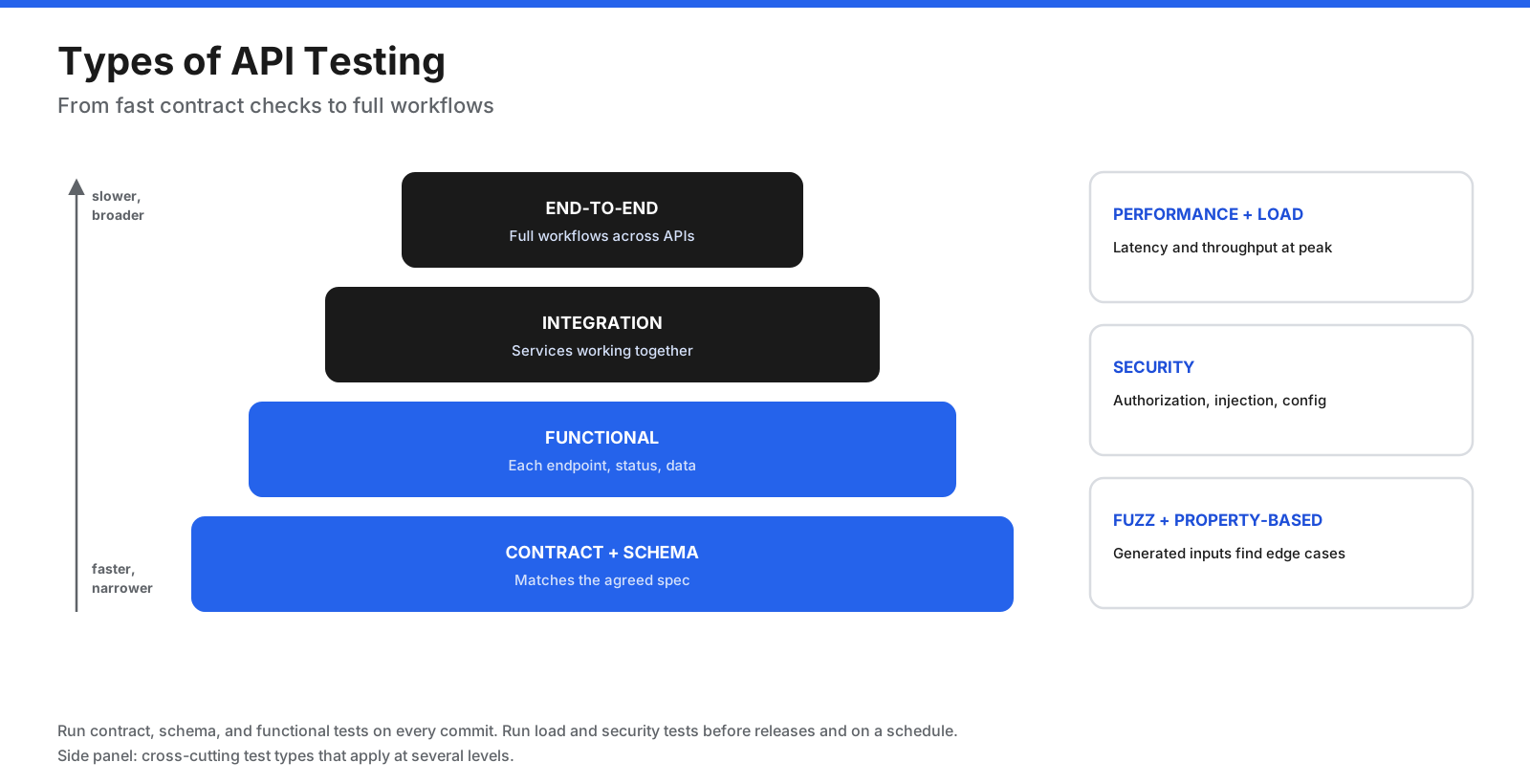
The main types of API testing are:
- Functional testing: Does each endpoint return the correct data, status codes, and errors for valid and invalid inputs?
- Contract testing: Do the provider and consumers agree on request and response formats, so a change on one side does not break the other?
- Schema validation: Do responses match the OpenAPI, GraphQL, or Protocol Buffers definition?
- Integration testing: Do multiple services and their APIs work correctly together?
- End-to-end testing: Do complete workflows, such as sign-up, checkout, and refund, succeed across APIs?
- Performance and load testing: How do latency, throughput, and error rates change under normal and peak traffic?
- Security testing: Can testers bypass authorization, inject malicious input, or exploit misconfigurations?
- Fuzz and property-based testing: Do generated, unexpected inputs cause crashes, server errors, or schema violations?
A typical API test checks several things at once: status code, response time, headers, response-body structure, specific field values, and side effects such as a record being created in a database.
What Are the Best API Testing Tools?
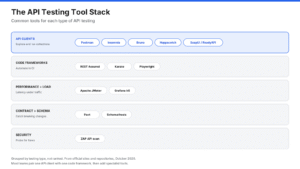
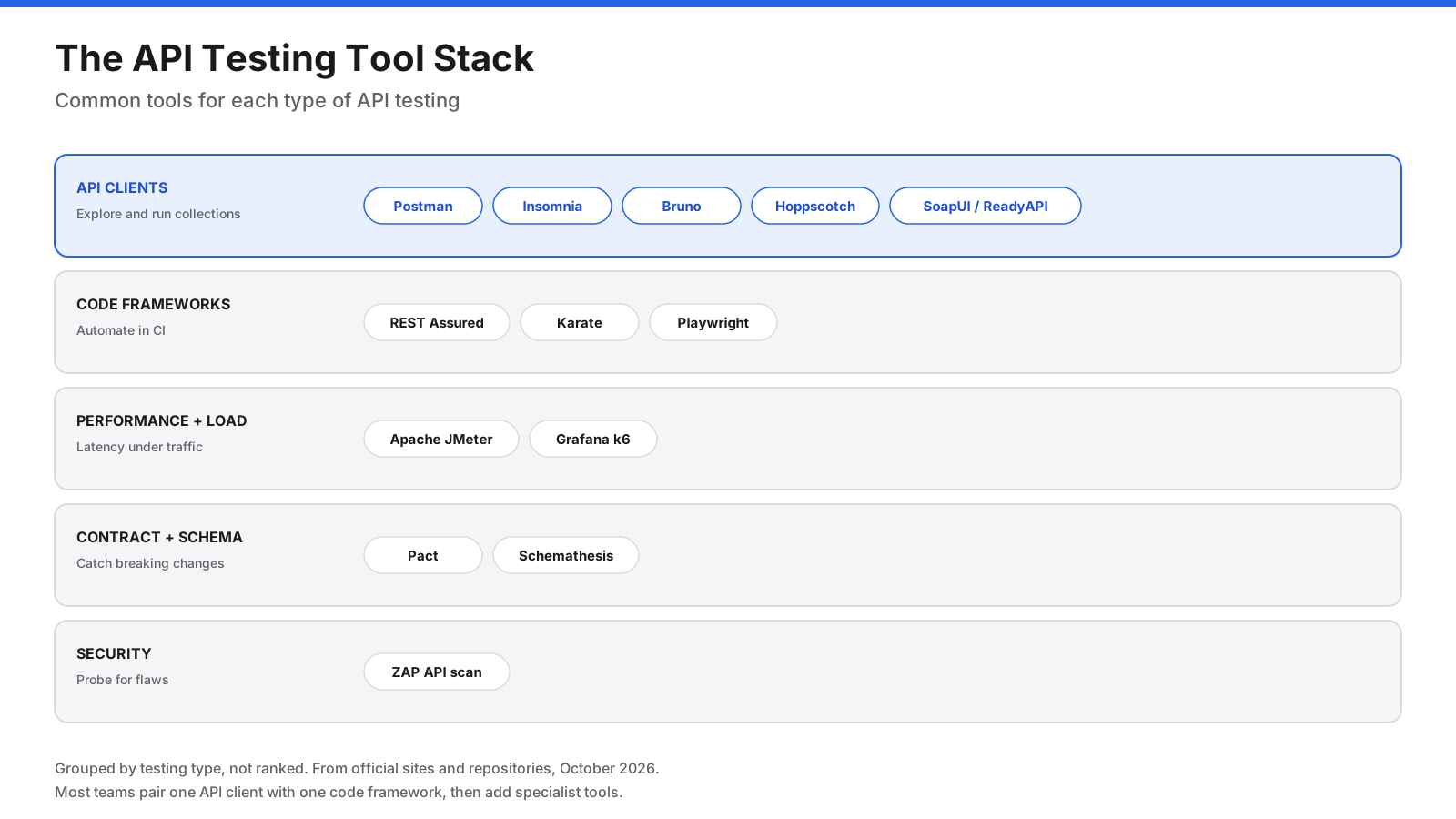
API testing tools fall into groups by the kind of testing they support. Most teams combine an API client for exploration with code-based tests in their CI pipeline, plus specialized tools for load, contract, and security testing. The tools below are grouped by use, not ranked.
API Clients for Exploratory and Collection Testing
API clients let you build requests, inspect responses, save collections, and add assertions, usually through a desktop or web interface.
| Tool | License or model | Notable capabilities |
|---|---|---|
| Postman | Commercial, with a free plan | Collections, Collection Runner for automated tests, mock servers, and monitoring. The source draft lists a free plan for one user, Solo at $9 per month, and Team at $19 per user per month billed annually; verify current pricing before relying on these figures. |
| Insomnia (Kong) | Open source (Apache 2.0) | Desktop client for REST, GraphQL, gRPC, WebSockets, and SSE; supports local, Git, or cloud collection storage and CLI use in CI. |
| Bruno | Open source (MIT) | Stores collections as plain-text files on your filesystem, works offline with no cloud sync, and fits Git-based workflows. |
| Hoppscotch | Open source (MIT) | Browser-based client with desktop and CLI options; self-hostable and supports REST, GraphQL, WebSocket, SSE, Socket.IO, and MQTT. |
| SoapUI Open Source and ReadyAPI | Open source and commercial | SoapUI supports REST, SOAP, GraphQL, and JMS; commercial ReadyAPI adds data-driven testing, CI plug-ins, security, performance, and virtualization testing. |
Teams weighing Postman alternatives often look at Bruno and Insomnia when they want collections stored in Git alongside code, and Hoppscotch when they want a self-hosted, browser-based client.
Code-Based API Test Frameworks
Code-based frameworks let developers write API tests alongside application code and run them in CI on every change.
- REST Assured (Apache 2.0): A Java library offering a domain-specific language for testing REST services with readable given, when, then chains.
- Karate (MIT): An open-source framework combining API test automation, mocks, performance testing through a Gatling integration, and UI automation.
- Playwright: Known for browser testing, it also provides an API request context to test server APIs, prepare server state before visiting a web app, and validate post-conditions after browser actions.
Many teams also write API tests with general-purpose test runners in their preferred language, using HTTP client and assertion libraries.
Performance and Load Testing Tools
- Apache JMeter: A Java application designed to load test functional behavior and measure performance, with support for HTTP and HTTPS, SOAP and REST web services, databases through JDBC, LDAP, JMS, and more.
- Grafana k6 (AGPL-3.0): A load-testing tool written in Go and scripted in JavaScript, supporting HTTP, WebSockets, gRPC, and browser protocols.
Performance tests should model realistic traffic: a mix of endpoints, think time between requests, ramp-up periods, and peak loads, measured against latency and error-rate targets.
Contract and Schema-Based Testing Tools
- Pact: A consumer-driven contract testing tool for HTTP and message integrations. Consumer tests generate a contract that is then verified against the provider.
- Schemathesis (MIT): Uses property-based testing to generate inputs from OpenAPI and GraphQL schemas, finding server errors, schema mismatches, validation gaps, and stateful bugs.
Contract and schema tests are especially valuable in microservice environments, where many teams change APIs independently.
API Security Testing Tools
ZAP API scan: ZAP includes an API scan in its Docker images. It imports an API definition and actively scans endpoints, with support for APIs defined by OpenAPI, SOAP, or GraphQL.
Automated scanners catch many misconfigurations and injection flaws, but authorization bugs such as broken object-level authorization usually need targeted tests using two different user accounts and checking that each can reach only its own data.
How to Choose API Testing Tools
- Match the API style. Confirm support for REST, GraphQL, gRPC, SOAP, WebSockets, or events as needed.
- Decide where tests live. Code-based frameworks and file-based clients keep tests in version control next to the code.
- Plan for CI. Choose tools with command-line runners that fail builds when tests fail.
- Use your API description. Tools that import OpenAPI or GraphQL schemas can generate tests and catch drift between documentation and behavior.
- Cover more than functional tests. Add contract, load, and security testing as APIs become business-critical.
- Consider collaboration and data handling. Check where collections, environments, and secrets are stored, especially with cloud-synced tools.
Tool licenses, plans, and features evolve quickly, so check each project’s site before standardizing on it.
API Glossary
- Endpoint: A URL where an API accepts requests for a resource or action.
- Request: A message from a client to an API, with a method, URL, headers, and optional body.
- Response: The API’s reply, with a status code, headers, and usually a body.
- JSON: JavaScript Object Notation, a common data format for web APIs.
- API key: A string that identifies the calling application or project.
- OAuth 2.0: A framework that lets applications obtain limited, delegated access on a user’s behalf.
- JWT: A compact, signed token that carries claims about a caller.
- Rate limiting: Restricting how many requests a client can make in a period.
- Idempotent: An operation that has the same effect whether performed once or many times.
- SDK: A software development kit, a library that wraps an API for a specific programming language.
- Webhook: An HTTP callback that an API sends to a registered URL when an event occurs.
- OpenAPI: A standard format for describing HTTP APIs.
Frequently Asked Questions
What is an API in simple terms?
An API is a set of rules that lets one program ask another program for data or to do something. It works like a restaurant menu: it lists what you can order and how, and the kitchen handles the rest.
What is an API with an example?
When a weather app shows today’s forecast, it sends a request to a weather service’s API with your location. The API returns forecast data in JSON, and the app displays it. The app never needs access to the weather service’s databases.
What does API stand for?
API stands for application programming interface.
What is an API key used for?
An API key identifies the application or project making a request, so the provider can track usage, apply quotas, and bill correctly. It does not identify an individual user and should be kept secret and restricted.
What is an API call?
An API call is a single request sent to an API endpoint and the response that comes back. Providers often meter usage and pricing by the number of API calls.
Is ChatGPT an API?
ChatGPT is an application, not an API. OpenAI separately offers APIs that developers can call from their own software to use its models. Many AI products have both a consumer app and a developer API.
Is Google considered an API?
Google is a company and search engine, not an API. Google offers APIs for services such as Maps, YouTube, Gmail, and Google Cloud.
Why would someone use an API?
APIs let developers reuse existing services instead of building everything themselves, connect systems so data flows automatically, and expose products to partners and customers. They speed up development and enable integrations.
What is the difference between REST and GraphQL?
REST organizes an API around resources at multiple endpoints, each returning a defined structure. GraphQL uses a single endpoint where clients send a query describing exactly the fields they need. This can reduce over-fetching but makes caching and cost control harder.
What is an API gateway?
An API gateway is a server in front of backend services that handles routing, authentication, rate limiting, caching, and logging for API requests.
What is API testing?
API testing sends requests directly to an API and checks responses for correctness, performance, and security without using a user interface. It includes functional, contract, integration, load, and security testing.
What are the best API testing tools?
Common choices include API clients such as Postman, Insomnia, Bruno, and Hoppscotch; code-based frameworks such as REST Assured, Karate, and Playwright; load-testing tools such as Apache JMeter and k6; contract and schema tools such as Pact and Schemathesis; and ZAP API scan for security.
Are APIs secure?
APIs can be secure when they use strong authentication, check authorization on every request, validate input, apply rate limits, and are tested and monitored. The OWASP API Security Top 10 lists common weaknesses to avoid.
Summary
An API is a contract that lets software systems request data and services from each other without knowing how the other is built. Most web APIs use HTTP: a client sends a request with a method, endpoint, headers, and optional body, and the server returns a status code and response, usually in JSON. APIs are secured with API keys, OAuth 2.0 tokens, JWTs, or mutual TLS, and come in several styles, including REST, SOAP, GraphQL, gRPC, WebSockets, and webhooks.
As APIs carry a large share of dynamic web traffic and increasingly serve AI agents, design and security matter. Authorization flaws top the OWASP API Security Top 10, and shadow APIs are common. Testing APIs at every level, from contracts and functionality to load and security, with a mix of API clients, code-based frameworks, and specialist tools, helps keep them reliable as they change.