Artificial intelligence software is any software that learns patterns from data and uses them to make predictions, understand language, recognize images, generate content, or take actions, instead of following only rules a programmer wrote by hand. It ranges from a spam filter in your inbox to chat assistants like ChatGPT and Claude, fraud checks in banking apps, product recommendations in online stores, and agents that update records across business systems.
The term covers more than finished apps. Behind every AI product sits a stack of other software: the models that do the thinking, the frameworks used to build and train those models, the platforms that serve them, and the data and computing power underneath. Knowing which layer you are looking at makes it much easier to compare products and understand what you are buying.
Quick answer: Artificial intelligence software uses machine learning and related techniques to perform tasks that normally need human judgment, such as understanding text, recognizing images, predicting outcomes, and generating content. It learns from data rather than relying only on fixed rules. AI software includes end-user applications, platforms and APIs that provide AI models, the models themselves, and frameworks such as PyTorch and TensorFlow that developers use to build them.
This guide explains how AI software works, how it differs from traditional software, the main types and frameworks, real examples, the benefits and risks, and how to choose the right tools. If you already know you want a shortlist of products, see our comparison of the best AI tools.
How Does AI Software Work?
AI software works in two phases. In training, a model learns patterns from large amounts of example data. In use, often called inference, the trained model applies those patterns to new inputs, such as a question, a photo, or a transaction.
- Collect and prepare data. Teams gather examples relevant to the task, such as past transactions labeled as fraud or not, or large collections of text, and clean them for training.
- Train a model. Using an AI framework and powerful hardware such as GPUs, the model adjusts millions or billions of internal settings until its outputs match the examples well.
- Test and tune. The model is measured on data it has not seen. Teams adjust it until accuracy, speed, and cost are acceptable.
- Deploy it. The model is made available through an app, a cloud platform, or an API so other software can send it requests.
- Run inference. When someone asks a question or a system sends data, the model returns a prediction, an answer, or generated content.
- Monitor and improve. Teams track accuracy and errors over time and retrain or update the model as conditions change.
Most businesses never train a model from scratch. They use AI applications, or build on large pretrained models from providers such as OpenAI, Anthropic, and Google through an API. They then add their own data, either by connecting the model to documents at answer time or by fine-tuning it on examples.
It helps to picture AI software as a stack of layers, each built on the one below it:
The AI software stack — 5 layers
What people use: ChatGPT, Copilot, and AI features inside business apps
How apps reach models: model APIs and cloud AI platforms
The trained systems: language, image, speech, and prediction models
How models are built and trained: PyTorch, TensorFlow, JAX, scikit-learn
What it all runs on: training data, GPUs, and cloud infrastructure
When a vendor calls its product “AI software,” it usually means the top layer: an application built on someone else’s model and infrastructure.
How Is AI Software Different From Traditional Software?
Traditional software does exactly what its code tells it to do. AI software learns how to do a task from examples, which lets it handle situations nobody wrote a rule for, but also means it can be wrong in ways that are harder to predict.
| Comparison | Traditional software | AI software |
|---|---|---|
| How it decides | Follows rules written by programmers | Uses patterns learned from data |
| Output | Same input always gives the same output | Output can vary, and is a best estimate rather than a certainty |
| Handling new situations | Fails or errors when a case was not planned for | Can generalize to cases it has not seen, with varying accuracy |
| How it improves | Developers change the code | Teams retrain or tune the model with new data |
| Testing | Check that each rule works as written | Measure accuracy on test data and monitor results over time |
| Main risks | Bugs in the code | Wrong answers, bias from training data, and drift as conditions change |
Most modern products combine both. An accounting app uses traditional code to calculate totals and AI to read receipts and suggest categories. A help desk uses fixed workflows to route tickets and AI to draft replies.
What Are the Main Types of AI Software?
AI software is usually grouped by the technique it uses. Many products combine several of these.
| Type | What it does | Everyday examples |
|---|---|---|
| Machine learning | Finds patterns in data to predict outcomes or classify items | Fraud detection, demand forecasting, churn prediction |
| Deep learning | Uses large neural networks for complex patterns in images, sound, and text | Image recognition, speech recognition, medical image analysis |
| Natural language processing | Understands and produces human language | Chat assistants, translation, sentiment analysis, document search |
| Generative AI | Creates new text, images, audio, video, or code from a prompt | ChatGPT, Claude, Gemini, image and video generators, coding assistants |
| Computer vision | Interprets images and video | Quality inspection, face unlock, reading receipts and IDs |
| Speech AI | Converts speech to text and text to speech | Meeting transcription, voice assistants, call center analytics |
| Recommendation systems | Suggests items based on behavior and similarity | Product, video, and music recommendations |
| AI agents | Plan and carry out multi-step tasks using tools and apps | Agents that research, update CRM records, or resolve support tickets |
Generative AI and AI agents get the most attention today, but much of the AI software in daily business use is classic machine learning working quietly inside other products. For a closer look at agents, see our list of the best AI agents.
What Are the Key Features of AI Software?
- Learning from data: The software improves its predictions or outputs when trained or tuned on more relevant examples.
- Natural language interface: You can ask questions or give instructions in plain language instead of using menus or code.
- Prediction and scoring: It estimates the likelihood of outcomes, such as a customer leaving or a transaction being fraudulent.
- Content generation: It drafts text, images, audio, video, or code from a description.
- Pattern and anomaly detection: It spots unusual activity in data, such as a spike in errors or a suspicious login.
- Personalization: It adapts content, offers, or results to each user.
- Automation and agents: It carries out tasks or multi-step workflows, sometimes across several connected apps.
- Grounding in your data: Better tools answer from your own documents and systems, often using retrieval-augmented generation, which we explain in What Is RAG?
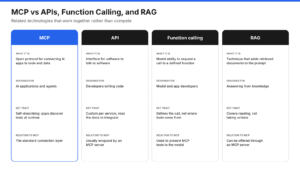
- Integrations and APIs: It connects to the software you already use, through built-in connectors, APIs, or standards such as the Model Context Protocol. Read What Is MCP? for more.
- Governance controls: Admin settings, permissions, audit logs, and data retention options keep AI use safe and accountable.
What Is a Software Framework for AI?
A software framework for AI is a set of ready-made libraries and tools that developers use to build, train, and run AI models without writing the underlying math and hardware code themselves. Frameworks handle the heavy lifting, such as running calculations on GPUs, calculating how a model should adjust during training, loading data, and saving trained models, so teams can focus on the problem they are solving.
AI frameworks fall into two groups. Model frameworks are used to create and train models. Application frameworks are used to build products on top of models that already exist, such as a chatbot that answers from company documents.
| Framework | Group | What it is used for |
|---|---|---|
| PyTorch | Model framework | Building and training deep learning models, widely used in research and production; governed by the PyTorch Foundation under the Linux Foundation |
| TensorFlow | Model framework | Building, training, and deploying models at scale, including on mobile and web; created at Google |
| Keras | Model framework | A simpler, high-level way to define and train neural networks on top of other frameworks |
| JAX | Model framework | High-performance numerical computing and model training, popular for large-scale research |
| scikit-learn | Model framework | Classic machine learning, such as classification, regression, and clustering on tabular data |
| Hugging Face Transformers | Model library | Downloading, fine-tuning, and running thousands of pretrained models for text, images, and audio |
| LangChain | Application framework | Connecting large language models to data, tools, and multi-step workflows |
| LlamaIndex | Application framework | Building retrieval-augmented generation apps that answer from your own documents |
Most business users never touch these frameworks directly. They matter when you hire developers, evaluate a custom AI project, or need to understand what a vendor’s product is built on. Two related ideas are worth knowing. AI models are usually reached through an API, and the Model Context Protocol gives AI applications a standard way to connect to tools and data, covered in What Is MCP?
What Are Examples of AI Software?
AI software now shows up in almost every business function:
- General assistants: ChatGPT, Claude, Gemini, and Microsoft Copilot handle research, writing, summarizing, and data analysis. Our ChatGPT vs GPT guide explains the difference between an AI app and the model behind it.
- Marketing: AI tools draft content, optimize pages for search, create images and video, and segment email audiences. Our guide to what AI marketing tools are covers this group in depth.
- Sales: CRM platforms score leads, summarize calls, and draft follow-up emails.
- Customer service: AI chatbots and agents answer common questions, suggest replies to support staff, and route tickets.
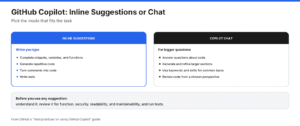
- Software development: Coding assistants suggest code, explain errors, and review pull requests, and AI app builders turn plain-language descriptions into working apps. See our list of the best AI software builders.
- Finance: AI reads invoices and receipts, flags unusual transactions, and helps with forecasting.
- HR: AI screens applications, drafts job descriptions, and answers employee policy questions.
- IT and security: AI detects anomalies in system data, groups related alerts, and flags suspicious activity.
- Design and media: Image, video, and audio generators create and edit visual and sound assets.
What Are the Benefits of AI Software?
Faster work. AI handles first drafts, summaries, data entry, and routine questions in seconds, which frees people for work that needs judgment.
Better use of data. Predictions, anomaly detection, and plain-language questions make data useful to people who do not write code or build reports.
Scale without the same headcount. AI can answer more customer questions, review more documents, and personalize more messages than a team could do by hand.
Fewer repetitive errors. For well-defined tasks such as reading forms or matching records, AI can be more consistent than manual work, as long as results are checked.
New capabilities. Some tasks, such as searching thousands of documents by meaning or generating images on demand, were not practical before AI software.
What Are the Limitations and Risks of AI Software?
Wrong answers stated with confidence. Generative AI predicts likely outputs and does not check facts unless it is connected to trusted sources. Every important output needs a human review.
Bias. AI learns from historical data, so it can repeat unfair patterns found in that data, for example in hiring or lending decisions.
Privacy and security. Sending customer data or confidential documents to an AI service can expose them if the service’s data terms or security controls are weak.
Lack of transparency. Many models cannot explain exactly why they produced a result, which matters in regulated decisions.
Drift. A model trained on last year’s data can become less accurate as customer behavior, prices, or products change.
Cost at scale. Usage-based pricing for AI models and features can grow quickly as more people and processes use them.
Regulation. Rules on AI use, transparency, and data protection differ by country and industry. Check what applies to your business before using AI in sensitive decisions.
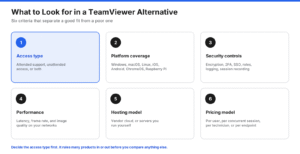
How Do You Choose AI Software for Your Business?
- Start with a specific problem. Name the task, who does it today, and how many hours it takes. “Answer tier-one support questions” is a better starting point than “use AI in support.”
- Check the AI already in your tools. CRM, help desk, office, design, and analytics platforms increasingly include AI features. Test those before buying something new.
- Decide between buying and building. Off-the-shelf AI apps are faster to adopt. Building on AI platforms and APIs gives more control but needs developers and ongoing maintenance.
- Look at the data it needs. AI that can use your documents, CRM, or knowledge base gives more useful answers. Confirm how it connects and who can see what.
- Review data and security terms. Check whether your inputs are used to train models, where data is stored, how long it is kept, and which compliance standards the vendor meets.
- Test accuracy on your own examples. Run a pilot with real cases and measure how often the output is right, partly right, or wrong.
- Understand the pricing model. Vendors charge per seat, per credit, per token, or per action. Estimate cost at the volume you expect, not the volume in the demo.
How Do You Get Started With AI Software?
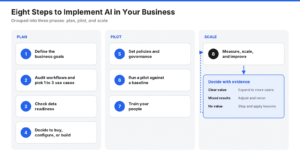
- Pick one use case with clear value. Choose a frequent, time-consuming task where mistakes are easy to catch.
- Set rules before rollout. Decide what data people may share with AI tools, which tools are approved, and which outputs must be checked by a person.
- Run a short pilot. Use the tool with a small group for a few weeks and compare results with the old process.
- Measure and decide. Track time saved, quality, and cost, then expand, adjust, or stop.
- Train your team. Show people how to write clear instructions, check outputs, and report problems.
For a fuller rollout plan, see our guide on how to use AI for business.
Frequently Asked Questions
What is artificial intelligence software in simple terms?
It is software that learns from examples to do tasks that usually need human judgment, such as understanding a question, recognizing a photo, predicting what a customer will do, or writing a draft. Traditional software follows fixed rules instead.
What are examples of AI software?
Common examples include chat assistants such as ChatGPT, Claude, and Gemini, spam filters, fraud detection in banking, product recommendations in online stores, voice assistants, meeting transcription tools, image generators, and coding assistants.
What is a software framework for AI?
It is a set of libraries and tools that developers use to build, train, and run AI models without writing low-level math and hardware code. PyTorch, TensorFlow, Keras, JAX, and scikit-learn are model frameworks, while LangChain and LlamaIndex help build applications on top of existing models.
Is ChatGPT AI software?
Yes, ChatGPT is an AI application built on OpenAI’s GPT family of large language models. The app is the product people use, and the model is the AI system underneath it.
What is the difference between AI software and machine learning?
Machine learning is one technique within AI, in which software learns patterns from data. AI software is the broader category and can include machine learning, deep learning, language models, computer vision, and rule-based components working together.
What is the difference between an AI model and AI software?
An AI model is the trained system that makes predictions or generates content. AI software is the complete product around it, including the interface, data connections, security, and business logic that make the model useful.
Is AI software free?
Some AI software is free to use. Many AI assistants and tools have free plans with limits, and frameworks such as PyTorch, TensorFlow, and scikit-learn are open source. Business plans, higher usage, and enterprise features are usually paid.
What are the four types of AI?
A common textbook model groups AI into reactive machines, limited memory, theory of mind, and self-aware AI. All AI software in use today falls into the first two groups. The other two describe research goals rather than products.
Can AI software replace human workers?
AI software usually replaces tasks rather than whole jobs. It handles drafting, sorting, summarizing, and routine questions, while people still set goals, check results, handle exceptions, and make judgment calls.
Is AI software safe to use with company data?
It can be, with the right plan and controls. Use business or enterprise plans with clear data terms, check whether inputs are used for model training, limit who can access sensitive data, and review the vendor’s security and compliance certifications.
AI Software Works Best When You Know Which Layer You Need
Artificial intelligence software covers everything from the apps people use every day to the models, platforms, and frameworks behind them. Most businesses will buy AI applications, or AI features inside tools they already use, rather than build models from scratch. The decisions that matter most are which problem to solve first, what data the AI can safely use, and who checks its output.
Start with one clear use case, test it on your own examples, and expand once the value is proven. When you are ready to compare products, our list of the best AI tools is a good next step, and our AI software directory covers more categories.