MySaaSJourney’s AI Add-On Price Index 2027 examines how 100 widely used software products charge for generative AI on top of their core subscriptions. The headline finding: a separately sold AI add-on costs a median of $28.50 per user per month, typically adding around 80% to the price of the seat it sits on. In some products, the AI charge is several times the base subscription.
The research covers 10 software categories and uses official vendor pricing pages, help centers, product documentation and announcements checked on October 31, 2026. It distinguishes AI bundled into a plan from per-seat add-ons, usage and credit charges, higher-tier upgrades and enterprise-only pricing.
Key findings at a glance
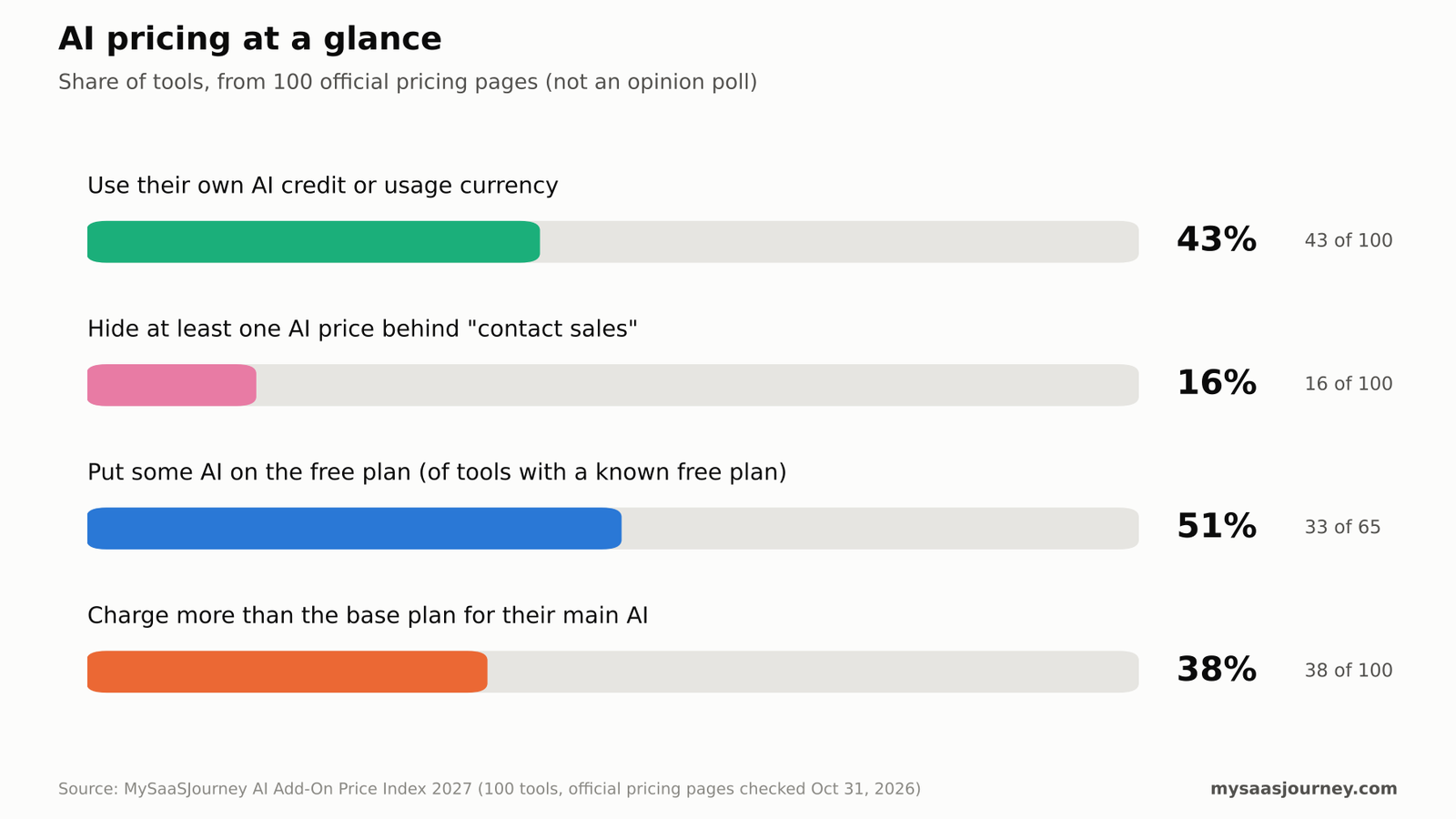
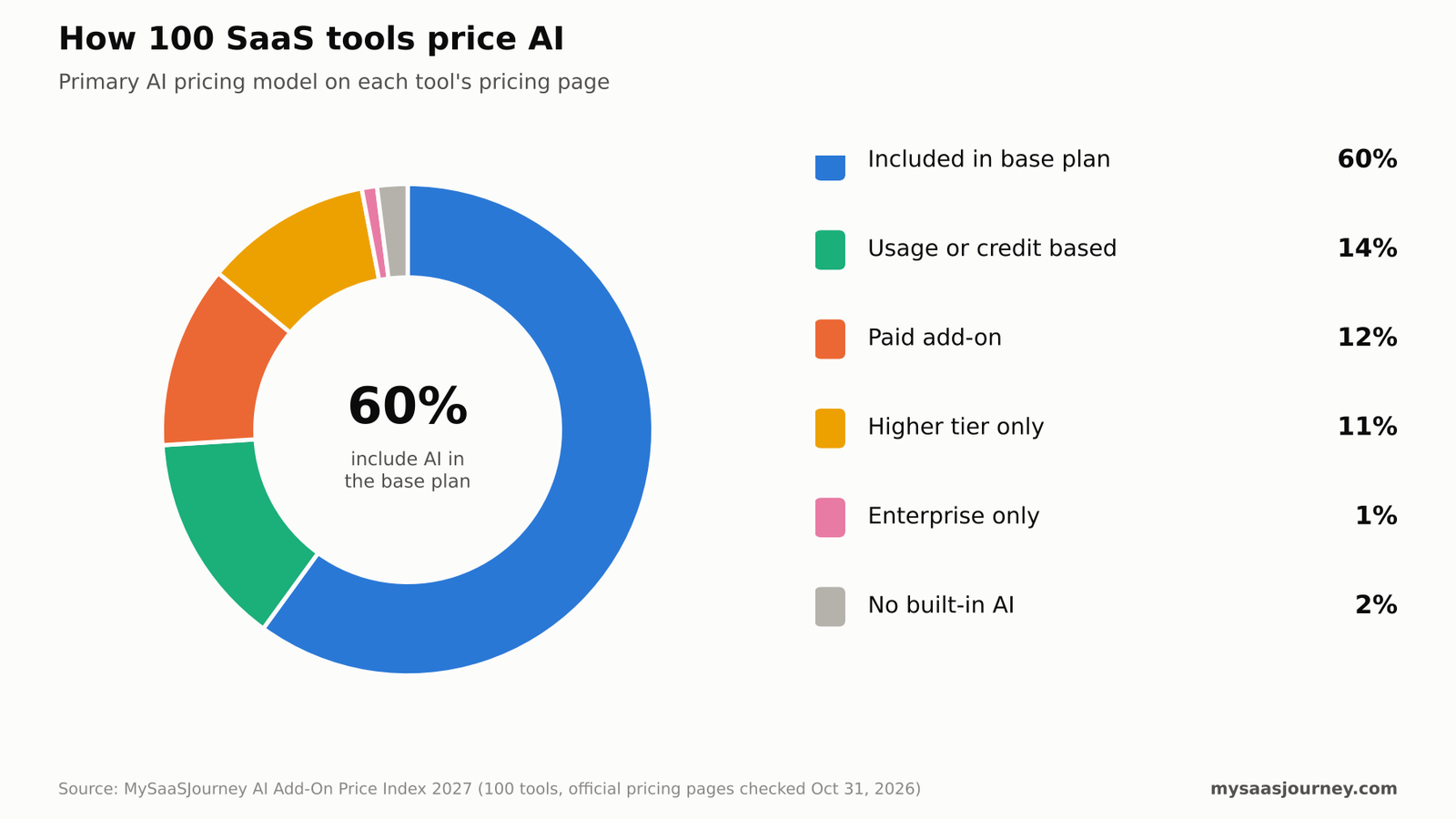
- 60 of 100 tools include AI in their base plan as their primary pricing model. Another 38 charge more for their main AI: 14 through usage or credits, 12 through a paid add-on, 11 through a higher tier and one through an enterprise-only plan. Two have no built-in generative AI.
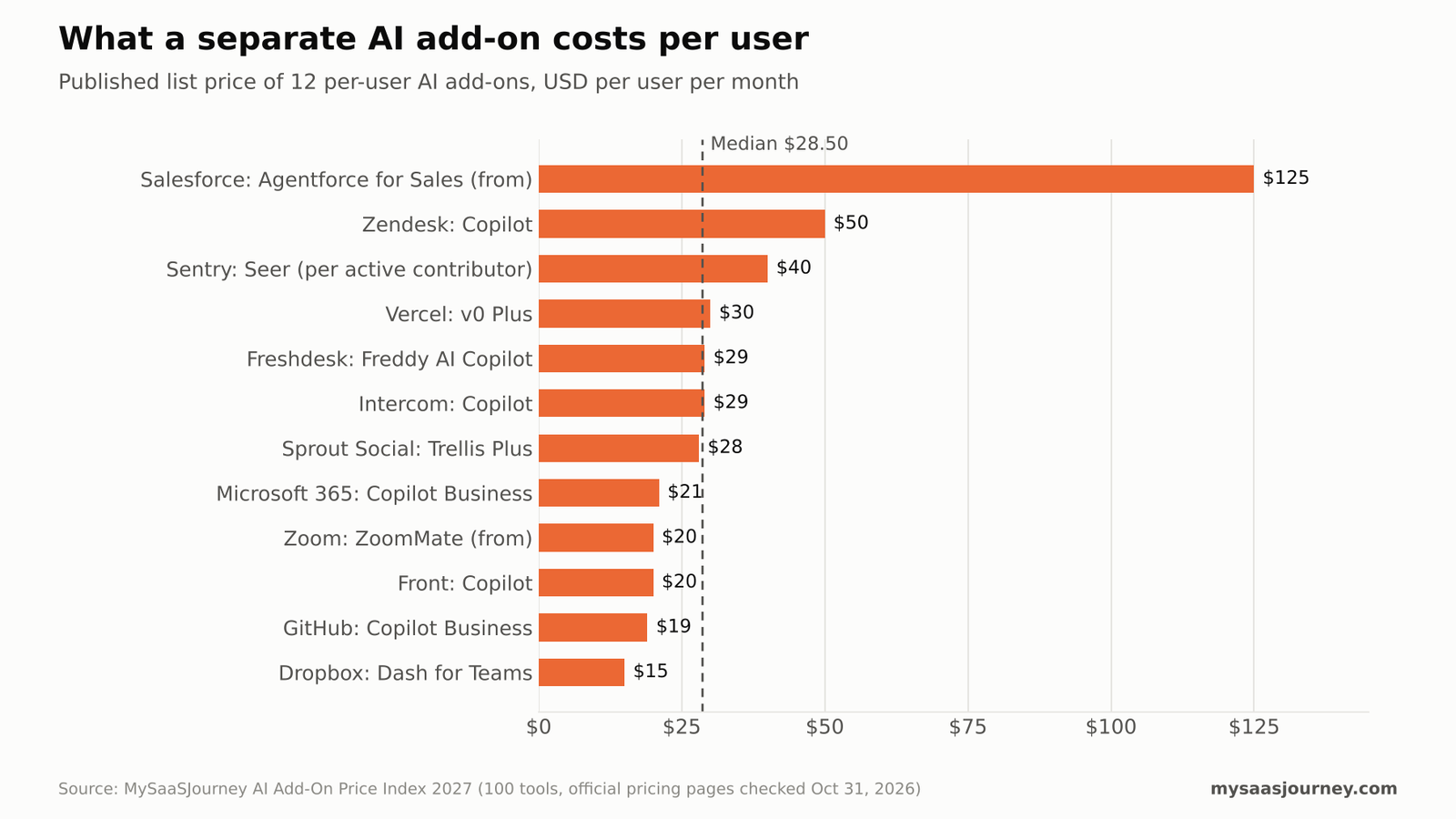
- Published per-user AI add-ons range from $15 to $125 per user per month. Dropbox Dash for Teams is the lowest; Salesforce Agentforce for Sales starts at the highest price.
- The median add-on equals 100% of its base plan when account- and domain-priced add-ons are included in the comparable sample.
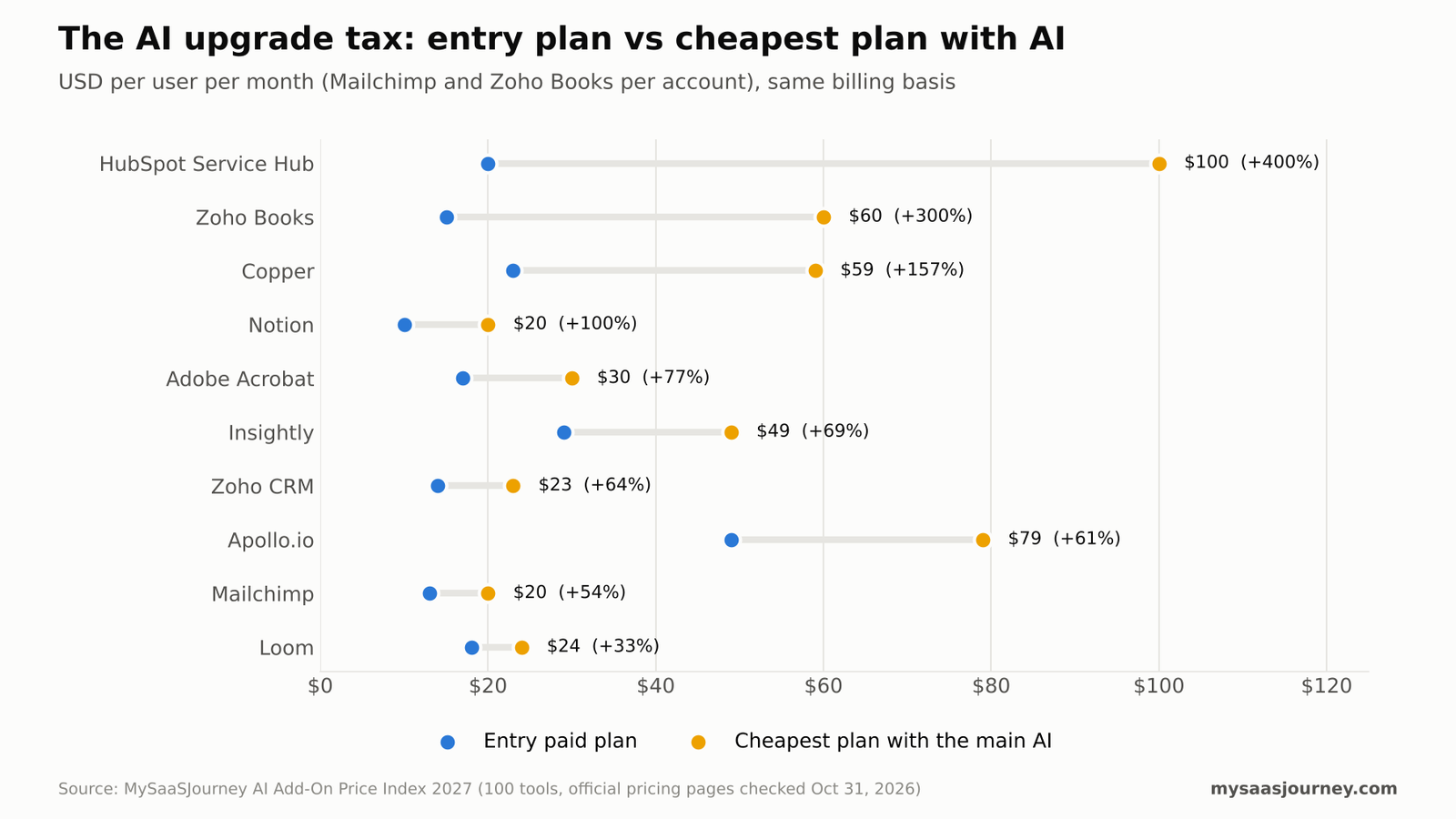
- Higher-tier AI has a median upgrade premium of 73%, or $16.50 more per user per month, across 10 tools.
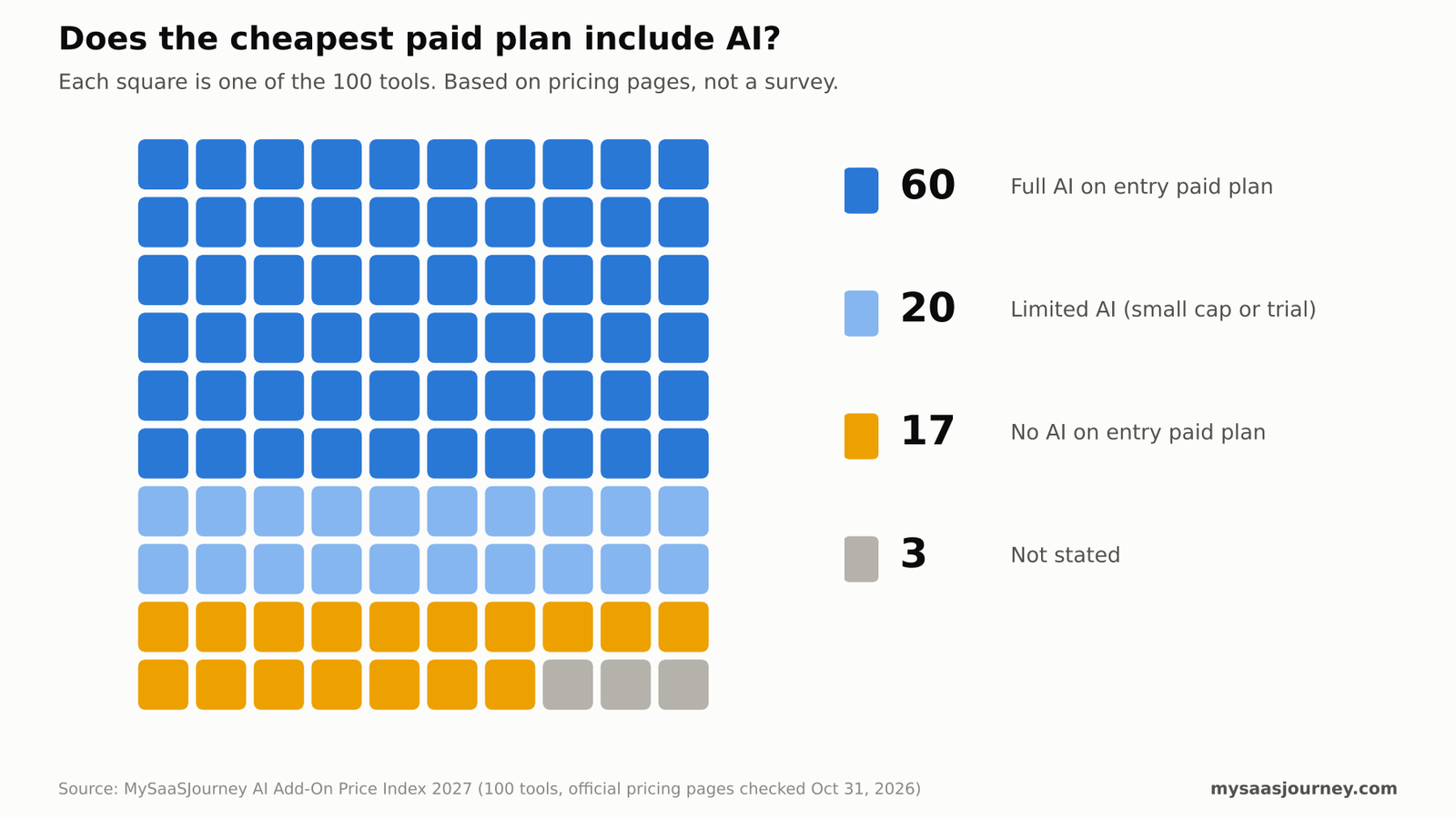
- Only 60 tools provide full AI on their cheapest paid plan; 20 provide a small cap or trial and 17 provide none. Three do not state plan-level availability publicly.
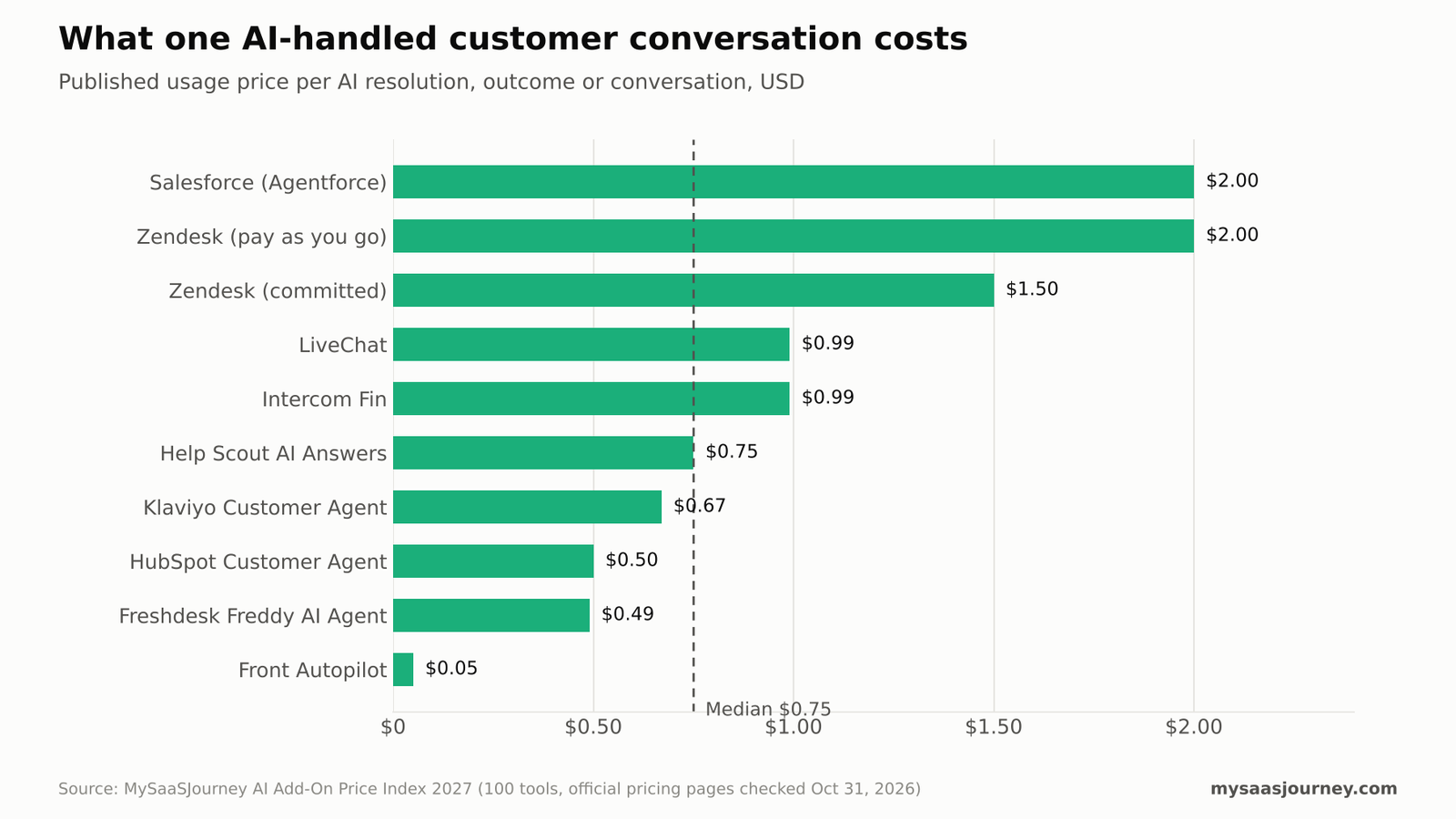
- Customer-service AI has a median published cost of $0.75 per AI-handled conversation, with rates from $0.05 to $2.00.
- 43 of 100 tools use their own AI credit system. Credits are not directly comparable between vendors.
- At least 16 tools hide an AI price behind contact-sales or a custom quote.
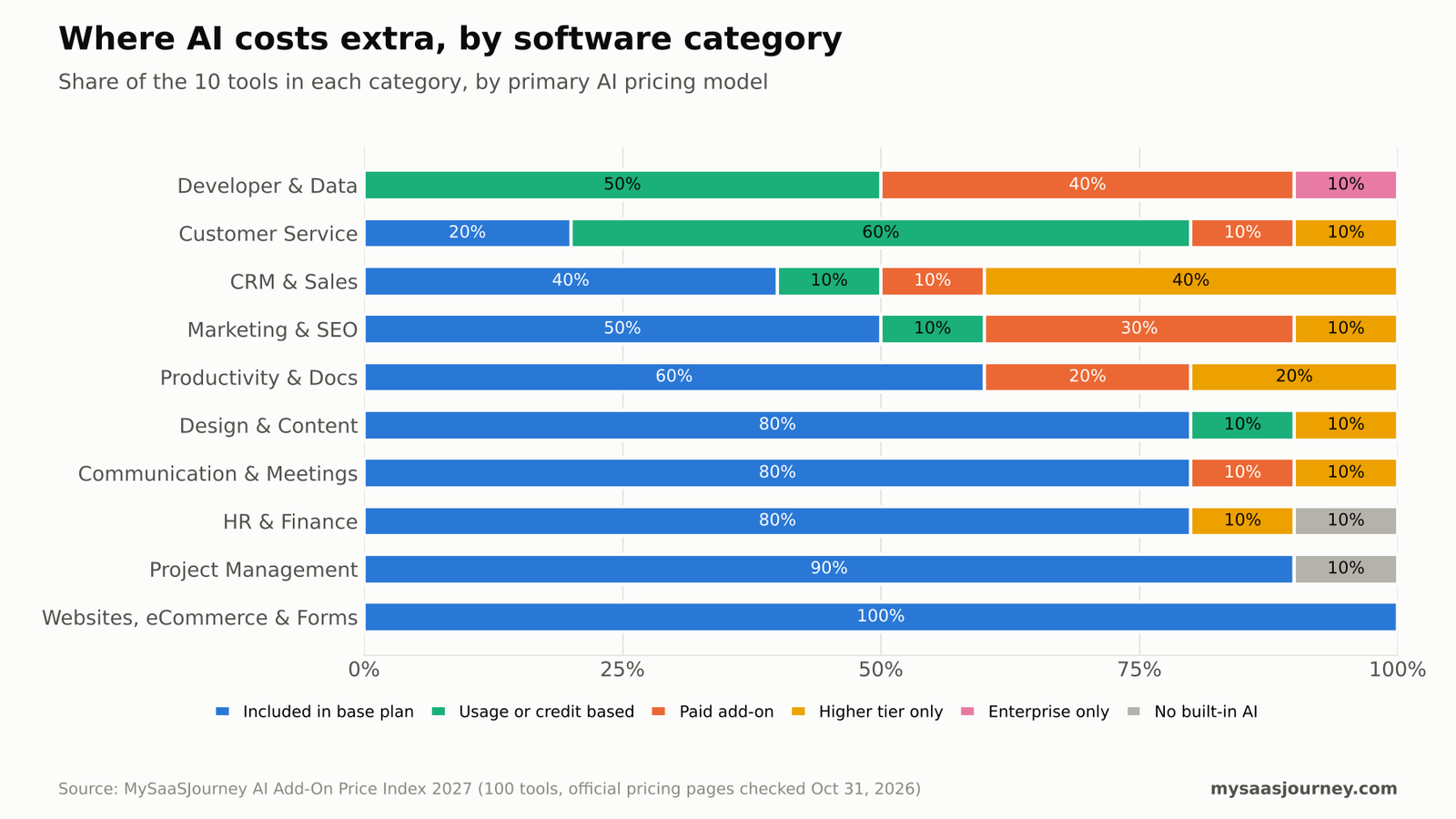
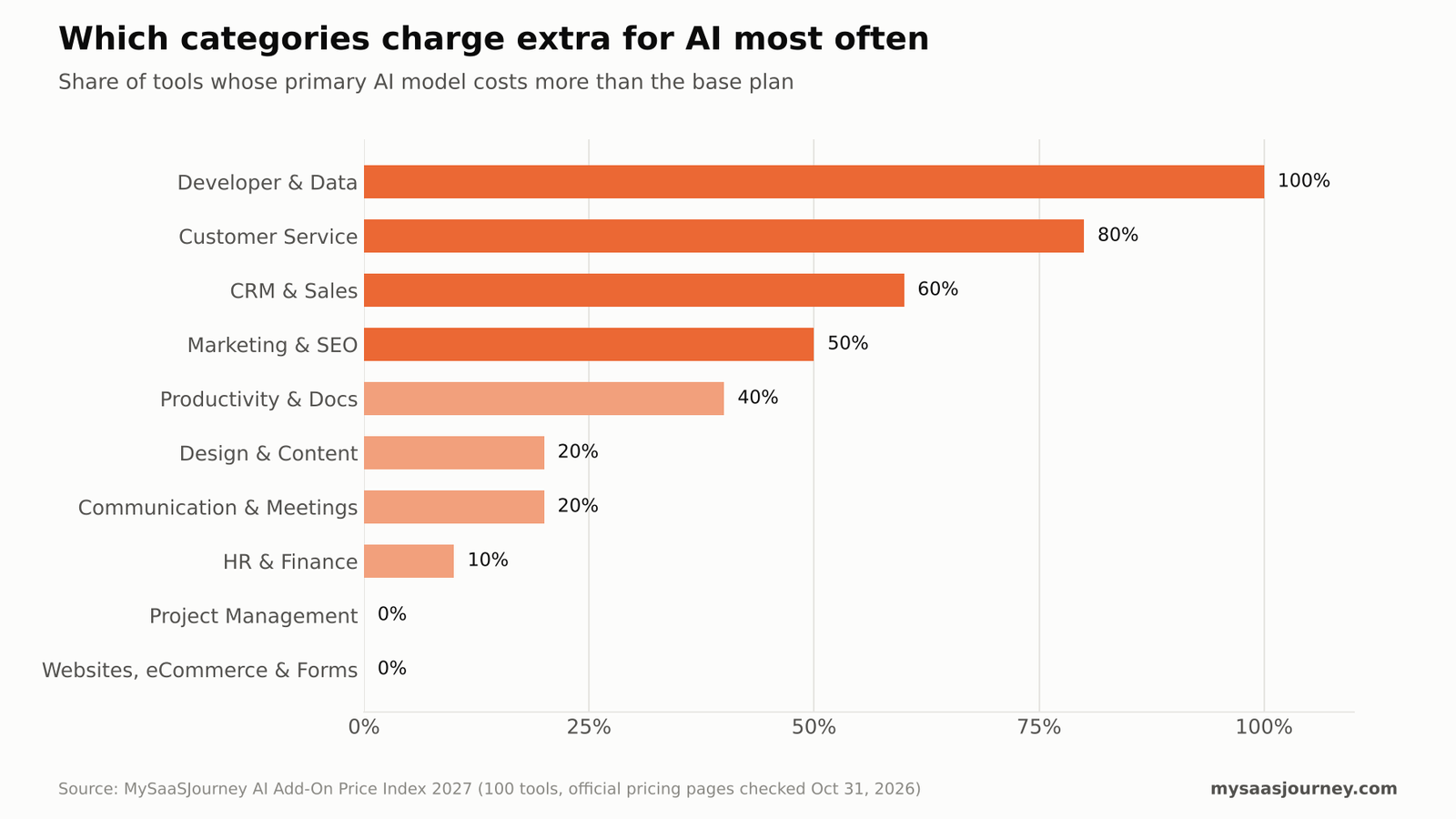
- None of the 10 Developer & Data tools uses included-in-base-plan as its primary model; all 10 Websites, eCommerce & Forms tools do.
- For a 10-person team, AI multiplies the annual bill by 1.4x to 5.8x in the scenarios modeled.
What the index measures
The index answers a practical buying question: how much more does a business pay for AI inside software it already uses? For each product, the research records the entry paid plan, base price, primary AI pricing model, AI on the free and entry paid plans, add-on price, cheapest AI-enabled tier, usage or credit prices, whether pricing is undisclosed, official source URLs and a confidence label.
The sample contains 10 tools in each of 10 categories: Productivity & Docs; Project Management; CRM & Sales; Customer Service; Marketing & SEO; Communication & Meetings; Design & Content; Developer & Data; HR & Finance; and Websites, eCommerce & Forms. General-purpose AI assistants and AI-only products without a non-AI base subscription were excluded.
The six AI pricing models
- Included in base plan: meaningful AI is part of the entry paid plan, even if usage is capped.
- Paid add-on: AI is sold separately for a user, seat, account or workspace.
- Usage or credit based: charges depend on credits, tokens, resolutions, conversations or other consumption.
- Higher tier only: the main AI features require a more expensive plan, without a separate add-on.
- Enterprise only: the main AI is restricted to a contact-sales plan.
- No built-in AI: the product has no native generative AI features.
Each product receives one primary model, although many combine approaches—for example, included AI plus paid credit packs. The analysis uses list prices in US dollars, annual billing where published, and medians alongside averages to reduce the influence of unusually high prices.
How the research was conducted
Prices were collected from official vendor websites on October 31, 2026, using US pricing pages where available. The research did not use third-party price lists, reseller quotes or estimated prices. Where a value could not be read reliably, it was left blank and noted in the dataset.
After collection, an independent reviewer re-checked 14 headline price claims against official pages: 10 were confirmed as recorded, three were confirmed with added context, and one was corrected. Adobe Acrobat’s old $4.99 AI Assistant early-access offer is no longer sold to businesses, so Acrobat is classified as higher tier, with AI Assistant available in Acrobat Studio. Other context notes include Microsoft’s $21 Copilot Business list price (with an $18 first-year promotion through December 31, 2026), Copper AI email features being available on Business as well as Professional, and HubSpot Customer Agent requiring a Professional or Enterprise edition of a HubSpot hub.
Forty tools are marked confirmed, meaning key fields were read directly from official pages; 60 are partial because at least one field could not be read or needed interpretation. The index is a snapshot, not a guarantee of current prices. Regional pricing, JavaScript-rendered price tables, negotiated enterprise contracts and unlabeled billing periods can affect comparisons. No missing price was estimated.
How 100 software tools price AI
Six in ten products include AI in their base plan as the primary model, but 38% make customers pay more for their main AI features. The two products with no native generative AI are Basecamp and FreshBooks; both offer connections to external AI assistants instead.
| Primary AI pricing model | Tools | Share |
|---|---|---|
| Included in base plan | 60 | 60% |
| Usage or credit based | 14 | 14% |
| Paid add-on | 12 | 12% |
| Higher tier only | 11 | 11% |
| Enterprise only | 1 | 1% |
| No built-in AI | 2 | 2% |
Included does not mean unlimited
About 30 of the 60 tools that bundle AI publish a specific cap, credit allowance or usage limit on paid plans. Examples include monday.com’s 1,000 monthly AI credits on Basic, Airtable’s 15,000 credits per collaborator on Team, Squarespace’s 10 one-time AI credits on Basic, Atlassian’s 25 Rovo credits per user per month on Standard, and Figma’s 3,000 monthly AI credits for a full Professional seat. Vendors sell extra capacity or require an upgrade once customers reach the allowance.
Free AI versus paid AI
Of 65 tools with a free plan whose AI status could be confirmed, 33 (51%) include at least some AI. Free AI is more common among products that bundle AI: 26 of 39 base-plan bundlers with a known free plan offer some free AI (67%), compared with 7 of 25 tools that charge extra for their main AI (28%). Free allowances are often small, such as monthly prompt, query, credit or meeting-summary limits.
Does the cheapest paid plan include AI?
Sixty tools provide full access to their standard AI features on the entry paid plan. Twenty provide only a small cap, trial or reduced feature set. Seventeen provide no AI on the entry paid plan, including Salesforce Starter, Copper Basic, Insightly Plus, Mailchimp Essentials, GitHub Team and Adobe Acrobat Standard. Rippling, Gusto and Kustomer do not publicly state plan-level AI availability.
What a separate AI add-on costs
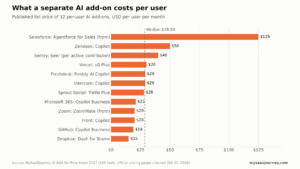
The median published per-user AI add-on is $28.50 per user per month. The average is $35.50, pulled upward by Salesforce. Without Salesforce, the average is $27.36. The 12 per-user prices below include separately sold copilots and AI products; billing periods vary, so check each vendor’s pricing basis before comparing.
| Vendor | AI add-on | Price per user/month | Required plan |
|---|---|---|---|
| Salesforce Sales Cloud | Agentforce for Sales | From $125 | Core (Enterprise), $195 |
| Zendesk Suite | Copilot | $50 | Suite Professional, $115 |
| Sentry | Seer | $40 per active contributor | Team or Business |
| Vercel | v0 Plus | $30 | Pro, $20 per seat |
| Freshdesk | Freddy AI Copilot | $29 | Pro, $55 |
| Intercom | Copilot | $29 | Any seat plan |
| Sprout Social | Trellis Plus | $28 annual / $35 monthly | Essentials, $79 |
| Microsoft 365 | Copilot Business | $21 annual / $25.20 monthly | Business Basic, $7 |
| Zoom Workplace | ZoomMate | From $20 | Pro, $14.16 |
| Front | Copilot | $20 | Starter, $25 |
| GitHub | Copilot Business | $19 | Team, $4 |
| Dropbox | Dash for Teams | $15 annual / $19 monthly | Standard, $15 |
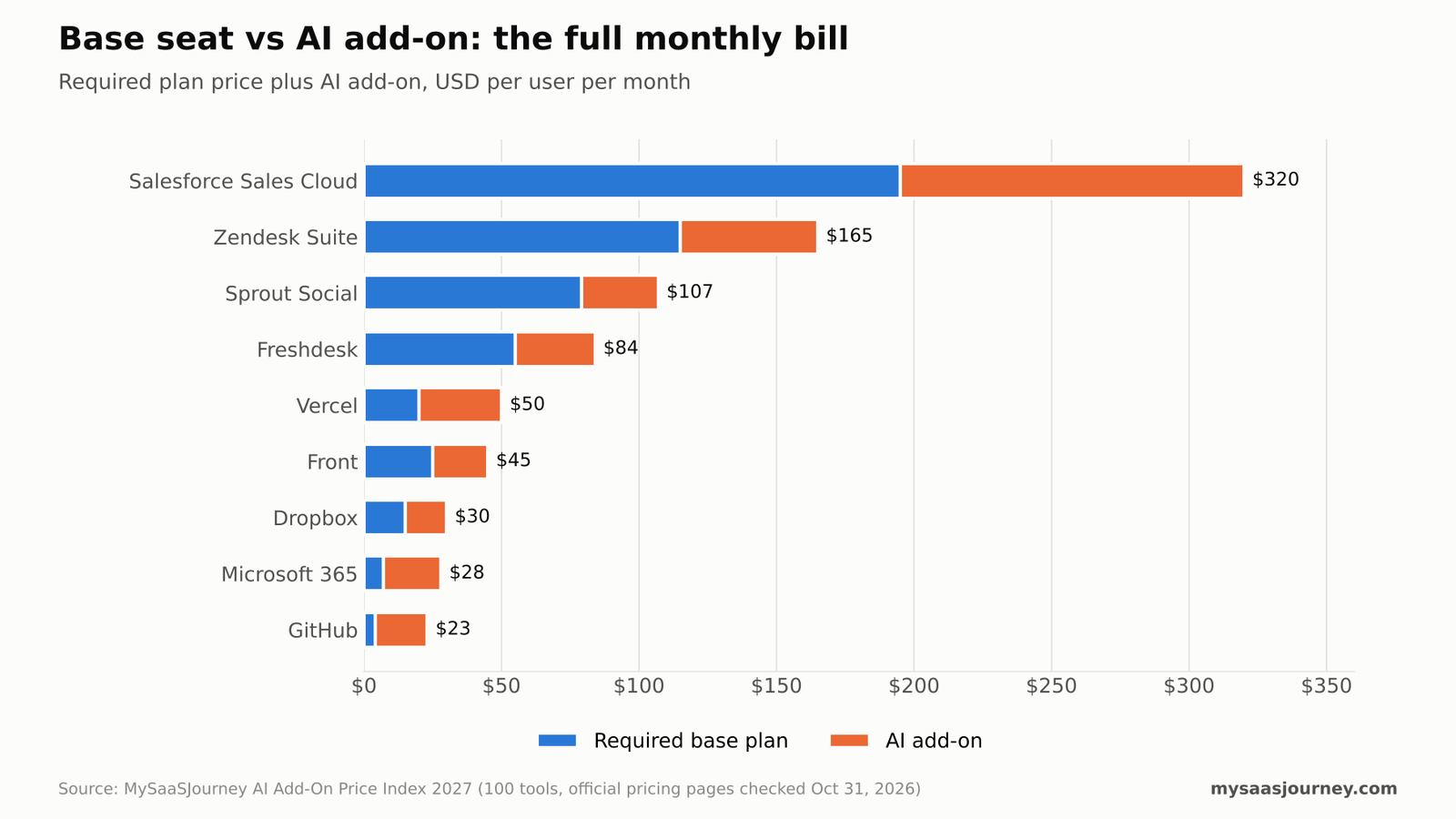
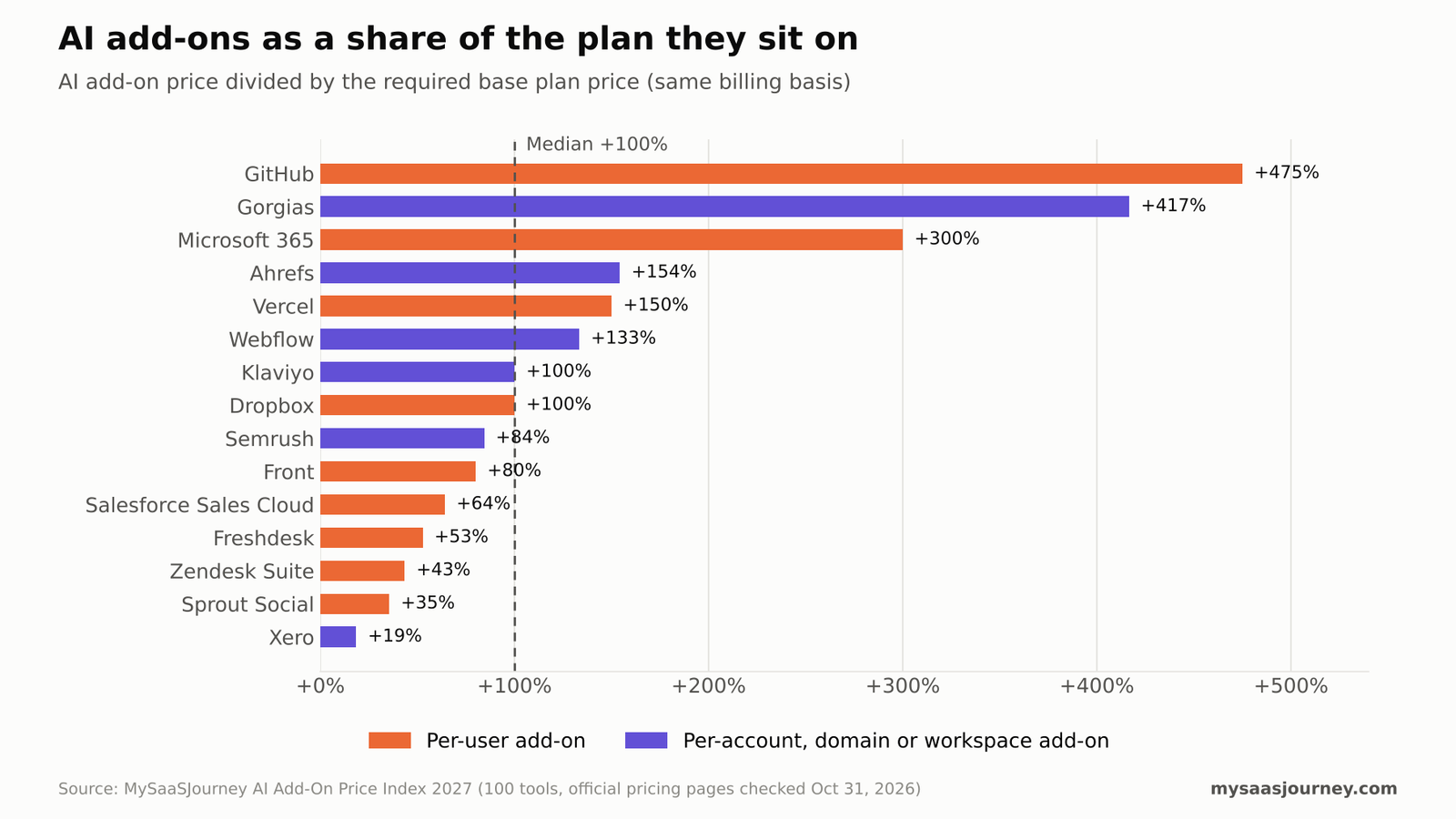
For 15 add-ons with comparable base and add-on prices, the median add-on equals 100% of the required base plan when per-account and per-domain offers are included. GitHub Copilot Business is 4.75 times the price of a GitHub Team seat. In other words, the AI can become the larger part of the software bill.
The cost of upgrading to get AI
Some vendors do not sell AI separately; they reserve the main AI features for a more expensive tier. Across 10 comparable tools, the median upgrade premium is 73%, or $16.50 more per user per month. In a separate analysis of advanced AI inside products that describe AI as included, the median price of the tier with advanced features was 183% above the entry tier.
Customer-service AI is priced by the outcome
Customer-service vendors often charge for resolved conversations or AI-handled outcomes, rather than access alone. Across nine vendors with published per-conversation rates, the median is $0.75, with a range of $0.05 to $2.00. Zendesk lists $1.50 to $2.00 per automated resolution; Intercom Fin starts at $0.99 per outcome; Help Scout AI Answers costs $0.75 per resolution; and Kustomer’s help center lists $0.75 falling to $0.40 per conversation. Some providers also sell per-agent copilots, creating two separate AI cost lines.
How AI pricing differs by category
| Category | Observed pattern |
|---|---|
| Developer & Data | None of the 10 tools uses included AI as its primary model. GitHub, Sentry and Vercel sell add-ons; GitLab, Postman, Replit and Retool meter usage; Tableau keeps some AI in contact-sales editions and Power BI requires Fabric capacity for Copilot. |
| Customer Service | Six of 10 tools bill AI by usage, often per resolution or conversation; several also sell per-agent copilots. |
| CRM & Sales | Four of 10 keep main AI on higher plans. Salesforce’s Agentforce for Sales starts at $125 per user; other CRMs mix bundled entry-level AI with tier-gated features. |
| Marketing & SEO | Five tools include AI, three sell paid add-ons and two sell AI search visibility products by domain or account. |
| Productivity & Docs | Microsoft 365 Copilot and Dropbox Dash are notable per-user add-ons; Notion and Box gate main AI behind higher tiers, while Google Workspace has folded Gemini into plans. |
| Communication & Meetings | AI summaries and assistants are mostly bundled; some tools meter credits or reserve advanced capabilities for higher plans. |
| Design & Content | AI is commonly bundled but metered through credits, including in Canva, Figma, Miro, Gamma, Pitch and Visme. |
| HR & Finance | Most products include AI assistants; Zoho Books reserves key Zia insights and forecasting for Premium. |
| Project Management | Nine of 10 tools include AI; Basecamp is the exception with no native AI. Credits and request caps control heavy use. |
| Websites, eCommerce & Forms | All 10 products include AI as their main model, reflecting the category’s competitive pressure to make AI standard. |
How AI changes the total software bill
For a 10-person team, the annual list-price scenarios below compare the base plan alone with the same plan plus AI. Annual billing is used where published. Usage charges are excluded unless stated.
| Scenario (10 users) | Without AI/year | With AI/year | Multiplier |
|---|---|---|---|
| GitHub Team + Copilot Business | $480 | $2,760 | 5.8x |
| Microsoft 365 Business Basic + Copilot Business | $840 | $3,360 | 4.0x |
| Dropbox Standard + Dash for Teams | $1,800 | $3,600 | 2.0x |
| Notion Plus upgraded to Business | $1,200 | $2,400 | 2.0x |
| Salesforce Core + Agentforce for Sales | $23,400 | $38,400 | 1.6x |
| Zendesk Suite Professional + Copilot | $13,800 | $19,800 | 1.4x |
| Sprout Social Essentials + Trellis Plus | $9,480 | $12,840 | 1.4x |
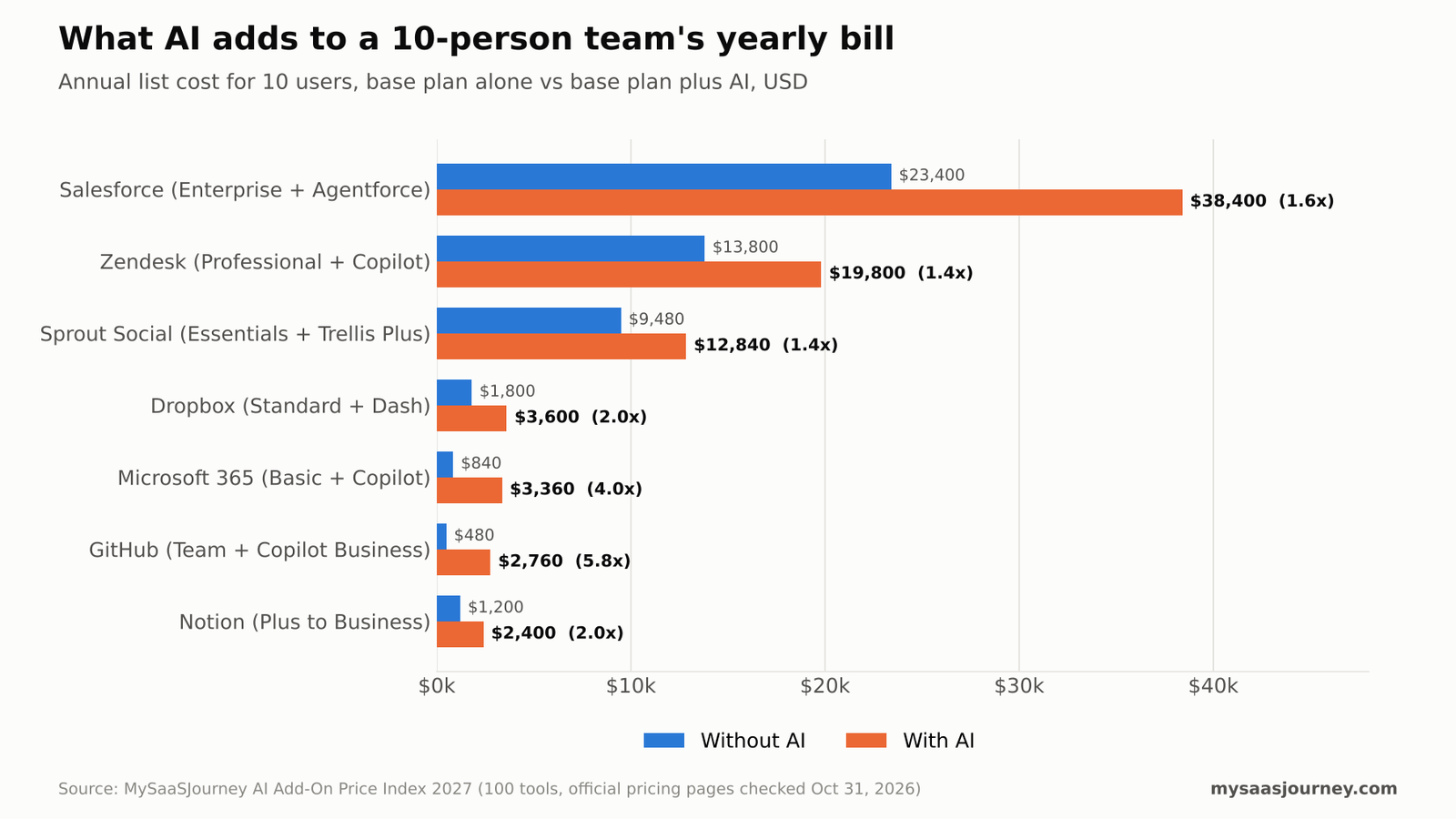
The proportional increase is largest on cheaper products: GitHub’s modeled bill nearly sextuples and Microsoft 365’s quadruples. In absolute dollars, expensive platforms add more: Salesforce adds $15,000 a year for 10 sales users, while Zendesk adds $6,000 before resolution fees. The Zendesk scenario excludes automated resolutions; at $1.50 each, every additional 1,000 AI resolutions adds $1,500 a month. A 10-person HubSpot Service Hub team moving from Starter to Professional to use Customer Agent rises from $200 to $1,000 a month on monthly billing, before onboarding fees and credits.
Monthly versus annual AI pricing
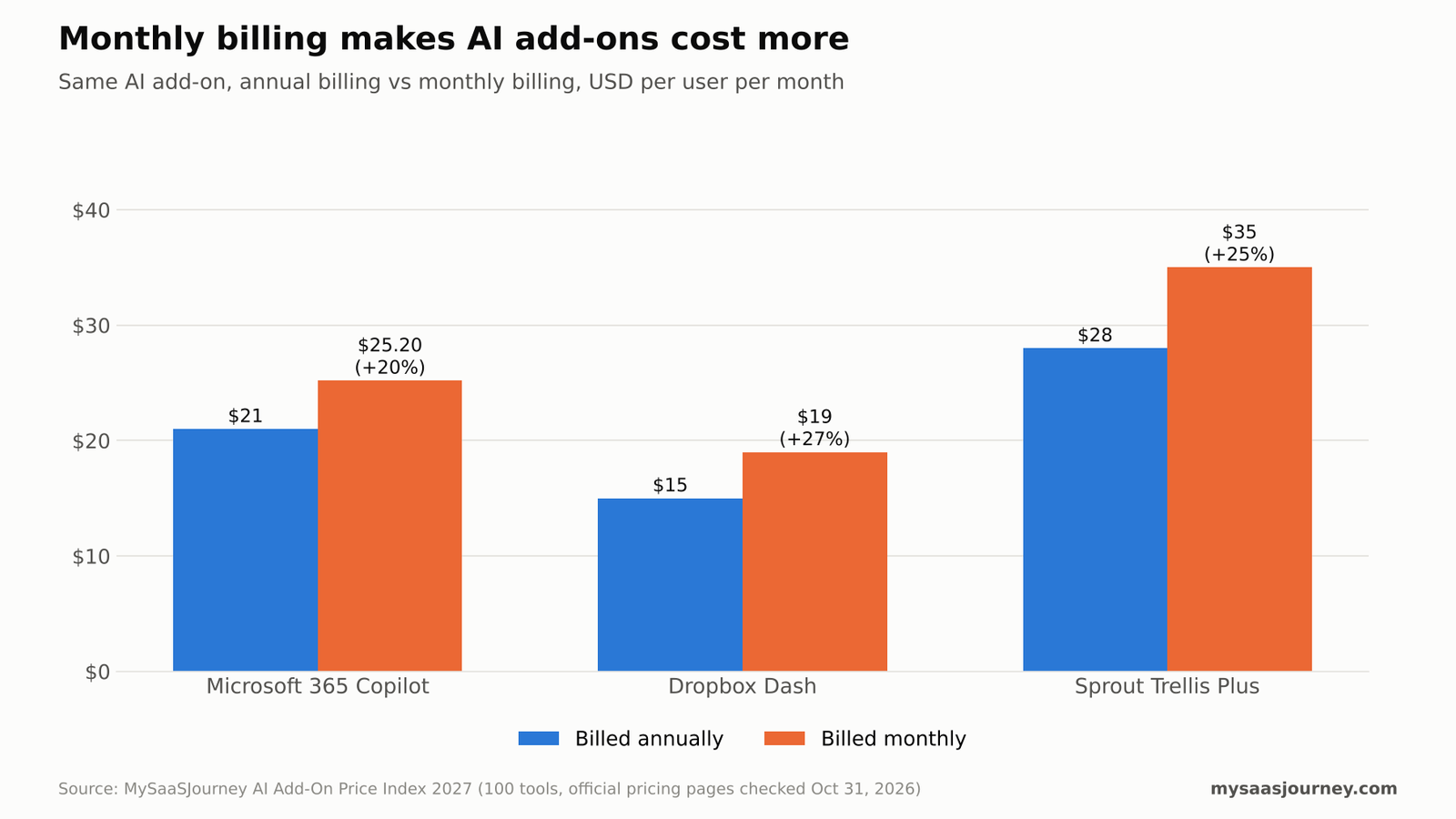
Where both billing prices are published, monthly AI add-ons cost 20% to 27% more than annual billing:
- Microsoft 365 Copilot Business: $21 annual versus $25.20 monthly (20% more).
- Dropbox Dash for Teams: $15 annual versus $19 monthly (27% more).
- Sprout Social Trellis Plus: $28 annual versus $35 monthly (25% more).
Across 36 tools that publish both annual and monthly base-plan prices, 33 charge less annually. Those 33 plans save a median of 21% and an average of 26%. Many AI prices are published on only one billing basis, so buyers should confirm the term before comparing.
Enterprise AI pricing and undisclosed prices
At least 16 of the 100 tools hide an AI price behind contact-sales or a custom quote, and six restrict some AI features to enterprise or contact-sales plans. The hidden prices include whole products sold by quote, AI agents sold through demonstrations, and credit packs or top-ups whose rates are not published. Examples include ClickUp Certified Agents, Dialpad AI Agents, Freshsales Freddy Copilot, RingCentral’s AI Customer Engagement Bundle, and extra capacity from Miro, Gamma, Descript, ActiveCampaign, Framer, Wrike and Retool.
For enterprise AI, ask for the per-unit rate, included allowance, overage price and a contractual cap. Salesforce Agentforce Flex Credits are listed at $500 per 100,000 credits, with 20 credits per Agentforce action. Other vendors meter custom agents or extra usage through negotiated plans.
Most expensive, most affordable and relative value
The most expensive per-user AI in the index is Salesforce Agentforce for Sales, starting at $125 per user per month and requiring Core. Among account-level add-ons, Gorgias AI Agent starts at $250 per month and Ahrefs Brand Radar AI at $199. Zendesk Copilot costs $50 per agent and Sentry Seer $40 per active contributor. The steepest tier upgrade in the report is HubSpot Service Hub, where access to Customer Agent means moving from $20 to $100 per seat on monthly billing.
Affordable examples include Xero AI auto-reconcile at $5 per organization per month and Dropbox Dash for Teams at $15 per user on annual billing. Klaviyo Composer and Webflow’s credit add-on are each $20 per month for an account or workspace.
On price alone, examples of low-cost bundled AI include Lattice from $4 per seat (with a $4,000 annual minimum), WordPress.com from $4 per site, Trello Standard at $5 per user, Buffer at $5 per channel, Google Workspace from $7 per user, Todoist Business at $8 per user, and monday.com and ClickUp from $9 per seat or user. Price is not the same as value: a paid copilot that saves meaningful staff time can be a better buy than a free assistant that nobody uses.
What SaaS buyers should do
- Price the full AI path, not just the seat. Add the required plan, add-on or tier upgrade, and expected usage fees.
- Check which AI features are included. A plan’s AI label may mean a limited trial or basic feature set, not full access.
- Estimate usage before buying. Run a pilot and measure real credit consumption or AI-handled resolutions. Credits are not comparable between vendors.
- Buy AI for the people who use it. Assign per-user add-ons selectively instead of paying for every employee by default.
- Choose annual billing for AI you expect to keep. Published monthly add-ons can cost 20% to 27% more.
- Negotiate enterprise AI. Ask for unit rates, included allowances, overage prices and caps.
- Re-check prices quarterly. AI pricing changes quickly as vendors rename, merge, retire and reprice products.
What SaaS companies should consider
- Clarity beats complexity: buyers need to see the AI premium, billing basis and overage price without contacting sales.
- Bundling is the default in competitive categories: every website builder in the sample includes AI, as do nine of 10 project management tools.
- Outcome pricing fits labor-replacing work: per-resolution pricing ties cost to delivered value, but the meaning of a resolution must be clear.
- Explain the add-on-to-base ratio: when AI costs several times the base seat, it becomes the main purchase decision.
- Translate credits into real actions: explain what one credit buys, such as a summary, image or resolution.
- Publish extra-capacity pricing: hidden overage rates create buyer uncertainty.
What to expect in 2027
These are MySaaSJourney’s forecasts based on patterns in the current dataset, not measured results:
- Separate AI add-ons will continue folding into plans, while vendors reserve advanced agents for paid upgrades.
- Credits will become a more common meter, with pooled workspace allowances and clearer top-up prices.
- Outcome pricing will spread beyond customer support into sales and marketing workflows.
- AI visibility will grow as a distinct software category, building on products such as Semrush AI Visibility Toolkit and Ahrefs Brand Radar AI.
- Some AI costs will be absorbed into higher base plan prices rather than shown as separate fees.
MySaaSJourney plans to update this index quarterly to track whether these expectations hold.
Conclusion: budget for AI as a separate line item
AI is no longer a free extra in business software. The index shows a market split between vendors that bundle AI to stay competitive and vendors that sell it as a premium product. A separately sold per-user add-on costs a median $28.50 a month; 38 of 100 tools charge more than the base plan for their main AI; higher-tier AI carries a median 73% upgrade premium; customer-service AI costs a median $0.75 per handled conversation; and a 10-person team’s annual bill can grow by 1.4x to 5.8x.
For buyers, the practical message is to budget explicitly for AI, match paid seats to actual users, test consumption before committing and check the full cost path—not just the headline subscription price.
Download the full 100-tool dataset
The complete CSV contains 100 tools, 21 recorded fields per tool, official source URLs, a confidence label and analyst notes. Use it to inspect individual vendor records and compare prices across the 10 categories.
Download the AI Add-On Price Index 2027 dataset (CSV)
MySaaSJourney. (2026). AI Add-On Price Index 2027: How Much Extra Do 100 Software Tools Charge for AI on Top of Their Base Subscription? Pricing collected October 31, 2026. This is a snapshot; vendor prices and plan terms may have changed since collection.
Frequently asked questions
How much does an AI add-on cost per user?
The median per-user AI add-on in this index is $28.50 per user per month. Published prices range from $15 for Dropbox Dash for Teams to $125 starting price for Salesforce Agentforce for Sales.
Do most SaaS tools charge extra for AI?
No. Sixty of 100 tools include AI in their base plan as their primary model. However, 38 charge more for their main AI through usage, add-ons, higher tiers or enterprise plans, and many bundled plans cap usage.
Which software category is most likely to charge extra for AI?
Developer & Data is the clearest category: none of its 10 tools uses included AI as its primary pricing model. Customer Service and CRM & Sales also frequently charge extra.
How much does AI customer support cost per conversation?
The median published price is $0.75 per AI-handled conversation, with rates in the index ranging from $0.05 to $2.00.
Is annual billing cheaper for AI add-ons?
Yes, among the add-ons that publish both prices. Monthly billing is 20% to 27% more expensive for the three comparable examples in this index.
Are AI credits comparable between vendors?
No. Each vendor defines what a credit buys, and the actions or models behind one credit differ. Compare the cost per useful outcome rather than the number of credits.
Sources and citation
Every tool’s official pricing page is linked from the source records in the downloadable dataset. Key vendor documentation reviewed includes Microsoft 365 Copilot Business, GitHub Copilot, Salesforce Sales Cloud, Zendesk, Intercom, Sprout Social, Dropbox Dash, Front, Semrush AI Visibility Toolkit, Notion AI, Copper, Help Scout, HubSpot Customer Agent, Adobe Acrobat, Atlassian, Airtable, Figma, Sentry, v0 and Power BI Copilot requirements.
No vendor paid for inclusion or reviewed the report before publication.