October 31, 2026 · Research by MySaaSJourney
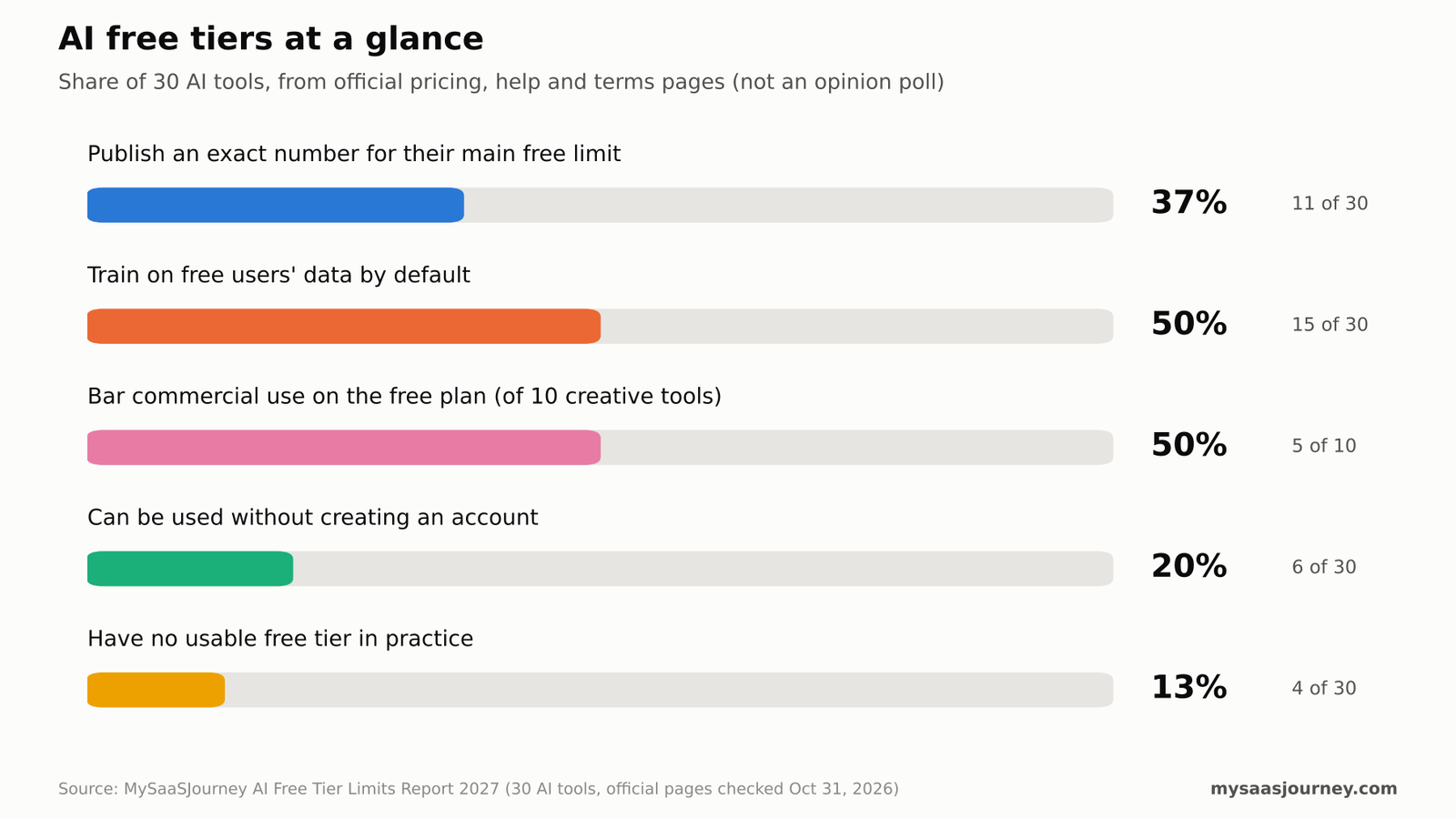
Only 11 of 30 popular AI tools publish an exact number for their main free limit, and none of the five biggest chat assistants publishes a free message count. This report compares free plans across six categories, using official pricing, help, documentation, privacy and terms pages checked on October 31, 2026. It tracks usage limits, reset windows, model access, features, commercial rights, watermarks, data-training defaults and the cheapest paid upgrade.
Key findings at a glance
- Free limits are mostly vague: 11 tools publish an exact main limit, 9 publish partial numbers and 10 publish no number. All five video and audio tools publish exact numbers; four of five chat assistants publish none.
- Rolling windows are common: Claude, Google Gemini and NotebookLM (now Gemini Notebook) reset usage every five hours with a weekly cap. ChatGPT lists unlimited text chats subject to abuse guardrails.
- Free users rarely get the best model: only 3 of 30 tools say their top model is available on free; 10 reserve it for paid users, while 15 do not say.
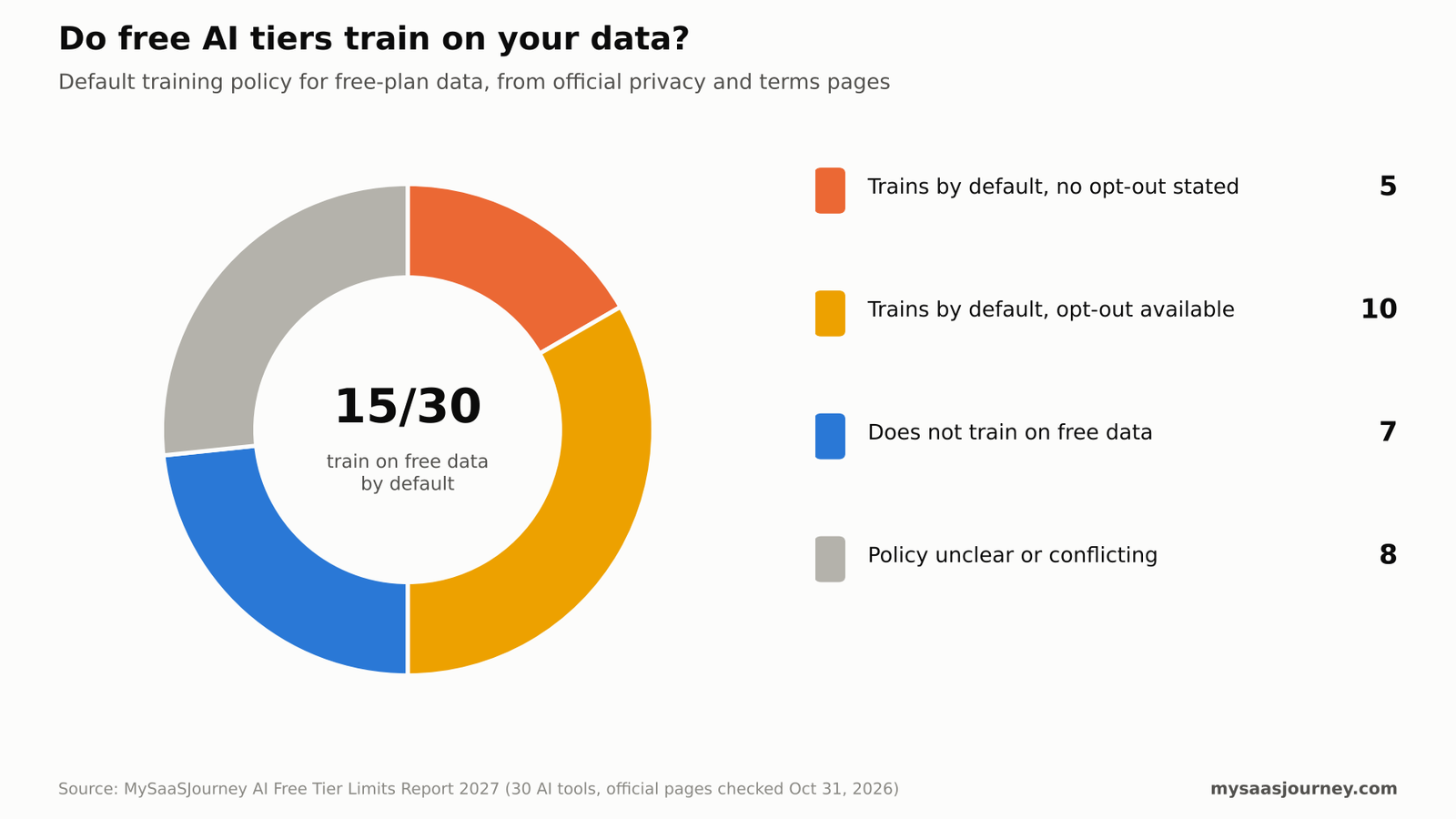
- Training is a privacy trade-off: 15 of 30 use free-plan data for training by default (10 with an opt-out, 5 with no opt-out stated). Seven clearly say they do not.
- Commercial rights are restricted: 5 of 10 creative tools limit free output to personal or non-commercial use; 4 allow commercial use.
- Four tools lack a usable free tier in practice: Writesonic offers a trial only, Copy.ai no longer lists a free plan, Pika gives 0 monthly credits and You.com’s free offer is now a developer API.
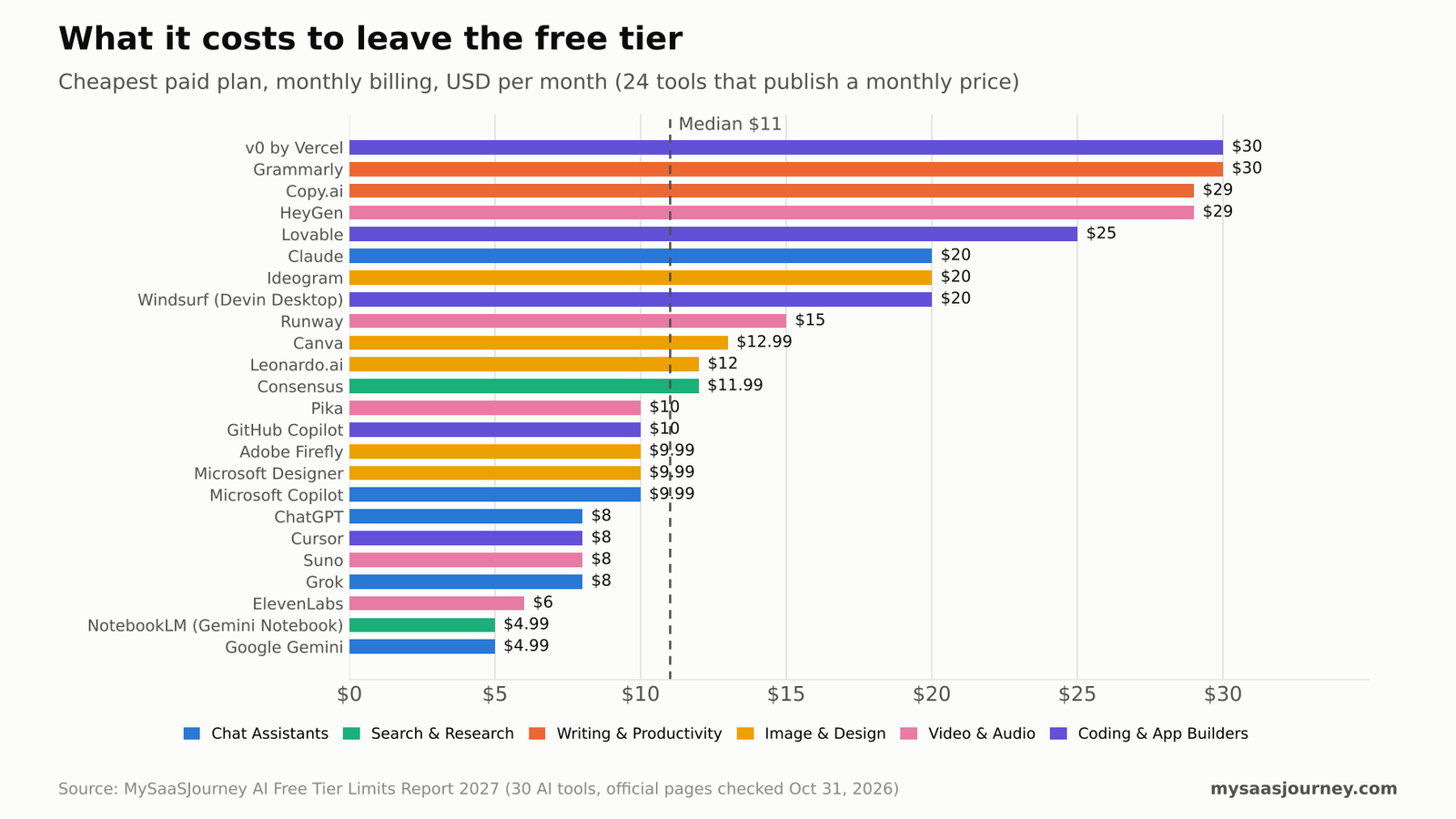
- The cheapest paid plan has a median price of $11/month across 24 tools with a published monthly price. The median paid-to-free allowance increase is 5x among the eight tools with comparable figures.
- Only 6 of 30 tools can be used without an account, and all six are chat or search tools (You.com only through its developer API).
What this report measures
Free tiers are often the first way students, freelancers, founders and small teams use AI for real work. But vendors change these offers frequently, and the terms are not always clear. A numbered allowance can become a “light quota”; a free model can be replaced by a smaller one; and a free creative plan can lose a download feature.
This study covers 30 tools, with five in each category:
| Category | Tools |
|---|---|
| AI Chat Assistants | ChatGPT, Claude, Google Gemini, Microsoft Copilot, Grok |
| AI Search & Research | Perplexity, NotebookLM (Gemini Notebook), You.com, Consensus, Elicit |
| AI Writing & Productivity | Grammarly, QuillBot, Notion AI, Copy.ai, Writesonic |
| AI Image & Design | Adobe Firefly, Leonardo.ai, Ideogram, Canva, Microsoft Designer |
| AI Video & Audio | Runway, Pika, ElevenLabs, Suno, HeyGen |
| AI Coding & App Builders | GitHub Copilot, Cursor, Windsurf (Devin Desktop), Lovable, v0 by Vercel |
Research methodology and limitations
Every data point comes from vendor-owned pricing pages, help centers, product documentation, terms, privacy policies and official announcements. Data was collected from US pages on October 31, 2026, with prices in US dollars. We did not use third-party reviews, forums or social posts. We record vendor wording rather than estimating vague limits: where a vendor says “limited,” this report says “limited.”
For each tool, we recorded free-plan status, account requirements, limit type and transparency, published message or request limits, reset windows, credits, free models, flagship access, features, commercial-use terms, watermark policy, training defaults, cheapest paid plan and paid-versus-free allowance.
An independent reviewer re-checked 21 headline claims against official pages. Fourteen were confirmed as recorded, four were confirmed with extra context, and three needed a correction or conflict note. Examples include Google’s $4.99 subscriptions-page price versus $7.99 in a January 2026 blog post; Grammarly Pro’s per-member pricing; and ElevenLabs Starter’s regular $6 price versus a promotional first month. Only Grammarly’s record had every key field clearly confirmed; the other 29 are labeled partial because at least one detail was missing, vague or conflicting.
This is a snapshot, not a guarantee of current limits. Vendor policies can change without notice, may vary by region or account, and sometimes conflict across official pages. The report records published policies rather than independently stress-testing each product.
Which free tiers are usable?
Twenty-six of the 30 tools offer a free plan that permits some real use. Four have moved away from a usable consumer free tier:
| Tool | What happened |
|---|---|
| Writesonic | No free plan; only a free trial. Its cheapest plan is $79/month on annual billing. |
| Copy.ai | The official pricing page no longer lists a free plan and “Try for free” leads to a demo request. A February 2026 help article still describes a legacy free plan. |
| Pika | The free account lists 0 credits/month; generation requires a credit pack, starting at $25. |
| You.com | The consumer chat app is no longer listed. The free tier is 100 Web Search API queries/day for developers. |
Some allowances are one-time rather than renewable. Runway deposits 125 credits once; Notion AI offers a limited trial with no published count; new v0 users receive a one-time $5 credit while existing users retain a monthly credit; and Suno’s free downloads are capped at seven over the account lifetime.
Do you need an account?
Only ChatGPT, Google Gemini, Microsoft Copilot, Grok, Perplexity and You.com’s web search API can be used without signing in (the Perplexity no-account conclusion is inferred from its pages). Every image, video, audio, writing and coding tool in the index requires an account. Signing in can unlock more features or credits.
When do free limits reset?
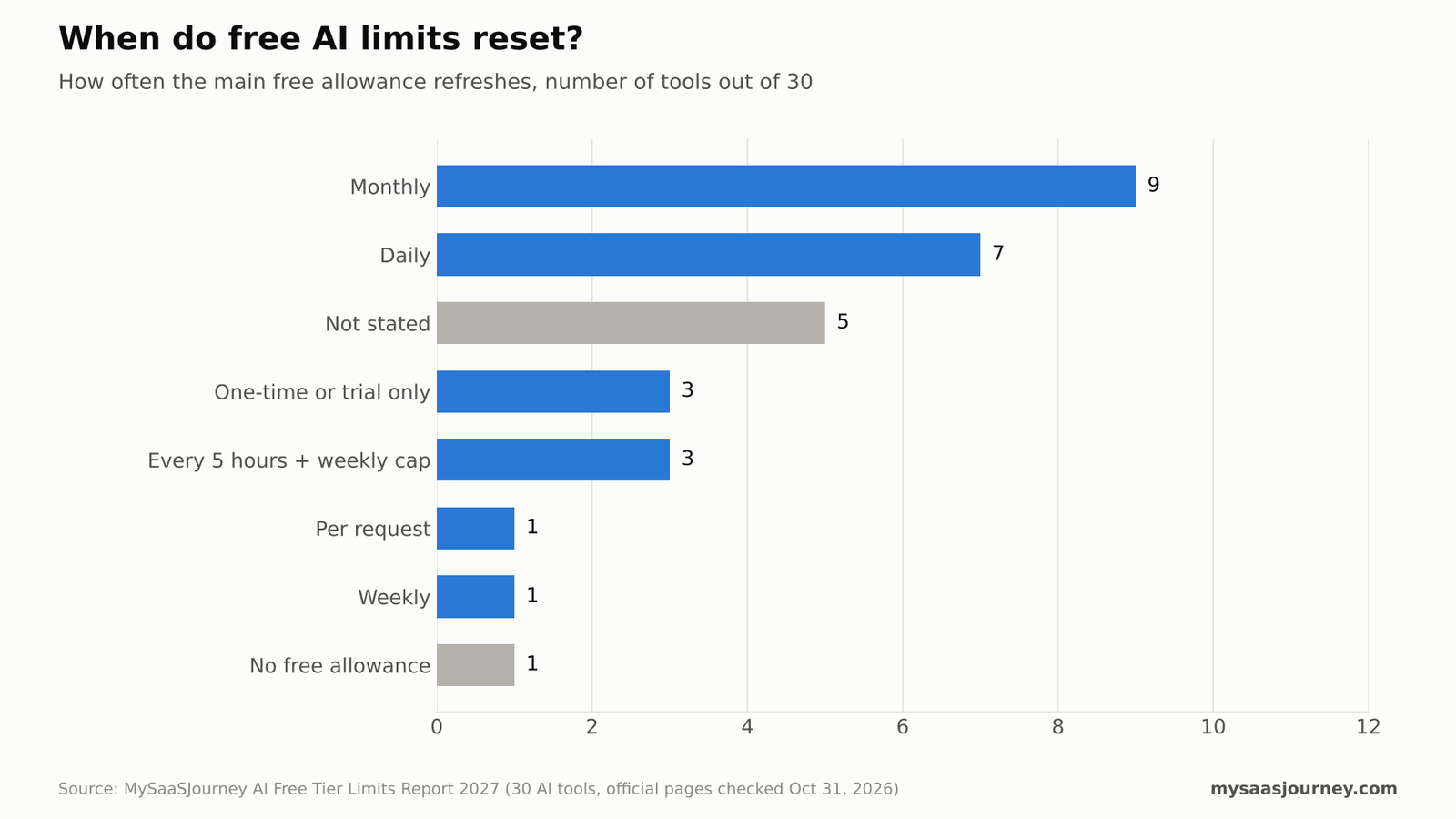
- Monthly (9 tools): Grammarly, Canva, ElevenLabs, HeyGen, GitHub Copilot, Consensus, Elicit, Microsoft Designer and Copy.ai’s legacy plan.
- Daily (7 tools): Perplexity, Adobe Firefly, Leonardo.ai, Suno, Lovable, v0 and You.com’s API.
- Every 5 hours plus a weekly cap (3 tools): Claude, Google Gemini and NotebookLM.
- Weekly (1 tool): Ideogram, with 30 credits a week.
- Not stated (5 tools): ChatGPT, Microsoft Copilot, Grok, Cursor and Windsurf.
Three chat assistants now show or test advertising on free plans: ChatGPT has tested ads in the US free tier, Microsoft Copilot says it may show ads, and Grok’s free tier includes standard X advertising.
Limit transparency: who publishes real numbers?
Only 11 of 30 tools (37%) publish an exact number for their main free limit. Three of those 11—Copy.ai, Pika and You.com—do not have a usable consumer free plan, so among the 26 usable free plans only eight publish an exact main limit. Another nine publish some numbers but leave the main limit vague, and 10 publish no number at all.
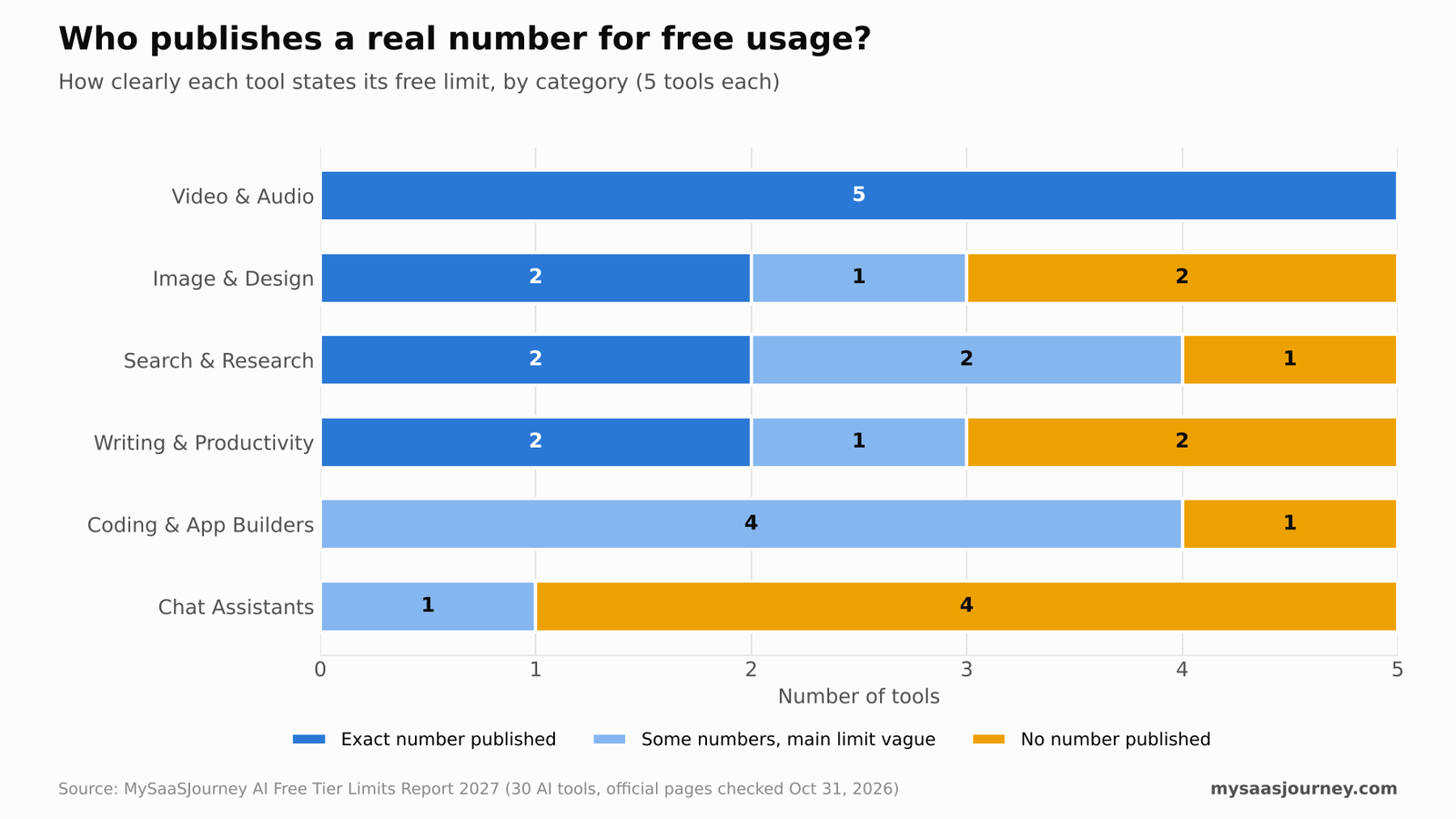
| Category | Exact | Partial | Vague |
|---|---|---|---|
| AI Video & Audio | 5 | 0 | 0 |
| AI Search & Research | 2 | 2 | 1 |
| AI Image & Design | 2 | 1 | 2 |
| AI Writing & Productivity | 2 | 1 | 2 |
| AI Coding & App Builders | 0 | 4 | 1 |
| AI Chat Assistants | 0 | 1 | 4 |
| All 30 tools | 11 | 9 | 10 |
Video and audio allowances are easier to express in seconds, credits or characters. Chat and coding usage varies with prompt length, model and task complexity, so vendors often use flexible wording that lets them adjust capacity.
The vocabulary of vague limits
| Tool | How the free limit is described |
|---|---|
| ChatGPT | Unlimited text chats subject to abuse guardrails; uploads, images and voice are limited. |
| Claude | Limited usage, resetting every 5 hours and weekly; limits may be adjusted for capacity. |
| Google Gemini | Standard, compute-based limits refreshing every 5 hours up to a weekly limit. |
| Microsoft Copilot | Subject to available capacity and limits. |
| Grok | Generous limits. |
| Cursor | Limited agent and chat requests. |
| Windsurf (Devin Desktop) | A light quota to code with agents. |
When official pages disagree
- Perplexity: the help center lists three Pro Searches/day and says advanced models are not included on free; the pricing FAQ suggests limited weekly access to top models.
- Adobe Firefly: the plans page says limited daily generations, while the credits help page says free credits are allocated on first use and expire after a month.
- HeyGen: the help center and FAQ differ on free video resolution; its privacy policy and FAQ also conflict on model training.
- v0: a March 2026 changelog describes a training opt-out, while the docs table says free users have no opt-out.
- ChatGPT: the plans page lists unlimited text chats, while the pricing page describes limited access to GPT-5.5 Instant.
- Google AI Plus: the subscriptions page lists $4.99/month, while a January 2026 blog post says $7.99.
Model access: do free users get the best model?
Only 3 of 30 tools say their top generally available model is available on free; 10 reserve it for paying customers, and 15 do not say whether free users get it. Two more offer top-model access only occasionally.
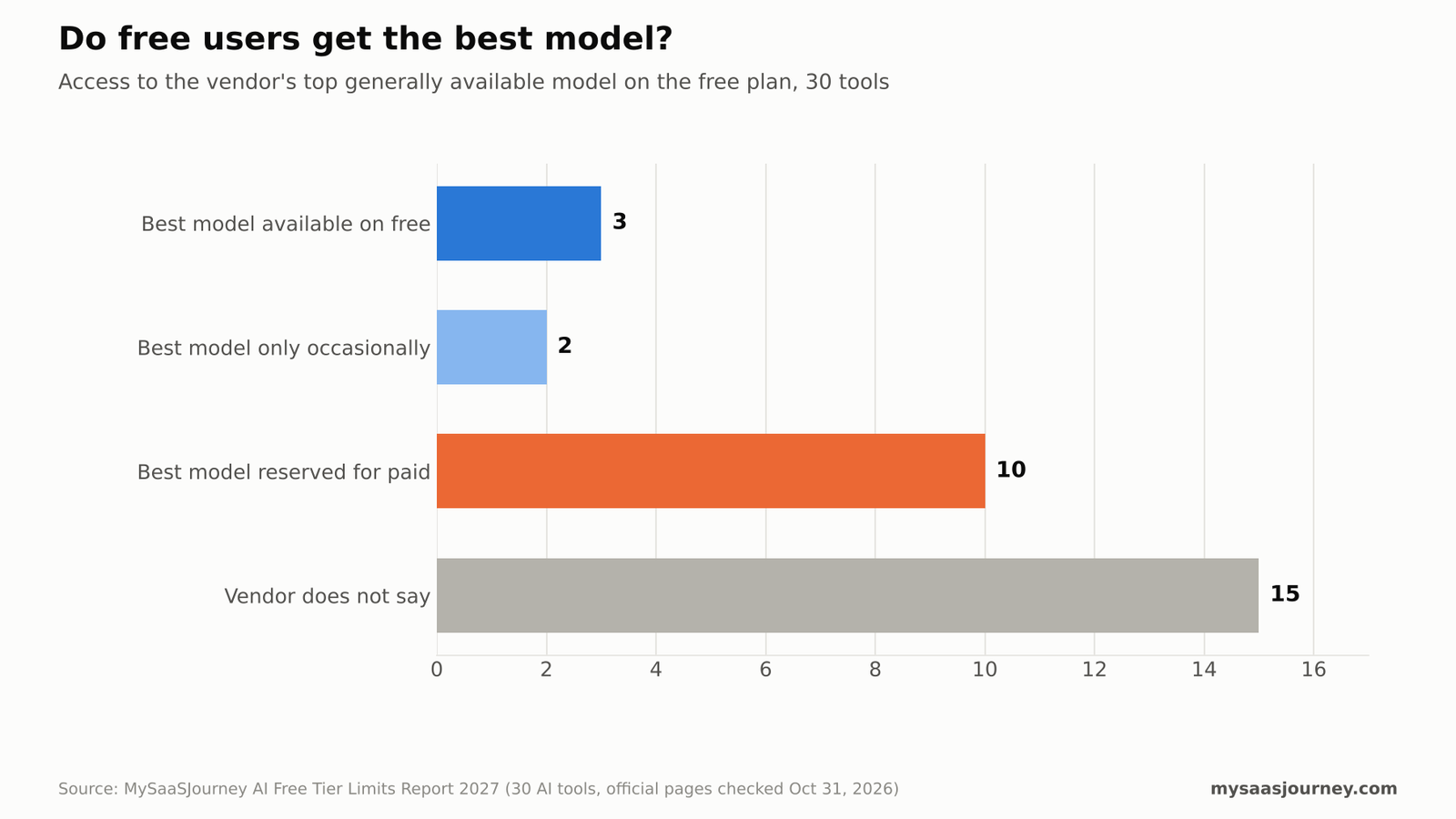
The three apparent exceptions have caveats: Pika lists all models but gives free users zero credits; ElevenLabs’ API pricing lists Eleven v4 in its free column, but free output is non-commercial and requires attribution; Lovable says it uses the same leading models across plans but limits daily credits.
Tools that restrict their top model include ChatGPT, Claude, Perplexity, GitHub Copilot, Cursor, Windsurf, Leonardo.ai, Canva, Runway and Suno. Some classifications rely on inference from plan pages, and Perplexity’s official pages conflict.
The five big chat assistants compared
| Assistant | Free limit | Free models | Cheapest paid plan | What paid adds |
|---|---|---|---|---|
| ChatGPT | Unlimited text chats subject to guardrails; other features limited | Default chat model; top tier not on free | Go, $8/month | 10x messages, uploads and images |
| Claude | Limited usage every 5 hours plus weekly cap | Sonnet and Haiku | Pro, $20/month or $17 annual | At least 5x usage per 5-hour session |
| Google Gemini | Standard limits every 5 hours plus weekly cap | Auto mode; mostly Flash-Lite, with harder prompts routed to Flash or Pro | AI Plus, $4.99/month | 2x standard limits, 128k context and video generation |
| Microsoft Copilot | Subject to capacity and limits | Not named in the new app | Microsoft 365 Personal, $9.99/month | Higher usage for chat, images, vision and audio |
| Grok | Generous limits | Not stated | X Subscription Plus, $8/month | Base usage across Grok and Cursor |
Four of the five assistants have an entry paid tier below $10/month; Claude’s entry plan is $20. Microsoft also retired Deep Research from Copilot on August 18, 2026, when it moved to a new Copilot app.
What free chat and search AI includes
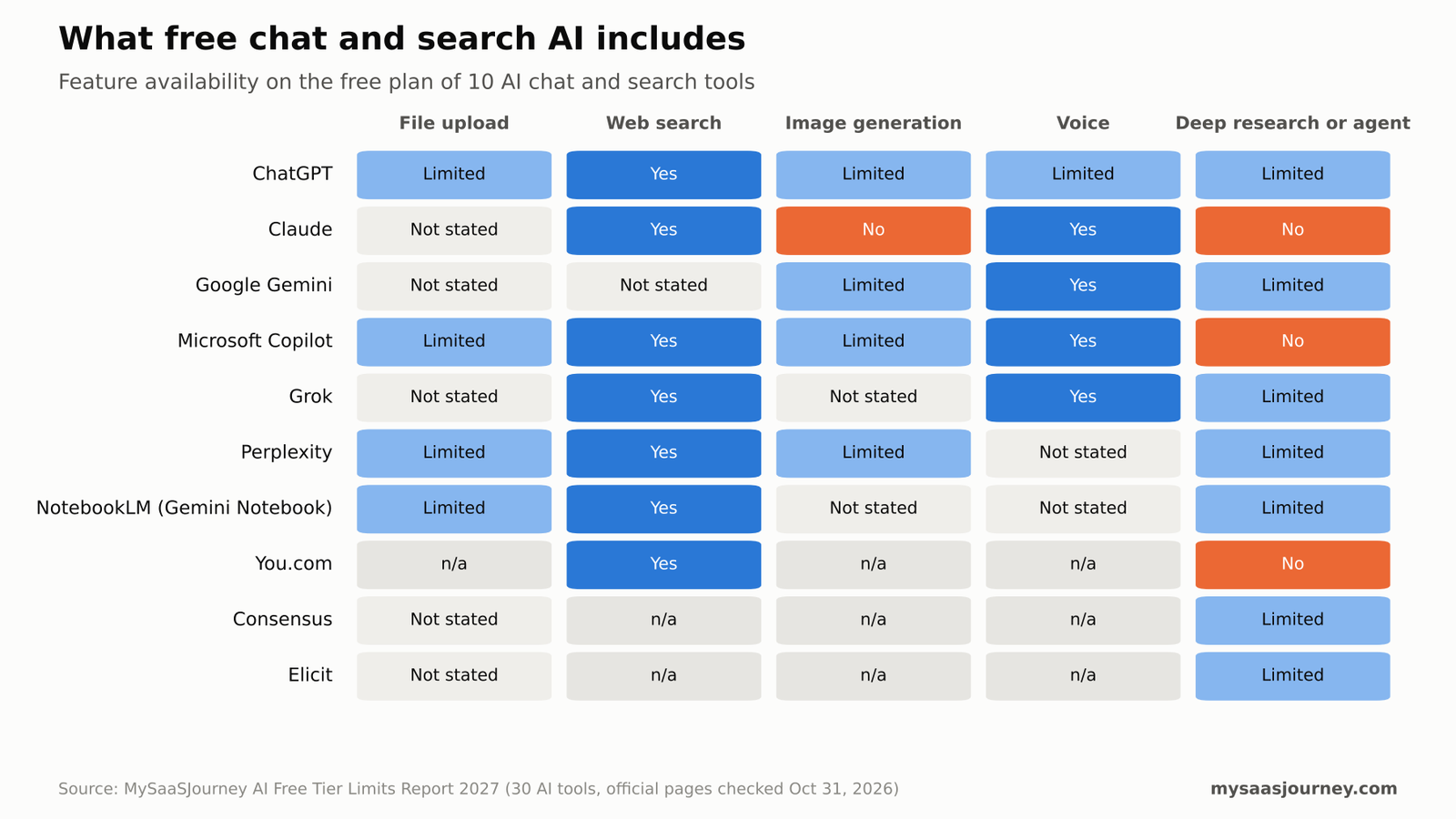
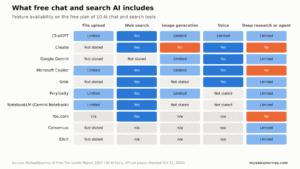
- Web search is nearly universal: seven of the 10 tools include it on free; for Gemini it is not explicitly stated.
- Voice is common: Claude, Gemini, Copilot and Grok list voice on free; ChatGPT limits it.
- Image generation is mostly limited: ChatGPT, Gemini, Copilot and Perplexity offer limited free image generation; Claude does not list it.
- Deep research and agents are restricted: seven tools offer some limited version; Claude, Copilot and You.com offer none. Perplexity allows one Research query/month.
- File uploads are capped or unstated: no tool publishes generous free upload limits.
AI search and research tools
Perplexity publishes three Pro Searches/day and one Research query/month, with basic searches described as practically unlimited. Consensus publishes 10 Pro Analyses, 10 Study Snapshots and 10 Ask Paper messages/month, plus three Deep Searches/month. NotebookLM, renamed Gemini Notebook on July 16, 2026, publishes source limits—100 notebooks, 50 sources per notebook and up to 500,000 words per source—but chat and Audio Overview limits remain compute-based. Elicit describes Research Agent and Research Reports usage only as limited, from a monthly pool.
Creative AI: what free credits actually buy
Image, video and audio tools are the most transparent about their free limits, but allowances are often small and carry restrictions. The practical output below uses vendor-published conversion rates.
| Tool | Free allowance | What it buys |
|---|---|---|
| Leonardo.ai | 150 tokens/day; a default 768×768 image costs 1 token | Up to about 150 basic images/day; all public |
| Suno | 50 credits/day; 10 credits make two songs | About 10 songs/day; no monthly downloads |
| ElevenLabs | 10,000 credits/month; one character equals one credit on the website | About 10 minutes of speech/month; non-commercial, with attribution |
| Canva | Shared pool of 200 Standard or 20 Premium AI uses/month | Up to 20 premium AI image generations/month |
| Ideogram | 30 credits/week for Google, Apple or Microsoft sign-ins | Cost per image not published; images public |
| HeyGen | 3 videos/month (1–3 by region), up to one minute each | Up to three minutes of watermarked avatar video/month |
| Runway | 125 credits once; Gen-4 Turbo uses about 6 credits/second | About 20 seconds of watermarked video, ever |
| Pika | 0 credits/month | No generation without buying a pack, from $25 |
| Adobe Firefly | Limited free daily generations | Not published |
| Microsoft Designer | Monthly credits; number not published; one credit per AI action | Not published |
The gap between tools is substantial: Leonardo.ai can make about 150 basic images in a day, while Canva’s free pool allows up to 20 Premium AI image generations a month. Runway’s free account offers about 20 seconds of video in total, while HeyGen provides up to three minutes of avatar video each month.
Can you use free AI output commercially?
Five of the 10 creative tools limit free output to personal or non-commercial use. Four allow commercial use, and one does not clearly state the terms for free users.
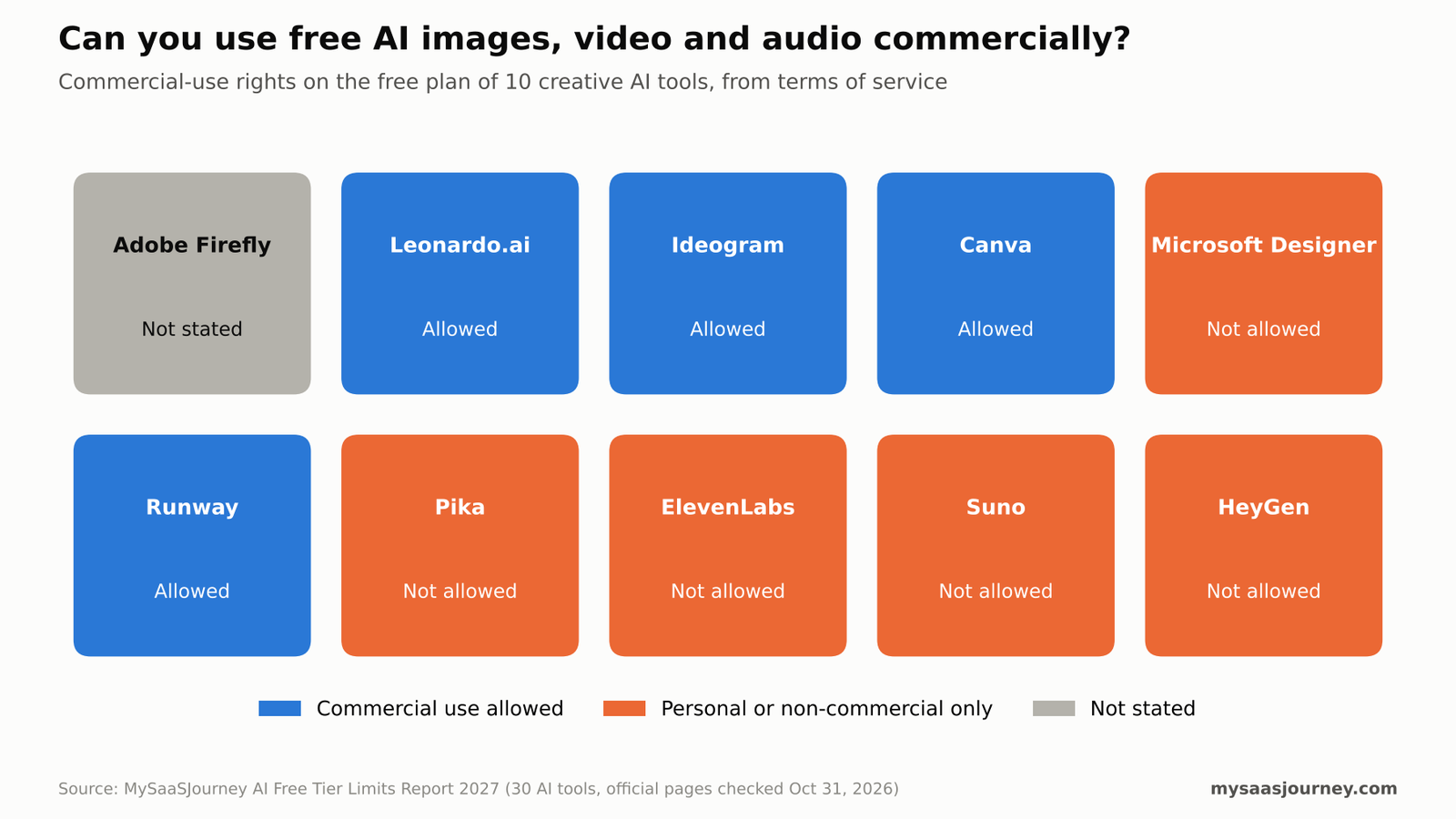
- Not allowed (5): Microsoft Designer, Pika, ElevenLabs, Suno and HeyGen.
- Allowed (4): Leonardo.ai, Ideogram, Canva and Runway.
- Not stated (1): Adobe Firefly.
For freelancers and small businesses, this can matter more than the size of the allowance. An asset made under a non-commercial free license should not be used for a client or paid product. Check the current terms before publishing or monetizing output.
Watermarks, attribution and public-by-default images
- Runway watermarks every free video; HeyGen’s free videos carry a watermark that cannot be removed. Gemini Notebook adds a visible watermark to generated images and videos.
- Lovable shows its badge on apps published from the free plan.
- ElevenLabs requires free users to credit elevenlabs.io or 11.ai in the title of shared content.
- Adobe Firefly attaches Content Credentials metadata to certain exports.
- Leonardo.ai and Ideogram publish free images to public galleries; private generation is paid.
- Pika explicitly says free output has no watermark, but its free plan includes no credits.
Seven of the 10 creative tools do not state a watermark policy for their free plans. Free plans also restrict downloads and quality: Suno removed monthly downloads on September 3, 2026, leaving up to seven lifetime trial downloads; Ideogram limits free full-size downloads to JPEG; Runway reserves 4K upscaling for paid plans; and HeyGen limits free videos to one minute each.
AI coding and app-builder free tiers
AI coding tools can be generous for autocomplete and restrictive for agents. Only two of five publish a number for chat or agent use: v0’s seven messages/day and Lovable’s five build credits/day.
| Tool | Free allowance | Free models | Cheapest paid plan |
|---|---|---|---|
| GitHub Copilot | 2,000 code completions/month; chat and agent usage “limited” | Automatic model selection | Copilot Pro, $10/month |
| Cursor | Limited agent and chat requests, no number | Cursor’s own models; no third-party frontier models | X Subscription Plus, $8/month or $80/year |
| Windsurf (Devin Desktop) | Unlimited tab completions and inline edits; light agent quota | SWE-1.6 only | Pro, $20/month |
| Lovable | 5 build credits/day, capped at 30/month, plus daily chat allowance | Same models across plans | Pro, $25/month or $21 annual |
| v0 by Vercel | 7 messages/day; new users get a one-time $5 credit | Not stated | Plus, $30/month |
Two corporate changes shaped these plans in 2026. Cognition renamed Windsurf to Devin Desktop on June 2, 2026. Cursor became part of The X Subscription on October 12, 2026; its old Hobby plan is now a legacy plan mapped to Free, and the $8 Plus tier covers Grok models only.
Autocomplete remains comparatively generous: Windsurf offers unlimited tab completions and GitHub Copilot offers 2,000 completions/month. Agents are tightly rationed and often described only as “limited” or a “light quota.” Lovable and v0 make app-building limits more explicit, but iteration can quickly consume the daily allowance.
Privacy: do free AI tiers train on your data?
Half of the free AI tiers in this index use free users’ data to train models by default. The study found 15 of 30 do so: 10 offer an opt-out and five state no opt-out. Seven clearly say they do not train on free users’ data; eight are unclear or conflicting.
| Default policy | Tools |
|---|---|
| Trains by default; opt-out available (10) | ChatGPT, Google Gemini, Grok, Perplexity, Grammarly, QuillBot, ElevenLabs, GitHub Copilot, Lovable, v0 by Vercel |
| Trains by default; no opt-out stated (5) | Ideogram, Runway, Pika, Suno, Windsurf (Devin Desktop; opt-out on paid plans only) |
| Does not train on free data (7) | NotebookLM (Gemini Notebook), You.com, Consensus, Notion AI, Copy.ai, Writesonic, Adobe Firefly |
| Unclear or conflicting (8) | Claude, Microsoft Copilot, Elicit, Leonardo.ai, Canva, Microsoft Designer, HeyGen, Cursor |
Opt-outs are not always available to everyone. Grok’s logged-out users outside the EU and UK cannot opt out; QuillBot documents an opt-out for certain browser-extension users; Windsurf limits opt-out to paid tiers. GitHub Copilot changed its free-plan data use on April 24, 2026, and Lovable changed its policy on September 9, 2026. HeyGen’s privacy policy and FAQ disagree, while Microsoft’s new Copilot app pages do not address training.
For anyone entering client work, code or personal information into a free AI tool, the cautious approach is to assume it may be used for training unless the vendor clearly says otherwise and you have checked the setting.
What it costs to leave the free tier
The cheapest way out of a free AI tier has a median price of $11/month. Across 24 tools with a published monthly price, the range is $4.99 (Google AI Plus) to $30 (v0 Plus and Grammarly Pro), with an average of $14.71.
The sub-$10 AI plan
Ten tools offer a paid plan under $10/month on monthly billing, and 13 do on annual billing. Monthly examples include Google AI Plus ($4.99), ElevenLabs Starter ($6), ChatGPT Go ($8), X Subscription Plus ($8), Suno Pro ($8), Cursor through X Subscription Plus ($8), Adobe Firefly Standard ($9.99) and Microsoft 365 Personal ($9.99). Annual billing brings QuillBot Premium ($8.33), Pika Starter ($8) and Consensus ($8.99) below $10.
Cheapest paid plan by category
| Category | Tools with a price | Median cheapest plan | Range |
|---|---|---|---|
| AI Chat Assistants | 5 | $8 | $4.99–$20 |
| AI Video & Audio | 5 | $10 | $6–$29 |
| AI Search & Research | 4 | $11.50 | $4.99–$17 |
| AI Image & Design | 5 | $12 | $9.99–$20 |
| AI Coding & App Builders | 5 | $20 | $8–$30 |
| AI Writing & Productivity | 5 | $29 | $8.33–$79 |
Prices use monthly billing where published, otherwise the annual-billing price per month. Writing tools are the most expensive category to upgrade, influenced by Writesonic’s $79 Starter plan (annual billing) and Copy.ai’s $29 Chat plan.
How much more does the cheapest paid plan give?
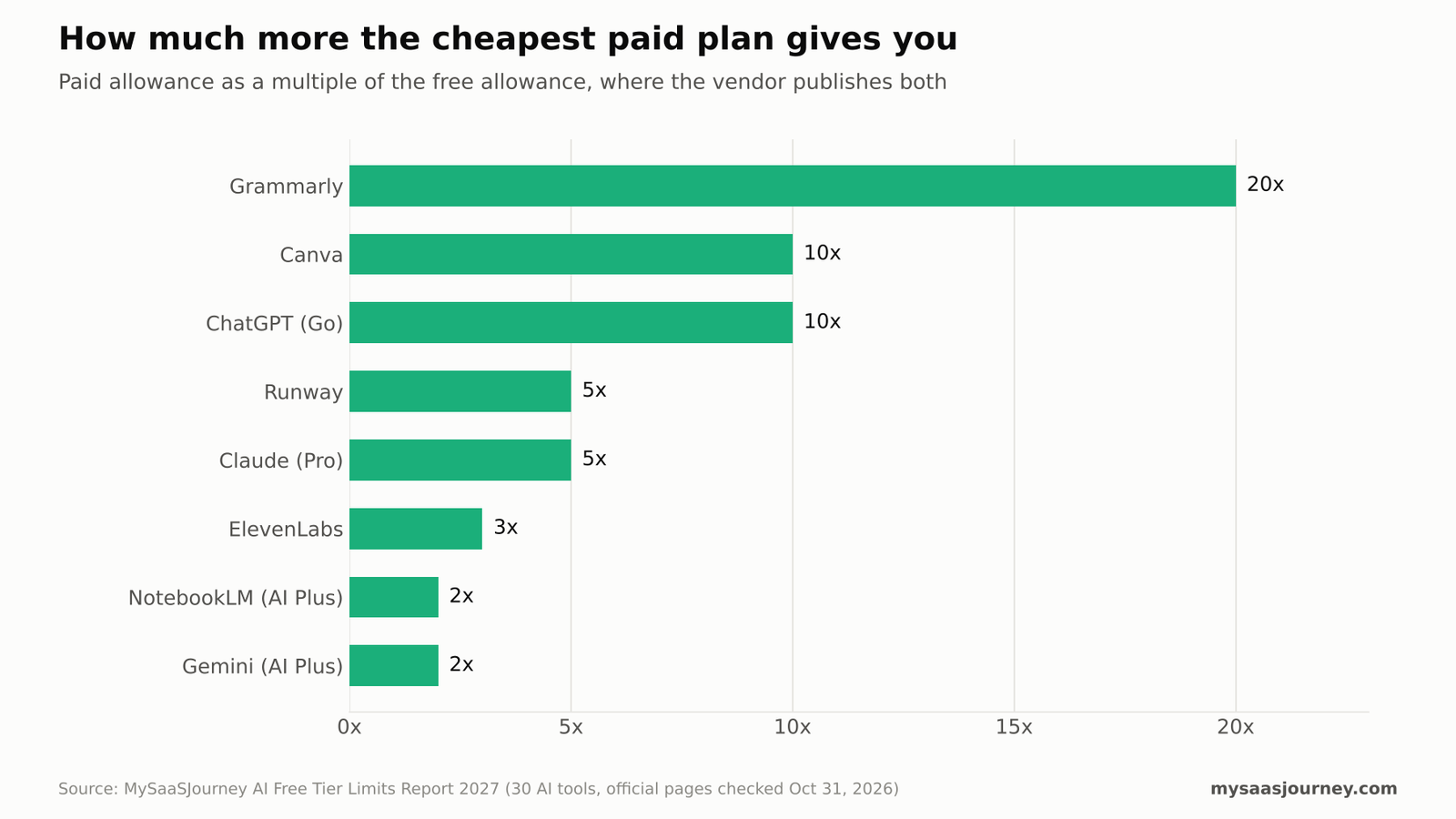
Where vendors publish comparable allowances or a paid-to-free multiple, the cheapest paid plan provides a median of 5x the free allowance.
| Tool | Free allowance | Cheapest paid plan | Multiple |
|---|---|---|---|
| Grammarly | 100 AI prompts/month | 2,000 prompts/member/month | 20x |
| ChatGPT | Free limits | Go: 10x messages, uploads and images | 10x |
| Canva | 200 Standard AI uses/month | 2,000 Standard AI uses/month | 10x |
| Claude | Free usage per 5 hours | Pro: at least 5x per 5-hour session | 5x |
| Runway | 125 credits once | 625 credits/month | 5x |
| ElevenLabs | 10,000 credits/month | 30,000 credits/month | 3x |
| Google Gemini | Standard limits | AI Plus: 2x standard limits | 2x |
Google’s entry plan offers the smallest increase (2x) at the lowest price ($4.99). Grammarly offers the largest increase (20x), with Pro at $30/month or $12/month billed annually.
Annual billing saves a median of 17%
Fifteen tools publish both monthly and annual prices for their cheapest paid plan. Annual billing saves a median of 17% and an average of 21%, ranging from 15% for Claude to 60% for Grammarly. Several popular plans, including ChatGPT Go, Google AI Plus, GitHub Copilot Pro and v0 Plus, show no annual option on their official pages.
Tool-by-tool profiles of all 30 free tiers
AI Chat Assistants
ChatGPT (OpenAI). OpenAI’s plans page lists unlimited text chats for free users, subject to abuse guardrails. Uploads, image generation, voice and deep research are limited without published numbers, and free users do not get the top model tier. OpenAI’s pages differ on the default model. The free tier can be used without an account and is testing ads in the US. Data trains models by default, with an opt-out. ChatGPT Go costs $8/month and is described as providing 10x the messages, uploads and image creation.
Claude (Anthropic). Free usage includes Sonnet and Haiku, resets every five hours and is subject to a weekly cap. No message count is published. Free includes web search, voice, memory, connectors, Artifacts, code execution and file creation; Research, Projects and Claude Code are paid. Pro costs $20/month or $17/month billed annually and gives at least 5x usage per five-hour session.
Google Gemini. Free usage uses compute-based standard limits refreshing every five hours up to a weekly cap. Auto mode sends most prompts to Flash-Lite and may route harder prompts to Flash or Pro, with a 32k-token context window. Voice is included; image generation and Deep Research are limited, while video generation is paid. Google AI Plus is $4.99/month on the subscriptions page (a January 2026 blog post says $7.99) and doubles standard limits.
Microsoft Copilot. The new Copilot app launched August 18, 2026, and Deep Research was retired the same day. Free use is subject to capacity and limits; models are not named. Web search and voice are included; image creation and voice require sign-in, and the app may show ads. The new app’s privacy pages do not address training. Microsoft 365 Personal costs $9.99/month or $99.99/year.
Grok (xAI). Grok describes free limits only as “generous”; the free model is not stated. Web search and voice are included, and free use includes a starter allowance for Cursor coding agents after the October 12, 2026 X Subscription change. Data trains models by default with an opt-out in settings, but logged-out users outside the EU and UK cannot opt out. X Subscription Plus costs $8/month or $80/year.
AI Search & Research
Perplexity. Free users get three Pro Searches/day, one Research query/month and practically unlimited basic searches. The help center says advanced models are not included on free, while the pricing FAQ suggests limited weekly access to top models. Uploads are capped at 40 MB per file within a weekly allowance. Data trains models by default with an opt-out. Pro is $17/month billed annually; no monthly price appears on official pages.
NotebookLM (Gemini Notebook). Renamed Gemini Notebook on July 16, 2026, it gives free users up to 100 notebooks with 50 sources each, and sources up to 500,000 words or 200 MB. Chat and Studio features use compute-based limits refreshing every five hours up to a weekly cap. Generated images and videos carry a visible watermark. Google says it does not train on Gemini Notebook data unless feedback is given. Google AI Plus costs $4.99/month and doubles limits.
You.com. The consumer chat app no longer appears on the official site. The free tier is 100 Web Search API queries/day through MCP, plus a signup credit whose amount differs across official pages ($10 versus $100). You.com says it does not train on prompts. Paid use is pay-as-you-go, from $5 per 1,000 web search calls.
Consensus. Free users get unlimited basic searches, 10 Pro Analyses, 10 Study Snapshots and 10 Ask Paper messages/month, plus three Deep Searches/month. Consensus says user content is never used for training. Its paid plan was listed as Premium at $11.99/month or $8.99/month billed annually; a September 2025 changelog says Premium became Pro, so current prices may differ.
Elicit. The free Basic plan offers unlimited search, paper summaries and chat with papers, with limited Research Agent and Research Reports usage from a monthly pool. Exports and premium PDF parsing are paid. Its privacy policy does not address training for non-Enterprise users. Plus costs $11/user/month billed annually.
AI Writing & Productivity
Grammarly. Free users get 100 generative AI prompts/month, basic corrections and tone detection. Rewrites, tone adjustment, AI detection and plagiarism checks are paid. Training on individual user content is on by default, with an opt-out. Pro costs $30/member/month or $144/year ($12/month) and gives 2,000 prompts/month, 20x the free allowance. It is the only fully confirmed record in this index.
QuillBot. Free paraphrasing is capped at 125 words per input in two modes; summaries are capped at 1,200 words; Humanizer Advanced has three uses. AI detection is limited. Inputs may be used for training, with an opt-out documented for certain browser-extension users. Premium costs $8.33/month billed annually.
Notion AI. Free and Plus plans include only a limited trial of AI responses, with no published number; upgrading from Free to Plus does not renew it. Full Notion AI requires Business at $20/member/month. Notion says customer data is not used for training by default. Plus costs $10/member/month.
Copy.ai. Its official pricing page no longer lists a free plan and “Try for free” leads to a demo request. A February 2026 help article still describes a legacy free plan with 2,000 words/month and 200 one-time workflow credits. Copy.ai says it does not train on customer data. Chat costs $29/month or $24/month billed annually.
Writesonic. Writesonic has no free plan, only a free trial with no stated length. It has repositioned around AI search visibility. Starter costs $79/month billed annually. Writesonic says customer data, including trial data, is not used to train general-purpose models.
AI Image & Design
Adobe Firefly. The plans page describes limited free daily generations without a number; the credits help page says credits are allocated on first use and expire after a month. Certain exports carry Content Credentials. Adobe says it does not train on customer content, but commercial terms for free users are not stated. Firefly Standard costs $9.99/month with 2,000 monthly credits.
Leonardo.ai. Free users get 150 tokens/day, resetting every 24 hours without rollover. A default 768×768 image costs one token, allowing about 150 basic images/day. Free uses community models, allows two jobs at once and makes every image public. Its help center says free users may use images commercially. Apprentice costs $12/month or $10/month billed annually.
Ideogram. It gives 30 credits/week only to accounts signing in with Google, Apple or Microsoft; email/password accounts get none. Cost per image is not published. Free images are public; full-size downloads are JPEG, with transparent PNG only at 1K; higher-resolution PNG and upscaling are paid. Its privacy policy lists model training with no opt-out described. Plus costs $20/month or $15/month billed annually.
Canva. Canva Free shares a monthly pool of up to 200 Standard or 20 Premium AI uses, described as estimates for simple prompts. Creating an image with Canva AI counts as Premium; Ultra tools such as video clips are paid. Canva’s AI terms say users own output for any lawful use. Pro costs $12.99/month or $119.99/year and gives 10x the AI uses.
Microsoft Designer. Designer uses monthly AI credits shared across Microsoft consumer AI apps, with one credit per AI action, but Microsoft does not publish the free-credit number. Consumer terms limit use to personal purposes, not trade or commerce. Microsoft 365 Personal costs $9.99/month and gives up to 4x more credits.
AI Video & Audio
Runway. It gives a one-time deposit of 125 credits that never renews; free users cannot buy more. At Gen-4 Turbo rates, that is about 20 seconds of video in total. Every free video carries a watermark, and Gen-4.5 is paid-only. Terms do not restrict commercial use of outputs, but inputs and outputs may be used to train models. Standard costs $15/month or $12/month billed annually, with 625 credits/month and no watermark.
Pika. Its free plan lists all models and no watermark, but includes zero credits/month and no commercial license. Generation requires a credit pack from $25 for 1,500 credits. Its privacy policy allows inputs and outputs to improve models without a dedicated opt-out. Starter costs $10/month or $8/month billed annually, with 900 credits and a commercial license.
ElevenLabs. Free users get 10,000 credits/month, about 10 minutes of text-to-speech on the website. Free output is non-commercial and must credit elevenlabs.io or 11.ai in the title. Voice cloning is not included. A Data use setting lets users opt out of training. Starter costs $6/month (currently promoted at $1 for the first month) and triples the credits.
Suno. It gives 50 credits/day, enough for about 10 songs at 10 credits per two-song generation, on v6-mini. Since September 3, 2026, free users have no monthly downloads, only up to seven lifetime trial downloads for personal use. Suno’s terms license content for improving models, with no opt-out. Pro costs $8/month with 2,500 credits, 20 downloads/month, v6 access and commercial rights.
HeyGen. Free allows up to three videos/month (one to three by region), each up to one minute, with a watermark that cannot be removed. Output is for personal, non-commercial or internal evaluation use. Its privacy policy and FAQ disagree on training. Creator costs $29/month or $24/month billed annually, with 600 credits, 30-minute videos, 1080p export and watermark removal.
AI Coding & App Builders
GitHub Copilot. Free gives 2,000 code completions/month and limited chat and agent usage, with models chosen automatically. Code review, cloud agent and extra credits are paid. Interaction data from free users is used for training from April 24, 2026 unless they opt out. Copilot Pro costs $10/month with unlimited inline suggestions and 1,500 AI credits/month.
Cursor. Cursor joined The X Subscription on October 12, 2026; its Hobby plan is now a legacy plan mapped to Free. Free usage is described only as limited agent and chat requests on Cursor’s own models, with no third-party frontier models or cloud agents. Whether Privacy Mode is on by default for free individual users is not stated. X Subscription Plus costs $8/month or $80/year and covers Grok models only.
Windsurf (Devin Desktop). Renamed Devin Desktop by Cognition on June 2, 2026, the free plan offers unlimited tab completions and inline edits plus a light quota for agents on SWE-1.6 only. Cognition’s terms assign outputs to the user but allow training on free data; opt-out is limited to paid tiers. Pro costs $20/month.
Lovable. Free gives five build credits/day up to 30/month, plus a daily chat allowance of unstated size, 20 Cloud credits and four AI credits/month. Projects can be private, but code editing, downloads and custom domains are paid, and published apps show a Lovable badge. Free and Pro data has been used for training since September 9, 2026 unless users opt out. Pro costs $25/month or $21/month billed annually.
v0 by Vercel. Free allows seven messages/day plus a one-time $5 credit for new users (existing users keep $5/month). Deployment to Vercel and GitHub sync are included. Vercel’s AI terms limit use to personal or internal business use, and its pages conflict on free users’ training opt-out. Plus costs $30/user/month.
Full comparison of all 30 free tiers
The table summarizes the main free-plan terms. “Not stated” means the vendor does not say; “n/a” means the field does not apply to that kind of tool. Paid prices are monthly unless marked annual. The downloadable CSV contains all recorded fields and source URLs for every tool.
| Tool | Main free limit | Reset | Top model on free | Commercial use | Training on free data | Cheapest paid plan |
|---|---|---|---|---|---|---|
| ChatGPT | Unlimited text chats (guardrails); other features limited | Not stated | No | n/a | Yes, opt-out | Go, $8 |
| Claude | Limited, no number | 5 hours + weekly cap | No | n/a | Unclear | Pro, $20 |
| Google Gemini | Standard limits, no number | 5 hours + weekly cap | Limited | n/a | Yes, opt-out | AI Plus, $4.99 |
| Microsoft Copilot | Capacity-based, no number | Not stated | Not stated | n/a | Unclear | Microsoft 365 Personal, $9.99 |
| Grok | Generous limits, no number | Not stated | Not stated | n/a | Yes, opt-out | X Subscription Plus, $8 |
| Perplexity | 3 Pro Searches/day; 1 Research query/month | Daily | No | n/a | Yes, opt-out | Pro, $17 (annual) |
| NotebookLM (Gemini Notebook) | 100 notebooks, 50 sources each; chat limits not stated | 5 hours + weekly cap | Not stated | n/a | No | Google AI Plus, $4.99 |
| You.com | 100 API searches/day | Daily | Not stated | Not stated | No | Pay as you go |
| Consensus | 10 Pro Analyses/month | Monthly | Not stated | n/a | No | Premium, $11.99 (may be outdated) |
| Elicit | Limited agent and report usage | Monthly | Not stated | n/a | Unclear | Plus, $11 (annual) |
| Grammarly | 100 AI prompts/month | Monthly | Not stated | n/a | Yes, opt-out | Pro, $30/member |
| QuillBot | 125 words per paraphrase | Per request | Not stated | n/a | Yes, opt-out | Premium, $8.33 (annual) |
| Notion AI | Limited AI trial, no number | One-time trial | Limited | n/a | No | Plus, $10 (annual) |
| Copy.ai | No free plan on pricing page | Legacy monthly plan | Not stated | n/a | No | Chat, $29 |
| Writesonic | Free trial only | Trial | Not stated | n/a | No | Starter, $79 (annual) |
| Adobe Firefly | Limited daily generations, no number | Daily | Not stated | Not stated | No | Firefly Standard, $9.99 |
| Leonardo.ai | 150 tokens/day | Daily | No | Yes | Unclear | Apprentice, $12 |
| Ideogram | 30 credits/week | Weekly | Not stated | Yes | Yes, no opt-out stated | Plus, $20 |
| Canva | 200 Standard or 20 Premium AI uses/month | Monthly | No | Yes | Unclear | Canva Pro, $12.99 |
| Microsoft Designer | Monthly credits, no number | Monthly | Not stated | No | Unclear | Microsoft 365 Personal, $9.99 |
| Runway | 125 credits once | One-time | No | Yes | Yes, no opt-out stated | Standard, $15 |
| Pika | 0 credits/month | No free allowance | Yes | No | Yes, no opt-out stated | Starter, $10 |
| ElevenLabs | 10,000 credits/month | Monthly | Yes | No | Yes, opt-out | Starter, $6 |
| Suno | 50 credits/day | Daily | No | No | Yes, no opt-out stated | Pro, $8 |
| HeyGen | 3 videos/month | Monthly | Not stated | No | Unclear | Creator, $29 |
| GitHub Copilot | 2,000 completions/month; chat limited | Monthly | No | n/a | Yes, opt-out | Copilot Pro, $10 |
| Cursor | Limited, no number | Not stated | No | n/a | Unclear | X Subscription Plus, $8 |
| Windsurf (Devin Desktop) | Light agent quota; unlimited tab completions | Not stated | No | Yes | Yes, no opt-out stated | Pro, $20 |
| Lovable | 5 credits/day, 30/month | Daily (monthly cap) | Yes | Yes | Yes, opt-out | Pro, $25 |
| v0 by Vercel | 7 messages/day | Daily | Not stated | Not stated | Yes, opt-out | Plus, $30 |
What these findings mean for AI users
- Match the reset window to your workflow. A five-hour window suits bursts of activity; a daily allowance is easier to plan around for steady use than a monthly limit that may run out early.
- Check commercial rights before publishing. Half of the creative free tiers in this report forbid commercial use. Do not assume a free image, voiceover, song or video can be used for client work.
- Turn off training where possible. Fifteen of 30 free tiers train on data by default. Check opt-out settings and avoid confidential material in tools with no opt-out.
- Do not assume you get the best model. Only three tools say their top model is available on free. Test the paid model before judging quality on an important task.
- Keep your own copies. Free plans can change quickly. Export work you need to retain.
- Consider sub-$10 paid tiers before $20 plans. Ten tools offer a monthly paid plan below $10; where comparisons are published, entry plans provide 2x to 10x the free allowance.
- Combine free tiers carefully. Using several tools spreads usage across limits but also spreads data across multiple privacy policies.
What AI companies should consider
- Publish a clear number for free usage wherever possible.
- Keep pricing, help and privacy pages consistent.
- State which models free users can access.
- Make commercial-use rights visible on pricing pages.
- Explain training defaults and opt-outs plainly.
- Design a transparent, proportionate step between free and premium plans.
Predictions and expectations for 2027
These are MySaaSJourney’s interpretations of current patterns, not measured outcomes:
- More vendors will stop publishing free message counts.
- The five-hour reset window will spread beyond Claude, Gemini and Gemini Notebook.
- Sub-$10 entry tiers will become more common.
- More free AI usage will be funded by advertising.
- Creative free tiers will tighten further, with trial credits rather than ongoing usable output.
- Training opt-outs may become a paid feature more often.
MySaaSJourney will update this report regularly to track whether these expectations hold.
Conclusion and key takeaways
Free AI remains widely available, but it is less transparent and more conditional than it appears. Most free tiers do not publish clear limits, rarely include the best model, often train on user data, and creative tools frequently restrict commercial use.
- Only 11 of 30 AI tools publish an exact main free limit; four of five chat assistants publish none.
- Claude, Gemini and Gemini Notebook reset usage every five hours with a weekly cap; ChatGPT lists unlimited text chats subject to guardrails.
- Only 3 of 30 tools say their top model is available on free.
- 15 of 30 free tiers train on user data by default.
- 5 of 10 free creative tools ban commercial use.
- 4 of 30 tools no longer offer a usable free tier.
- The cheapest paid plan has a median price of $11/month and a median 5x allowance increase where comparable data is published.
For a wider look at which AI tools are worth paying for, see MySaaSJourney’s guide to the best AI tools for marketing.
Download the dataset
The complete dataset behind this report contains 30 tools and 34 columns per tool, including official source URLs, confidence labels, analyst notes and collection date. Download the AI Free Tier Limits Report 2027 dataset (CSV).
Cite this study
MySaaSJourney. (2026). AI Free Tier Limits Report 2027: Daily Messages, Credits and Model Access on the Free Plans of 30 AI Tools. Data collected October 31, 2026. https://mysaasjourney.com/research/ai-free-tier-limits/
Quotable findings: “Only 11 of 30 popular AI tools publish an exact number for their main free limit”; “15 of 30 free AI tiers train on users’ data by default”; “5 of 10 free creative AI tools ban commercial use of their output.” Please link back to this report when quoting or embedding its charts.
Frequently asked questions
What is ChatGPT’s free limit in 2026?
OpenAI’s plans page lists unlimited text chats for free users, subject to abuse guardrails. File uploads, image generation, voice and deep research are limited, with no numbers published, and free users do not get the top model tier.
How many messages does Claude’s free plan allow?
Anthropic does not publish a number. Free usage resets every five hours and is subject to a weekly cap; Anthropic may adjust limits to manage capacity. Pro gives at least 5x the usage per five-hour session.
Which free AI tools publish exact limits?
Eleven of 30 publish an exact main limit, including Leonardo.ai (150 tokens/day), Suno (50 credits/day), ElevenLabs (10,000 credits/month), HeyGen (three videos/month), Runway (125 one-time credits), Grammarly (100 prompts/month) and Ideogram (30 credits/week).
Can I use free AI images commercially?
It depends on the tool. Leonardo.ai, Ideogram, Canva and Runway allow commercial use on free; Microsoft Designer does not, and Adobe Firefly does not state its terms for free users.
Do free AI tools train on my data?
Half of the 30 tools in this report (15) use free-plan data for training by default, 10 with an opt-out. Seven clearly say they do not train on free users’ data.
What is the cheapest way to upgrade from a free AI plan?
Google AI Plus is the cheapest entry plan in this report at $4.99/month, followed by ElevenLabs Starter at $6 and ChatGPT Go, X Subscription Plus and Suno Pro at $8.
Sources and disclosure
Every tool’s official page is linked in the comparison table in the source report; the downloadable dataset lists the official URLs used for each record. Key sources include official ChatGPT and Claude plans, Gemini usage limits and subscriptions, Copilot plans, X Subscription, GitHub Copilot plans and data-use policy, Lovable and v0 pricing, Perplexity plans, Gemini Notebook announcements, Grammarly, Copy.ai and Writesonic pricing, Leonardo.ai tokens, Ideogram, Canva AI, Microsoft Designer terms, Runway, Pika, ElevenLabs, Suno and HeyGen pricing.
Research and analysis by MySaaSJourney. Limits and prices reflect official vendor pages checked October 31, 2026, and may have changed since. MySaaSJourney may earn a commission from some links; no vendor paid for inclusion or reviewed this report before publication.