Which sites an AI search engine cites for 500 “best X software” queries
Research snapshot: October 31, 2026. MySaaSJourney ran 500 “best software” queries through Claude with live web search, recorded all 9,624 search results and all 2,714 citations, and classified every cited site.
Key findings
One company now controls a quarter of the sources an AI search assistant cites when buyers ask for the “best” software. G2, which acquired Capterra, Software Advice and GetApp from Gartner in February 2026, earned 25.2% of all citations and appeared in 75.2% of answers.
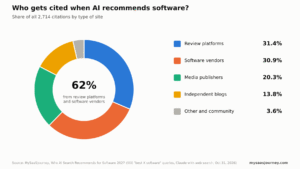
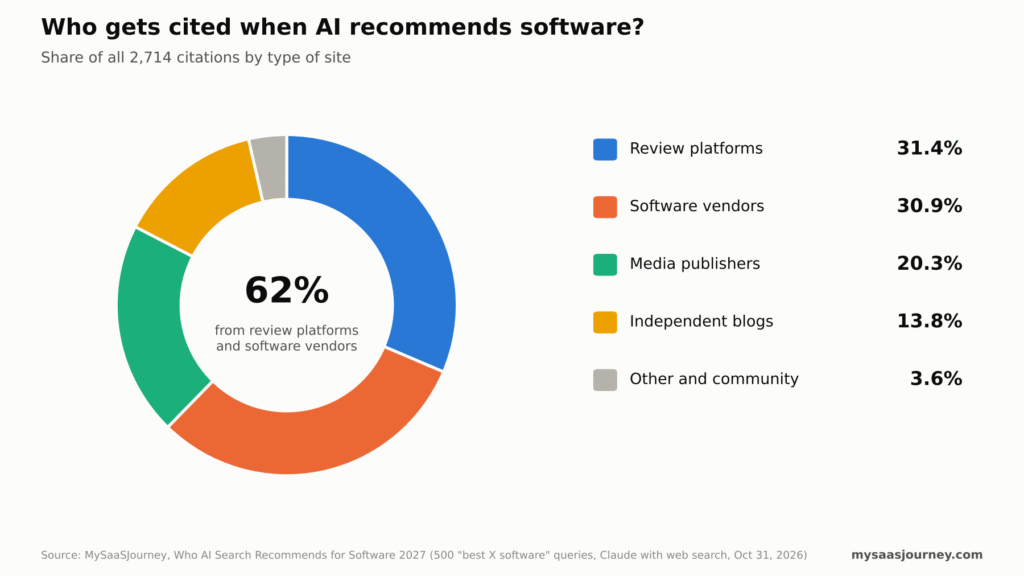
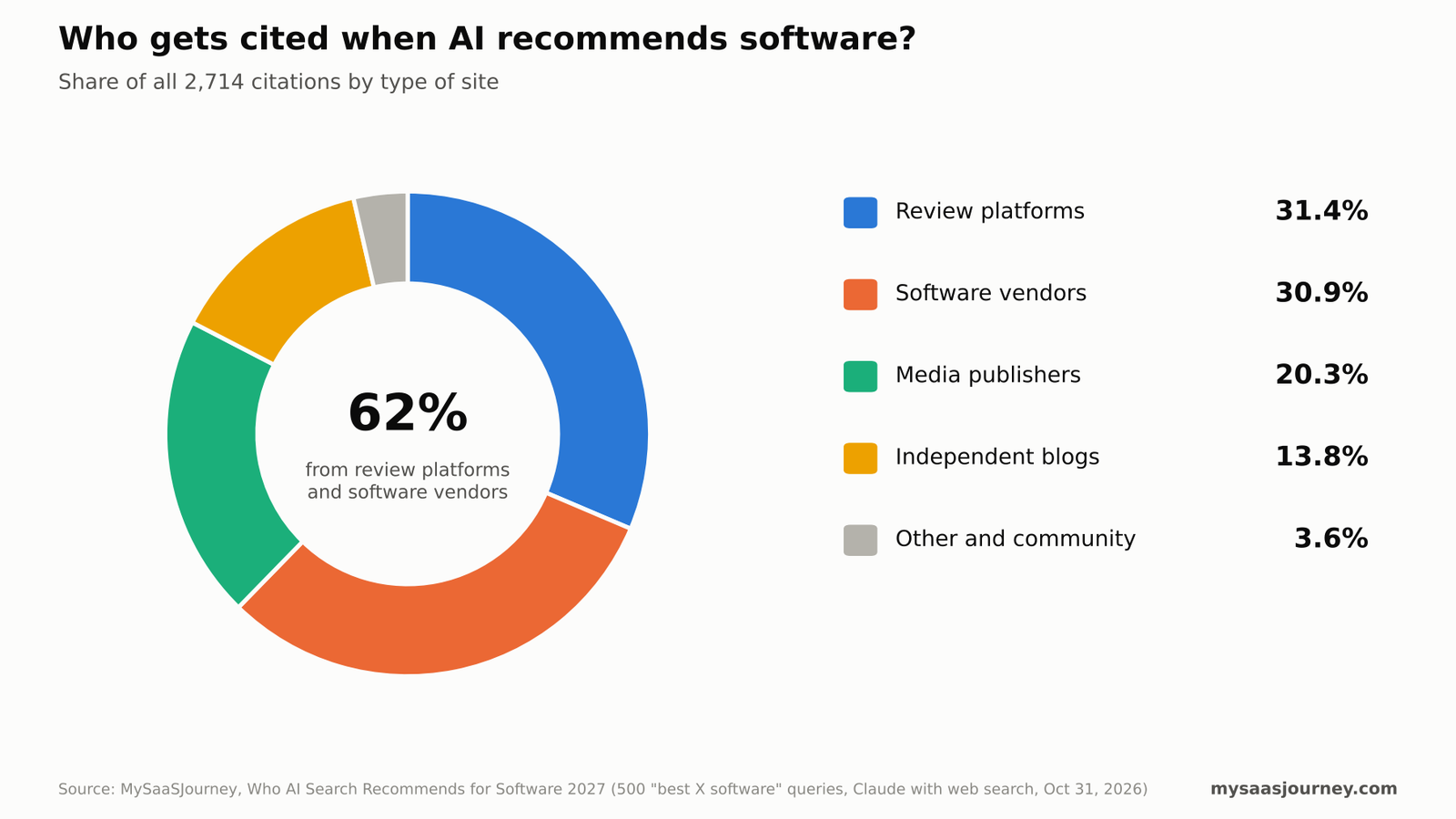
- Review platforms and vendors dominate: review platforms earned 31.4% of citations and software vendors 30.9%. Together they account for 62.3% of citations. Media publishers earned 20.3%; independent blogs earned 13.8%.
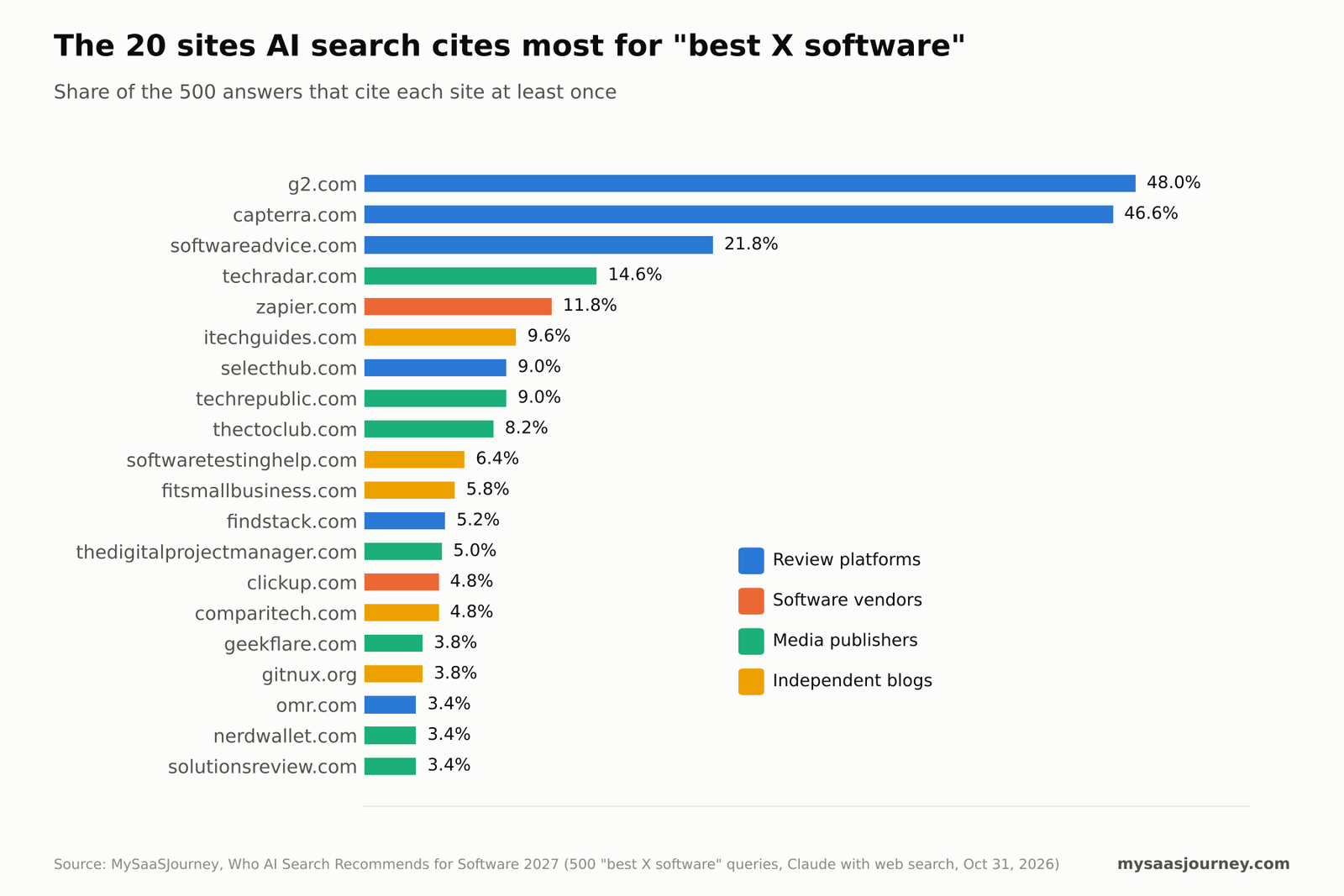
- The G2 network is in three out of four answers: G2 appeared in 48.0% of answers and Capterra in 46.6%. Across G2, Capterra, Software Advice and GetApp, at least one appeared in 75.2% of answers; 44.2% cited two or more network pages.
- Vendors shape the shortlist: 66.2% of answers cited at least one page from a company selling software in the category. When such a vendor page was cited, that vendor’s own product appeared in the AI shortlist 46.1% of the time.
- Search rank matters: results in positions 1–3 were cited 50.6% of the time, versus 11.9% for results ranked 16th or lower. Still, 1,458 domains appeared in search results without a single citation.
- “Best X” lists dominate: 72.5% of cited pages were roundups and 22.4% were review-platform pages. Comparison pages earned 1.6%; vendor product pages just 0.1%.
- Citations are concentrated: the 10 most-cited sites earned 37.5% of citations; 29 sites earned half. Of 901 cited sites, 668 were cited exactly once.
- Four publisher groups earned 37.5%: G2 network (25.2%), Black & White Zebra (5.2%), Future plc (3.6%) and TechnologyAdvice (3.4%).
- Reddit and YouTube were absent: neither appeared in the 9,624 search results, so neither was cited. All community sources together earned 0.4% of citations.
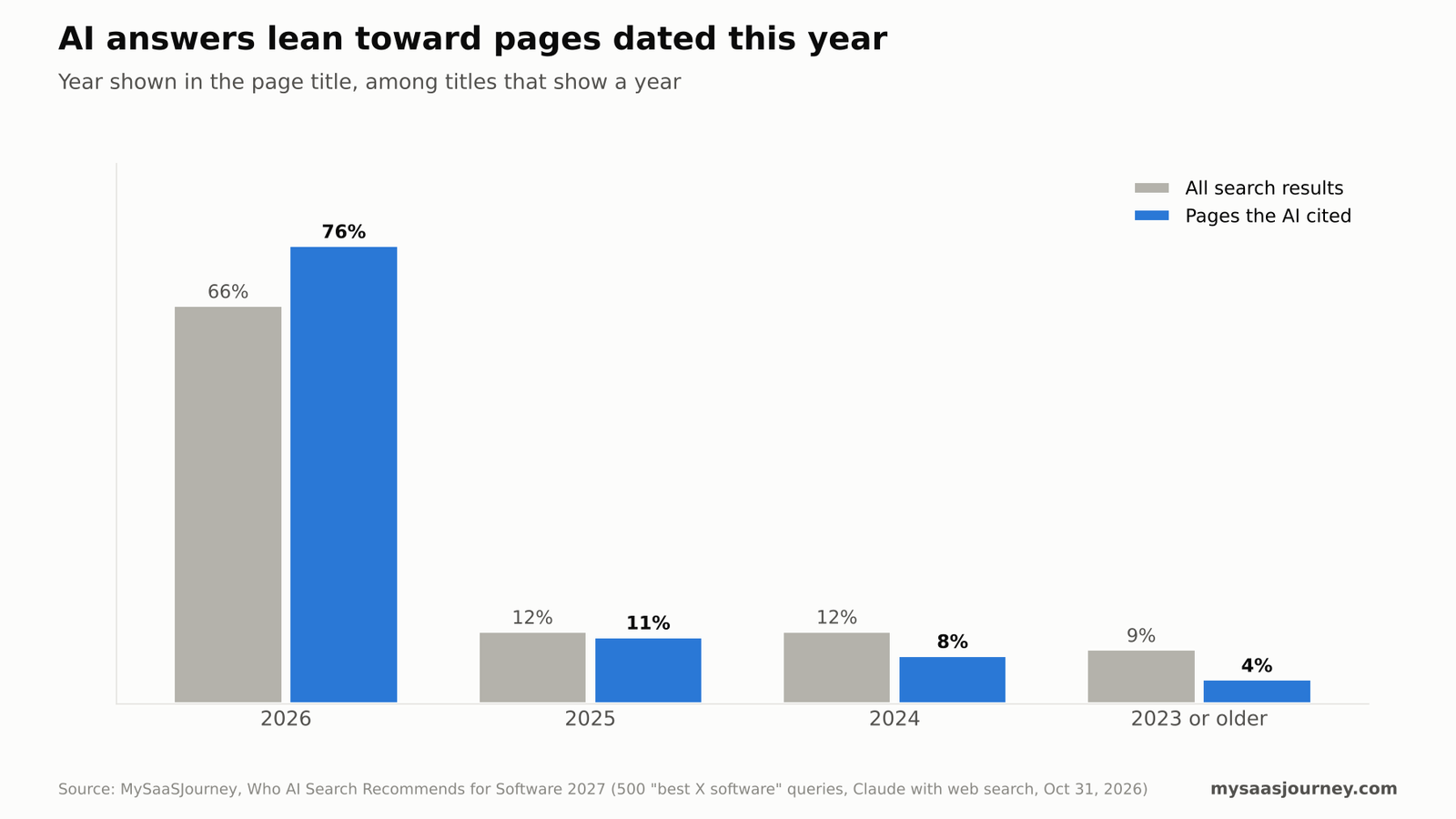
- Freshness correlates with citation: among cited page titles that showed a year, 76.4% said 2026, compared with 66.4% of all search results with a year.
- The AI filtered noise: off-topic listicles and likely spam on .edu and .gov hosts appeared 185 times and were cited once. Regional review-site editions appeared 358 times and were cited 13 times.
Quotable findings
- “One company, G2, now owns the sites behind 25% of the citations Claude’s web search answers gave for ‘best software’ questions.”
- “75.2% of Claude’s web search answers to ‘best X software’ queries cite G2, Capterra, Software Advice or GetApp.”
- “When Claude’s answer cites a software vendor’s own listicle, that vendor makes the shortlist 46% of the time.”
- “Top-three search results are about four times as likely to be cited by Claude as results ranked 16th or lower.”
Why we ran this study
The software shortlist used to start with a search results page. A buyer typed “best CRM software” into Google, opened several tabs, skimmed a review platform and read a roundup. A growing share of that discovery now happens inside an AI answer: the buyer asks a question and the assistant searches the web, selects sources and names a short list of products.
That changes the question for software marketers. It is no longer only “who ranks for best CRM software?” It is also “who does the AI choose to read, and who does it name?” A site that ranks fifth but gets cited may matter more than one that ranks second and is ignored. A vendor’s own category roundup may feed the answer that recommends it.
We wanted a large, documented dataset focused on the commercial-investigation query that matters to software buying: “best X software”. This report answers which sites are cited, what kinds of publishers they are, how concentrated ownership is, how the assistant selects among search results, how vendor content shapes recommendations, and how patterns vary across 20 areas of software.
Important scope limitation
This study measures one AI engine: Claude by Anthropic, using its built-in web search. It does not measure ChatGPT, Perplexity, Google AI Overviews, Gemini or Copilot. Those products use different search indexes and citation logic. Patterns such as rank effects and the popularity of roundups may carry over directionally, but exact shares will differ. References to “the AI” below mean Claude with web search as run in this study.
Methodology
The query set
We built 500 distinct software categories and turned each into a query in the form “best software”. The queries were divided into 20 groups of 25 categories each, giving every area equal weight in the group comparisons.
| Group | Example categories |
|---|---|
| Marketing | Email marketing, SEO, social media management, social listening |
| Sales | CRM, sales engagement, CPQ, revenue intelligence |
| Customer Service | Help desk, live chat, contact center, knowledge base |
| HR | HRIS, payroll, applicant tracking, performance management |
| Finance & Accounting | Accounting, expense management, accounts payable, FP&A |
| Project & Work Management | Project management, kanban, resource management, OKR |
| Collaboration & Communication | Team chat, video conferencing, wiki, business phone system |
| IT & Operations | IT service management, RMM, observability, status page |
| Security | Password manager, SIEM, EDR, GRC |
| Development | IDE, CI/CD, feature flag, AI code assistant |
| Data & Analytics | Business intelligence, ETL, product analytics, A/B testing |
| E-commerce & Retail | Ecommerce platform, POS, inventory management, sales tax |
| Design & Creative | Graphic design, video editing, CAD, podcast hosting |
| Website & Content | Website builder, CMS, form builder, plagiarism checker |
| Healthcare & Professional Services | EHR, medical billing, legal practice management, e-discovery |
| Industry Verticals | Property management, church management, HVAC, roofing |
| Supply Chain & Operations | ERP, fleet management, CMMS, visitor management |
| Productivity & Automation | PDF editor, iPaaS, RPA, meeting scheduler |
| AI Tools | AI chatbot, AI video generator, vector database, AI detector |
| Small Business & Startups | Small-business accounting, cap table management, virtual data room |
How each query was run
- One search, verbatim. Exactly one web search was run using the query text as written. It was not rephrased, expanded with a year or followed by additional searches, and no pages were opened.
- Record every result. Every returned result was stored in order with its URL and title. Search returned 7–33 results per query: 9,624 total, averaging 19.2 per query, across 2,360 domains.
- Answer as a buyer would expect. The assistant named the best five products, or fewer only when the results clearly supported fewer.
- Record citations. The assistant cited three to eight sources from that query’s results. Across the study there were 2,714 citations, averaging 5.43 per answer, from 901 domains.
The search tool returned titles and URLs, not page text. Source selection therefore rested on titles, URLs and the assistant’s general category knowledge. This makes the process repeatable, but it is an important limitation. The 500 queries were run in three waves on the same day using identical instructions and validation.
Classification and validation
Each citation was classified by publisher type (review platform, software vendor, media publisher, independent blog, community, video or other), page type (roundup, comparison, review-platform page, product page, forum, video, article or other), and whether the publisher sold software in the queried category. URLs were normalized to registered domains. Domain types were assigned by majority vote and the 60 most-cited domains were manually reviewed. Domains were grouped by owner where public records confirmed ownership.
Product names were mapped to parent companies where the relationship was unambiguous, with each company counted once per answer. Vendor self-citation was measured by checking whether a vendor’s brand appeared among the products recommended in the same answer as a citation to that vendor’s category content. Brand matching can miss products whose names differ from their domains and can occasionally produce false matches.
Validation found all 500 queries had results and an answer, with no failed queries or duplicates. Every citation URL matched a result returned for that query. The 60 most-cited domains (59.0% of citations) were manually checked, and ownership groupings were checked against public announcements, site footers and reference sources.
Limitations
- One engine and one day: results describe Claude with web search on October 31, 2026; answers change daily and other engines differ.
- One search per query, titles only: real assistants may run several searches and read pages in full.
- US, English: queries were run in English without a location and results skewed toward US sites.
- Labels from titles and URLs: long-tail classification errors are possible.
- Not a measure of quality: being cited does not prove that a source is accurate or unbiased.
The most-cited sites in AI software recommendations
Across 500 answers, Claude made 2,714 citations to 901 websites. G2 and Capterra appeared in almost half of all answers each; no other individual site reached a quarter.
| Rank | Site | Type | Citations | Share of citations | Share of answers |
|---|---|---|---|---|---|
| 1 | g2.com | Review platform | 316 | 11.6% | 48.0% |
| 2 | capterra.com | Review platform | 246 | 9.1% | 46.6% |
| 3 | softwareadvice.com | Review platform | 110 | 4.1% | 21.8% |
| 4 | techradar.com | Media publisher | 73 | 2.7% | 14.6% |
| 5 | zapier.com | Software vendor | 60 | 2.2% | 11.8% |
| 6 | itechguides.com | Independent blog | 48 | 1.8% | 9.6% |
| 7 | selecthub.com | Review platform | 47 | 1.7% | 9.0% |
| 8 | techrepublic.com | Media publisher | 45 | 1.7% | 9.0% |
| 9 | thectoclub.com | Media publisher | 41 | 1.5% | 8.2% |
| 10 | softwaretestinghelp.com | Independent blog | 32 | 1.2% | 6.4% |
G2’s 316 citations included 112 to learn.g2.com, its editorial site. G2 therefore earned citations both as a review platform and as a publisher of “best X” articles. TechRadar was the first non-review site and appeared across all 20 groups. Zapier was the most-cited vendor; its broad app roundups often covered categories in which it was not itself a direct competitor. Independent publishers such as iTechGuides and Software Testing Help also reached the top 10.
The long tail is substantial: 668 of the 901 cited sites (74%) were cited exactly once. A focused page in a specialist category can therefore earn a citation without a major media brand behind it.
Which sites convert appearances into citations?
| Site | Search appearances | Citations | Citation rate |
|---|---|---|---|
| Fit Small Business | 29 | 29 | 100% |
| The Digital Project Manager | 31 | 25 | 80.6% |
| The CTO Club | 59 | 41 | 69.5% |
| NerdWallet | 25 | 17 | 68.0% |
| TechRadar | 108 | 73 | 67.6% |
| Geekflare | 33 | 19 | 57.6% |
| Comparitech | 42 | 24 | 57.1% |
| Software Testing Help | 58 | 32 | 55.2% |
| Zapier | 110 | 60 | 54.5% |
| Capterra | 534 | 246 | 46.1% |
| G2 | 1,065 | 316 | 29.7% |
G2’s reach comes from appearing almost everywhere, not from being selected every time. It often returned several URLs for the same query, while the AI cited only one or two. Focused editorial roundups converted appearances into citations at a higher rate.
Who gets cited: the five kinds of sources
| Site type | Citations | Share of citations | Share of answers citing at least one |
|---|---|---|---|
| Review platforms | 852 | 31.4% | 82.6% |
| Software vendors | 838 | 30.9% | 84.2% |
| Media publishers | 552 | 20.3% | 65.0% |
| Independent blogs | 374 | 13.8% | 55.2% |
| Other | 87 | 3.2% | — |
| Community (forums, Q&A) | 11 | 0.4% | 2.2% |
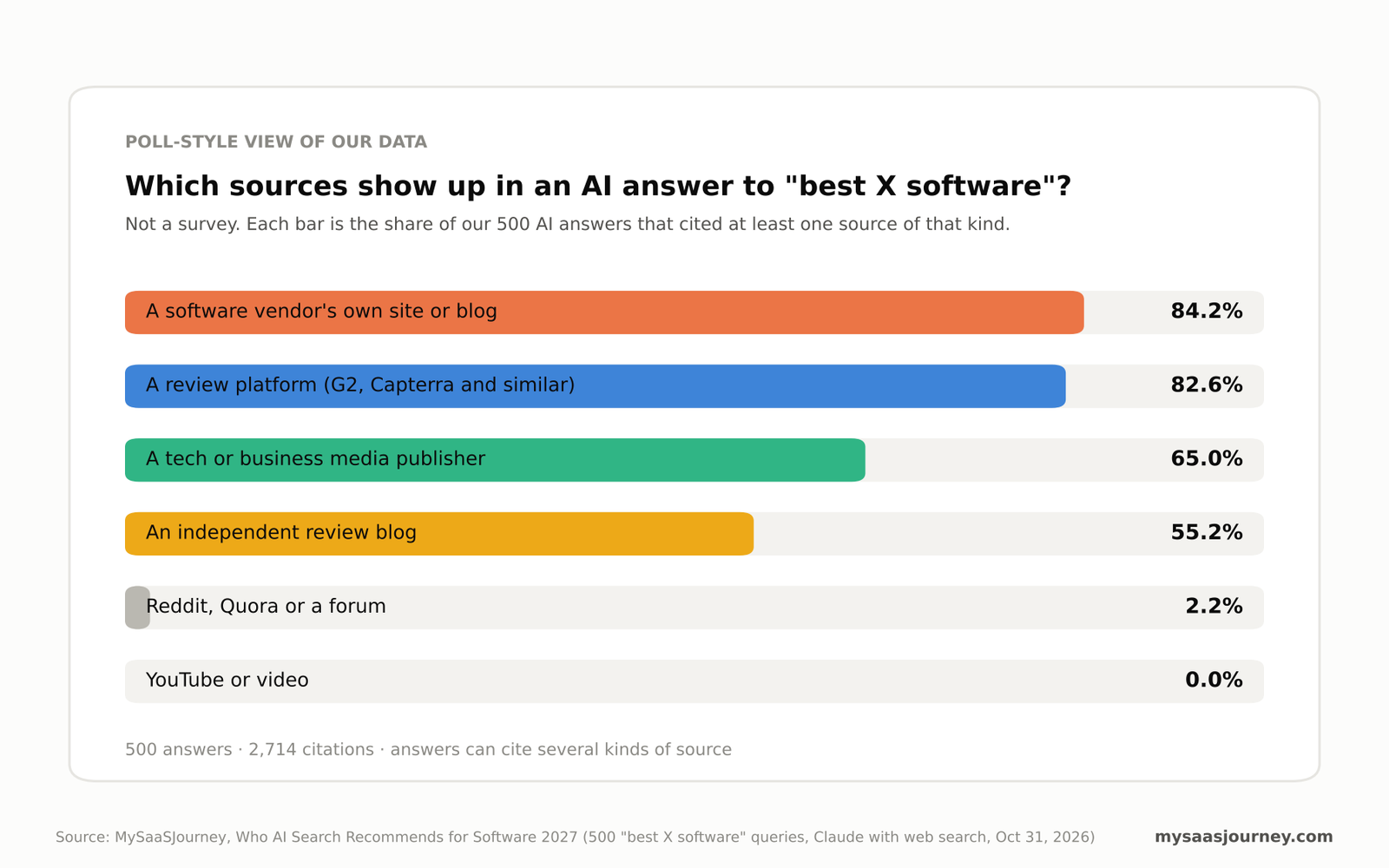
The typical answer blended several sources. Each answer cited an average of 5.24 different domains; 77.2% mixed at least three source types and 97.8% mixed at least two. Only 10.6% relied entirely on review platforms and vendors.
Review platforms
Review platforms earned 31.4% of citations and appeared in 82.6% of answers. Category pages match “best X software” queries closely and aggregate ratings across many products. Of 852 review-platform citations, 685 (80.4%) went to the four brands now owned by G2. Outside that network, SelectHub earned 47 citations, Findstack 26, OMR Reviews 17, SourceForge 16, SoftwareSuggest 14 and TrustRadius 12.
Review platforms’ weakness is duplicate presence: G2 appeared 1,065 times and was cited 316 times; Capterra appeared 534 times and was cited 246 times. Paginated category pages, regional editions and product pages create many opportunities to appear, but the AI usually selects only a small number.
Software vendors
Vendors earned 30.9% of citations and appeared in 84.2% of answers. Of 838 vendor citations, 553 (66.0%) came from a company selling software in the queried category. Overall, 331 answers (66.2%) cited at least one such in-category vendor page. These were usually category roundups rather than product pages.
Media publishers and independent blogs
Media publishers earned 20.3% of citations and appeared in 65.0% of answers. TechRadar led the group, followed by TechRepublic, The CTO Club, The Digital Project Manager, Geekflare, NerdWallet and Solutions Review. Three media groups—Black & White Zebra, TechnologyAdvice and Future plc—earned 333 citations, or 60.3% of all media citations. Independent blogs earned 13.8% of citations and appeared in 55.2% of answers, but this segment was fragmented across many specialist sites.
Community and video
Reddit, Quora and YouTube did not appear once in the 9,624 search results. LinkedIn appeared twice and Medium three times. Community sources earned 11 citations (0.4%), mostly niche practitioner forums and a few DEV Community or StackShare pages. Video earned none. This is a property of the search layer used in this study, not evidence that community platforms are unimportant on other AI engines.
From search results to citations: what the AI keeps and drops
Of 9,624 returned search results, 2,714 were cited, a 28.2% citation rate. Position strongly predicted selection:
| Search position | Share of results cited |
|---|---|
| 1–3 | 50.6% |
| 4–5 | 34.1% |
| 6–10 | 29.6% |
| 11–15 | 25.2% |
| 16 and lower | 11.9% |
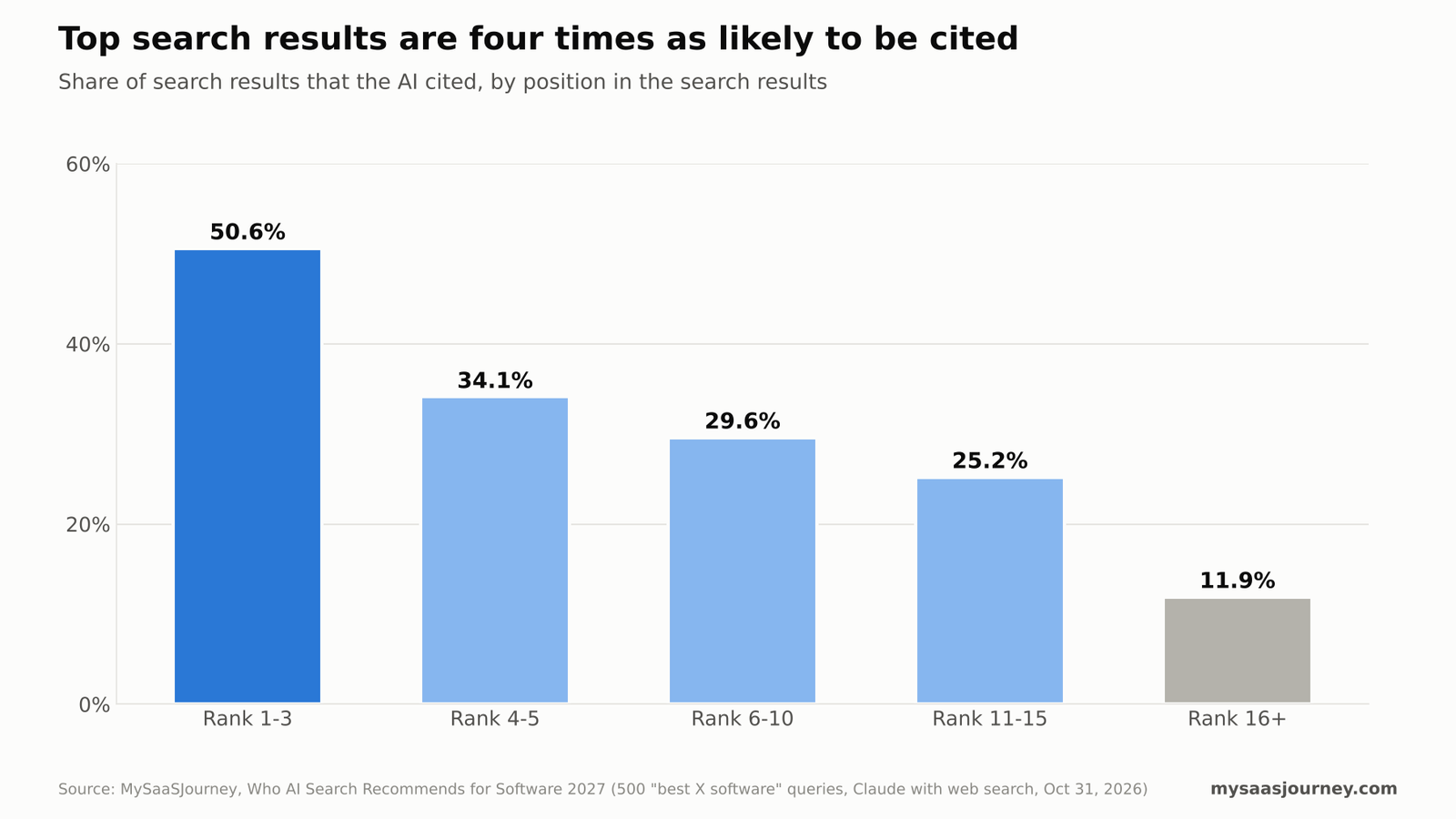
The median cited page sat at position 7, compared with a median of 10 for all results. Ranking is the ticket into consideration, but it does not guarantee a citation: half of top-three results were still not cited, and 1,458 domains appeared without a single citation.
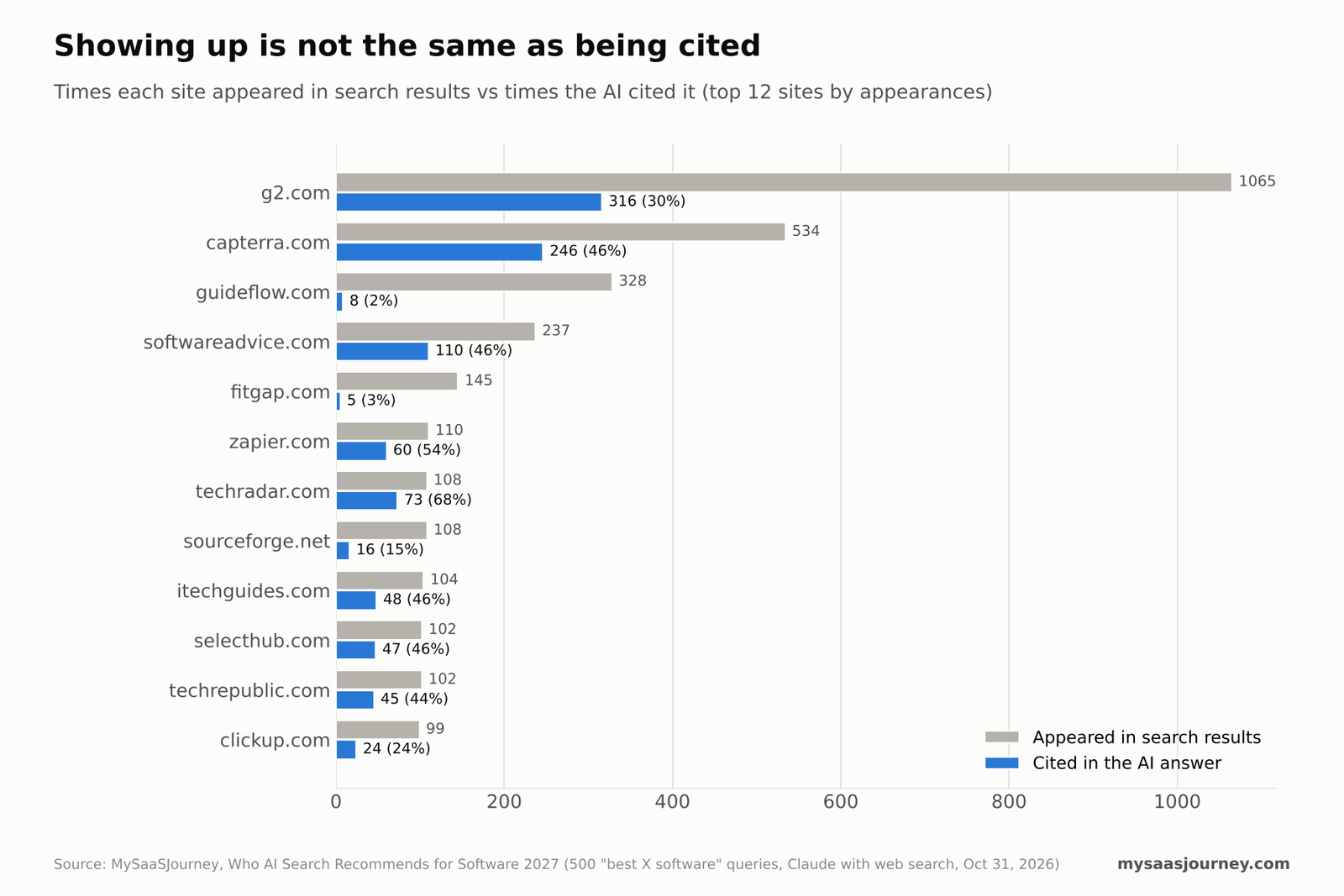
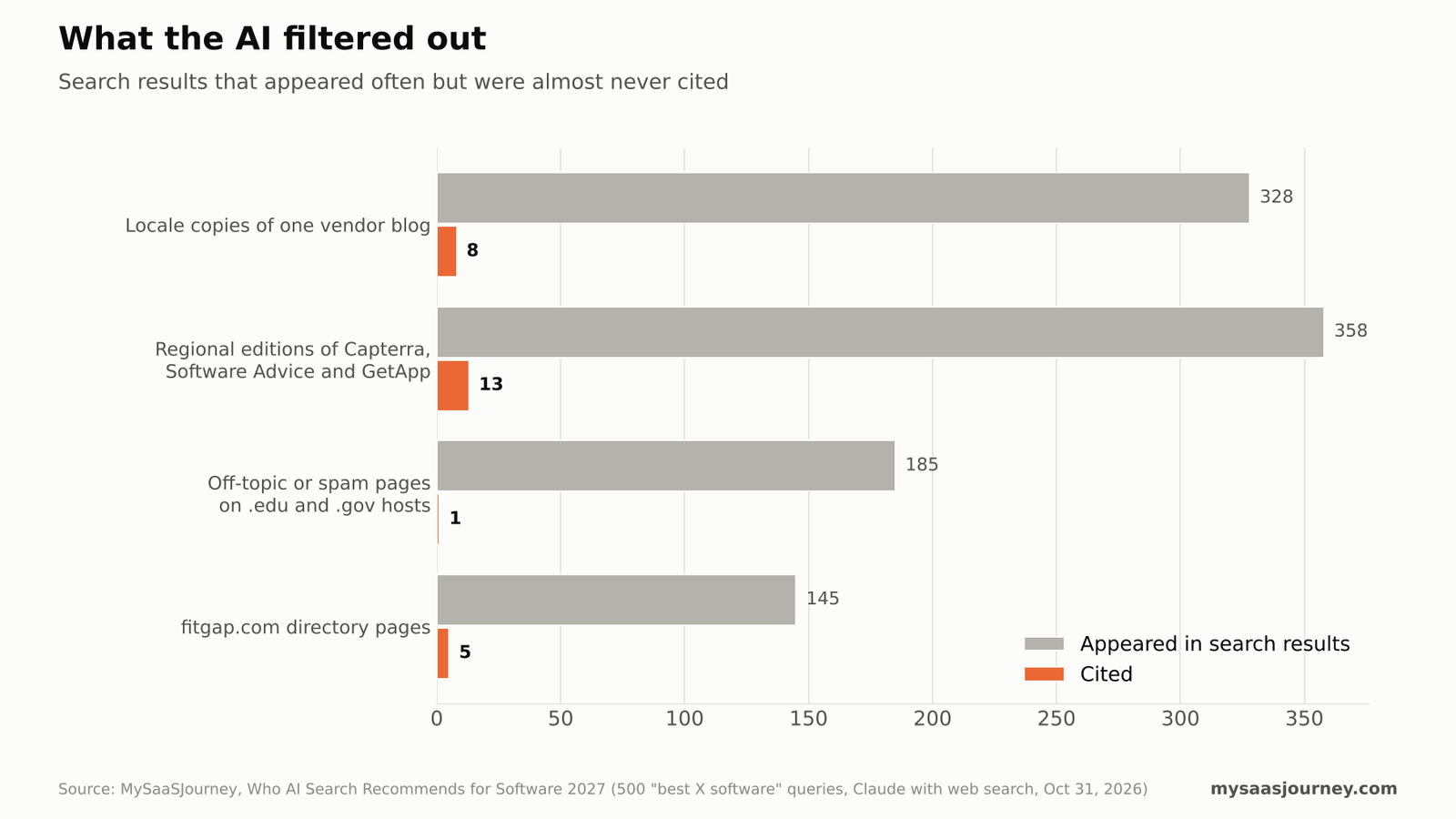
Four patterns explain much of the filtering. First, duplicate locale copies were ignored: guideflow.com appeared 328 times across 206 queries, but 150 appearances were locale-path copies and 326 results had the generic title “Best tools”; only eight were cited. Second, regional editions of Capterra, Software Advice and GetApp appeared 358 times and were cited 13 times, while their US counterparts were cited about 46% of the time they appeared. Third, off-topic listicles and likely spam hosted on university and public-body subdomains appeared 185 times but were cited once. Fourth, thin directory pages were often skipped: fitgap.com appeared 145 times and earned five citations; SourceForge appeared 108 times and earned 16.
Inside one answer: “best CRM software”
The CRM query returned 26 results and the AI cited six. The cited sources included G2 at position 1, Brevo at position 5, Software Advice at position 7, Capterra at position 12, Zapier at position 9 and TechRepublic at position 14. The AI recommended Salesforce Sales Cloud, HubSpot CRM, Zoho CRM, Pipedrive and monday CRM.
This one answer illustrates the wider patterns: duplicates from G2 and Zapier were collapsed; three G2-owned sites appeared among the citations; a vendor roundup was cited even though Brevo was not recommended; and results below position 14 were ignored. TechRadar appeared at position 13 but was passed over in favor of TechRepublic at position 14, showing that rank is influential rather than absolute.
Review platforms and the G2 network
G2 announced its agreement to acquire Capterra, Software Advice and GetApp from Gartner on January 29, 2026; the deal was reported closed on February 5, 2026. In this dataset, the network supplied 685 citations (25.2%) and appeared in 376 answers (75.2%).
| G2 network site | Citations | Share of all citations | Answers citing it |
|---|---|---|---|
| G2, including Learn and former G2Crowd | 316 | 11.6% | 240 (48.0%) |
| Capterra | 246 | 9.1% | 233 (46.6%) |
| Software Advice | 110 | 4.1% | 109 (21.8%) |
| Regional editions, including GetApp UK | 13 | 0.5% | — |
| Network total | 685 | 25.2% | 376 (75.2%) |
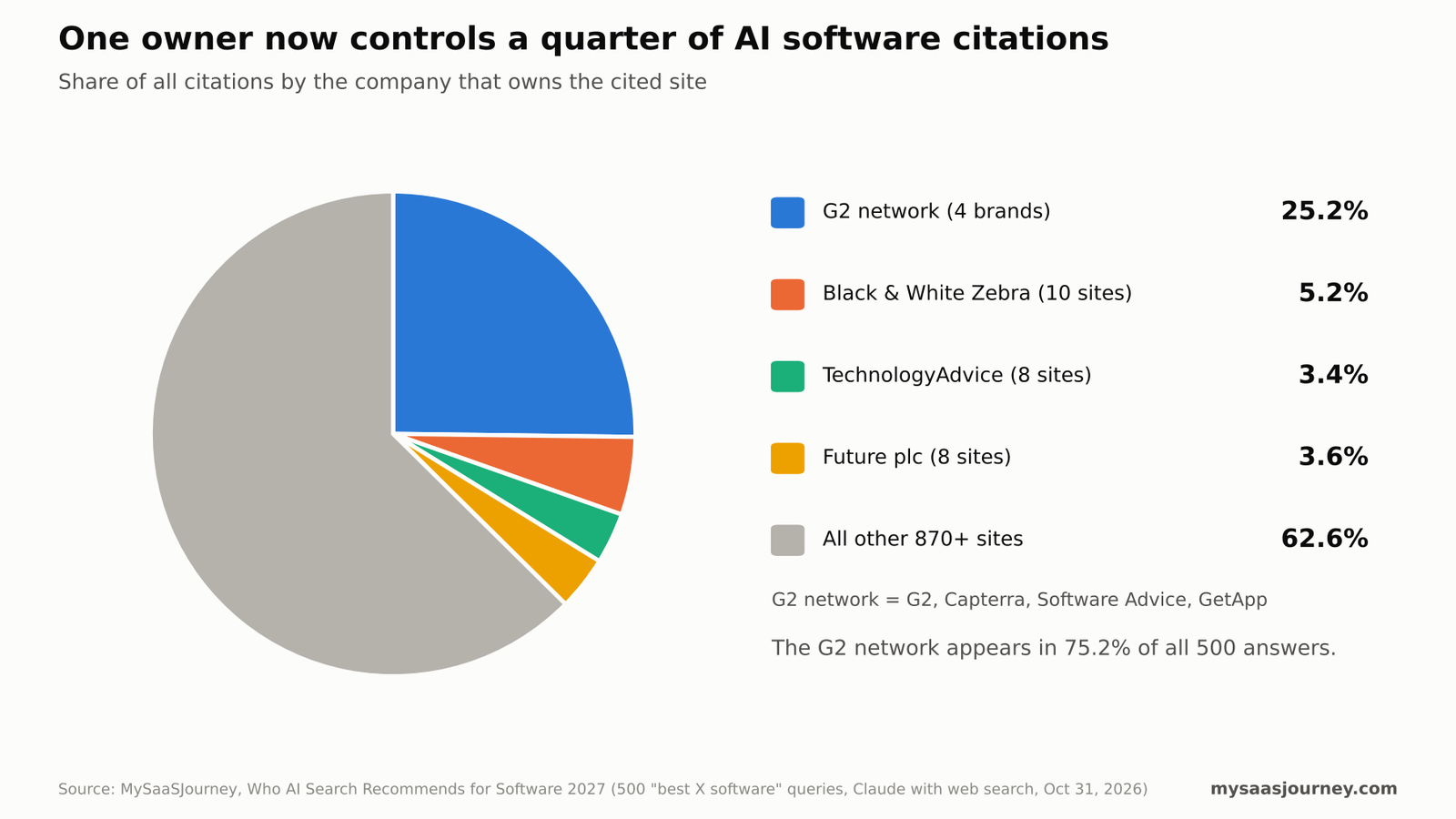
Three out of four answers cited at least one G2-owned site, and 44.2% cited two or more. For buyers, several links may therefore represent fewer independent viewpoints than they appear to. We found no evidence that G2-owned sites ranked products unfairly or that the AI favored paid placements; the finding is concentration of ownership and source reach, not proof of bias.
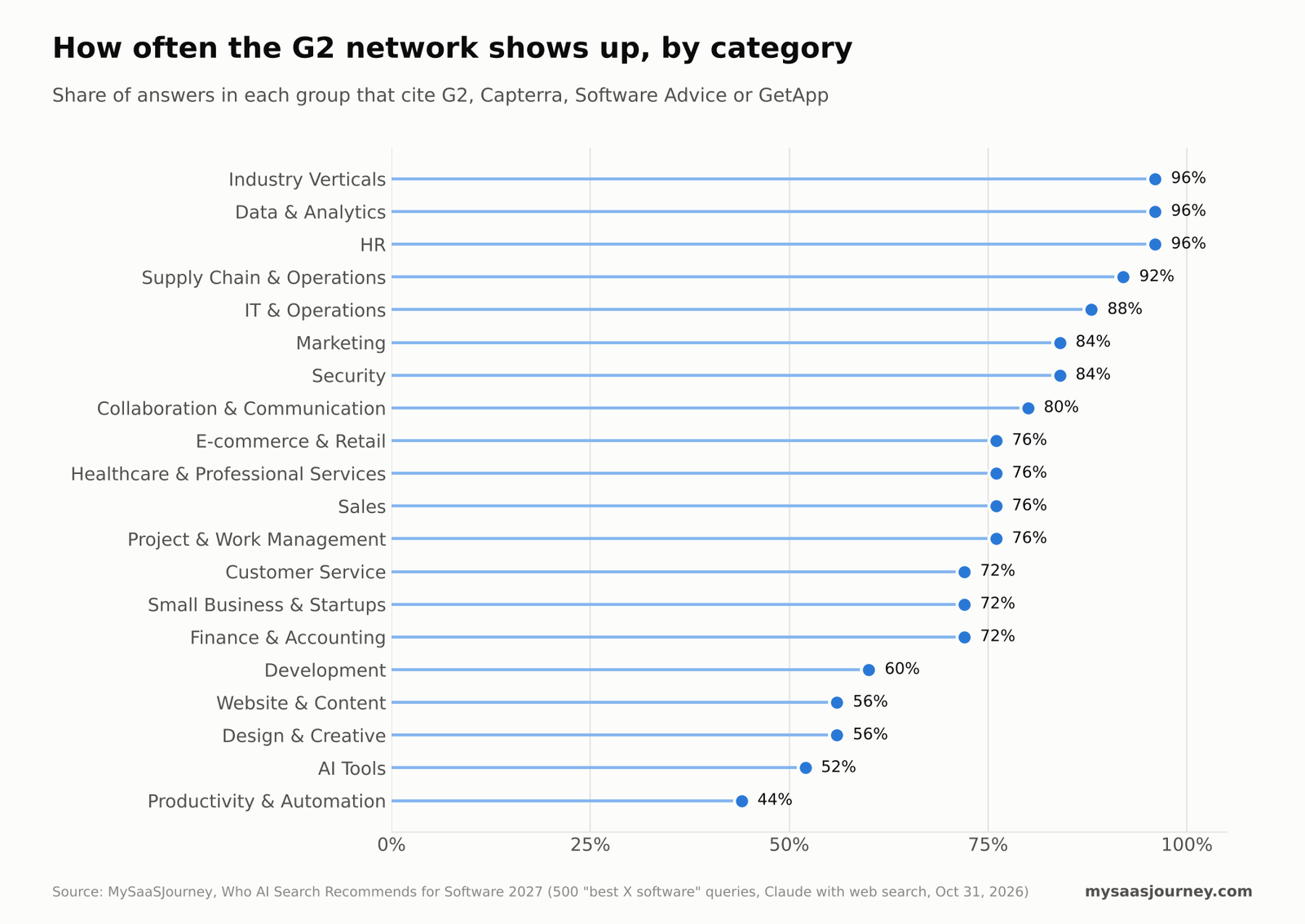
The network’s presence varied by category: it appeared in 24 of 25 answers in HR, Data & Analytics and Industry Verticals; 23 of 25 in Supply Chain & Operations; and 22 of 25 in IT & Operations. It appeared in only 44% of Productivity & Automation answers, 52% of AI Tools answers and 56% of Design & Creative and Website & Content answers.
Vendor sites and self-published listicles
Of 838 citations to vendor sites, 553 went to a vendor selling in the queried category. Of those 553 in-category vendor citations, 255 (46.1%) were to a vendor whose own brand also appeared among the AI’s recommendations. Across the full study, 187 answers (37.4%) both cited a vendor’s own article and recommended that vendor.
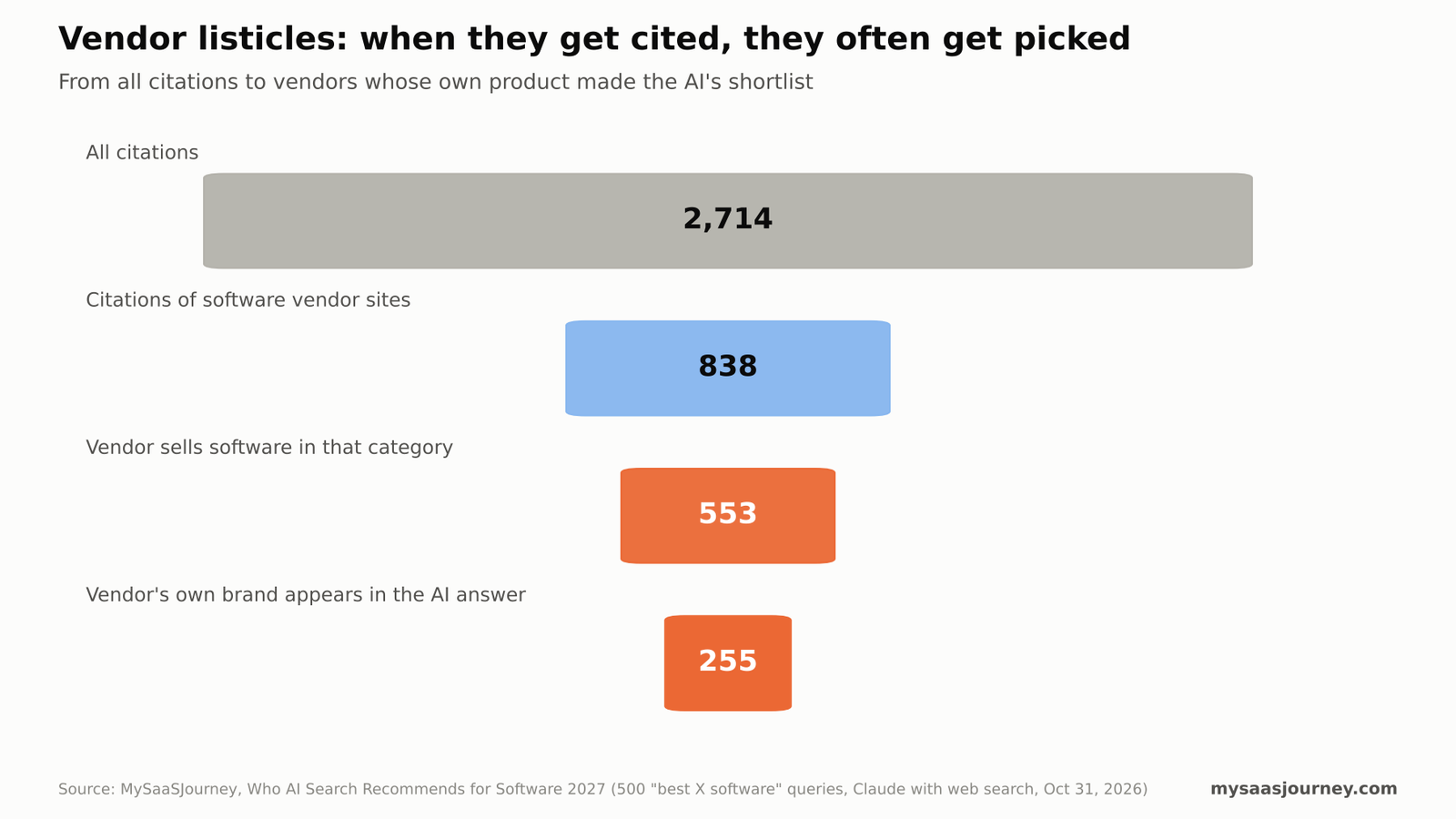
For “best HRIS software”, the AI cited roundups from HiBob and Lattice and recommended HiBob among five products. For “best CRM software”, it cited Brevo’s roundup, but Brevo did not make the shortlist. This overlap does not prove that the citation caused the recommendation: strong products may both publish credible roundups and earn recommendations on their merits. It does show that vendor content is a routine part of the evidence base.
HubSpot and ClickUp led vendors with eight in-category citations each, followed by Rippling with six. Brevo, Connecteam, Freshworks, Optimonk, Zapier and Zendesk earned four each. Vendor influence was broad but shallow rather than dominated by one company.
Who the AI recommends
Across 500 answers, Claude recommended 1,836 differently named products, or about 1,590 distinct company or product names after partial mapping to parent companies. The most frequently recommended individual product, monday.com, appeared in only 11 answers. At the parent-company level, Microsoft appeared in 75 answers (15%), followed by Zoho (40), Google (38), Salesforce (33), Adobe (29) and HubSpot (25).
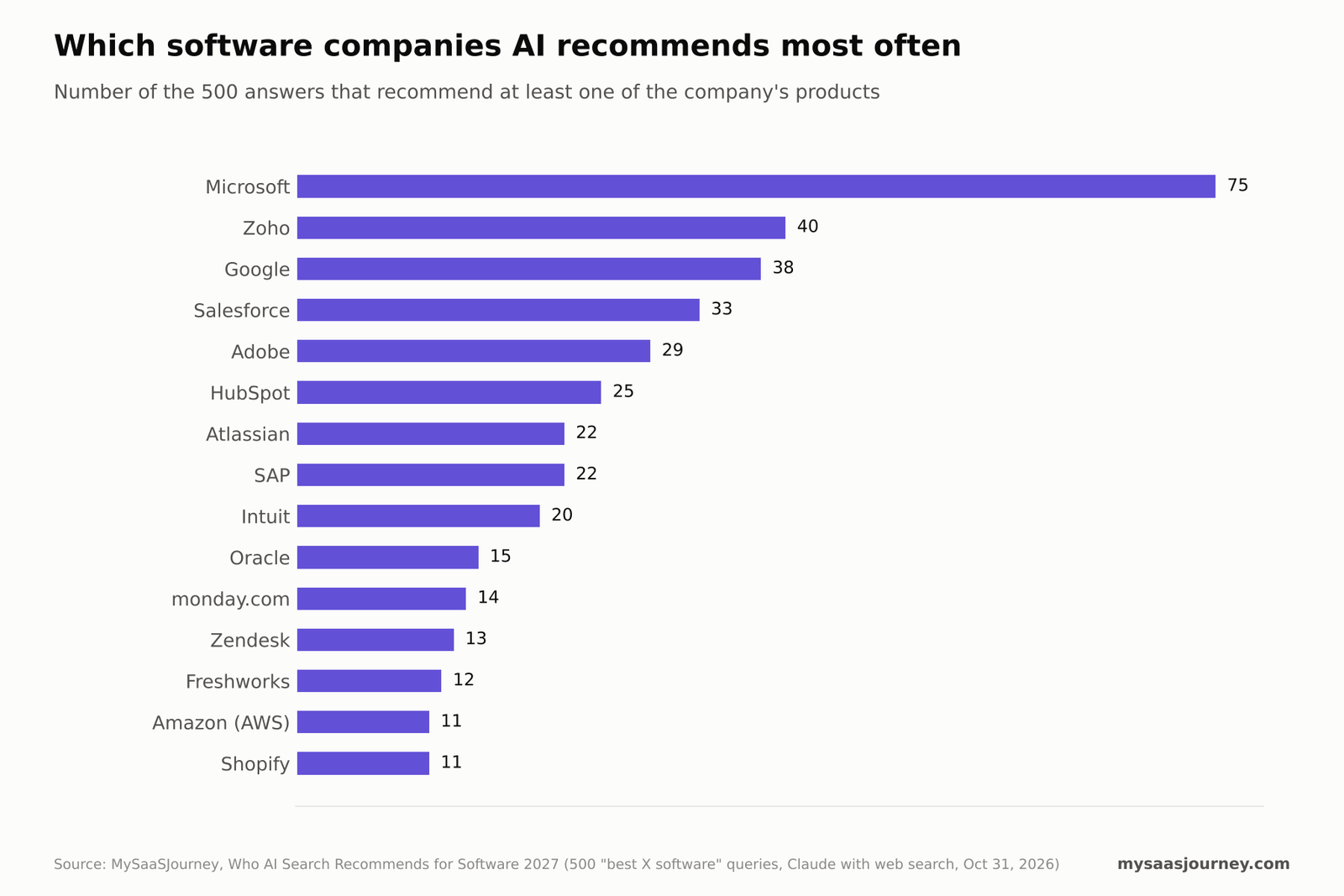
These broad portfolios compete across many categories. Specialist vendors should make the case for their fit in the category and buyer context rather than assume a shortlist will contain only specialist products.
Category deep dives: 20 areas of software
The mix of citations varies widely. Review-platform share ranges from 13% in Productivity & Automation to 44% in Healthcare & Professional Services. Vendor share ranges from 9% in Security to 49% in Sales.
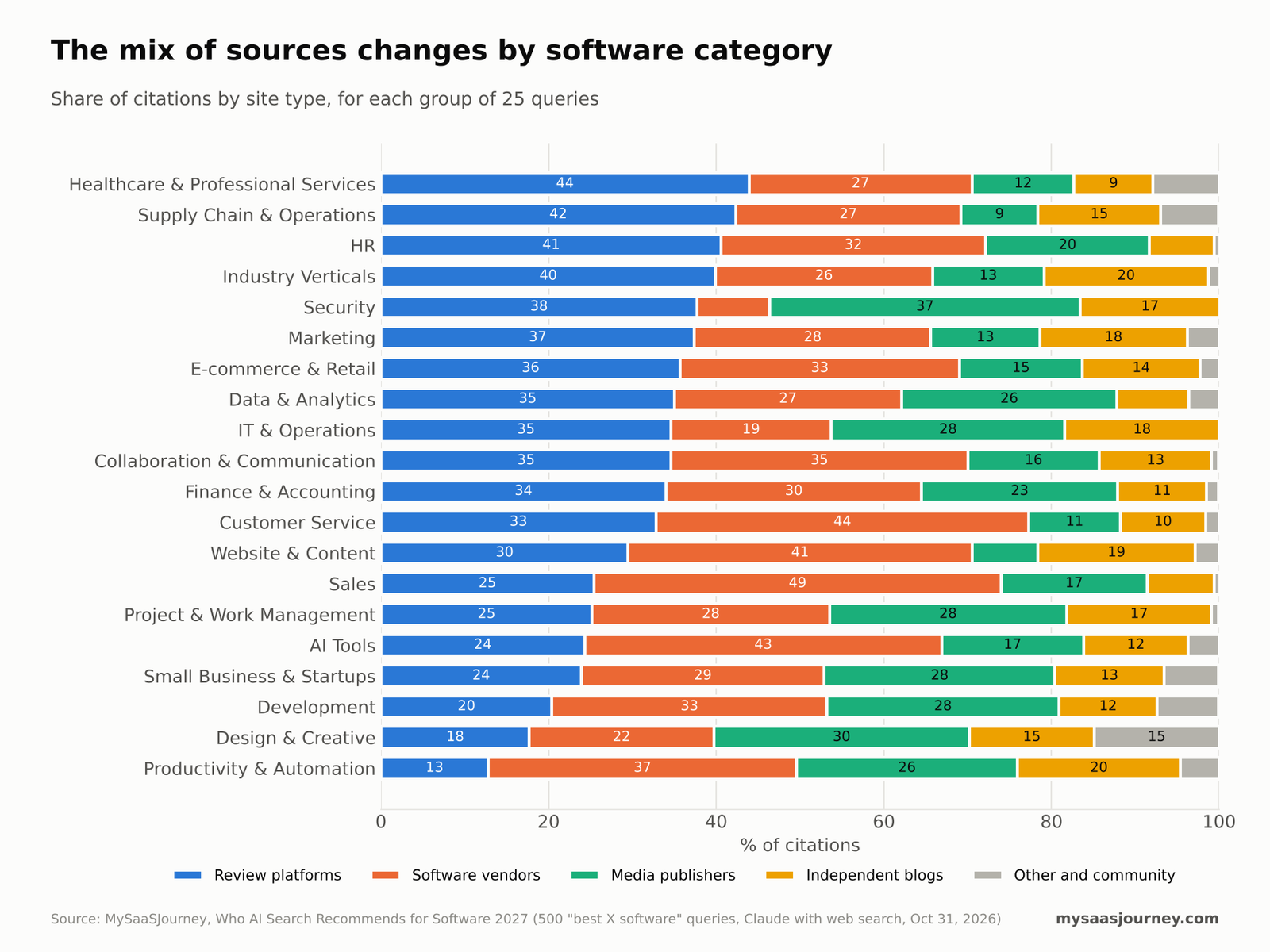
| Group | Review platforms | Vendors | Media | Independent | Answers citing G2 network | Most-cited site |
|---|---|---|---|---|---|---|
| Healthcare & Professional Services | 44% | 27% | 12% | 9% | 76% | Capterra |
| Supply Chain & Operations | 42% | 27% | 9% | 15% | 92% | Capterra |
| HR | 41% | 32% | 20% | 8% | 96% | G2 |
| Industry Verticals | 40% | 26% | 13% | 20% | 96% | Capterra |
| Security | 38% | 9% | 37% | 17% | 84% | G2 |
| Marketing | 37% | 28% | 13% | 18% | 84% | G2 |
| E-commerce & Retail | 36% | 33% | 15% | 14% | 76% | Capterra |
| Data & Analytics | 35% | 27% | 26% | 9% | 96% | G2 |
| IT & Operations | 35% | 19% | 28% | 18% | 88% | G2 |
| Collaboration & Communication | 35% | 35% | 16% | 13% | 80% | G2 |
| Finance & Accounting | 34% | 30% | 23% | 11% | 72% | G2 |
| Customer Service | 33% | 45% | 11% | 10% | 72% | G2 |
| Website & Content | 29% | 41% | 8% | 19% | 56% | Capterra |
| Sales | 25% | 49% | 17% | 8% | 76% | G2 |
| Project & Work Management | 25% | 28% | 28% | 17% | 76% | G2 |
| AI Tools | 24% | 43% | 17% | 12% | 52% | G2 |
| Small Business & Startups | 24% | 29% | 28% | 13% | 72% | Capterra |
| Development | 20% | 33% | 28% | 12% | 60% | G2 |
| Design & Creative | 18% | 22% | 30% | 15% | 56% | G2 |
| Productivity & Automation | 13% | 37% | 26% | 20% | 44% | TechRadar |
Healthcare & Professional Services: review platforms earned 44% of citations, led by Capterra and Software Advice. Recommended products included athenahealth, SimplePractice, MyCase, NextGen Healthcare, AdvancedMD and Tebra.
Supply Chain & Operations: 92% of answers cited a G2-owned site. Capterra and G2 led, while media publishers earned only 9%. Recommended products included UpKeep, Blue Yonder, Kinaxis, SAP Ariba, Coupa and Gatekeeper.
HR: 24 of 25 answers cited a G2-owned site. Vendors were active sources, and Rippling, BambooHR, Connecteam, Lattice, Paylocity and Workday were frequently recommended.
Industry Verticals: 96% of answers cited the G2 network. Independent blogs earned 20% of citations, including Fit Small Business and CRM.org. Jobber and Housecall Pro were among the recommended products.
Security: vendor sites earned just 9% of citations; media publishers earned 37%. G2 led, followed by Capterra, The CTO Club and Comparitech. No product appeared in more than two answers.
Marketing: G2 and Capterra led, with The CMO, Zapier and Findstack contributing roundups. Semrush, HubSpot, Sprout Social, Brevo, Klaviyo and ActiveCampaign were among the recommended products.
E-commerce & Retail: Capterra edged G2. The source mix was balanced between review platforms and vendors. BigCommerce, Shopify, WooCommerce, Wix and Squarespace led recommendations.
Data & Analytics: the G2 network appeared in 96% of answers, while media earned 26% of citations, led by Datamation and Solutions Review. Power BI, Tableau, Zoho Analytics, Looker Studio, Hotjar and Qlik Sense were recommended.
IT & Operations: vendor share was only 19%; editorial publishers and independent blogs had a stronger role. Recommended products included Freshservice, Zabbix, NinjaOne, Microsoft Intune, Dynatrace and Datadog.
Collaboration & Communication: review platforms and vendors were almost tied. Microsoft Teams, Box, Notion, RingCentral, Slack and Webex were among the most recommended.
Finance & Accounting: NerdWallet was a notable media source alongside G2 and Capterra. QuickBooks Online, Xero, FreshBooks, Ramp, Brex and BILL were frequently recommended.
Customer Service: vendors earned 45% of citations through extensive category roundups. Zendesk was most recommended, followed by Freshdesk, HubSpot Service Hub, Five9 and Talkdesk.
Website & Content: vendors earned 41% of citations and 88% of answers cited an in-category vendor. Wix, Squarespace, Typeform, Google Forms, Kajabi and Mighty Networks led recommendations.
Sales: this was the most vendor-driven area: vendors earned 49% of citations and 88% of answers cited an in-category vendor. Salesforce, Apollo.io, HubSpot, PandaDoc, Zoho CRM and Pipedrive led recommendations.
Project & Work Management: sources were unusually balanced across review platforms, vendors, media and independent sites. monday.com appeared in eight of 25 answers, followed by Smartsheet, ClickUp and Jira.
AI Tools: vendor sites earned 43% of citations and 84% of answers cited an in-category vendor. Recommendations included ChatGPT, Claude, Synthesia, HeyGen, ElevenLabs and Murf AI.
Small Business & Startups: Fit Small Business and NerdWallet were prominent editorial sources. QuickBooks Online, Xero, FreshBooks and Wave each appeared in three answers.
Development: technical editorial sources mattered. G2 and The CTO Club led, followed by Capterra and Software Testing Help. GitHub, GitLab, Visual Studio Code, Bitbucket, Jenkins and Azure DevOps led recommendations.
Design & Creative: media publishers earned 30% of citations and review platforms only 18%. TechRadar, Creative Bloq and Top Ten Reviews led; Canva and Adobe products appeared repeatedly.
Productivity & Automation: TechRadar was the most-cited site, ahead of Zapier and Capterra. The G2 network appeared in just 44% of answers, the lowest share of any group.
Which pages get cited: formats and freshness
| Page type | Share of citations |
|---|---|
| Roundup (“best X” list) | 72.5% |
| Review-platform category or product page | 22.4% |
| Guide, article or news | 2.7% |
| Comparison or alternatives page | 1.6% |
| Forum thread | 0.5% |
| Vendor product page, video or other | 0.2% |
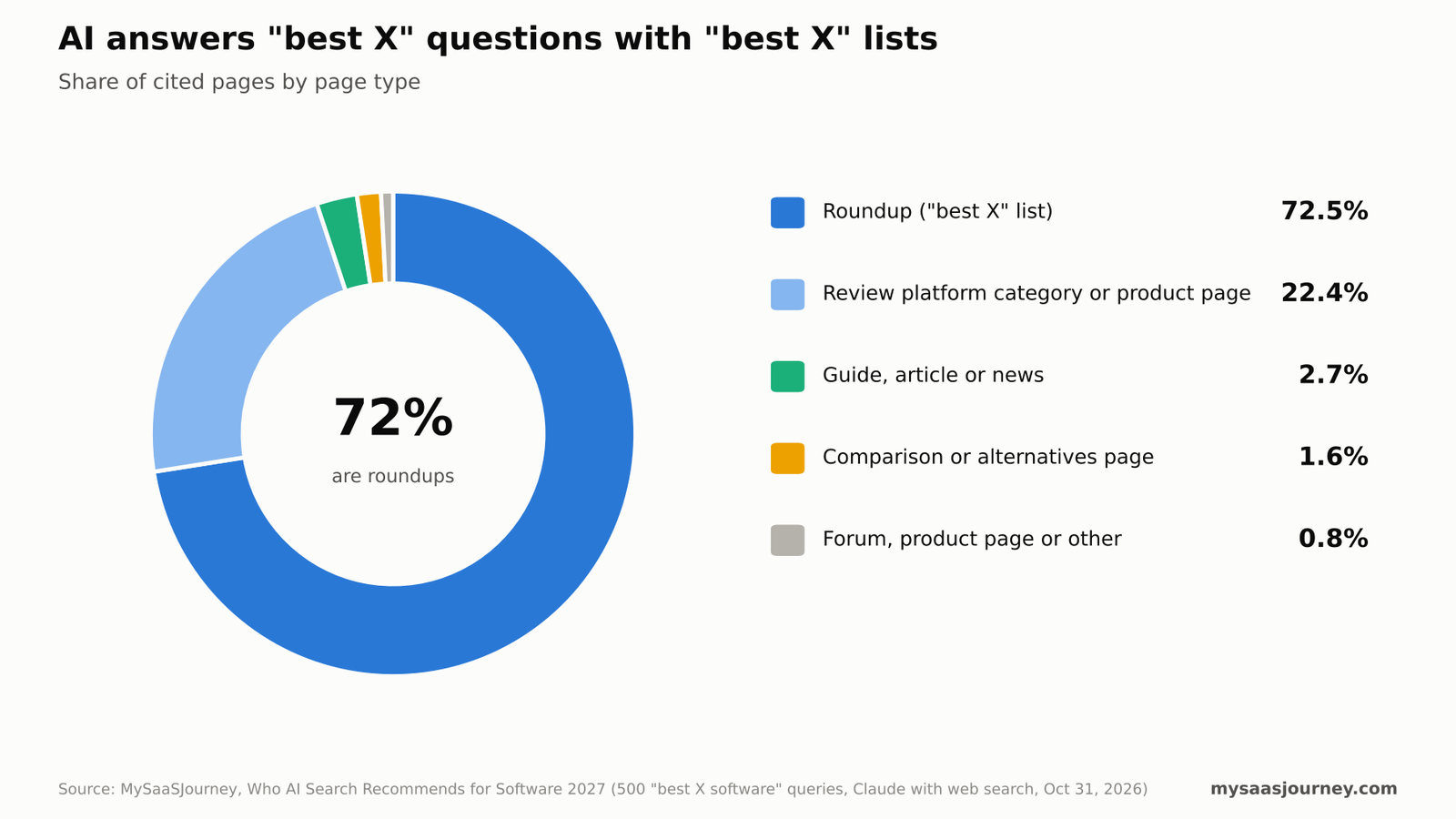
List-style pages made up 94.9% of citations. Comparison pages earned only 1.6%, because they answer a later-stage question such as “X vs Y”. Vendor product, pricing and homepage pages earned 0.1%: a product page does not directly answer “what is the best software in this category?”
Among page titles that included a year, 76.4% of cited pages said 2026, compared with 66.4% of search results. Only 12.3% of dated cited pages showed 2024 or earlier, compared with 21% of dated results. A year in a title is an imperfect freshness signal, but the association is clear.
What makes a citable page?
- A list format that answers “best X” directly.
- A title that matches the query, with the category name spelled out.
- A current date in the title or clearly on the page.
- A canonical URL, not a regional mirror, translated copy or page two of a list.
- A recognizable publisher, whether a review platform, established media brand or specialist site with consistent coverage.
Concentration: how few sites win most citations
| Measure | Value |
|---|---|
| Different sites cited | 901 |
| Share of citations to top 3 sites | 24.8% |
| Share of citations to top 10 sites | 37.5% |
| Share of citations to top 25 sites | 48.3% |
| Sites needed to reach 50% of citations | 29 |
| Sites needed to reach 80% of citations | 359 |
| Sites cited exactly once | 668 (74%) |
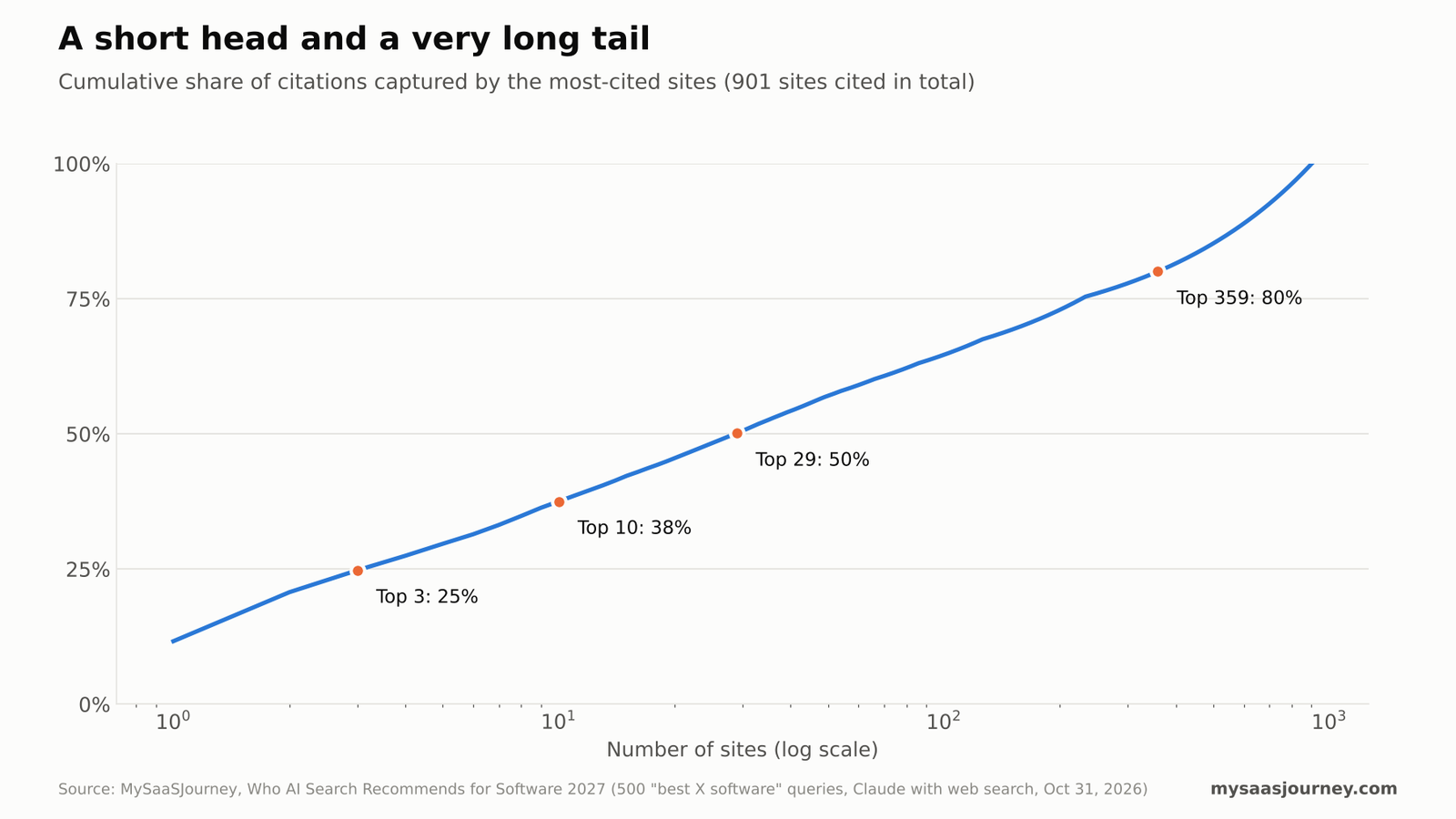
The top is concentrated: three sites earned a quarter of citations and 29 earned half. The long tail is broad: 359 sites were needed to reach 80%, and three quarters of cited sites appeared once.
Concentration by owner
| Publisher group | Sites cited in the study | Citations | Share of citations | Answers citing group |
|---|---|---|---|---|
| G2 network | G2, Capterra, Software Advice, GetApp and regional editions | 685 | 25.2% | 75.2% |
| Black & White Zebra | The CTO Club, The Digital Project Manager, The CMO, CRO Club, People Managing People, The CX Lead, The CFO Club, The Retail Exec, The Ecomm Manager, The QA Lead | 142 | 5.2% | 27.0% |
| TechnologyAdvice | TechRepublic, eWeek, Datamation, TechnologyAdvice, Project-Management.com, eSecurity Planet and related titles | 92 | 3.4% | 16.4% |
| Future plc | TechRadar, Tom’s Guide, Creative Bloq, ITPro, Top Ten Reviews and related titles | 99 | 3.6% | 16.6% |
| Combined | — | 1,018 | 37.5% | — |
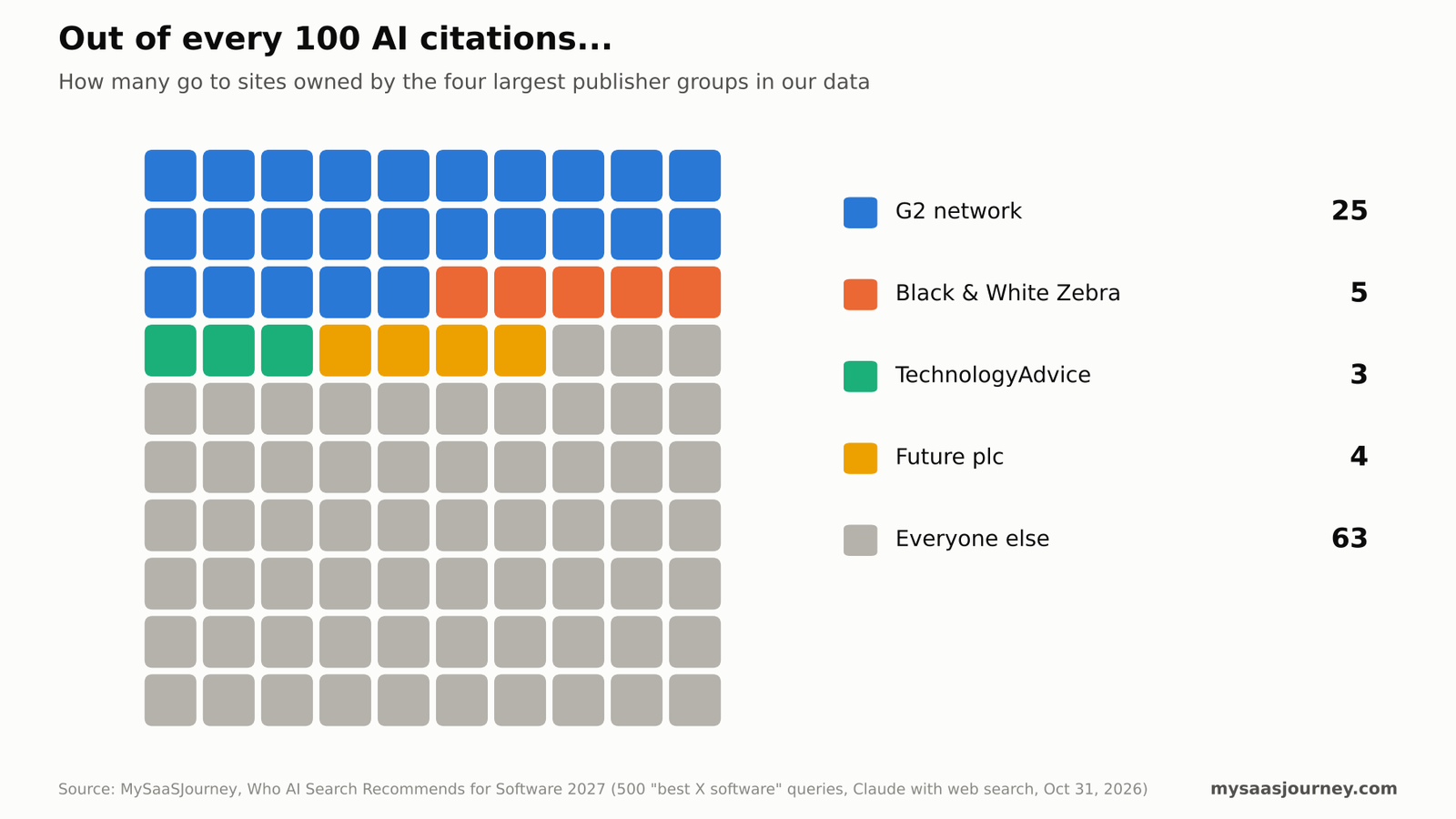
Black & White Zebra’s portfolio of role-specific publications collectively appeared in more than a quarter of answers. TechnologyAdvice and Future plc also operate portfolios of technology titles. Buyers should count owners, not just links: several citations from one publisher group do not represent several independent viewpoints.
What this means for buyers, vendors and publishers
For software buyers
- Check who wrote each citation. In 66.2% of answers, at least one source was published by a company that sells software in the category. A vendor roundup may be useful, but it is not independent.
- Count owners, not links. The G2 network supplied a quarter of citations, and 44.2% of answers cited two or more of its pages. Treat G2, Capterra, Software Advice and GetApp as one owner when weighing evidence.
- Look for missing perspectives. Reddit and YouTube were absent from this engine’s results. Search community platforms directly when real-user experience matters.
- Ask a second question. Follow “best X software” with your company size, budget, industry and integration requirements to surface more relevant sources.
For software vendors and marketers
- Treat review platforms as infrastructure. Keep G2 and Capterra profiles, reviews, category assignments and product information current. In categories where the network is weaker, invest relatively more in editorial coverage.
- Publish one honest category roundup. Vendor roundups earned nearly 30% of citations; when a vendor’s roundup was cited, the vendor made the shortlist 46% of the time. Make it a useful buyer guide, not a disguised product pitch.
- Rank first, then get chosen. Top-three results were cited 50.6% of the time, but ranking alone is insufficient. Make pages specific, current, canonical and genuinely helpful.
- Avoid duplicate pages. Consolidate locale copies and use clear titles and correct language/region markup for genuinely localized pages.
- Earn coverage in the right publications. Identify the publishers cited in your category and build credible editorial relationships.
- Match page format to search intent. Comparison pages serve “X vs Y” queries; category queries need a strong category roundup.
- Keep content fresh and show it. Update roundups on a schedule and make the update visible.
- Do not build around one engine. Search indexes differ. Diversify across review platforms, editorial publishers, vendor content and communities.
For publishers and review sites
The four largest publisher groups earned 37.5% of citations, but 668 sites earned exactly one citation. The opportunity for smaller publishers is the long tail: create focused coverage in specific categories, use accurate current titles, maintain one canonical page per category, avoid duplicate regional pages and disclose commercial relationships clearly.
How to audit your own category in an afternoon
- List five to ten “best X software” queries buyers actually use, including modifiers such as “for small business” or “for agencies”.
- Run each query with the same AI assistant in a fresh conversation and use the exact wording. Repeat on other assistants to compare their retrieval layers.
- Record every citation, URL, domain, owner and whether the publisher sells in the category.
- Search the same phrase in a conventional search engine and record cited pages’ positions and high-ranking pages that were ignored.
- Classify and count citations by review platform, vendor, media and independent source; group by owner.
- Act on gaps: improve review profiles, pitch relevant publishers, consolidate duplicate pages and publish a current, honest category guide.
- Repeat quarterly. Keep the date, assistant, query, cited URLs and recommended products in a spreadsheet.
What comes next: five predictions
These are MySaaSJourney’s expectations based on the observed patterns, not measured findings.
- Review-platform concentration will receive more public scrutiny as one company owns the sites behind a quarter of citations.
- AI assistants may begin labeling source types such as review platform, vendor and editorial publisher.
- Vendors will invest more in category roundups, and genuinely useful buyer guides will outperform thin promotional pages.
- Role-based publisher portfolios will multiply as media groups copy the model of focused publications for specific buyer roles.
- “Search rank for AI” will converge with SEO because ordinary search ranking remains the gateway to web-search citations.
Conclusion
When a buyer asks an AI for the best software in a category, the answer looks simple: five names and a few links. In our 500 queries, the process looked like a busy editor working from headlines: it considered about 19 results per question, cited about five, preferred higher-ranked pages, ignored spam and duplicates, favored fresh pages and leaned on roundups and review platforms.
The citation landscape has two faces. Influence is concentrated: one company owns sites behind a quarter of citations and reaches three quarters of answers, while four publisher groups together earn 37.5%. Vendor roundups make up nearly 30% of the evidence base, and the vendor behind a cited list makes the shortlist almost half the time. Yet 901 sites were cited, 668 only once, leaving room for specialist publishers.
Buyers should check who is speaking, count owners rather than links and seek missing perspectives. Vendors and publishers should create pages that are specific, current, honest and easy to find. We plan to repeat the study and extend it to other AI engines so changes can be tracked over time.
The 30 most-cited sites: full table
The full dataset contains all 901 cited sites. The following table lists the 30 most-cited and summarizes citation frequency and citation rate.
| Rank | Site | Type | Owner group | Citations | Share of answers | Search appearances | Citation rate |
|---|---|---|---|---|---|---|---|
| 1 | g2.com | Review platform | G2 network | 316 | 48.0% | 1,065 | 29.7% |
| 2 | capterra.com | Review platform | G2 network | 246 | 46.6% | 534 | 46.1% |
| 3 | softwareadvice.com | Review platform | G2 network | 110 | 21.8% | 237 | 46.4% |
| 4 | techradar.com | Media publisher | Future plc | 73 | 14.6% | 108 | 67.6% |
| 5 | zapier.com | Software vendor | Other | 60 | 11.8% | 110 | 54.5% |
| 6 | itechguides.com | Independent blog | Other | 48 | 9.6% | 104 | 46.2% |
| 7 | selecthub.com | Review platform | Other | 47 | 9.0% | 102 | 46.1% |
| 8 | techrepublic.com | Media publisher | TechnologyAdvice | 45 | 9.0% | 102 | 44.1% |
| 9 | thectoclub.com | Media publisher | Black & White Zebra | 41 | 8.2% | 59 | 69.5% |
| 10 | softwaretestinghelp.com | Independent blog | Other | 32 | 6.4% | 58 | 55.2% |
| 11 | fitsmallbusiness.com | Independent blog | Other | 29 | 5.8% | 29 | 100.0% |
| 12 | findstack.com | Review platform | Other | 26 | 5.2% | 71 | 36.6% |
| 13 | thedigitalprojectmanager.com | Media publisher | Black & White Zebra | 25 | 5.0% | 31 | 80.6% |
| 14 | clickup.com | Software vendor | Other | 24 | 4.8% | 99 | 24.2% |
| 15 | comparitech.com | Independent blog | Other | 24 | 4.8% | 42 | 57.1% |
| 16 | geekflare.com | Media publisher | Other | 19 | 3.8% | 33 | 57.6% |
| 17 | gitnux.org | Independent blog | Other | 19 | 3.8% | 48 | 39.6% |
| 18 | omr.com | Review platform | Other | 17 | 3.4% | 53 | 32.1% |
| 19 | nerdwallet.com | Media publisher | Other | 17 | 3.4% | 25 | 68.0% |
| 20 | solutionsreview.com | Media publisher | Other | 17 | 3.4% | 38 | 44.7% |
| 21 | quicksprout.com | Independent blog | Other | 16 | 3.2% | 20 | 80.0% |
| 22 | sourceforge.net | Review platform | Other | 16 | 3.2% | 108 | 14.8% |
| 23 | crm.org | Independent blog | Other | 15 | 3.0% | 31 | 48.4% |
| 24 | cloudwards.net | Independent blog | Other | 14 | 2.8% | 19 | 73.7% |
| 25 | softwaresuggest.com | Review platform | Other | 14 | 2.8% | 95 | 14.7% |
| 26 | thecmo.com | Media publisher | Black & White Zebra | 13 | 2.6% | 14 | 92.9% |
| 27 | hubspot.com | Software vendor | Other | 13 | 2.6% | 15 | 86.7% |
| 28 | croclub.com | Media publisher | Black & White Zebra | 12 | 2.4% | 17 | 70.6% |
| 29 | expertmarket.com | Independent blog | Other | 12 | 2.4% | 23 | 52.2% |
| 30 | peoplemanagingpeople.com | Media publisher | Black & White Zebra | 12 | 2.4% | 16 | 75.0% |
Download the dataset
The full dataset is available in four CSV files. Together they contain all 500 queries and answers, 2,714 citations, 9,624 search results and 901 cited sites.
- Download queries and answers (500 rows)
- Download citations (2,714 rows)
- Download search results (9,624 rows)
- Download cited sites (901 rows)
All data was collected on October 31, 2026.
Frequently asked questions
Which websites do AI search engines cite most for “best software” questions?
In this study of 500 queries run through Claude with web search, the most-cited sites were G2 (cited in 48.0% of answers), Capterra (46.6%), Software Advice (21.8%), TechRadar (14.6%) and Zapier (11.8%).
Who owns G2, Capterra and Software Advice?
G2 announced its acquisition of Capterra, Software Advice and GetApp from Gartner in January 2026; the deal was reported closed in February. Together, these brands earned 25.2% of citations and appeared in 75.2% of answers in this dataset.
Do AI assistants cite software vendors’ own blogs?
Yes. Vendor sites earned 30.9% of citations, and 66.2% of answers cited at least one page from a company selling in the category. When such a vendor page was cited, the vendor’s own product made the shortlist 46.1% of the time.
Does search ranking still matter for AI citations?
In this study, results in positions 1–3 were cited 50.6% of the time, compared with 11.9% for results ranked 16th or lower.
Does AI search cite Reddit and YouTube for software recommendations?
Not in the engine and search snapshot studied. Reddit, YouTube and Quora did not appear in the 9,624 search results, so they were never cited. Other AI engines may differ.
What kind of page is most likely to be cited for a “best X software” query?
A roundup: 72.5% of cited pages were “best X” lists and 22.4% were review-platform pages. Comparison pages earned 1.6% and vendor product pages 0.1%.
Do AI answers prefer recent content?
Among page titles that showed a year, 76.4% of cited pages said 2026, compared with 66.4% of search results. This is an association, not proof that changing a title year alone improves citations.
How concentrated are AI software citations?
The top 10 sites earned 37.5% of citations and 29 sites earned half. At the same time, 901 different sites were cited, and 668 were cited only once.
Which AI engine does this study cover?
Claude by Anthropic, using its built-in web search, run on October 31, 2026. Results for ChatGPT, Perplexity, Google AI Overviews, Gemini or Copilot may differ.
Sources and disclosure
The AI search dataset is original research by MySaaSJourney. Publisher ownership groupings were checked against public records and company announcements, including G2’s acquisition announcement, TechnologyAdvice’s ownership information, Black & White Zebra’s publication information and Future plc’s portfolio information.
Suggested citation: MySaaSJourney (2026). Who AI Search Recommends for Software 2027: Which sites an AI search engine cites for 500 “best X” software queries. Data collected October 31, 2026. https://mysaasjourney.com/research/who-ai-search-recommends-for-software/
This study was conducted independently by MySaaSJourney. It was not commissioned, sponsored or reviewed by any software vendor, review platform or publisher named in it. MySaaSJourney did not appear in any search results or citations in the dataset. Claude was used as a research assistant to run queries and label cited sources; the most-cited-site labels, ownership groupings and calculations were checked by MySaaSJourney. Findings describe one AI engine on one day and should be read as a snapshot, not a permanent ranking.