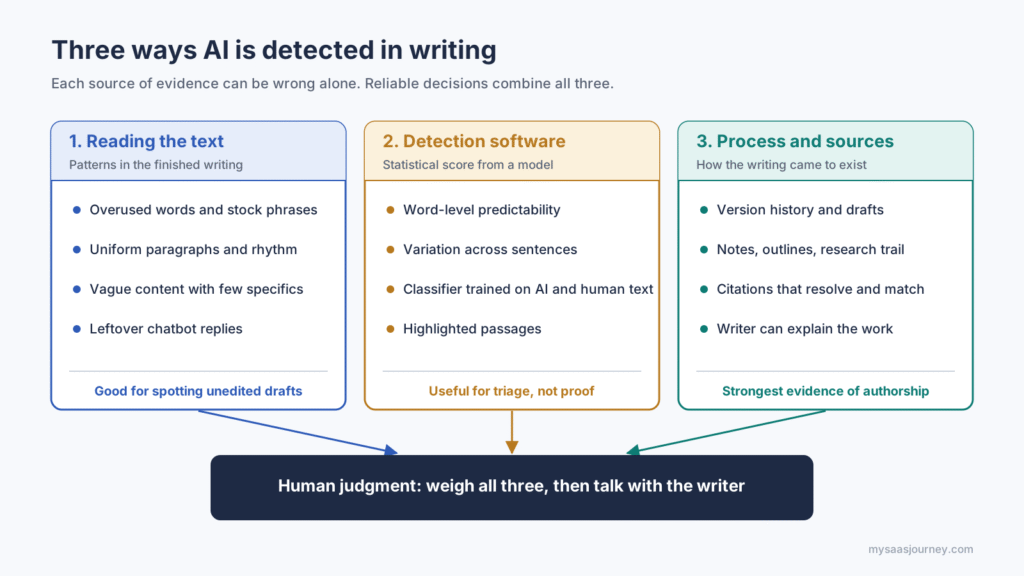

How AI is detected in writing, in short: AI-generated writing is detected in three ways. Readers look for linguistic patterns that language models overuse, AI detection software scores how predictable the text is, and reviewers check the writing process, such as drafts, version history, and whether sources are real. Each method can be wrong on its own, so reliable judgments combine all three.
AI writing is now common enough to leave measurable traces. A 2024 study of about 14 million PubMed abstracts tracked sudden jumps in words that language models favor and estimated that at least 10% of biomedical abstracts published in 2024 were processed with large language models. Teachers, editors, hiring managers, and publishers now face the same question every day: was this written by a person, by AI, or by both?
This guide focuses on how people actually detect AI in written work. It covers the signs reviewers look for in vocabulary, structure, and content, what detection tools add, how process evidence and citation checks settle most cases, a step-by-step review workflow, why honest writers sometimes get flagged, and how writers can show their work is their own. It is vendor-neutral and written for educators, editors, content managers, and writers on both sides of the question.
What Are the Three Ways AI Is Detected in Writing?
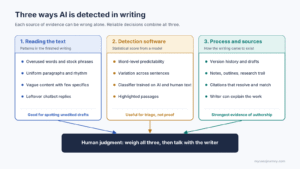
AI writing is detected through the text itself, through software, and through the story of how the text was made. These three sources of evidence differ in how strong they are and how easy they are to fool.
| Method | What it looks at | Strength | Main weakness |
| Reading for patterns | Word choice, sentence rhythm, structure, tone, and content quality | Good at spotting unedited AI drafts | Subjective, and many patterns also appear in human writing |
| Detection software | Statistical predictability of the text compared with known human and AI writing | Fast and consistent across large volumes | Produces false positives and misses edited AI text |
| Process evidence | Drafts, version history, notes, sources, and the writer’s ability to explain the work | Strongest evidence of authorship | Takes time and requires access to the writer or their files |
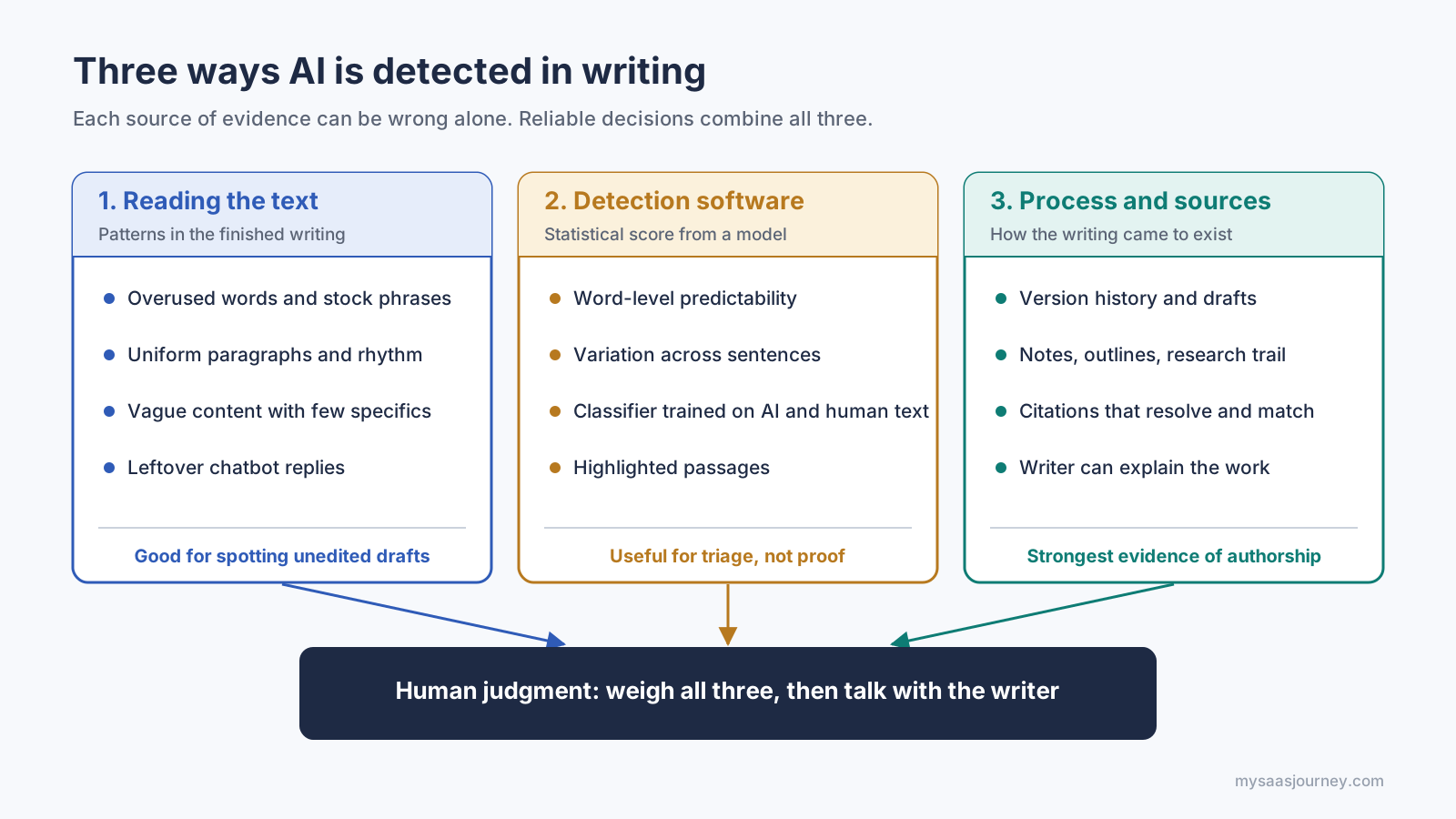
Text patterns, detector scores, and process evidence each answer a different question, so reviewers combine them before deciding.
The first two methods examine the finished product. The third examines how the product came to exist, which is why it carries the most weight. A polished essay with a detailed version history, real sources, and a writer who can discuss every argument is very likely human, whatever a detector says. An essay that appeared in a single paste, cites a book that does not exist, and that the writer cannot explain raises serious questions, even if a detector gives it a low score.
If you want to understand the statistics behind detection software, such as perplexity, burstiness, classifiers, and watermarks, our companion guide on how AI detection works covers the technical side in depth. This guide stays focused on how to review written work.
What Are the Signs of AI-Generated Writing?
The most reliable signs of AI-generated writing are generic content, predictable structure, and polished but empty phrasing, especially when several appear together. A single sign proves nothing, because every one of them also shows up in human writing. Look for clusters of signs that point the same way instead.
Wikipedia’s volunteer editors, who review large volumes of submitted text, maintain a public guide called “Signs of AI writing” that catalogs these habits in detail. Their main lesson matches what educators and editors report: specific patterns are easier to trust than a general feeling that text “sounds like AI.”
Vocabulary and Phrasing
- Favorite words: Language models overuse certain words, such as delve, intricate, pivotal, tapestry, testament, underscore, showcase, and seamless. The 2024 PubMed study found that this kind of style vocabulary rose sharply after ChatGPT’s release, far above normal year-to-year change.
- Inflated significance: Ordinary facts are framed as “a pivotal moment,” “a testament to,” or “a rich tapestry of” something, without evidence for the claim.
- Vague trailing clauses: Sentences end with phrases such as “highlighting the importance of collaboration” or “reflecting a broader commitment to innovation” that add tone but no information.
- Promotional tone: Neutral topics are described in advertising language, such as “vibrant,” “breathtaking,” or “nestled in the heart of.”
- Hedged balance: Paragraphs that weigh both sides and conclude that “ultimately, the right choice depends on your needs” without ever taking a position.
Structure and Rhythm
- Groups of three: Lists, adjectives, and examples arrive in threes far more often than in typical human writing.
- Uniform paragraphs: Each paragraph is a similar length, opens with a topic sentence, and closes with a summary line.
- Formulaic transitions: Heavy use of “Furthermore,” “Moreover,” “Additionally,” and “In conclusion.”
- Restated conclusions: The ending repeats the introduction in slightly different words.
- Even rhythm: Sentences are similar in length and complexity throughout, with few short, punchy lines or long, winding ones.
Content and Substance
- Missing specifics: Few names, dates, numbers, places, or firsthand details, and examples that could apply to almost anything.
- Confident errors: Plausible but wrong facts, invented statistics, and citations to sources that do not exist.
- No personal stake: No opinion, experience, doubt, or humor that ties the writing to a real person.
- Off-target answers: A well-written response to a slightly different question than the one assigned.
Formatting and Leftover Chat Artifacts
- Chatbot formatting in prose: Bolded mini-headings, bullet lists, and title-case headings in places that call for paragraphs, plus unusually heavy use of em dashes.
- Leftover replies: Phrases such as “Certainly! Here is,” “I hope this helps,” “As of my last knowledge update,” or “[insert example here]” pasted in by mistake.
- Broken source formatting: Citation markers, placeholder links, or URL parameters copied from a chat interface.
| Sign | Strength as evidence | Why it can mislead |
| Leftover chatbot replies or placeholders | Strong | Rare in human writing, though a writer may have used AI only for one section |
| Fabricated citations or facts | Strong | Humans also cite carelessly, so verify before concluding |
| Generic content with no specifics | Moderate | Common in rushed or inexperienced human writing |
| Overused AI vocabulary | Weak to moderate | Many of these words were normal before AI, and people pick up AI phrasing too |
| Groups of three and formulaic transitions | Weak | Taught in many schools and style guides |
| Uniform paragraphs and even rhythm | Weak | Typical of careful, edited, or non-native writing |
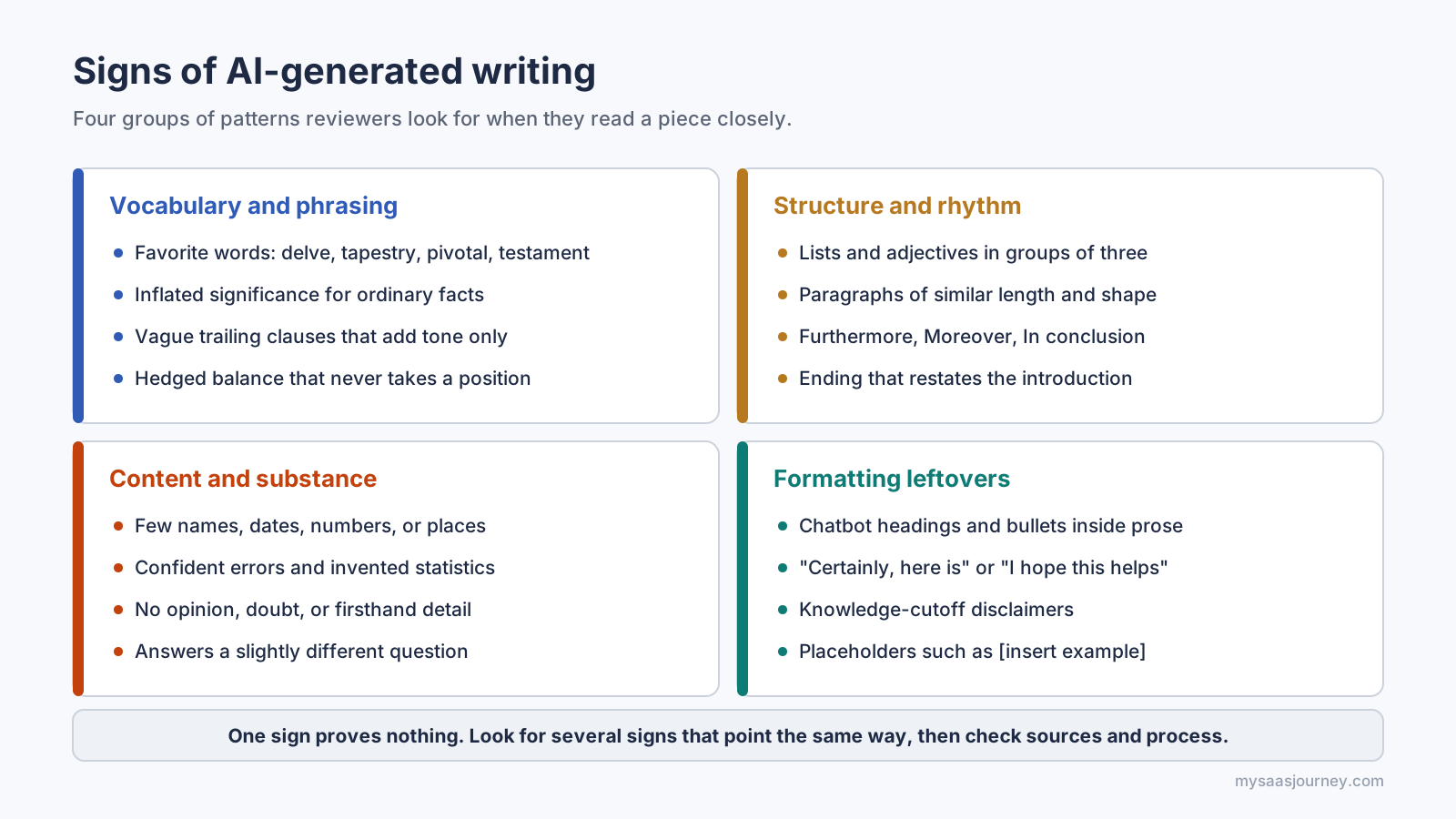
The four groups of signs reviewers look for. Several signs pointing the same way matter more than any single one.
How Do AI Detection Tools Analyze Writing?
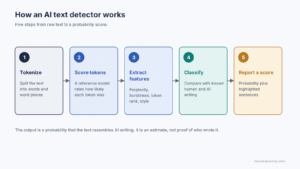
AI detection tools analyze writing by measuring how predictable each word and sentence is to a language model, then comparing that pattern with large samples of known human and AI text. They return a probability that the writing resembles AI output, often with sentence-level highlights.
What the Tool Actually Measures
A detector does not look for the vocabulary and structure signs listed above in the way a person does. It runs the text through its own model and records how likely each word was. AI writing tends to follow the most probable path, so it scores as highly predictable. Detectors also measure how much that predictability varies across sentences, a signal often called burstiness. Human writing usually rises and falls more.
How to Read the Report
Most detector reports have three parts:
- An overall score, such as “78% AI” or “likely AI-generated.” Check your tool’s definition. A score often means the probability that the text resembles AI writing, not the share of words a machine wrote.
- Highlighted sentences, which show where the tool found the strongest signal. These are the passages to read closely and to ask the writer about.
- A confidence note or threshold, which some tools show when a result is uncertain, such as for short texts or low scores.
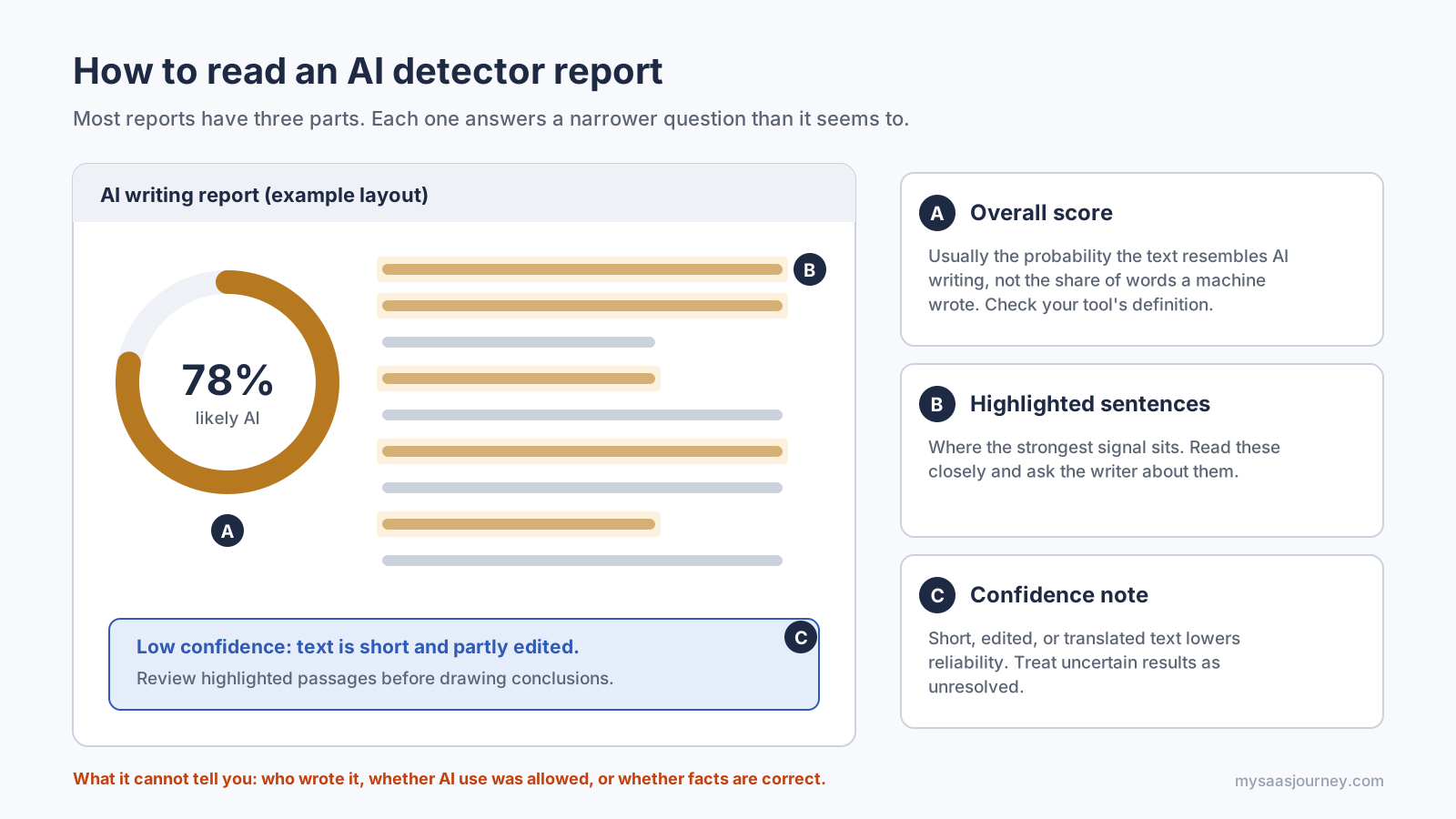
A generic report layout. The overall score, the highlights, and the confidence note each answer a narrower question than they appear to.
What Detection Tools Cannot Tell You
- Who wrote the text. A tool cannot say whether a person, an AI, or both produced a passage, only how closely it matches patterns.
- Whether AI use was allowed. Using AI to outline, translate, or fix grammar may be fine under your policy, and a detector cannot see the difference.
- Whether the content is accurate. A low AI score does not mean facts and citations are real.
Use a detector as a triage tool that tells you where to look. It is fast and consistent for screening large volumes, but its result should lead to a closer human review, not to a verdict.
How Do Teachers and Editors Check the Writing Process?
Teachers and editors increasingly judge AI use by how a piece was written rather than by how it reads. Process evidence is harder to fake than finished text, and it protects honest writers whose style happens to resemble AI.
Version History
Cloud editors such as Google Docs and Microsoft Word on OneDrive keep a version history that shows when text was added, by whom, and in what order. Human writing usually grows in many small sessions with typing, deleting, and reordering. A document where several polished paragraphs appear in one moment, with no earlier drafts, suggests the text was pasted from somewhere else. That might be AI, but it might also be a writer who drafted offline, so ask before concluding. If your team is choosing a cloud editor, our Google Drive vs OneDrive comparison covers how each handles files and sharing.
Drafts, Notes, and Outlines
Earlier drafts, research notes, outlines, and annotated sources show how ideas developed. Writers rarely produce these as an afterthought, so they are good evidence. Many teachers now collect an outline or rough draft before the final submission for exactly this reason.
Comparison With Earlier Work
A sudden change in vocabulary, sentence length, error patterns, or confidence compared with a writer’s previous work is worth a conversation. This is the human version of stylometry. It works best when you have several earlier samples written under known conditions.
A Conversation About the Work
Asking a writer to explain their argument, define a term they used, or describe how they found a source is often the fastest way to resolve doubt. People who wrote a piece can usually talk about it in their own words, including the parts they struggled with. Keep the tone curious rather than accusatory.
Supervised or In-Class Writing
Short timed writing, handwritten responses, and in-class drafts create a baseline sample produced without AI. Many educators combine these with take-home work so both can be compared.
| Evidence | Strength | Notes |
| Detailed version history with gradual drafting | Strong | Hard to fake, though it can be reconstructed by retyping AI text |
| Writer can explain the work in depth | Strong | Best used as a supportive conversation |
| Real, relevant, correctly cited sources | Strong | Fabricated sources are a serious red flag |
| Earlier drafts, outlines, and notes | Moderate to strong | Check that dates and content fit the timeline |
| Consistency with earlier writing samples | Moderate | Writers improve, and editing tools change style |
| AI detector score | Weak to moderate | Useful for triage only |
| A feeling that it sounds like AI | Weak | Prone to bias, so look for specific evidence |
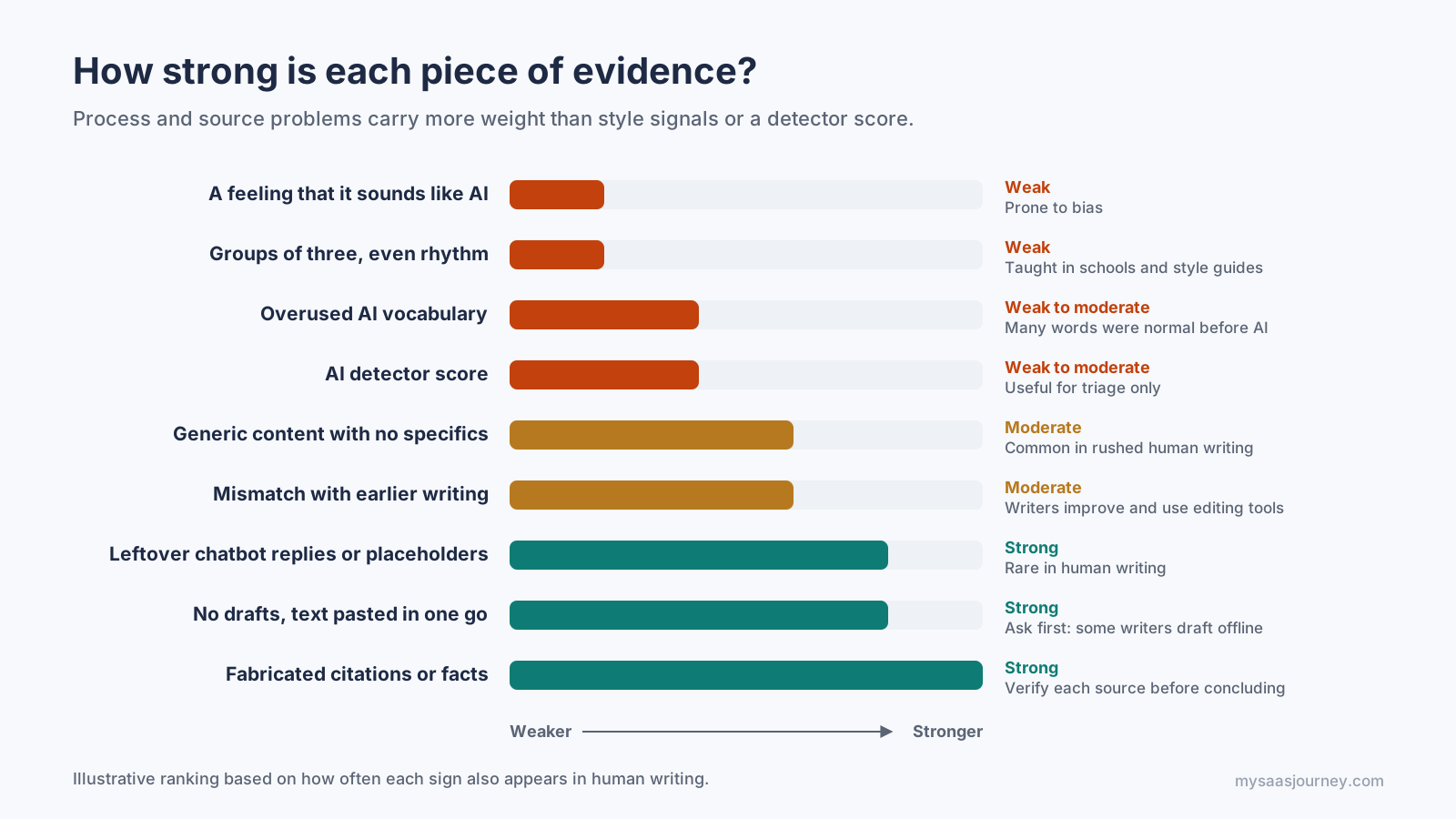
An illustrative ranking of evidence strength. Process and source problems outweigh style signals and detector scores.
How Do You Check Citations and Facts for AI Fabrication?
Check citations and facts by confirming that every source exists, says what the writing claims it says, and is cited correctly. Fabricated references are one of the strongest signs of unreviewed AI writing, because language models can produce titles, authors, and journal names that look real but are not.
Research published in 2023 on early ChatGPT versions found high rates of fabricated and inaccurate references in AI-generated medical writing, and newer models with web search still make citation mistakes. A person who did the research usually knows where each source came from. A fabricated source often has a plausible author, a real journal name, and a title that no database has ever recorded.
Manual Checks
- Search the exact title in a search engine and in Google Scholar or a library database. Real papers and books usually appear immediately.
- Open the DOI or link. A digital object identifier (DOI) should resolve to the cited work, not to a different paper or an error page.
- Confirm the details. Check that the authors, year, and journal match, and that the page or quote actually supports the claim in the text.
- Check statistics at the source. Search for any number the writing gives, and confirm the original source, year, and context.
- Watch for misattributed quotes. AI tools often attach a real-sounding quote to a famous person who never said it.
Automate DOI Checks for Long Reference Lists
For a reference list with many DOIs, you can check each one against Crossref, the main registry for scholarly DOIs, using its free public API. The short Python script below looks up each DOI and compares the registered title with the title in the reference. If you are new to APIs, our guide to what an API is explains the request and response pattern it uses.
# check_dois.py: confirm that each DOI exists and matches the cited title
import requests
from difflib import SequenceMatcher
CROSSREF = “https://api.crossref.org/works/”
HEADERS = {“User-Agent”: “citation-checker/1.0 (mailto:you@example.com)”}
references = [
{“doi”: “10.1000/example-doi-1”, “title”: “Title as written in the reference list”},
{“doi”: “10.1000/example-doi-2”, “title”: “Another cited title”},
]
def similarity(a: str, b: str) -> float:
return SequenceMatcher(None, a.lower(), b.lower()).ratio()
for ref in references:
resp = requests.get(CROSSREF + ref[“doi”], headers=HEADERS, timeout=15)
if resp.status_code == 404:
print(f”NOT FOUND {ref[‘doi’]} (possible fabricated DOI)”)
continue
resp.raise_for_status()
work = resp.json()[“message”]
registered = (work.get(“title”) or [“”])[0]
score = similarity(ref[“title”], registered)
status = “OK ” if score > 0.8 else “MISMATCH ”
print(f”{status}{ref[‘doi’]} cited: {ref[‘title’][:50]} registered: {registered[:50]}”)
A “NOT FOUND” result means the DOI is not registered with Crossref. That is a strong warning sign, but some DOIs are registered with other agencies, so confirm by opening the DOI link before concluding. A “MISMATCH” result means the DOI belongs to a different work, which often happens when AI attaches a real DOI to an invented title. Replace the email address in the header with your own, as Crossref asks API users to identify themselves.
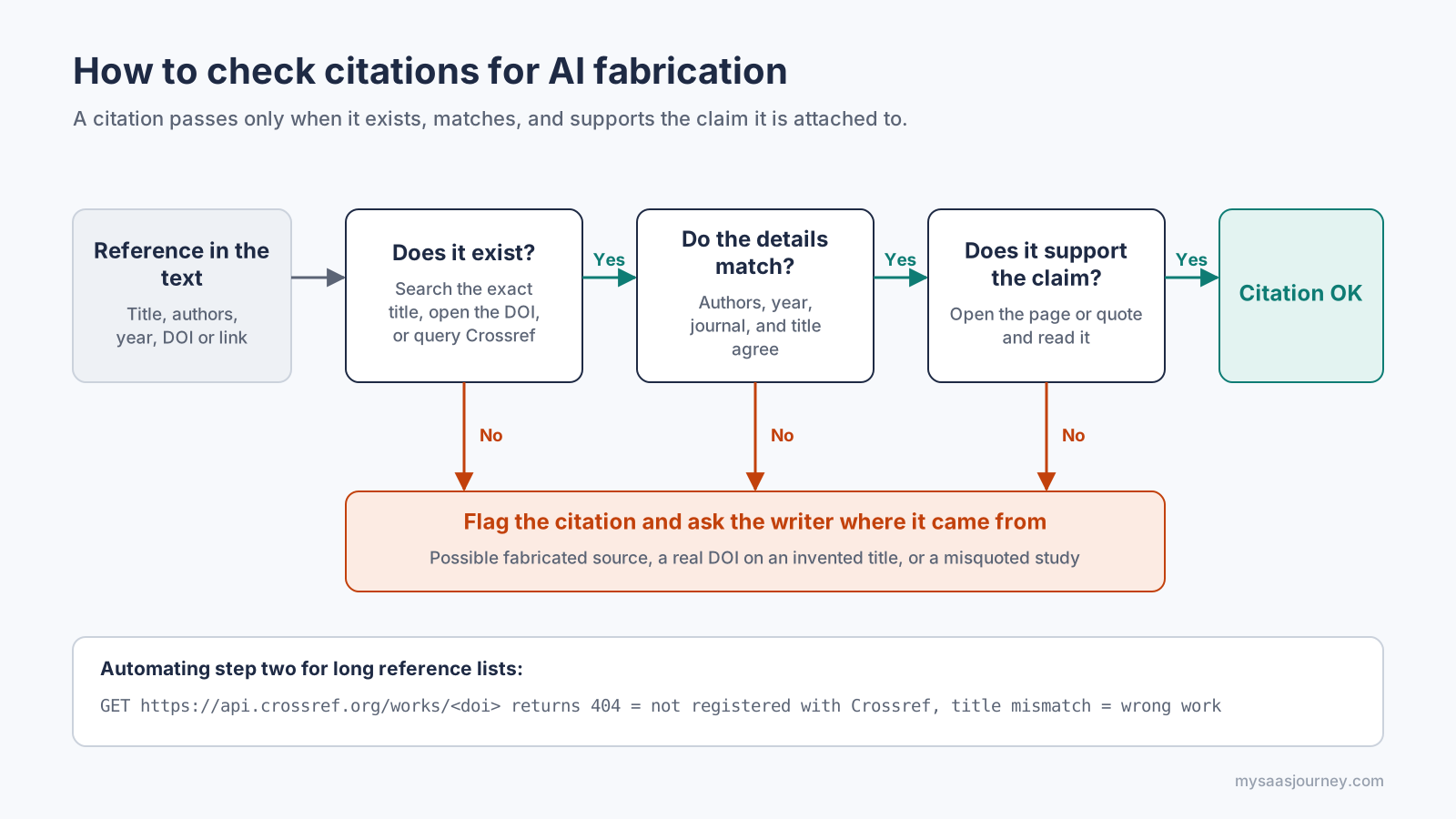
A citation passes only when it exists, its details match, and it supports the claim. A failure at any step is a reason to ask the writer.
How to Check a Piece of Writing for AI, Step by Step
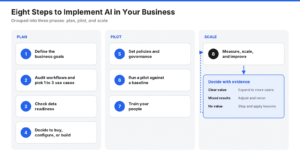
To check a piece of writing for AI, start with the rules that apply, read for specific signs, verify sources, run a detector for triage, review process evidence, and talk with the writer before deciding. The order matters, because it keeps a single weak signal from driving the outcome.
- Confirm the AI policy. Check what your school, publication, or company allows. Many policies permit AI for brainstorming, grammar, or translation but require disclosure. You cannot judge a piece against an unwritten rule.
- Read the whole piece first. Note where it feels generic or off-target, and mark specific sentences rather than recording a general impression.
- Look for strong signs. Search for leftover chatbot phrases, placeholders, and knowledge-cutoff disclaimers. These are rare in human writing and quick to find.
- Verify sources and facts. Check every citation, DOI, quote, and statistic using the steps in the previous section. Fabricated sources settle many cases on their own.
- Run a detector for triage. Use it to find passages worth a closer look. Treat its score as a prompt for questions, not an answer. If possible, compare results from two tools, since disagreement signals low confidence.
- Review process evidence. Ask for version history, drafts, notes, or outlines. Compare with earlier writing samples if you have them.
- Talk with the writer. Ask how they approached the piece, why they chose certain sources, and what they would change. Give them a fair chance to explain.
- Decide and document. Record what you checked, what you found, and why you reached your conclusion. Apply the same process to everyone so outcomes are consistent.
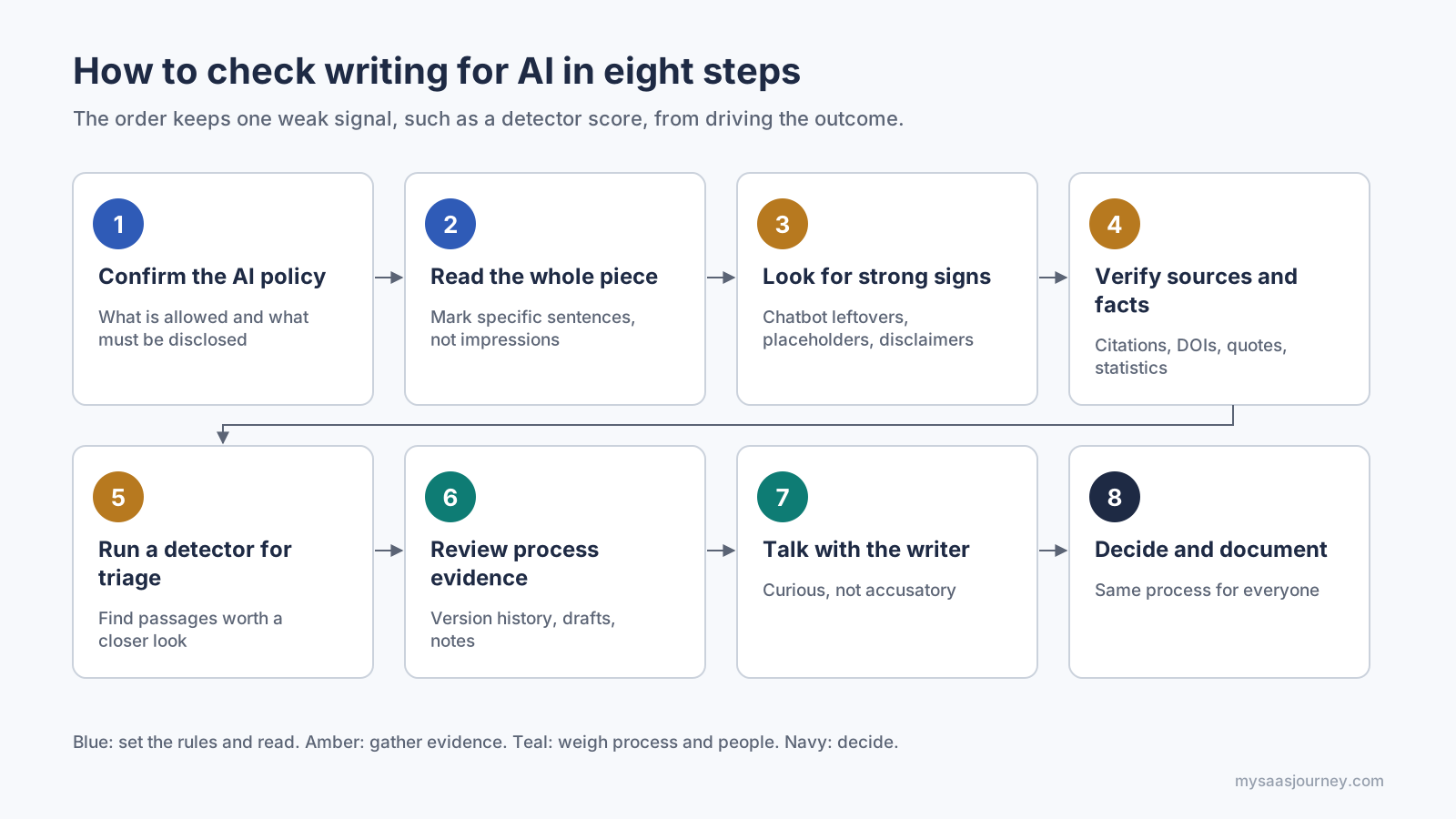
The eight-step review workflow. Evidence gathering comes before the conversation, and the decision comes last.
For content teams, the same workflow doubles as a quality review. Editors who check facts, sources, specificity, and voice catch weak AI-assisted drafts and weak human drafts alike. Many teams also standardize which AI writing tools writers may use, so the review focuses on quality rather than suspicion.
Why Does Human Writing Get Flagged as AI?
Human writing gets flagged as AI when it shares the qualities detectors and readers associate with machines: predictable word choice, even rhythm, formal tone, and textbook structure. Those qualities are often signs of careful or constrained writing, not of AI.
- Non-native English writers tend to use a smaller, more common vocabulary, which makes their text more predictable. A 2023 Stanford study found that seven detectors labeled 61% of essays by non-native English speakers as AI-generated.
- Formulaic genres such as lab reports, legal summaries, product descriptions, and five-paragraph essays follow fixed patterns by design.
- Grammar and style tools that rewrite sentences can smooth out the irregularities that make writing look human.
- Neurodivergent writers may write in a consistent, structured, or literal style that resembles model output.
- Writers who learned from AI text pick up its phrasing. As AI-assisted text spreads, words such as “delve” appear more often in writing by people who never used a chatbot for that piece.
- Short pieces give tools and readers too little evidence, so a few predictable sentences can tip the result.
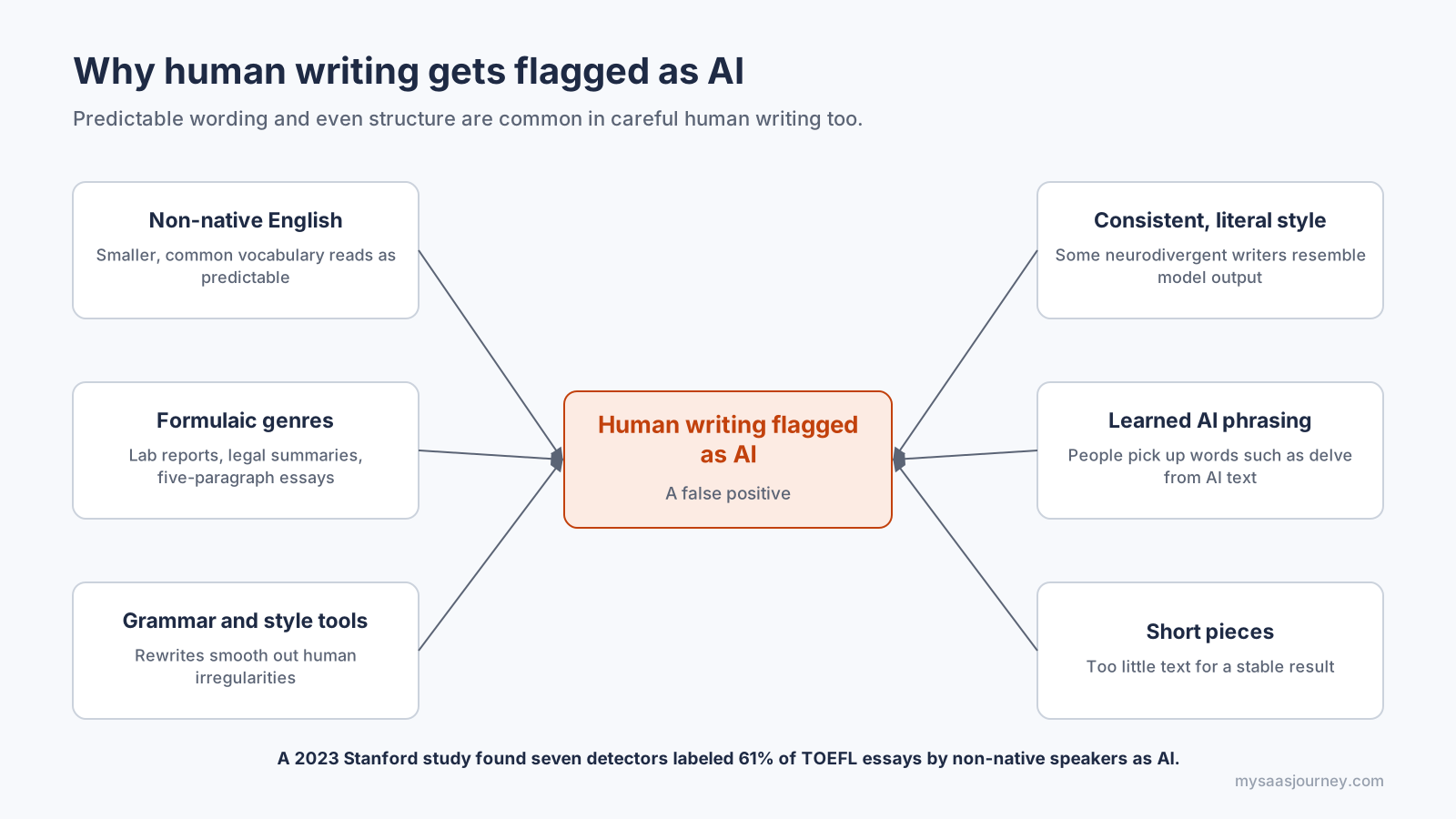
Common causes of false positives. Each one makes careful human writing look more predictable to a detector or a reader.
This is why a fair review never rests on style alone. When the only evidence is that a piece “sounds like AI,” give the possibility of a careful human writer at least as much weight as the possibility of AI.
How Is AI Detected in Schools, Workplaces, and Publishing?
AI is detected differently depending on who reviews the writing and what is at stake. Schools combine detectors with draft checkpoints, publishers focus on sources and disclosure, employers look for consistency with how a person communicates live, and search engines judge page quality rather than authorship.
| Setting | Who reviews | Common methods | What usually decides the outcome |
| Schools and universities | Teachers and academic integrity staff | Detector in the submission platform, draft checkpoints, in-class writing, short oral follow-ups | Process evidence and the student’s explanation |
| Publishing and journalism | Editors, fact-checkers, and peer reviewers | Source and quote checks, plagiarism scans, close editing, AI disclosure statements | Accuracy of sources and compliance with the disclosure policy |
| Hiring | Recruiters and hiring managers | Comparing cover letters and writing samples with interview answers, timed writing tasks | Whether live communication matches the written work |
| Content teams | Managers and editors | Review against a style guide, fact checks, optional detector screening | Quality and accuracy under the team’s AI policy |
| Search engines | Automated ranking systems | Signals of helpfulness, originality, and mass-produced low-value pages | Page quality, not whether AI was involved |
In Schools and Universities
Most schools pair a detector built into their submission platform with assignments that make the process visible. A typical sequence asks for a topic proposal, an outline, a rough draft, and a final version, each submitted separately. Some instructors add a short in-class writing task or a five-minute conversation about the paper. Academic integrity policies at many institutions require evidence beyond a detector score before a case can proceed, which is why drafts and conversations carry so much weight.
In Publishing and Journalism
Editors care most about whether claims, quotes, and sources hold up. A fabricated quote or an invented study is a serious problem whether a person or a model produced it. Many journals and publishers now require authors to disclose any AI use in a methods or acknowledgments section, and publishing ethics bodies such as COPE state that AI tools cannot be listed as authors because they cannot take responsibility for the work.
In Hiring
Recruiters read large numbers of cover letters and writing samples, and polished, generic letters are easy to spot in bulk. What raises concern is a gap between the written application and how the candidate writes or speaks in an interview. Some employers add a short supervised writing exercise to see a baseline. Many do not object to AI help with a cover letter as long as the candidate can back up every claim in it.
On Websites and in Search
Google’s published guidance says it rewards helpful content however it is produced, and its spam policies target scaled content abuse, meaning large numbers of pages created mainly to manipulate rankings. In practice, a site is at risk when it publishes thin, repetitive, or inaccurate pages at volume, not because a single article had AI assistance. Editorial review for accuracy and original insight matters far more for search than passing a detector.
How Can Writers Show Their Work Is Their Own?
Writers can show their work is their own by keeping a visible record of the writing process and by writing with specifics only they could provide. These habits also make writing better, so they are worth adopting whether or not anyone asks.
- Write in a tool with version history. Draft in a cloud editor so your progress is recorded automatically. If you draft offline, save dated copies of each version.
- Keep notes and sources. Save your outline, research notes, and links in a note-taking app or folder, so you can show where ideas came from.
- Add specifics. Use concrete names, numbers, dates, and firsthand observations. Specific detail is the clearest mark of a real writer and the hardest thing for a model to invent correctly.
- Let your voice show. Take positions, explain your reasoning, and vary sentence length naturally. Avoid padding paragraphs with summary lines and stock transitions.
- Cite carefully. Link to sources you actually read and check that each one supports your claim.
- Disclose AI use where required. If you used AI for brainstorming, translation, or grammar, say so according to your school’s or employer’s policy. Disclosure turns a potential accusation into a documented choice.
- Be ready to talk about your work. If questioned, walk through your drafts and decisions calmly. Process evidence is far stronger than any detector score.
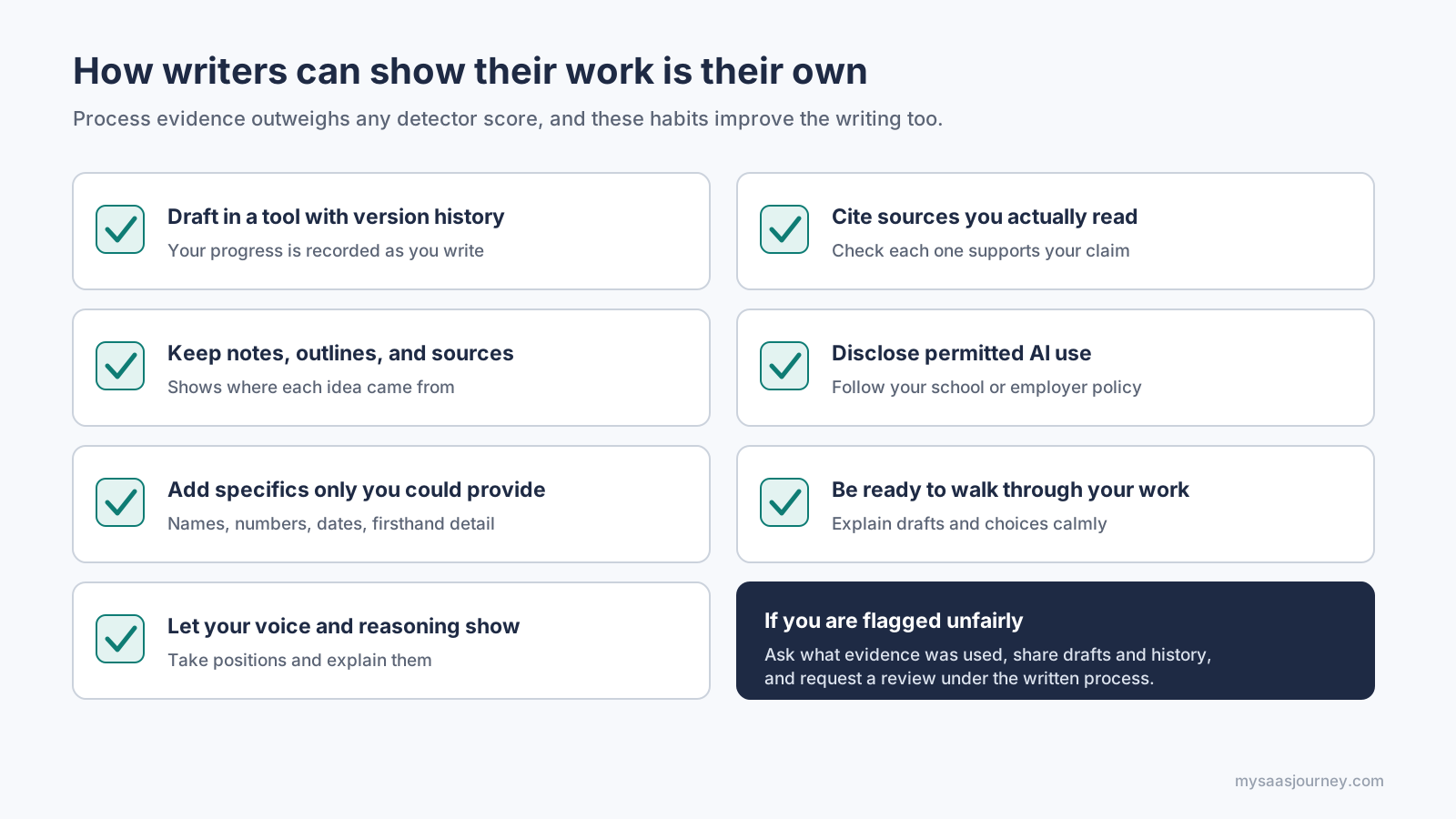
Habits that leave a clear record of authorship and make the writing stronger at the same time.
If you are flagged unfairly, ask which evidence led to the concern, share your version history and notes, and request a review that follows the institution’s written process. Many schools and publishers now state that a detector score alone is not grounds for a penalty.
Frequently Asked Questions
Can teachers tell if you used AI to write an essay?
Teachers often notice AI use through a mismatch with a student’s earlier work, generic arguments that ignore class material, or citations that do not exist. Many also run submissions through a detector such as Turnitin. A careful teacher treats these as reasons to ask questions, then looks at drafts and version history before reaching a conclusion.
How accurate are AI writing detectors?
Accuracy varies by tool, text length, and writing style. Detectors do best on long, unedited AI output and worst on short, heavily edited, or translated text. Independent studies have found meaningful false positive rates, especially for non-native English writers, so a score should never be treated as proof.
What words and phrases give away AI writing?
Common giveaways include “delve,” “tapestry,” “testament to,” “in today’s fast-paced world,” “it’s important to note,” and stock closers such as “in conclusion” followed by a restated summary. A single word proves little on its own, so reviewers look for many of these signs clustered together alongside vague content.
Does Turnitin detect ChatGPT writing?
Yes, Turnitin includes an AI writing indicator that estimates how much of a submission looks machine-generated, and it covers text from ChatGPT and other common models. Turnitin itself advises that the indicator should start a conversation with the student rather than serve as the sole basis for misconduct decisions.
Can Google detect AI-generated content?
Google can likely identify many patterns of mass-produced text, but its published guidance says it rewards helpful, original content however it is produced. What Google targets is content made mainly to manipulate rankings, such as large volumes of thin pages. The quality of the page matters more than whether AI helped write it.
Is using AI to write considered plagiarism?
It depends on the rules that apply to you. Many schools treat undisclosed AI-generated work as academic misconduct even when it is not copied from a specific source. Many employers and publishers allow AI assistance with disclosure. Check your institution’s or client’s policy before you use AI for any part of a piece.
How can I prove I did not use AI?
Share your version history, drafts, outline, and research notes, and offer to explain your choices in person. A document that grew over several sessions with visible revisions is strong evidence of human authorship. Ask the reviewer to weigh this evidence above any detector score.
Can AI detectors flag human writing by mistake?
Yes, this happens often enough that most detector vendors warn about it. Formal, formulaic, or simple writing can look predictable to a detector. Non-native English speakers, technical writers, and people who use grammar tools are flagged more often than others.
Does editing AI text make it undetectable?
Heavy editing usually lowers detector scores, which is one reason scores are unreliable as proof. Editing does not remove the other evidence reviewers check, though. Missing drafts, fabricated citations, and a style that does not match the writer’s other work still show up in a careful review.
Do AI detectors work on languages other than English?
Some detectors support several languages, but accuracy is generally lower outside English because the tools were trained mostly on English text. Translated text is also hard to judge, since translation tools produce smooth, predictable phrasing that can look machine-written.
Summary
AI is detected in writing through three kinds of evidence: patterns in the text itself, scores from detection software, and checks on the writing process and sources. Text signs such as stock phrases, uniform structure, and vague content are useful for spotting a draft that needs a closer look. Detector scores add a second opinion, but they produce false positives often enough that they cannot stand alone. The strongest evidence comes from version history, drafts, and citations that can be verified.
If you review writing, combine all three and talk to the writer before you decide anything. If you write, keep your drafts, add specific detail, and disclose AI use where the rules require it. To understand the statistics behind detector scores, read our guide on how AI detection works, and to compare the assistants these checks are built around, see our roundup of AI writing tools.