
Nov 5, 2026
How AI detection works, in short: An AI detector estimates how likely it is that a piece of content was produced by a generative AI model. For text, most detectors run the writing through a language model of their own, measure how predictable each word is, compare patterns such as perplexity and burstiness with known human and AI writing, and return a probability score. That score is an estimate, not proof.
The gap between estimate and proof is the most important thing to understand about these tools. OpenAI shut down its own AI text classifier in July 2023 because of its low accuracy: it correctly labeled only 26% of AI-written text and wrongly flagged 9% of human writing. A 2023 Stanford study found that seven popular detectors classified 61% of essays by non-native English writers as AI-generated. At the same time, detection is moving beyond guesswork. Since August 2, 2026, the EU AI Act requires providers of generative AI systems to mark their output in a machine-readable way, which pushes the industry toward watermarks and provenance data that can be checked rather than inferred.
This guide explains each step of an AI detection check, the signals detectors measure, the four main detection methods, how accurate they are, why they make mistakes, how image and audio detection differ, and how to use detection results fairly. It is vendor-neutral and written for educators, editors, content teams, and anyone choosing AI content detection tools.
How Does AI Detection Work, Step by Step?
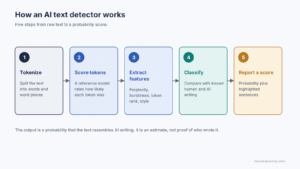
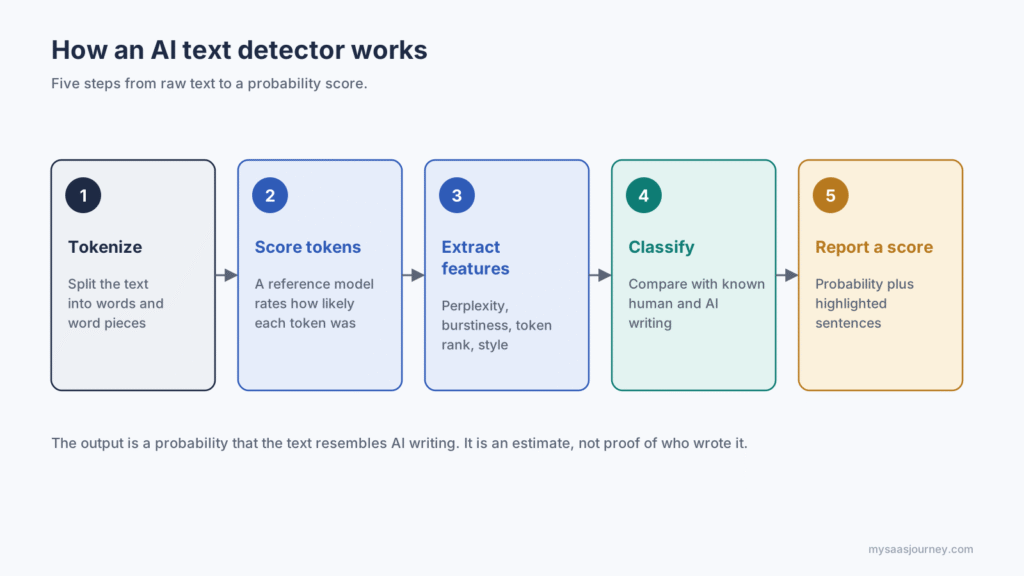
Most AI text detectors follow five steps: split the text into tokens, score how predictable those tokens are, extract style features, run a classifier, and report a probability. The details differ by vendor, but the pipeline looks broadly the same.
- Tokenize the text. The detector breaks your text into tokens, which are words or word fragments, the same units a language model reads and writes.
- Score each token. A reference language model predicts each next token and records how likely the actual token was. AI-generated text tends to use highly probable words, because that is how models generate text.
- Extract features. The detector summarizes those scores into measurable signals, such as average predictability (perplexity), how much that predictability varies from sentence to sentence (burstiness), and patterns in sentence length, vocabulary, and structure.
- Classify. A model trained on large sets of known human and AI writing compares your text's features with both groups and calculates how closely it matches each.
- Report a score. The tool returns an overall probability, often with sentence-level highlights. Many tools only show a verdict once the score passes a threshold they have chosen.
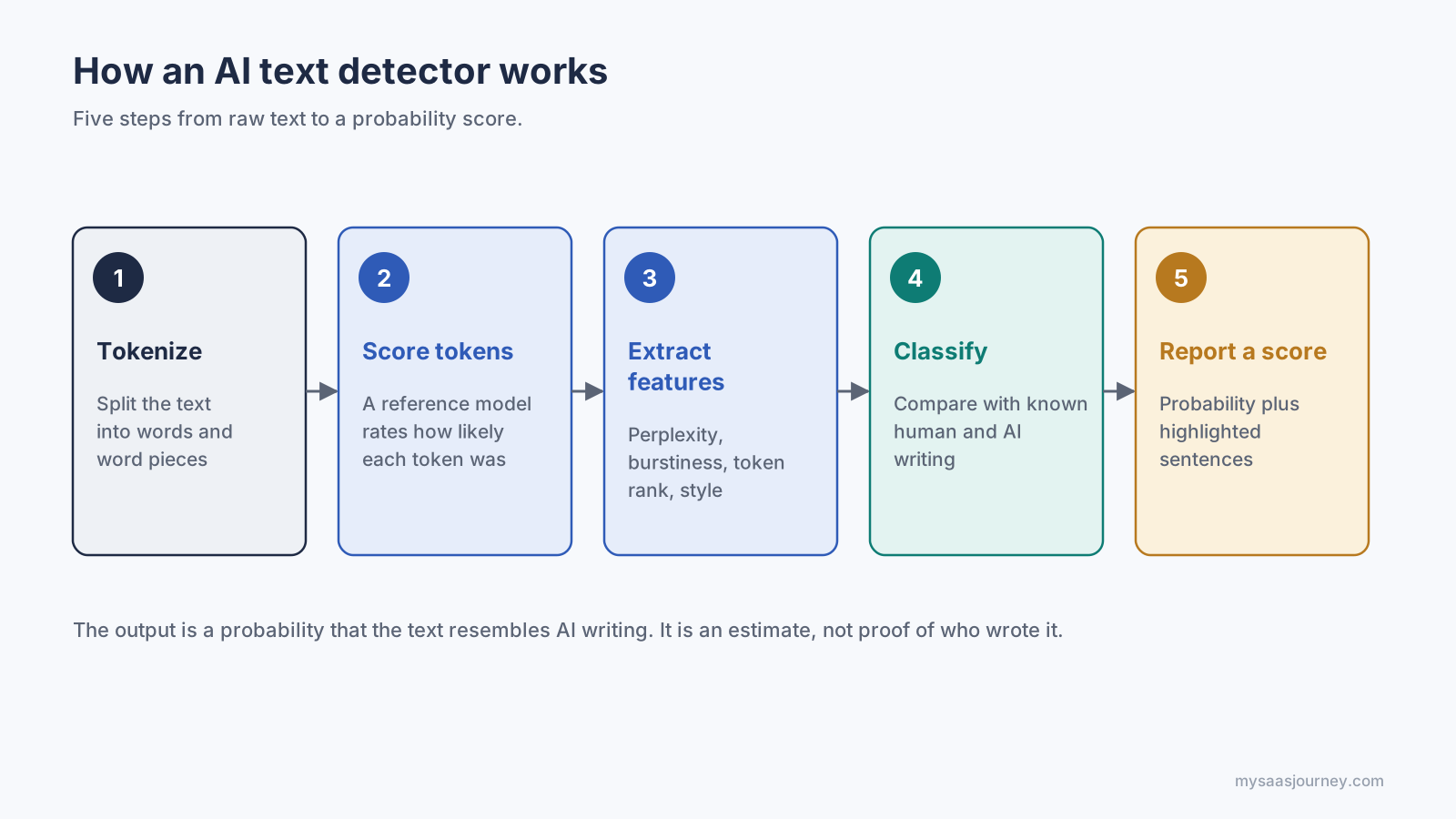
An AI detector turns text into a probability score in five steps.
It helps to know how text generators work to see why this method is possible. A large language model writes by repeatedly choosing a likely next token, as explained in our guide to . Detectors work by running that process in reverse and asking how often the text took the most likely path.
What Signals Do AI Detectors Look For?
AI detectors look for statistical fingerprints of machine generation: text that is consistently predictable, evenly paced, and free of the irregular choices people make. The four signals below appear in some form in almost every text detector.
Perplexity
Perplexity measures how surprised a language model is by a piece of text. Low perplexity means the model could easily predict each word, which is typical of AI output. High perplexity means the text contains unexpected word choices, typos, slang, or unusual phrasing, which is more typical of human writing. Perplexity on its own is weak evidence, because clear, simple human writing is also predictable.
Burstiness
Burstiness measures how much perplexity and sentence structure vary across a document. People tend to mix long, complex sentences with short ones and switch between plain and unusual wording. Language models tend to produce a steadier rhythm. A text with low perplexity and low burstiness is the pattern most detectors associate with AI.
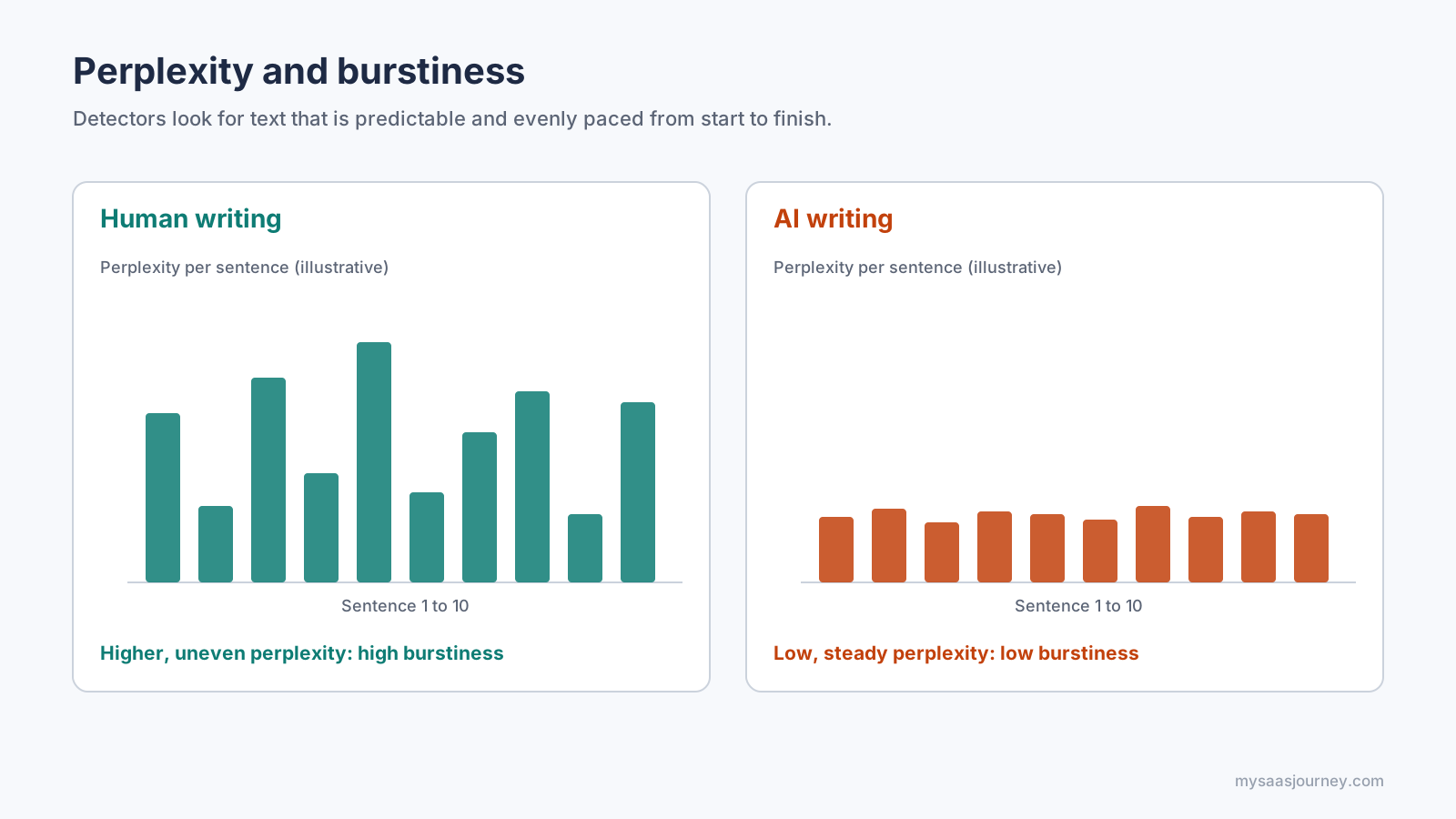
Human writing tends to vary. AI writing tends to stay low and steady.
Token Probability Patterns
More advanced detectors look at where each word ranks among the model's predictions, not just its average score. If most words come from the model's top few choices, the text is more likely to be generated. Research methods such as DetectGPT also test how the probability changes when the text is slightly rewritten. AI text tends to sit at a peak of probability, so small edits make it less likely, while human text does not show that pattern as strongly.
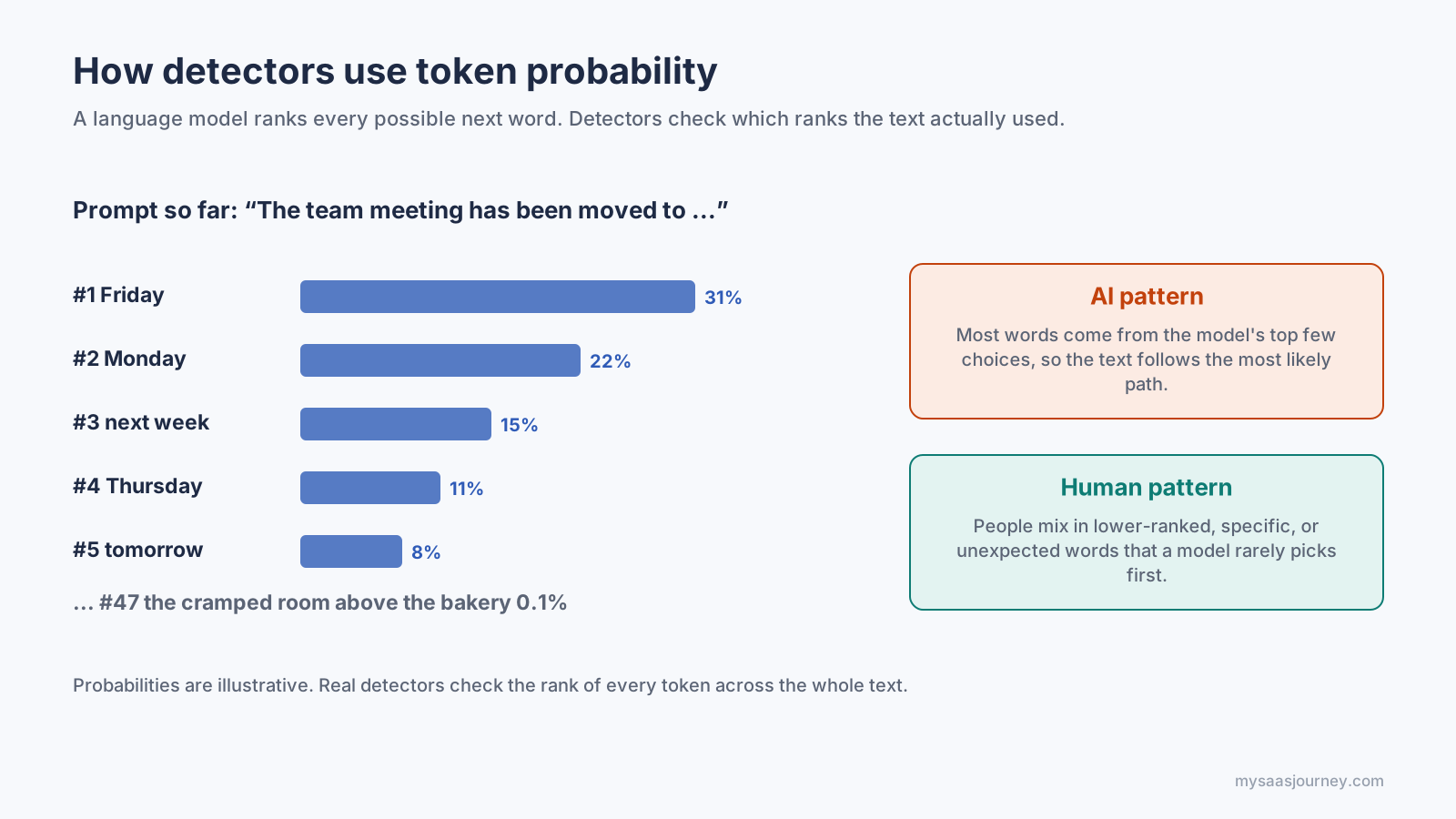
Detectors check how often a text picks the model's top-ranked words.
Style and Structure (Stylometry)
Some detectors add classic stylometry, the analysis of writing style. They measure sentence length distribution, vocabulary range, punctuation habits, repeated phrases, and how often certain transition words appear. These features help, but they are also the easiest to change with editing.
| Signal | What it measures | Typical AI pattern | Typical human pattern |
|---|---|---|---|
| Perplexity | How predictable each word is | Low and even | Higher, with surprises |
| Burstiness | Variation in predictability and sentence shape | Low | High |
| Token rank | How often words come from the model's top choices | Mostly top choices | More lower-ranked choices |
| Stylometry | Sentence length, vocabulary, punctuation, repeated phrases | Uniform, polished | Irregular, personal |
What Are the Main Types of AI Detection?
There are four main approaches to AI detection. Two guess from the content itself: trained classifiers and zero-shot statistical tests. Two check for a signal the AI provider added on purpose: watermarks and provenance metadata. The first pair works on any text but can be wrong. The second pair is far more reliable, but only when the generator cooperated.
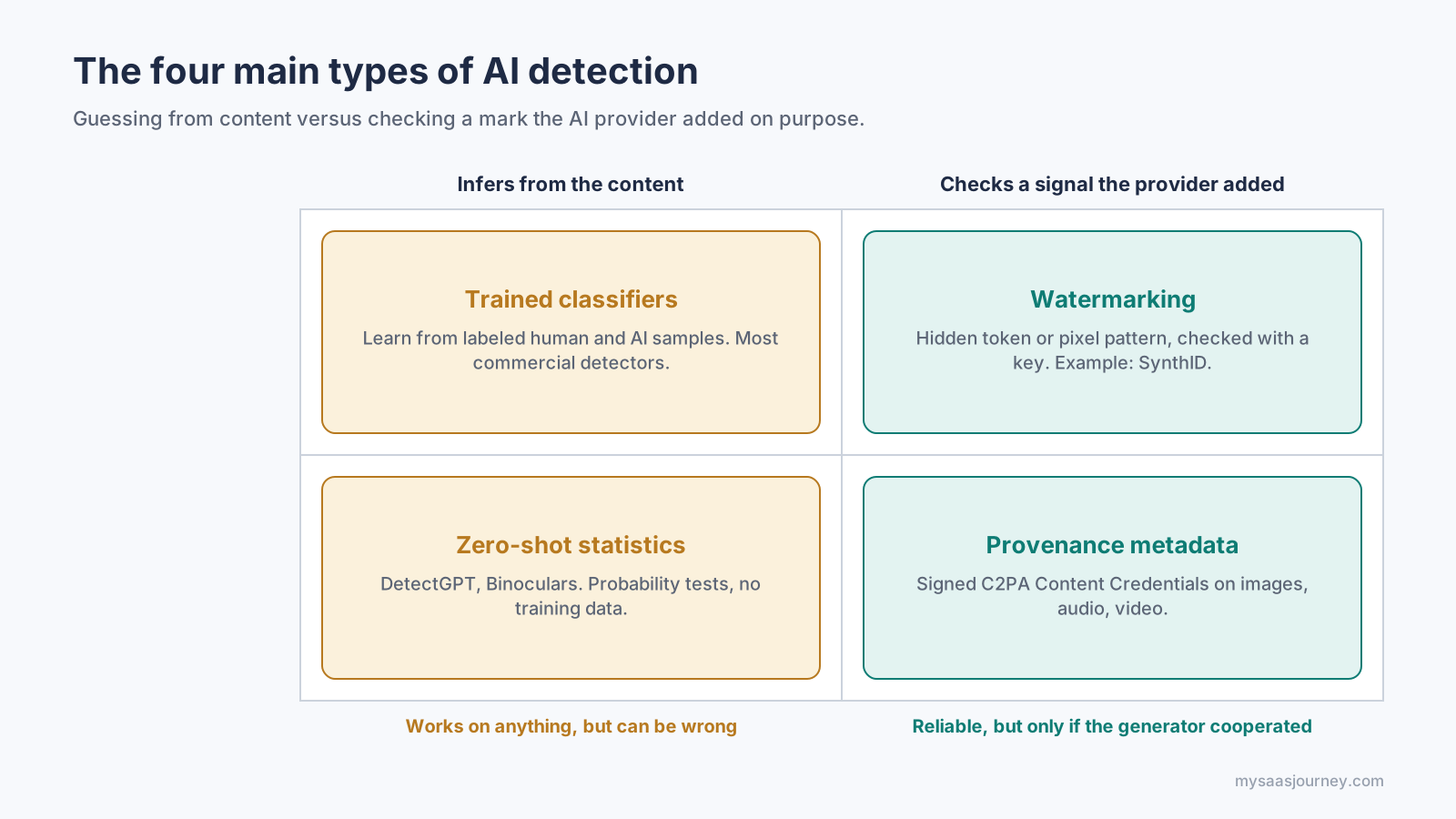
Two methods guess from the content. Two check a mark the provider added.
Trained Classifiers
A trained classifier is a machine learning model fed large sets of labeled human and AI writing until it learns to tell them apart. Most commercial AI content detectors use this approach, often combined with perplexity and burstiness features. Classifiers can be accurate on the kinds of text they were trained on, but they struggle with new models, new writing styles, and text that falls outside their training data.
Zero-Shot Statistical Methods
Zero-shot methods need no training on labeled examples. They use one or more language models to test the text directly. DetectGPT, published in 2023, checks whether a text sits at a local peak of probability. Binoculars, published in 2024, compares how two related models score the same text. These methods adapt more easily to new generators, but they are slower and less common in consumer tools.
Watermarking
A watermark is a hidden statistical pattern that the AI model adds while it generates. For text, the model slightly favors certain tokens in a way readers cannot notice, and a detector with the matching key can test for that pattern. Google DeepMind's SynthID is one example, and Google open-sourced its text watermarking in 2024. Watermarks give strong evidence when present, but they only exist if the provider added them, and heavy paraphrasing or translation can weaken a text watermark.
Provenance Metadata (Content Credentials)
Provenance metadata is a signed record attached to a file that says how it was made and edited. The C2PA standard, known as Content Credentials, is the most widely adopted format for images, audio, and video. A viewer can verify the signature and see whether an AI tool was involved. Metadata is easy to strip by taking a screenshot or re-saving the file, which is why regulators and providers pair it with watermarks.
| Method | How it works | Works on any content | Reliability | Main weakness |
|---|---|---|---|---|
| Trained classifier | Model trained on labeled human and AI samples | Yes | Moderate, varies by text type | False positives, falls behind new models |
| Zero-shot statistics | Probability tests using reference language models | Yes | Moderate | Slower, sensitive to editing |
| Watermarking | Hidden pattern added by the generator, checked with a key | Only if the provider watermarked it | High when present | Absent from many models, weakened by heavy rewriting |
| Provenance metadata | Signed record of how a file was created | Only if credentials were attached | High when present | Easily stripped by screenshots or re-saving |
Regulation is pushing toward the second pair. Under Article 50 of the EU AI Act, which has applied since August 2, 2026, providers of generative AI systems must mark output in a machine-readable, detectable way. The European Commission's code of practice favors combining signed metadata with imperceptible watermarks, asks providers to offer detection tools, and sets February 2, 2027, as the target for interoperable watermark detection. Systems already on the market before August 2026 have until December 2, 2026, to add marking.
How Accurate Are AI Detectors?
AI detectors can be reasonably accurate on long, unedited AI text, but no text detector is reliable enough to prove on its own that a specific person used AI. Their accuracy drops on short, edited, translated, or formulaic writing, and every tool has to trade missed AI text against false accusations.
What the Published Evidence Shows
- OpenAI's own classifier: Before it was withdrawn in July 2023, OpenAI's AI text classifier correctly flagged 26% of AI-written text as likely AI and wrongly labeled 9% of human-written text as AI.
- Turnitin's reported rates: In May 2023, Turnitin reported a document-level false positive rate of less than 1% for documents in which it detected over 20% AI writing, and a sentence-level false positive rate of about 4%. It added an asterisk to scores below 20% because results in that range were less reliable.
- Bias against non-native writers: A Stanford study published in 2023 tested seven detectors on 91 TOEFL essays written by non-native English speakers. The detectors classified 61% of them as AI-generated, and all seven detectors agreed on 18 of the 91 essays.
These figures come from different tools, years, and test sets, so they are not directly comparable. Together they show the pattern that matters: detectors perform best on clean samples and worst on the kinds of writing they meet in real classrooms and workplaces.
Why a Low False Positive Rate Still Matters
A false positive rate that sounds small adds up at scale. A tool that wrongly flags 1% of human documents will flag about 100 genuine essays out of every 10,000 it checks. Each of those can mean a student or writer accused of something they did not do.
Every detector sets a threshold, the score at which it calls text AI. Lowering the threshold catches more AI text but flags more humans. Raising it protects honest writers but lets more AI text through. No setting removes both errors, which is why the score should start a conversation rather than settle one.
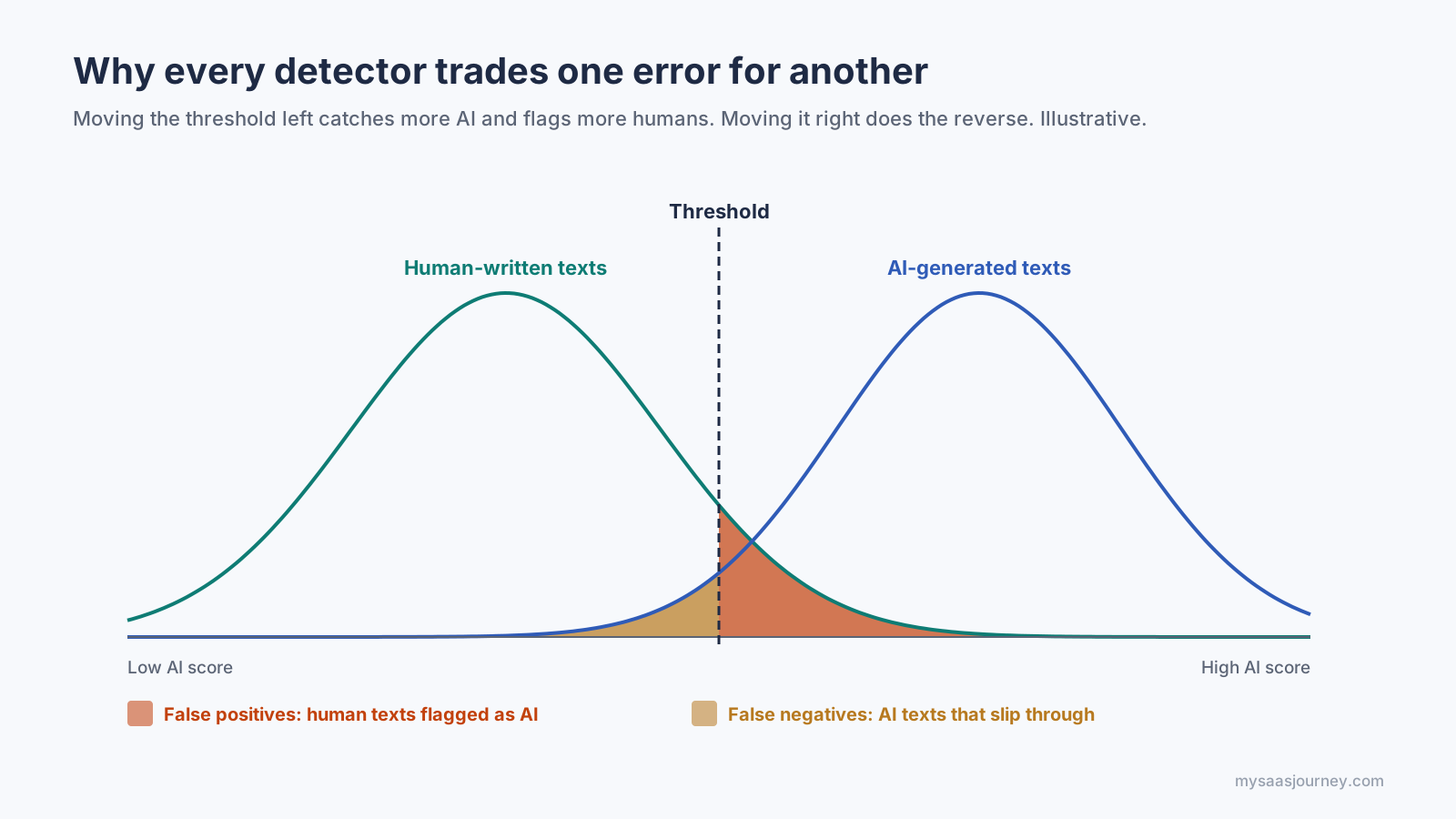
Where the threshold sits decides which mistake a detector makes more often.
Why Do AI Detectors Get It Wrong?
AI detectors get it wrong because human and AI writing overlap. Clear, simple, or rule-bound human writing can look as predictable as a model's output, and AI text that has been edited can look as varied as a person's. The most common causes are below.
| Cause | What happens | Error it creates |
|---|---|---|
| Short text | A few sentences give too little data for stable scores | Both false positives and false negatives |
| Formulaic writing | Lab reports, legal text, product descriptions, and lists follow fixed patterns | False positives |
| Non-native English | Writers with a smaller working vocabulary choose more common words, which lowers perplexity | False positives |
| Grammar and editing tools | Heavy rewriting by grammar or style assistants smooths out human irregularity | False positives |
| Human editing of AI drafts | A person rewrites parts of a generated draft, mixing both styles | False negatives and unclear scores |
| Paraphrasing and "humanizer" tools | Software rewrites AI text to raise perplexity and burstiness | False negatives |
| Translation | Text generated in one language and translated into another loses the original patterns | False negatives |
| New or unfamiliar models | The detector was trained before a model's release or on different models | False negatives |
Two of these deserve extra attention. First, mixed authorship is now normal. Many people draft with AI and then edit by hand, or write by hand and polish with AI, and a single score cannot describe that mix. Second, detectors judge style, not honesty. A detector cannot tell whether someone was allowed to use AI, only whether the text resembles AI output.
How Does AI Image, Audio, and Video Detection Work?
AI image, audio, and video detectors look for traces that generators leave in pixels, sound waves, and frames, and they check for watermarks and Content Credentials when those are present. The approach is similar to text detection, but the signals are physical rather than linguistic.
- Images: Detectors inspect frequency patterns, noise, and textures that diffusion and other image models tend to leave behind, along with telltale errors in hands, text, reflections, and lighting. They also read C2PA Content Credentials and invisible watermarks such as SynthID when a provider has added them. If you work with generated visuals, our roundup of covers which tools are in common use.
- Audio and voice: Detectors analyze the spectrogram, a visual map of frequencies over time, for unnatural breathing, pitch, and background consistency that synthetic voices often get wrong.
- Video and deepfakes: Detectors check each frame like an image and then look for problems over time, such as blinking, lip movement that does not match the audio, or lighting that shifts between frames.
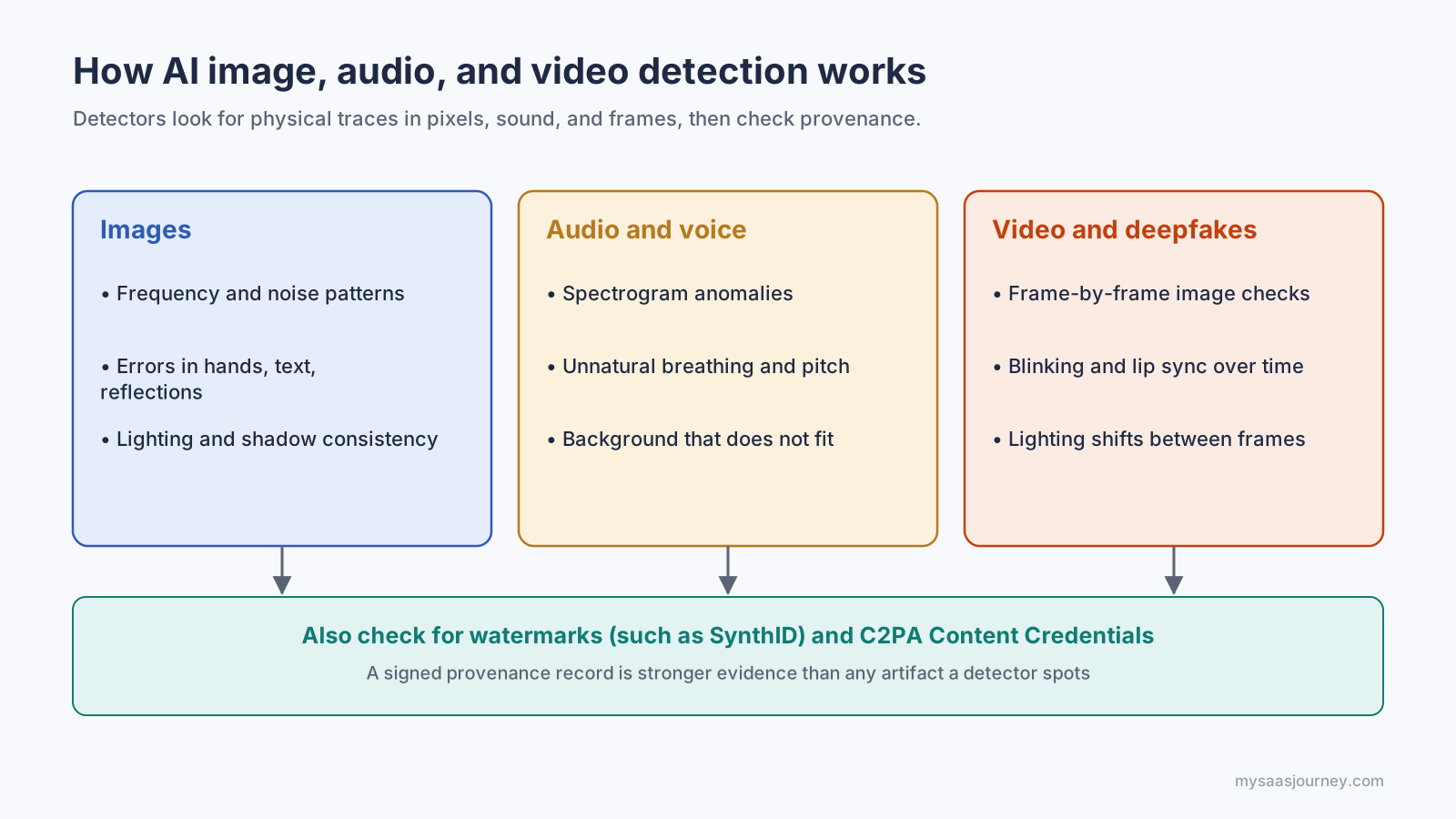
Media detectors look for physical traces, then check provenance.
As with text, a clean result does not prove content is genuine, because new generators fix the flaws older detectors relied on. Signed provenance data is the stronger signal when it exists.
How Should You Use AI Detection Results?
Use an AI detection result as one signal that prompts a closer look, never as the sole basis for a grade, a rejected article, or a disciplinary decision. The steps below work for schools, publishers, and content teams.
- Set a written AI policy first. Decide what AI use is allowed, what must be disclosed, and what is not permitted. A detector cannot enforce a rule that nobody stated.
- Check that the text is long enough. Most tools are unreliable on short passages. Treat results on a few sentences with extra caution.
- Read the score as a probability. A 70% AI score means the text resembles AI writing, not that 70% of it was written by AI. Check how your tool defines its number.
- Look at the highlighted passages. Ask whether the flagged sections are formulaic by nature, such as definitions, citations, or standard phrases, before reading anything into them.
- Get a second view. Run the text through a different detection method or tool. Disagreement between tools is itself a sign of low confidence.
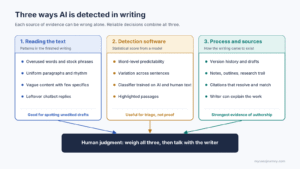
- Gather human evidence. Check version history, drafts, notes, and sources. For students, a short conversation about how they wrote the piece often settles the question.
- Consider the writer's context. Non-native writers, neurodivergent writers, and people who rely on grammar tools face higher false positive rates. Weigh that before drawing conclusions.
- Record the decision and the reasons. Keep a note of what you checked and why you reached your conclusion, so the process is fair and consistent.
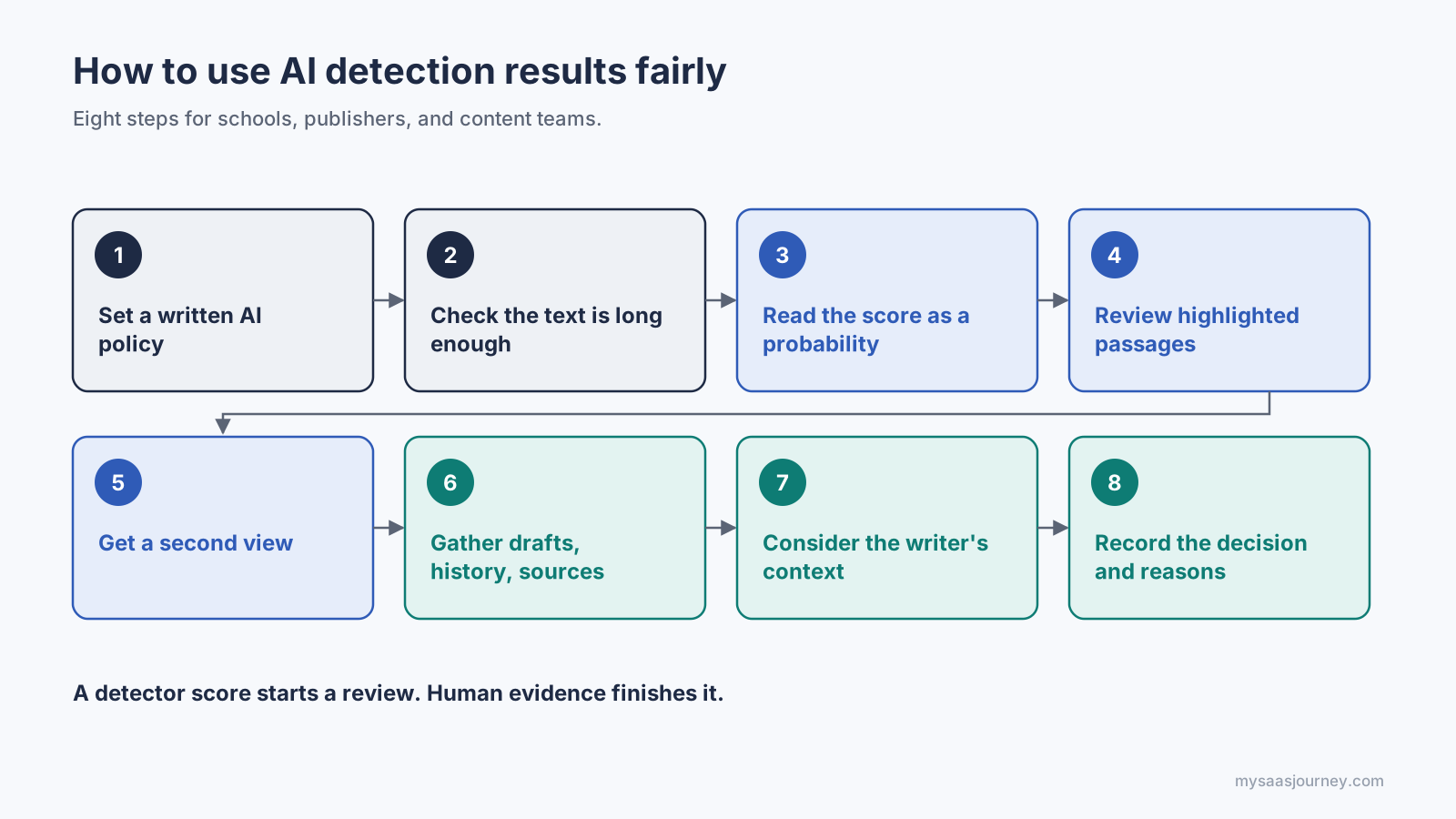
A detector score starts a review. Human evidence finishes it.
For content teams, the more useful question is often quality, not origin. Editors can review AI-assisted drafts for accuracy, originality, and voice, and many teams now disclose how they use the in their workflow instead of trying to hide it.
AI Detection Glossary
- Token: A word or part of a word, the basic unit a language model reads and generates.
- Language model: An AI model that predicts the next token in a sequence, used both to generate text and to score it.
- Perplexity: A measure of how predictable a text is to a language model. Lower perplexity means more predictable.
- Burstiness: How much predictability and sentence structure vary across a text.
- Classifier: A model trained to sort inputs into categories, such as human-written or AI-generated.
- Zero-shot detection: Detection that uses statistical tests on the text without training on labeled examples.
- Watermark: A hidden pattern added by a generator so its output can be identified later.
- Content Credentials (C2PA): An open standard for signed metadata that records how a file was created and edited.
- False positive: Human-written content wrongly labeled as AI-generated.
- False negative: AI-generated content that a detector misses.
- Threshold: The score at which a detector labels content as AI.
- Humanizer: A tool that rewrites AI text to make it look human to detectors.
Frequently Asked Questions
How do AI detectors work in simple terms?
AI detectors check how predictable a piece of writing is to a language model. AI tends to choose the most likely words in a steady rhythm, so text that is very predictable and evenly paced scores as more likely to be AI-generated.
What is perplexity in AI detection?
Perplexity measures how surprised a language model is by a text. Low perplexity means the words were easy to predict, which detectors associate with AI writing. High perplexity suggests more unusual, human-like choices.
What is burstiness in AI detection?
Burstiness measures how much a text's predictability and sentence length vary from one part to the next. Human writing usually mixes long and short, plain and unusual sentences, while AI writing is often more uniform.
Can AI detectors be wrong?
AI detectors can be wrong in both directions. They can flag human writing as AI, especially short, formulaic, or non-native English text, and they can miss AI text that has been edited, paraphrased, or translated.
Can ChatGPT detect if text was written by ChatGPT?
ChatGPT cannot reliably tell whether it wrote a piece of text. OpenAI withdrew its own AI text classifier in 2023 because of its low accuracy, and asking a chatbot whether it wrote something produces a guess, not a verified answer.
Can AI detection be bypassed?
Statistical detectors can often be fooled by heavy editing, paraphrasing tools, or translation, because those change the patterns they measure. Watermarks and signed provenance data are harder to remove, which is why providers and regulators are moving toward them.
What AI detection score should I worry about?
No score is proof on its own. Treat a high score as a reason to review drafts, sources, and version history, and treat low scores below a tool's reliability threshold with extra caution, since some vendors warn that results in that range are less dependable.
Does Google penalize AI-generated content?
Google has said it rewards helpful, original content regardless of how it is produced, and that it acts against content made mainly to manipulate rankings. Quality and usefulness matter more than whether AI helped write a page. Our guide to the covers tools for checking content quality and performance.
Can AI detectors identify AI images and deepfakes?
Specialized detectors can spot many AI images, cloned voices, and deepfake videos by looking for pixel, audio, and timing artifacts, and by reading watermarks and Content Credentials. Accuracy varies, and new generators regularly fix the flaws detectors depend on.
Is AI watermarking required by law?
In the European Union, Article 50 of the AI Act has required providers of generative AI systems to mark their output in a machine-readable, detectable format since August 2, 2026. Other countries are developing their own rules, so requirements depend on where content is produced and published.
Do AI detectors store the text I submit?
It depends on the tool. Some detectors keep submissions to improve their models or build institutional records, while others delete them after the check. Read the privacy policy before you submit confidential or personal content.
Summary
AI detection works by measuring how closely content matches the patterns AI models leave behind. Text detectors score how predictable each word is, summarize that into signals such as perplexity, burstiness, and token rank, and use a classifier or statistical test to estimate the probability that a model wrote it. Watermarks and Content Credentials take a different route by checking for a signal the AI provider added on purpose.
Statistical detectors are useful for spotting content that deserves a closer look, but they make mistakes in both directions and fall hardest on short, formulaic, and non-native writing. Treat every score as a starting point, confirm it with drafts, sources, and conversation, and expect verifiable watermarks and provenance data to play a bigger role in 2027 as rules such as the EU AI Act take hold. To explore the wider landscape of AI products, browse our category.