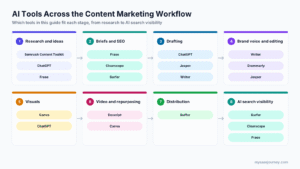
The best AI tools for content marketing depend on which part of the workflow you want to speed up. ChatGPT is the best all-round assistant for research, outlines, and first drafts. Jasper and Writer are the strongest choices for keeping a whole team on brand. Frase, Surfer, and Clearscope lead for SEO briefs and optimization, and now track how often your content appears in AI answers. Canva and Descript cover visuals and video, and Buffer handles scheduling with a free AI assistant.
Content marketing is a chain of jobs: researching topics, briefing writers, drafting, editing, adding visuals, turning one piece into many, distributing it, and measuring whether it is found. No single AI tool does every job well. Most teams get better results from two to four focused tools than from one platform that claims to do everything.
This guide compares 11 AI tools by the stage of the content workflow they serve, with current pricing, free plans, trade-offs, and sample stacks for different team sizes. If you want a wider view of AI across email, ads, and CRM, see our guide to the best AI tools for marketing.
Key takeaways:
- ChatGPT Plus at $20 a month covers more of the content workflow than any other single tool, but it does not track rankings or enforce brand rules across a team.
- Brand voice is the main reason to pay for Jasper, Writer, or the Semrush Content Toolkit over a general assistant.
- SEO content tools now measure AI search visibility: Frase, Surfer, and Clearscope track how your brand appears in ChatGPT, Gemini, and other AI answers.
- A capable solo stack costs under $400 a year, while a five-person SEO content team can expect around $5,000 to $6,000 a year in tool costs.
- Google judges content on helpfulness, not on whether AI wrote it, but mass-producing pages mainly to rank breaks its spam policies.
Quick Picks: The Best AI Tools for Content Marketing
| Tool | Best for | Workflow stage | Free plan | Starting price |
|---|---|---|---|---|
| ChatGPT | Research, outlines, and first drafts | Research, drafting, visuals | Yes | $20 a month (Plus) |
| Jasper | On-brand content for marketing teams | Drafting, brand voice | 7-day trial | $59 per seat a month, billed yearly |
| Writer | Enterprise brand governance | Drafting, brand voice | 14-day trial | Quote only |
| Semrush Content Toolkit | SEO articles with brand voices | Research, briefs, drafting | 7-day trial | $60 a month |
| Frase | SEO briefs plus AI visibility on a budget | Research, briefs, AI visibility | 7-day trial | $39 a month, billed yearly |
| Clearscope | Content optimization for larger teams | Briefs, AI visibility | 14-day trial | $129 a month |
| Surfer | On-page SEO scoring and AI tracking | Briefs, drafting, AI visibility | No | $49 a month, billed yearly |
| Grammarly | Editing and tone in every app | Editing, brand voice | Yes | $12 per member a month |
| Canva | Graphics, social posts, and brand kits | Visuals, video | Yes | $144 a year (Pro) |
| Descript | Editing video and podcasts by text | Video, repurposing | Yes | $16 a month, billed yearly |
| Buffer | Scheduling with AI-written posts | Distribution | Yes | $5 per channel a month |
How We Chose These Tools
We started from the jobs content marketers do every week and picked tools that do at least one of those jobs well. Each tool was assessed on:
- Workflow fit: which stage it serves, and whether it connects to the tools around it
- Output quality: how much editing the AI output needs before it is ready to publish
- Brand control: whether you can store a voice, style rules, or approved facts
- SEO and AI search support: briefs, content scoring, and tracking in AI answers
- Pricing transparency: published prices, free plans, and how costs grow with seats or usage
- Team features: collaboration, permissions, and admin controls
Prices come from vendor pricing pages checked in November 2026. Where a page could not be read, we used recent third-party listings and say so in the entry.
How AI Is Used in Content Marketing
AI is used in content marketing to speed up research, briefs, first drafts, editing, visual creation, video repurposing, and social distribution. It works best on the repetitive, structured parts of the job, such as summarizing sources, building outlines, or cutting a webinar into clips, while people supply the expertise, opinions, and final judgment that make content worth reading.
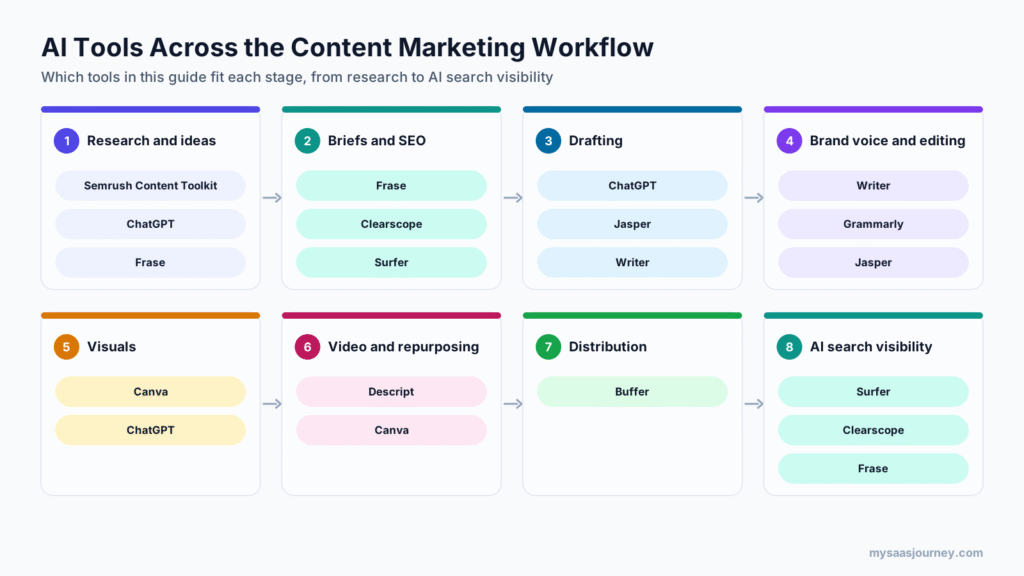
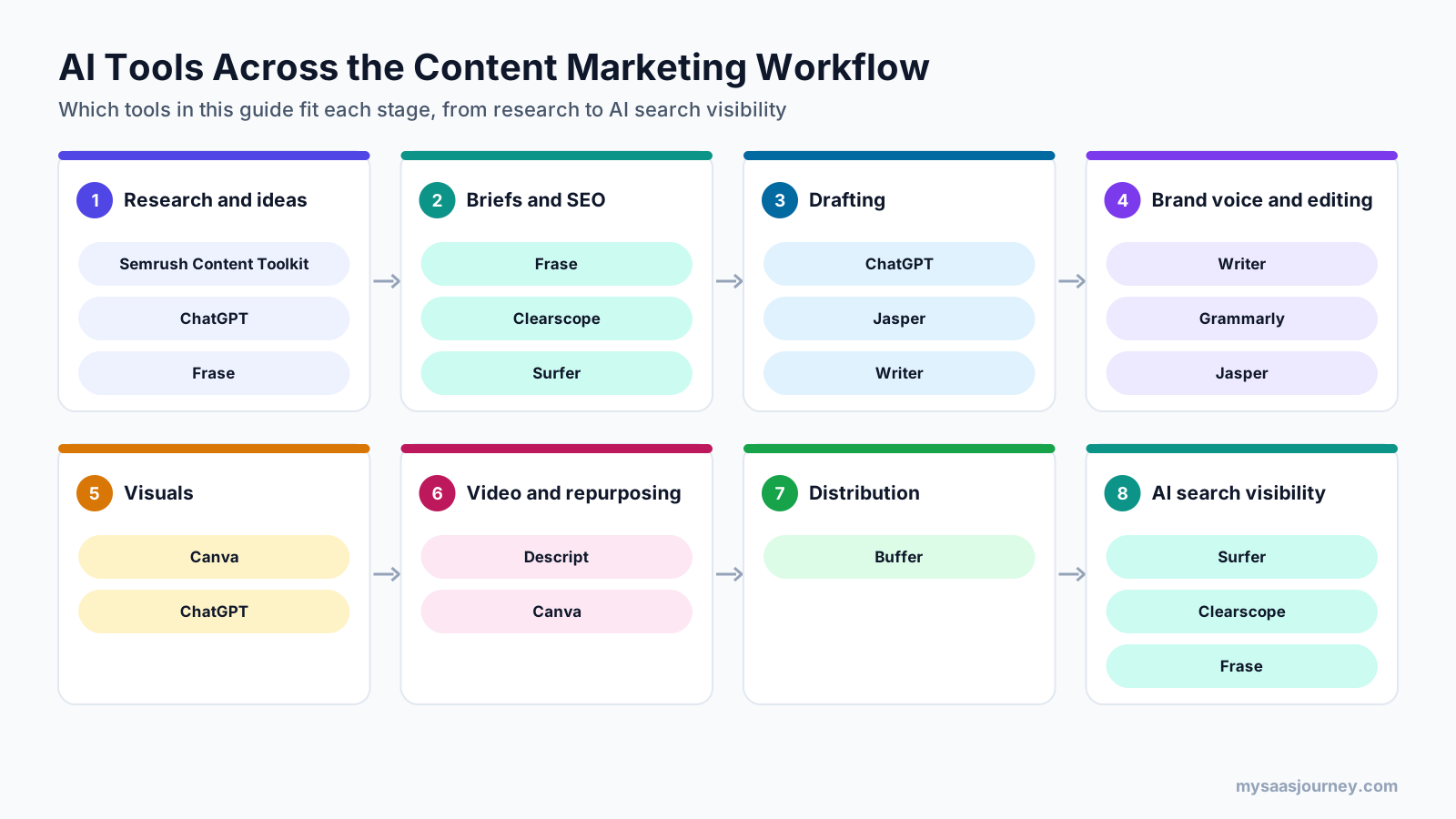
A typical AI-assisted workflow looks like this:
- Research topics and audience questions with an assistant or SEO tool.
- Build a brief with target keywords, headings, and questions to answer.
- Draft sections with AI, then add your own examples, data, and point of view.
- Edit for accuracy, tone, and brand style.
- Create images, social graphics, and short video from the finished piece.
- Schedule the finished content for distribution across your channels.
- Track rankings, traffic, and visibility in AI answers, then update content that slips.
Each tool below is grouped by the stage where it adds the most value.
AI Assistants for Research and Drafting
1. ChatGPT
ChatGPT, from OpenAI, is the most widely used general AI assistant and the most flexible tool for content work. You can use it to research topics, summarize sources, outline articles, draft sections, rewrite copy for different channels, and generate images, all in one place.
Best for: marketers who want one assistant for research, outlines, drafts, and quick visuals.
Key features:
- Deep research for multi-source topic research
- Projects to keep files, instructions, and chats together for each client or campaign
- Image generation for blog and social visuals
- Rewriting one piece into emails, social posts, and scripts
- Business workspace with admin controls and shared workspaces
Pricing: ChatGPT has a Free plan, Go at $8 a month, and Plus at $20 a month. Pro starts at $100 a month. ChatGPT Business costs $20 per user a month billed yearly or $25 billed monthly, with a two-seat minimum.
Trade-offs: ChatGPT has no built-in keyword data, content scoring, or rank tracking, so you still need an SEO tool for search content. Keeping a consistent brand voice across a team relies on shared instructions rather than enforced rules. If you are choosing between general assistants, our Claude vs ChatGPT comparison covers how they differ for long-form writing, and Perplexity vs ChatGPT covers research with cited sources.
AI Writing Platforms for Brand Voice
General assistants can write well, but they do not enforce your style across ten writers and five channels. These platforms store your brand voice, audiences, and approved knowledge so every draft starts closer to on-brand.
2. Jasper
Jasper is an AI content platform built for marketing teams. It combines a writing workspace with stored brand voices, knowledge assets, and audiences, plus AI agents for common marketing jobs.
Best for: marketing teams that produce a high volume of on-brand content across channels.
Key features:
- Canvas workspace for creating and editing content
- Agents for core marketing workflows
- Brand voices, knowledge assets, and audience profiles
- Business plan agents for GEO, translation, and deep research
- No-code builder for custom agents and Jasper Grid for scaled content on Business
Pricing: Jasper Pro costs $59 per seat a month billed yearly or $69 billed monthly, with one seat and a 7-day free trial. Pro includes 2 brand voices, 5 knowledge assets, and 3 audiences. Business has custom pricing with unlimited brand voices, API access, SSO, and admin controls.
Trade-offs: Pro is a single-seat plan, so teams need to talk to sales for more users. Jasper has no built-in keyword research or rank tracking, so most SEO teams pair it with a separate SEO tool.
3. Writer
Writer is an enterprise AI platform focused on governance: brand and voice profiles, approved company knowledge, and controls over how AI is used across departments. It suits larger organizations where legal, compliance, and brand teams need oversight of AI content.
Best for: enterprises and regulated industries that need brand governance and audit trails.
Key features:
- WRITER Agent and reusable Playbooks for repeatable content tasks
- Scheduled routines and connectors to company tools
- Team voice profiles on Starter, and departmental brand and voice profiles on Enterprise
- Knowledge Graph for grounding content in company information on Enterprise
- Governance, observability, audit logs, SSO, and SCIM on Enterprise
Pricing: Writer does not publish prices. The Starter plan supports up to 5 users on monthly or annual per-seat billing with a 14-day free trial and no credit card. Enterprise is priced through sales. Nonprofits and educational institutions get 20% off.
Trade-offs: The lack of public pricing makes budgeting harder, and the platform is more than a small team needs. Its strengths are governance and consistency rather than SEO research.
SEO Content and Optimization Tools
For content that needs to rank, these tools turn search data into briefs and scores, and most now track how often your brand appears in AI-generated answers. Our guide to who AI search recommends for software shows why AI visibility has become part of content planning.
4. Semrush Content Toolkit
The Semrush Content Toolkit, formerly ContentShake AI, is Semrush’s AI writing tool for SEO content. It uses Semrush search data to suggest topics, build briefs, and generate articles in your brand voice.
Best for: small businesses and marketers who want SEO articles with keyword data built in.
Key features:
- Weekly content ideas based on trends in your location
- SEO brief generator and full article generation
- Up to 50 saved brand voices
- Social media posts and AI images
- One-click WordPress publishing, Google Docs export, and a Chrome extension
Pricing: The Content Toolkit costs $60 a month as a standalone subscription, with a 7-day free trial.
Trade-offs: It is narrower than the full Semrush SEO suite, which is priced separately. Generated articles still need fact-checking and original input before publishing.
5. Frase
Frase is an SEO and GEO content platform that researches the search results, builds content, and tracks your visibility in AI answers. It is one of the most affordable ways to combine content optimization with AI visibility tracking.
Best for: small teams and freelancers who want SEO content and AI visibility in one affordable tool.
Key features:
- SEO and GEO scores while you write
- Publishing to WordPress, Webflow, Sanity, Wix, and FraseCMS
- AI visibility tracking in ChatGPT and Google AI, with Perplexity added on Professional and Claude and Gemini on Scale
- Content calendar, internal linking suggestions, and repurposing into channel posts on Professional
- Site audits and Content Guard pages for monitoring existing content
Pricing: Frase Starter costs $39 a month billed yearly ($468 a year) for 1 seat and 10 articles. Professional costs $103 a month billed yearly ($1,236) for 3 seats and 40 articles, and Scale costs $239 a month billed yearly ($2,868) for 5 seats. Yearly billing saves 20%, and the 7-day trial needs no credit card.
Trade-offs: Monthly article and AI generation limits are tight on the lower plans, so high-volume teams may need Scale or pay-as-you-go overages.
6. Clearscope
Clearscope is a content optimization platform known for clear, easy-to-follow recommendations. It grades drafts against what ranks and what AI systems pull into answers, and it allows unlimited users on every plan.
Best for: content teams and agencies with many writers who need consistent optimization guidance.
Key features:
- Content recommendations for Google and AI-driven discovery
- Query tracking across ChatGPT and Gemini
- Brand visibility tracking across search engines and AI systems
- Query fan-out awareness, showing the searches AI platforms run to build answers
- Unlimited users and projects on every plan
Pricing: Clearscope Essentials costs $129 a month with 50 tracked queries, 50 pages, and 20 drafts a month. Business costs $399 a month with higher limits and a dedicated account manager. Enterprise plans are priced on request. There is a 14-day free trial and no contract on monthly plans.
Trade-offs: Clearscope is the most expensive entry plan on this list. It optimizes content rather than drafting it at volume, so many teams pair it with an AI writer.
7. Surfer
Surfer is an on-page SEO tool that scores content against top-ranking pages while you write. Its Content Editor gives term, structure, and length guidance, and higher plans track brand visibility across major AI platforms.
Best for: SEO writers and teams who want live content scoring plus AI search tracking.
Key features:
- Content Editor with AI SEO guidelines, a content score, and the Surfy writing assistant
- AI detector and humanizer on all plans
- AI visibility tracking across ChatGPT, Gemini, Perplexity, Google AI Overviews, and AI Mode on Standard and above
- Internal linking, content gap ideas, and a cannibalization report on Pro
- WordPress and Google Docs integrations
Pricing: Billed yearly, Surfer Discovery costs $49 a month ($588 a year), Standard $99 a month, Pro $182 a month, and Peace of Mind $299 a month. A standalone AI Search Analytics plan costs $82 a month. Yearly billing saves up to 17% compared with monthly payments.
Trade-offs: Discovery has no AI prompt tracking, and team seats are limited on lower plans. The page did not state free trial terms.
Editing and Brand Consistency
8. Grammarly
Grammarly checks grammar, clarity, and tone in your browser, documents, and email. Its AI features rewrite sentences, adjust tone, and generate text, and paid plans include brand tones and AI detection.
Best for: every writer and editor who wants a final quality and tone check wherever they write.
Key features:
- Grammar, clarity, and tone suggestions across apps
- AI rewriting and text generation
- Brand tones to keep writing consistent
- AI-generated text detection on Pro
- Unlimited prompts and brand tones on Enterprise
Pricing: Grammarly Free includes 100 AI prompts a month. Pro costs $12 per member a month with 2,000 prompts per member and 1 brand tone. Enterprise is priced through sales with unlimited prompts and brand tones.
Trade-offs: Grammarly polishes writing but does not plan, research, or optimize content for search. Its pricing page showed only the monthly figure during this check, so confirm the billing period at checkout.
Visuals and Video
Content performs better with strong visuals and video, and AI now handles much of the production work. For dedicated image tools, see our guide to the best AI image generators.
9. Canva
Canva is a design platform with AI tools for creating social graphics, blog images, presentations, and short videos. Brand kits keep colors, fonts, and logos consistent across everything your team makes.
Best for: marketers who create their own graphics and social content without a designer.
Key features:
- Templates for social posts, blog headers, ads, and presentations
- Magic Studio AI tools for generating and editing images and text
- Brand kits, with approvals on Business
- Video editing for short social clips
- Team collaboration and admin tools on Business
Pricing: Canva Free costs nothing. Canva Pro costs $144 a year or $18 a month for one person, and Canva Business costs $250 per person a year or $25 per person a month. Canva’s pricing page could not be read during this check, so these figures come from recent third-party listings.
Trade-offs: Pro is a one-person plan, so teams move to Business pricing per person. Heavy AI users may need extra AI credits.
10. Descript
Descript edits video and audio by editing a transcript, which makes it fast to cut webinars, interviews, and podcasts into short clips. Its AI co-editor, Underlord, handles tasks such as removing filler words and creating clips.
Best for: teams repurposing webinars, podcasts, and interviews into short video and audio content.
Key features:
- Edit video and audio by editing the transcript
- Underlord AI co-editor for cleanup and editing tasks
- Clip creation for social video
- Text-to-speech and custom voice clones
- Screen recording and team collaboration
Pricing: Descript Free includes 1 media hour a month and 100 one-time AI credits. Hobbyist costs $16 a month on the lower billing rate ($24 on the higher), Creator $24 ($35), and Business $50 ($65) per person. The lower figures appear to be annual billing.
Trade-offs: Media hours and AI credits cap usage on every plan. Descript suits talking-head and spoken content more than heavily designed video. Our list of the best free video editing software covers alternatives.
Distribution
11. Buffer
Buffer is a social media scheduling tool with a built-in AI Assistant for drafting and rewriting posts. It is one of the simplest ways to turn finished content into a steady social schedule.
Best for: small teams and creators who want simple scheduling with AI help writing posts.
Key features:
- Scheduling across major social networks
- AI Assistant for drafting and rewriting posts, included on the free plan
- Content calendar and post ideas
- Analytics on paid plans
- Team collaboration on the Team plan
Pricing: Buffer Free covers up to 3 channels. Essentials costs $5 per channel a month ($60 a year per channel) and Team costs $10 per channel a month ($120 a year per channel), with lower rates above 10 channels.
Trade-offs: Per-channel pricing adds up for brands on many networks. Buffer focuses on scheduling and does not include social listening or deep reporting.
Features Compared
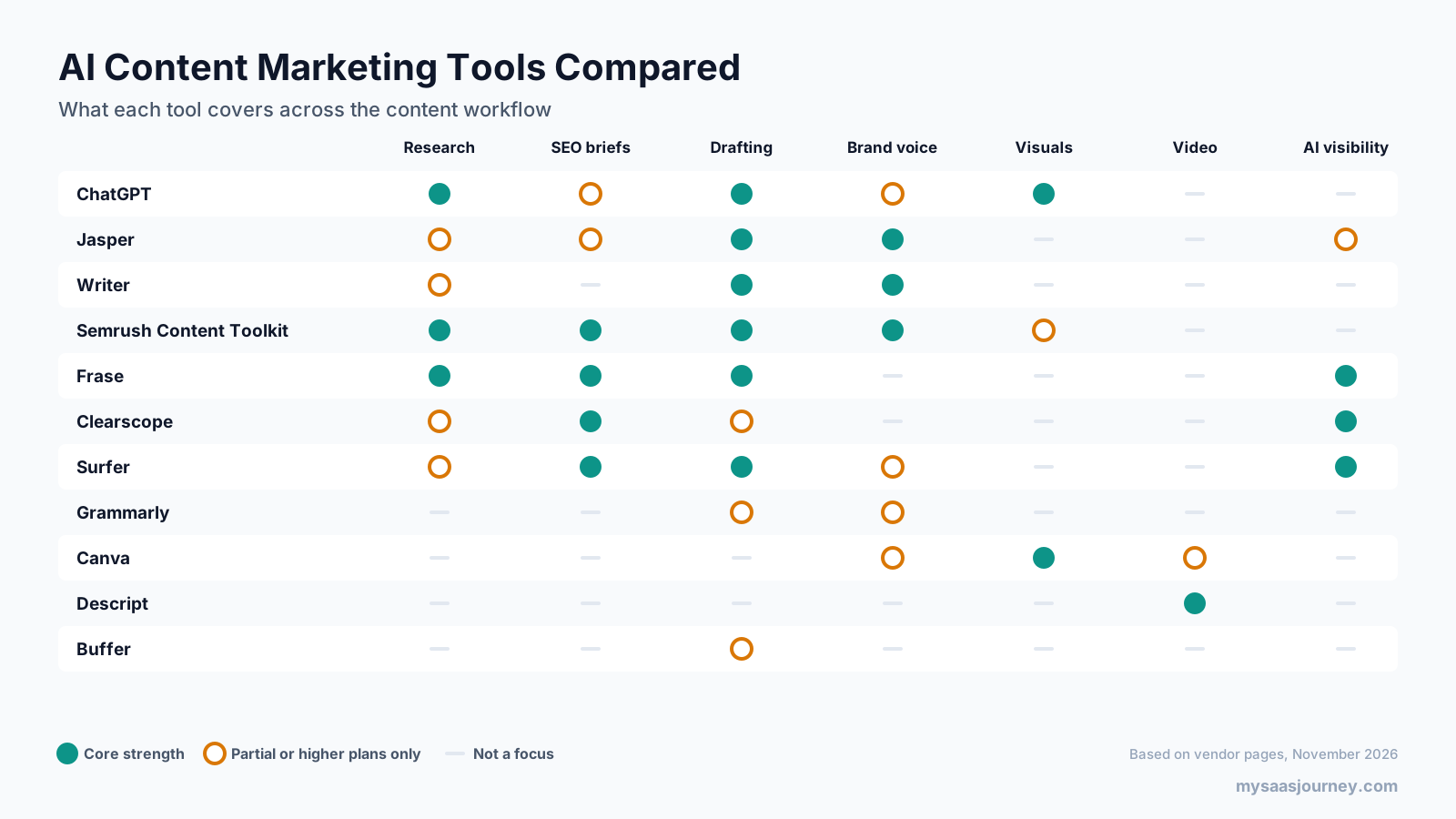
Two patterns stand out. SEO content tools such as Frase, Surfer, and Clearscope are moving into AI search visibility, while writing platforms such as Jasper and Writer compete on brand control rather than search data. No tool covers every column, which is why most teams combine an assistant, an SEO tool, and a design tool.
Pricing Compared
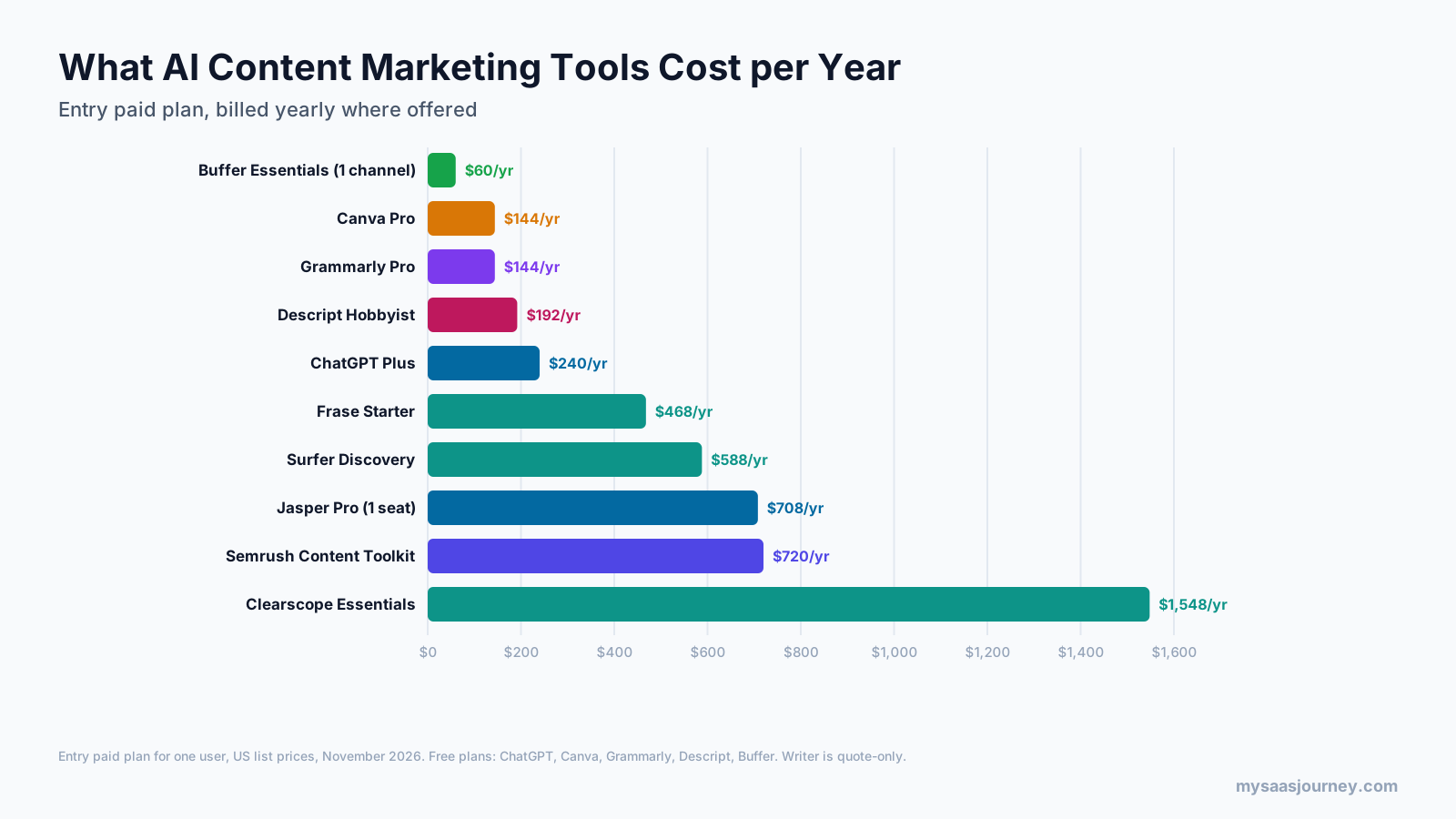
| Tool | Free option | Entry paid plan | Yearly cost |
|---|---|---|---|
| Buffer | Free (3 channels) | Essentials | $60 per channel |
| Canva | Free | Pro | $144 |
| Grammarly | Free | Pro | About $144 |
| Descript | Free | Hobbyist | About $192 |
| ChatGPT | Free | Plus | $240 |
| Frase | 7-day trial | Starter | $468 |
| Surfer | No | Discovery | $588 |
| Jasper | 7-day trial | Pro | $708 per seat |
| Semrush Content Toolkit | 7-day trial | Content Toolkit | $720 |
| Clearscope | 14-day trial | Essentials | $1,548 |
| Writer | 14-day trial | Starter | Quote only |
Before you compare sticker prices, check:
- Seats: Jasper Pro, Frase Starter, and Surfer Discovery include one seat. Clearscope includes unlimited users on every plan.
- Usage limits: articles, AI generations, media hours, and tracked prompts are capped on most plans.
- AI visibility tracking: some tools include it only on higher plans.
- Monthly versus yearly billing: most tools discount yearly billing by 17% to 20%.
Our glossary entry on pricing models explains seat-based and usage-based pricing, and our AI add-on price index tracks what software vendors charge for AI features.
Sample AI Content Marketing Stacks
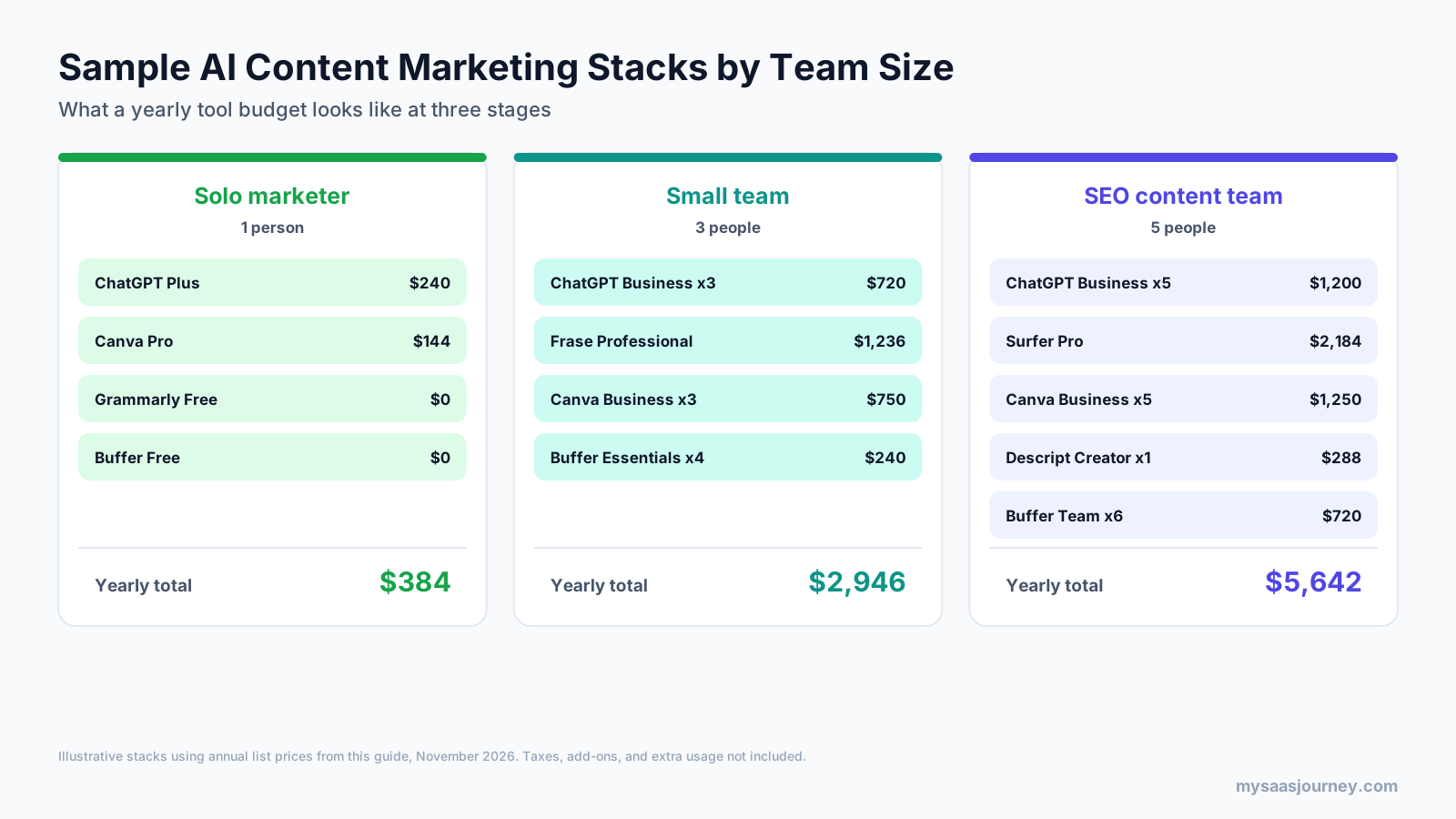
These stacks show what a realistic yearly tool budget looks like at three stages, using the list prices above:
- Solo marketer, about $384 a year: ChatGPT Plus for research and drafts, Canva Pro for visuals, and the free plans of Grammarly and Buffer.
- Small team of three, about $2,946 a year: ChatGPT Business for three users, Frase Professional for SEO and AI visibility, Canva Business for three, and Buffer Essentials for four channels.
- SEO content team of five, about $5,642 a year: ChatGPT Business for five users, Surfer Pro, Canva Business for five, one Descript Creator seat for video, and Buffer Team for six channels.
Start smaller than you think. Add a tool only when a specific bottleneck, such as briefs taking too long or brand voice drifting between writers, justifies the cost.
Best Free AI Tools for Content Marketing
You can build a capable content workflow without paying anything:
- ChatGPT Free for research, outlines, and drafts, with limited deep research and image generation
- Canva Free for graphics and social posts
- Grammarly Free for editing, with 100 AI prompts a month
- Descript Free for editing short video and audio, with 1 media hour a month
- Buffer Free for scheduling up to 3 channels, with the AI Assistant included
The main gaps in a free stack are SEO data and AI visibility tracking. Frase, Clearscope, Jasper, Writer, and the Semrush Content Toolkit offer trials of 7 to 14 days, which are long enough to test them on a few pieces of content before paying.
How to Choose AI Tools for Content Marketing
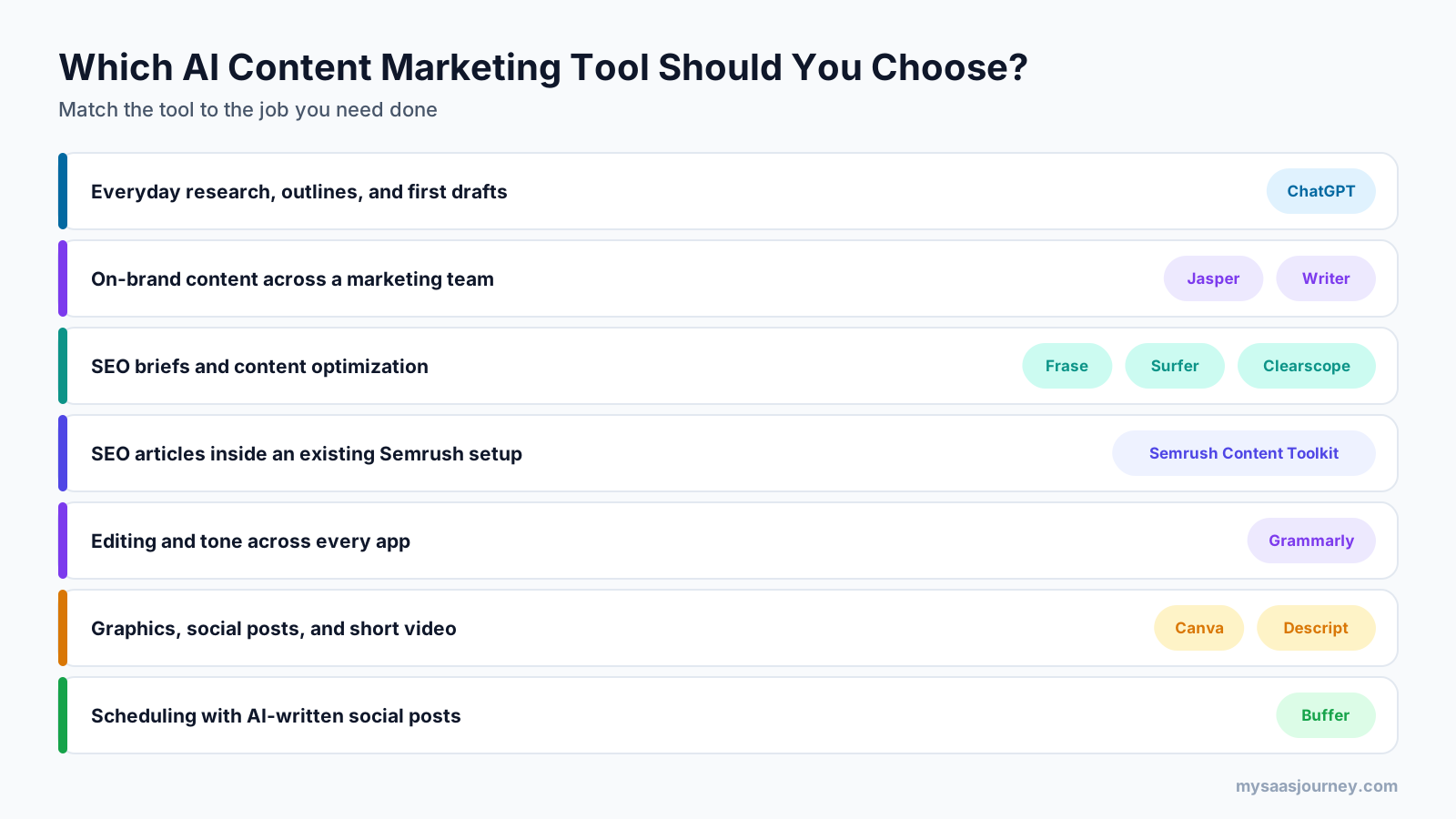
- Find your biggest bottleneck first. List the content tasks that take the most time, such as research, briefs, first drafts, or repurposing, and pick tools for those first.
- Decide how much search matters. If organic and AI search drive your growth, an SEO content tool such as Frase, Surfer, or Clearscope earns its place. If social or email drives growth, an assistant and a design tool may be enough.
- Check how much brand control you need. Teams with many writers or strict style rules benefit from Jasper, Writer, or the Semrush Content Toolkit’s stored brand voices.
- Confirm the tool fits your publishing stack. Check that the tool publishes to your CMS or exports to Google Docs, and connects to the rest of your stack. Our Zapier vs Make comparison covers tools for linking apps that lack native integrations.
- Model the full cost for your team. Multiply seat prices by your team size and check usage limits against your monthly output.
- Test with your own content. Use trials to produce two or three pieces you would actually publish, then compare editing time and quality against your current process.
How to Use AI for Content Creation Without Hurting Quality
AI speeds up content production, but it can also produce generic, inaccurate, or repetitive content. These habits keep quality high:
- Give AI context. Share your brief, audience, examples, and brand guidelines before asking for a draft.
- Add what AI cannot provide on its own. Original data, customer stories, expert quotes, and your own opinions are what make content stand out.
- Fact-check every claim before publishing. Verify statistics, product details, and claims against original sources before publishing.
- Edit every draft for your brand voice. Read drafts aloud and cut filler phrases and repetitive structures.
- Disclose AI use where rules require it. Follow your industry’s rules and platform policies on AI-generated content.
Google’s guidance says it rewards helpful, reliable content however it is produced, but using AI to generate many pages mainly to manipulate rankings breaks its spam policy on scaled content abuse. The safest approach is to use AI to help experts produce better content faster, not to replace them. For a deeper look at AI writing quality, see our guide to the best AI writing tools.
How AI Agents Are Changing Content Marketing
AI agents can now carry out multi-step content tasks with less prompting: researching a topic, drafting a brief, writing a first draft, and preparing it for publishing. Jasper offers agents for marketing workflows and a builder for custom agents on its Business plan, Writer offers agents and scheduled routines, and Frase’s agent can publish to your CMS.
Agents are most useful for repeatable, well-defined work such as refreshing old posts, creating social variations, or producing localized versions. They still need clear instructions, approved source material, and human review before content goes live. Our roundup of the best AI agents covers general-purpose agent tools beyond content marketing.
Final Thoughts
The best AI tools for content marketing are the ones that remove your biggest bottleneck. For most marketers, ChatGPT is the right starting point for research and drafts, Canva handles visuals, and a free scheduling tool covers distribution. As search becomes a bigger growth channel, Frase, Surfer, or Clearscope add the briefs, scoring, and AI visibility tracking a general assistant lacks. For larger teams, Jasper and Writer keep content on brand across many writers.
Start with one or two tools, measure the time they save on your own content, and expand only when a clear gap appears. AI handles the repetitive work well, but your expertise, data, and point of view are still what make content worth reading and citing.
Sources
| Source | Used for |
|---|---|
| ChatGPT pricing | ChatGPT plan features (page did not show prices) |
| ChatGPT Business pricing reference | ChatGPT Business seat pricing and two-seat minimum (third-party, citing OpenAI) |
| ChatGPT plan price sheet | ChatGPT Free, Go, and Plus prices (third-party, read from OpenAI pages November 2026) |
| Jasper pricing | Jasper plans, prices, trial, and features |
| Writer plans | Writer plans, seat limits, trial, and features |
| Semrush Content Toolkit pricing | Semrush Content Toolkit price and brand voice limit |
| Semrush ContentShake pricing | Content Toolkit features, trial, and ContentShake rename |
| Frase pricing | Frase plans, prices, limits, AI visibility, and trial |
| Clearscope pricing | Clearscope plans, prices, limits, and trial |
| Surfer pricing | Surfer plans, prices, AI tracking, and features |
| Grammarly plans | Grammarly plans, prices, and AI features |
| Canva pricing reference | Canva Pro and Business prices (third-party, Canva page could not be read) |
| Descript pricing | Descript plans, prices, media hours, and AI credits |
| Buffer pricing | Buffer plans, per-channel prices, and AI Assistant on Free |
| Google guidance on AI content | Google guidance on AI-generated content |
| Google spam policies | Google spam policy on scaled content abuse |
| Ahrefs Keywords Explorer and SERP Overview (US, November 2026) | Keyword volumes, difficulty, SERP and People Also Ask analysis |
Frequently Asked Questions
What is the top AI tool for content marketing?
ChatGPT is the top all-round AI tool for content marketing because it handles research, outlines, drafts, rewrites, and images in one place, starting free or at $20 a month for Plus. For SEO content, Frase, Surfer, and Clearscope are stronger, and for team brand control, Jasper and Writer lead.
What is the best free AI tool for content marketing?
ChatGPT Free is the best free AI tool for research and drafting. Pair it with Canva Free for graphics, Grammarly Free for editing, and Buffer Free, which includes an AI Assistant, for scheduling up to three social channels. Free plans lack SEO data and AI visibility tracking.
How can AI be used in content marketing?
AI can be used to research topics, build content briefs, draft and edit articles, keep a consistent brand voice, create images and social graphics, cut long videos into clips, schedule posts, and track how content appears in search and AI answers. People still provide expertise, original insight, and final review.
How do you use AI for content creation?
Start with a clear brief that covers the audience, goal, keywords, and key points. Ask AI for an outline, then draft section by section, adding your own examples and data. Fact-check every claim, edit for brand voice, and use AI again to create social posts, emails, and visuals from the finished piece.
Is AI-generated content bad for SEO?
No, not by itself. Google says it rewards helpful, reliable content regardless of how it is produced. AI content becomes a problem when it is published at scale mainly to manipulate rankings, which breaks Google’s spam policy on scaled content abuse, or when it is thin, inaccurate, or adds nothing new.
What is the best AI tool for content marketing teams?
Jasper and Writer are the best AI tools for content marketing teams that need consistent brand voice across many writers. Jasper suits marketing teams and agencies, while Writer suits enterprises that need governance and audit logs. Clearscope is a strong add-on because it includes unlimited users on every plan.
How much do AI content marketing tools cost?
Most AI content marketing tools cost between $144 and $1,548 a year for an entry paid plan. Canva Pro costs $144 a year, ChatGPT Plus $240, Frase Starter $468, Surfer Discovery $588, Jasper Pro $708 per seat, the Semrush Content Toolkit $720, and Clearscope Essentials $1,548. Several tools also have free plans.
How are AI agents transforming content marketing?
AI agents carry out multi-step content tasks such as researching a topic, building a brief, drafting, and publishing with less manual prompting. They are most useful for repeatable work such as content refreshes, social variations, and localization, but they still need clear instructions, approved source material, and human review.