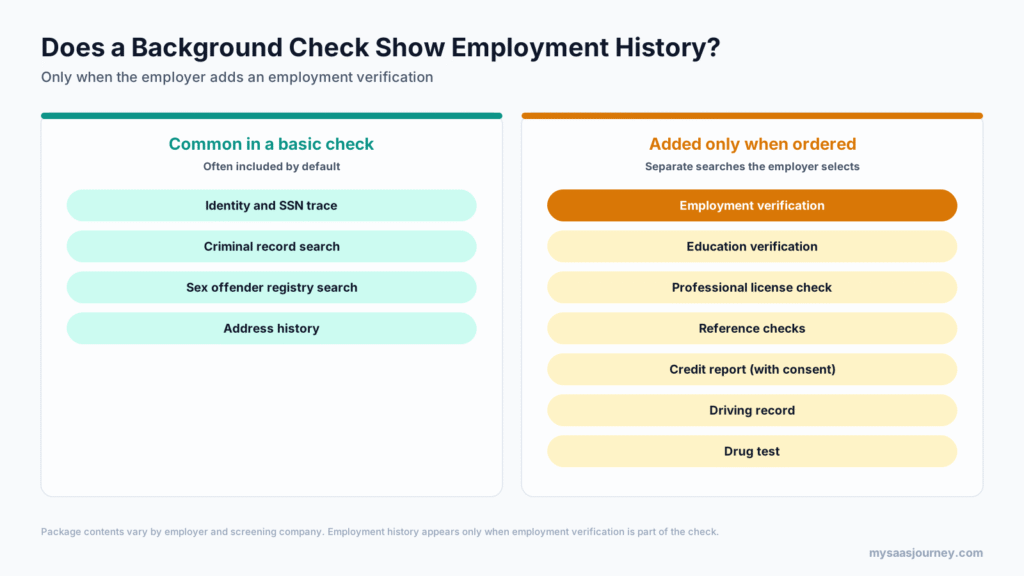

A background check shows your employment history only if the employer orders an employment verification as part of it. Many standard background checks focus on identity and criminal records and do not include past jobs. When employment verification is added, the screening company confirms the employers, dates, and job titles you listed, usually by checking payroll databases or contacting each employer’s HR department.
So the short answer is: not automatically, but often. Employment verification is one of the most common add-ons, especially for professional, financial, and senior roles. It confirms what you told the employer rather than producing a complete list of every job you have held.
This guide explains what a background check includes, how employment verification works, what former employers can share, how far back checks go under federal law, and how to check your own employment history before an employer does.
This article covers general US federal rules and is not legal advice. State and local laws can add further protections.
Key takeaways:
- Employment history appears on a background check only when the employer adds an employment verification search.
- Verification usually confirms employer names, start and end dates, and job titles. Reasons for leaving, rehire eligibility, and salary are shared less often and depend on company policy and state law.
- The federal seven-year reporting limit does not apply to employment history, because it is not considered adverse information.
- Under the Fair Credit Reporting Act (FCRA), an employer must get your written permission before a screening company runs a background check on you.
- You can see your own employment record through a Social Security itemized earnings statement, an IRS wage and income transcript, or The Work Number.
What a Standard Background Check Includes
“Background check” is a broad term. Employers choose which searches to include, and the package often depends on the job.
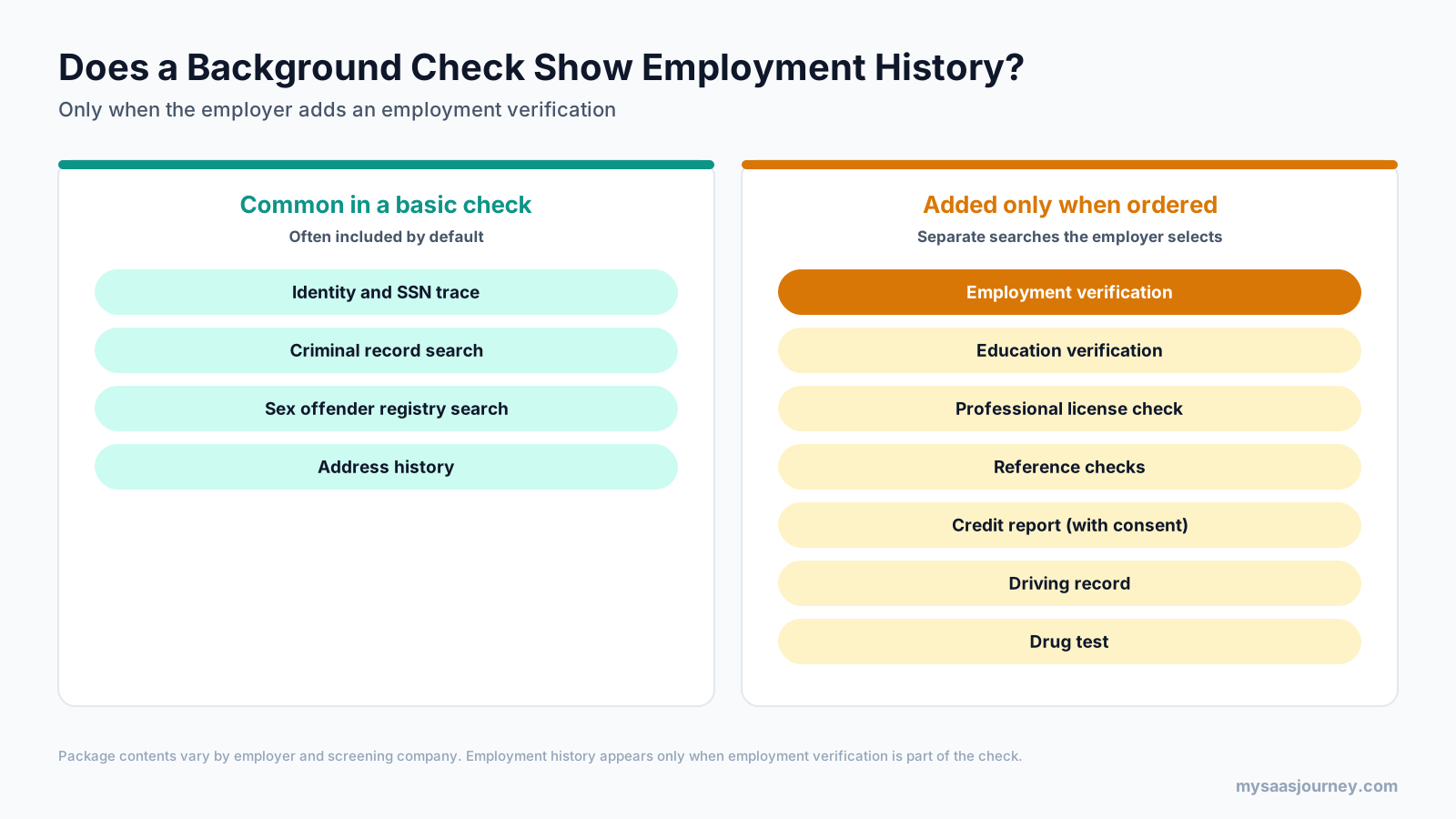
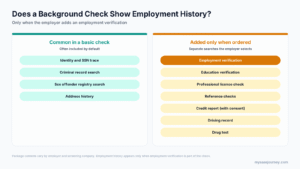
Searches commonly included in a basic check:
- Identity and Social Security number trace, which links your name to addresses and confirms your identity
- Criminal record searches at county, state, or national level
- Sex offender registry searches
- Address history
Searches added only when the employer orders them:
- Employment verification
- Education verification
- Professional license checks
- Reference checks
- Credit reports, with your consent and where state law allows
- Driving records
- Drug tests
The FTC lists work history alongside education, criminal record, and financial history as the kinds of background information employers may seek. Whether your history is checked depends on the package your employer chose. If you are unsure, you can ask the employer which screening company it uses and what the check covers.
How Employers Verify Employment History
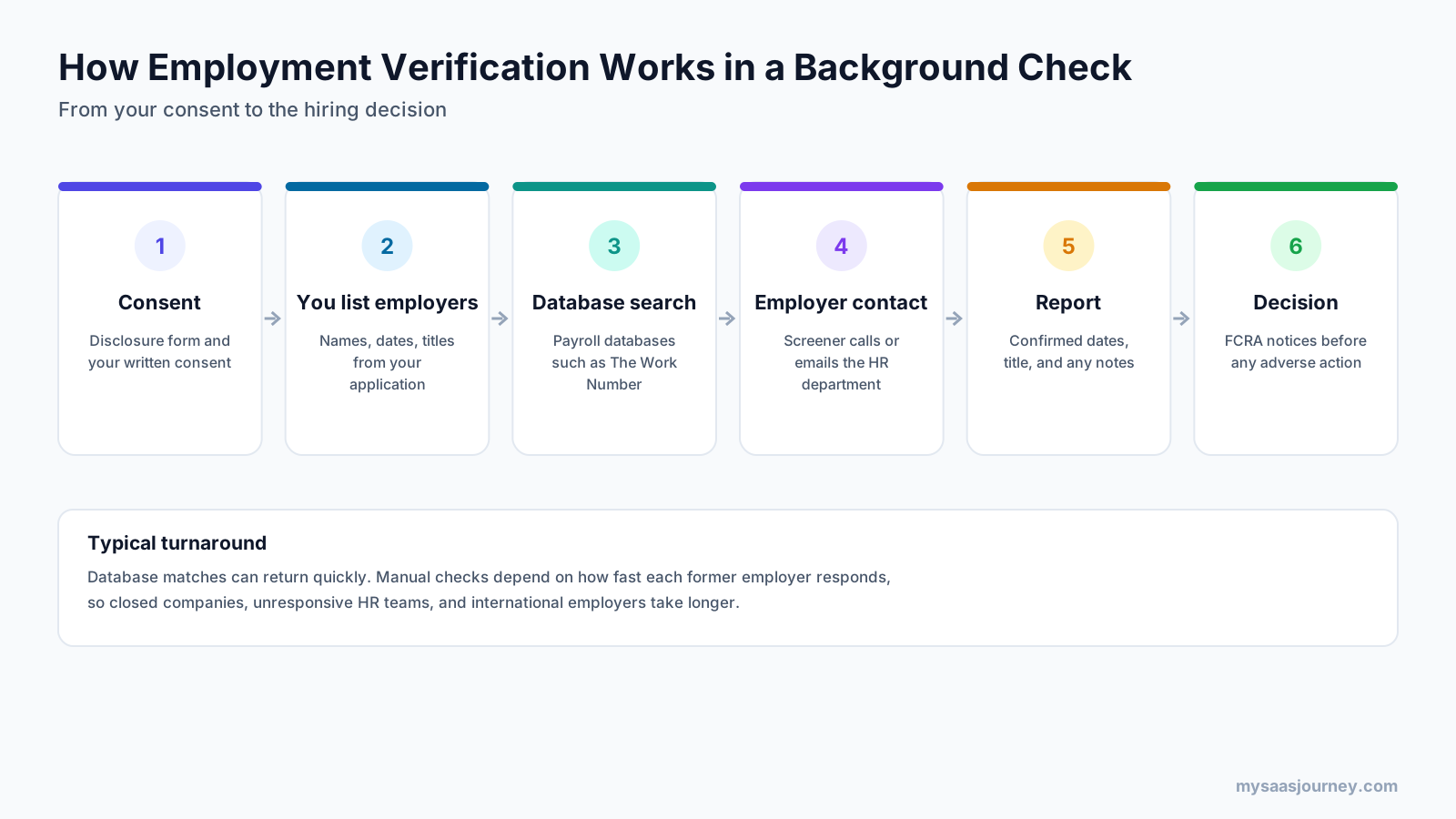
When a screening company verifies employment history, the process usually follows these steps:
- You give written consent first. The employer gives you a standalone disclosure and gets your written authorization before running the check.
- You provide your employment history. The employer uses the employers, dates, and job titles from your application or resume.
- The screener searches payroll databases. Services such as The Work Number, operated by Equifax, hold employment and income data contributed by employers or their payroll providers.
- The screener contacts employers directly. If there is no database match, the screening company calls or emails each former employer’s HR or payroll team.
- The results go into a report. The report shows what was confirmed, what differed, and what could not be verified.
- The employer makes a hiring decision. If the employer plans to reject you based on the report, the FCRA requires it to follow the adverse action process described below.
Database matches can come back quickly, while manual verifications depend on how fast each former employer responds. Closed companies, acquisitions, and international employers usually take longer.
Some employers skip the screening company and call your former employers themselves. FTC staff have noted that checks done directly by the employer are not covered by the FCRA in the same way as reports from a screening company, although state laws on references still apply.
What Employment Verification Shows
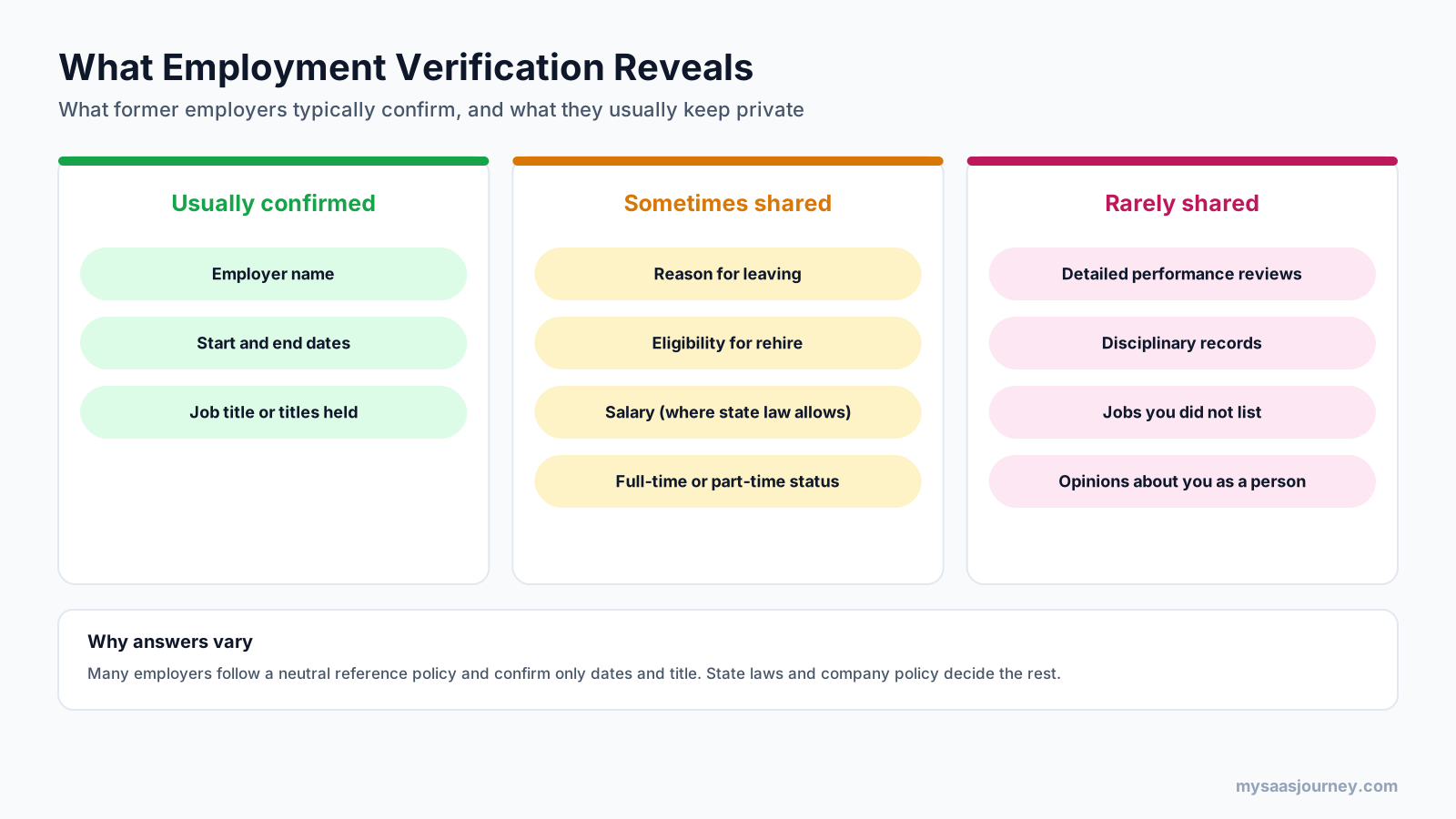
What a former employer shares depends on its policy and on state law. In practice:
- Usually confirmed: employer name, your start and end dates, and your job title or titles.
- Sometimes shared: reason for leaving, whether you are eligible for rehire, full-time or part-time status, and salary where state law allows it.
- Rarely shared: detailed performance reviews, disciplinary records, and personal opinions about you.
Many companies follow a neutral reference policy, which means they confirm only dates and titles, and sometimes pay rate. They do this mainly to reduce the risk of defamation claims. That is a company choice, not a legal requirement.
Can Employers See Jobs You Did Not List?
A standard employment verification checks the employers you provide. It does not produce a complete record of every job you have held. However, gaps or overlaps between your listed jobs can raise questions, and an SSN trace can show addresses that suggest work in other locations. It is better to explain gaps honestly than to leave them for the employer to discover.
Does a Background Check Show Salary?
In most cases, salary is not part of the check. Some payroll databases hold income data, which lenders use to verify income. For hiring, many states and cities have salary history laws that bar employers from asking about or relying on your past pay, so screening companies often leave salary out of employment verifications in those places. Check the rules where the job is located.
Employment Verification vs Reference Checks
Employment verification and reference checks are often confused, but they answer different questions:
- Employment verification confirms facts: where you worked, when, and in what role. It usually goes to HR or a payroll database.
- Reference checks ask for opinions: how you performed, how you worked with others, and whether the person would recommend you. They usually go to former managers or colleagues you name.
An employer may run one, both, or neither. If a screening company conducts reference interviews about your character or reputation, the FCRA treats it as an investigative consumer report, which comes with extra disclosure requirements.
Does a Background Check Show Self-Employment or Gig Work?
Self-employment, freelance work, and gig work are harder to verify, because there is no HR department to call. Screening companies may ask for supporting documents instead, such as:
- Tax returns or IRS transcripts showing self-employment or 1099 income
- Client contracts, invoices, or letters from clients
- Business registration records or a professional website
- Platform earnings statements for gig work
If you list freelance or contract work, keep these records ready so the verification does not stall. For contract roles placed through a staffing agency, the agency is often the employer of record, so list it alongside the client company.
How Long Does Employment Verification Take?
Timing varies with how each employer responds. Database matches can return quickly, while manual checks can take several business days, especially when former employers are slow to reply, have closed, or are based in another country. You can speed things up by providing accurate contact details for each employer’s HR or payroll team and by having documents ready for employers that cannot be reached.
Does a Background Check Show If You Were Fired?
A background check does not list terminations as a standard item. However, if the employer orders employment verification or reference checks, your former employer may be asked why you left.
There is no federal law that stops a former employer from saying you were fired. In general, an employer can share information that is truthful and related to your job performance, and many states give employers some legal protection when they provide references in good faith. At the same time, many employers choose to confirm only dates and titles.
Some states, such as Missouri, have service letter laws that let former employees request a written statement of their employment and, in some cases, the reason for their termination. If you are worried about what a former employer will say, you can ask its HR department about its reference policy or request that it follow a neutral reference policy.
How Far Back Do Employment Background Checks Go?
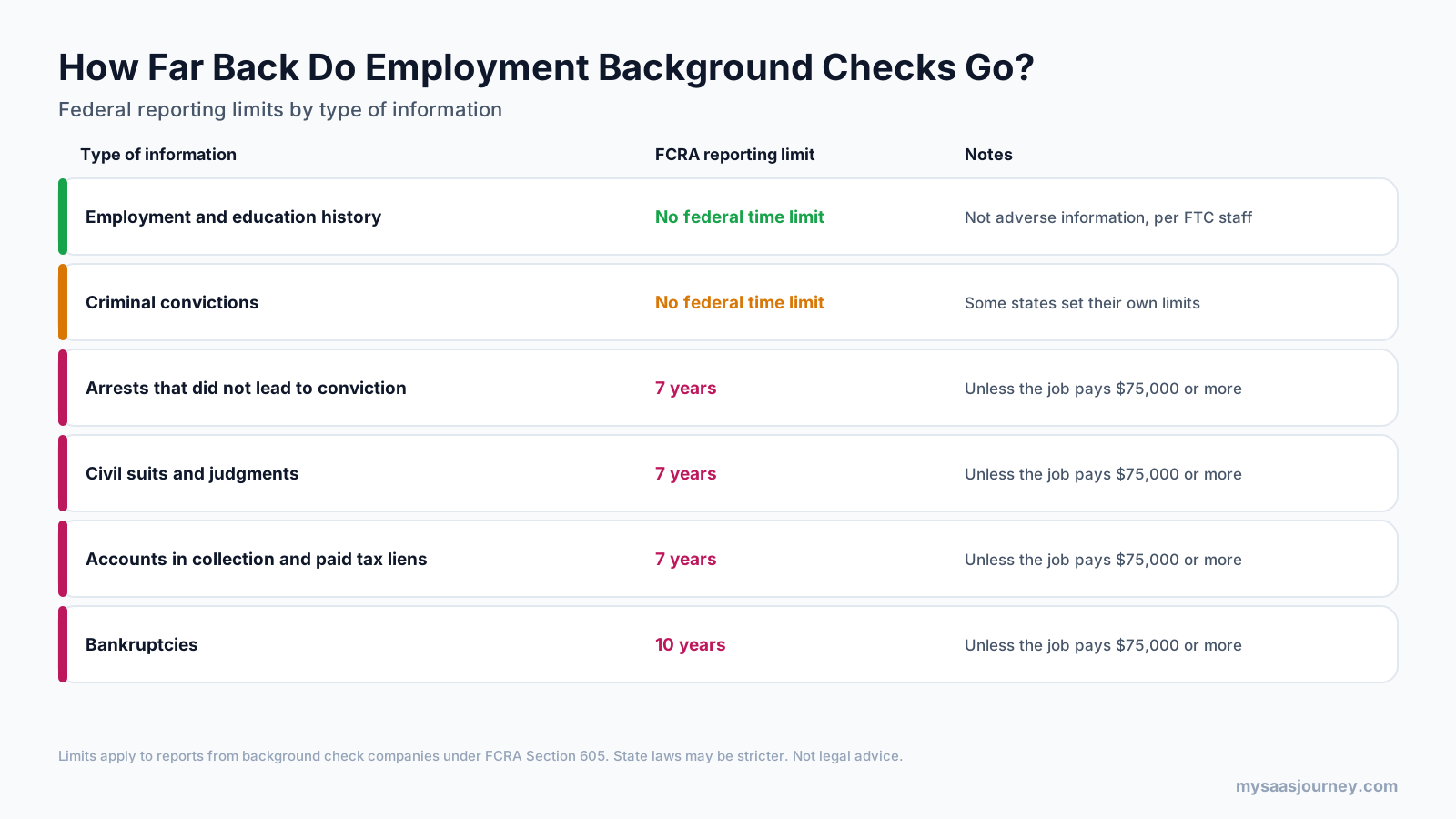
The FCRA limits how long background check companies can report certain negative information. These limits are often called the seven-year rule:
- Arrests that did not lead to a conviction, civil suits and judgments, paid tax liens, and accounts placed for collection cannot be reported after seven years.
- Bankruptcies cannot be reported after 10 years.
- Criminal convictions have no federal time limit, though some states set their own limits.
- These limits do not apply when the job pays, or is expected to pay, $75,000 a year or more.
Employment history is treated differently from those records. FTC staff have said the seven-year limit applies only to adverse information, so screening companies can verify employment and education older than seven years. In practice, employers usually verify a set number of recent jobs or years rather than your full career, and the scope depends on the role.
Your Rights When an Employer Checks Your Employment History
When an employer uses a screening company, the FCRA gives you several protections:
- Disclosure: the employer must tell you in writing, in a standalone document, that it may use a background report.
- Written permission: the employer must get your written authorization before running the check.
- Pre-adverse action notice: before rejecting you based on the report, the employer must give you a copy of the report and “A Summary of Your Rights Under the Fair Credit Reporting Act,” so you can review it and explain any problems.
- Adverse action notice: if the employer rejects you, it must tell you the decision was based on the report, give you the screening company’s contact details, and explain your right to dispute inaccurate information and get a free copy of the report within 60 days.
- Investigative reports: if the check includes interviews about your character or reputation, such as reference interviews, the employer must tell you and you can ask for a description of its nature and scope.
Employers must also apply the same background check standards to all applicants and must not discriminate based on protected characteristics such as race, color, national origin, sex, religion, disability, genetic information, or age 40 or older. The EEOC enforces these protections.
What If Your Employment History Does Not Match?
Small differences are common and are usually easy to explain. Typical causes include:
- Rounded or approximate dates, such as listing a start month rather than an exact date
- Company name changes, mergers, or acquisitions
- Working through a staffing agency, which may be the legal employer of record
- Different job titles in HR systems than the ones you used day to day
- Former employers that have closed and cannot be reached
If a verification comes back with a discrepancy, the employer should give you a chance to respond before making a final decision. Keep documents such as W-2s, pay stubs, offer letters, and separation letters, especially for employers that have closed.
What If You Lied About Your Employment History?
Deliberately inventing jobs, inflating titles, or hiding dates is different from an honest mistake. If a verification shows false information, the employer may withdraw the offer, and if it comes to light after you are hired, it can lead to termination. If you have something on your record you are worried about, it is usually better to explain it upfront than to have the employer find it.
How to Check Your Own Employment History
Before applying, it helps to see the same records an employer might rely on.
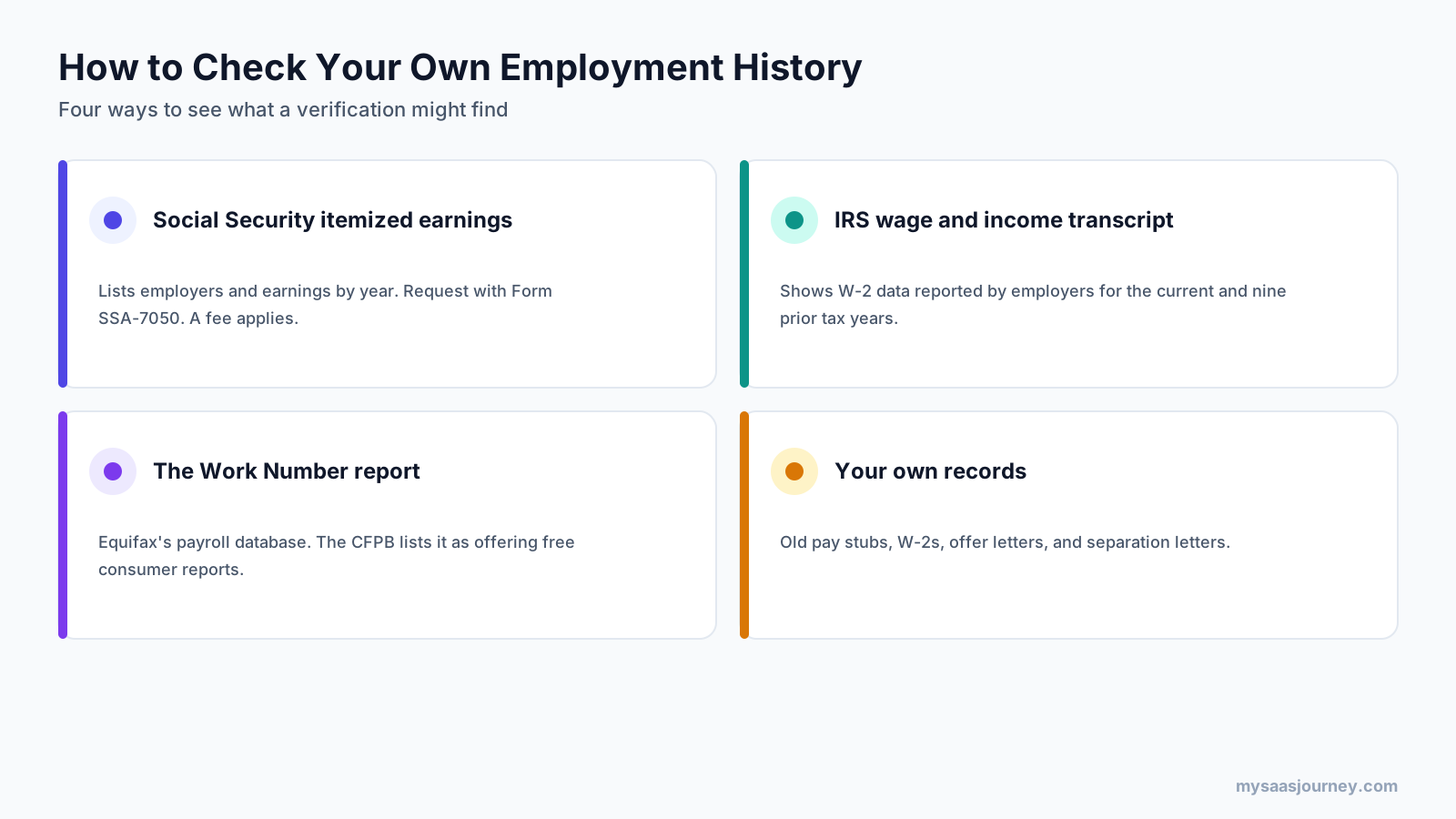
- Social Security itemized earnings statement: request it from the Social Security Administration with Form SSA-7050. It lists your employment periods and the names and addresses of your employers. The SSA charges a fee for itemized statements, so check the current fee on the form. Yearly earnings totals without employer names are available through a my Social Security account.
- IRS wage and income transcript: this shows data from W-2s and other forms reported to the IRS. You can get it through the IRS Get Transcript service or Form 4506-T for the current and nine prior tax years.
- The Work Number: Equifax’s employment and income verification service holds data from employers and payroll providers. The CFPB lists The Work Number among employment screening companies that offer free reports, and you can view your own data through its employee site.
- Your own records: pay stubs, W-2s, offer letters, and separation letters help fill gaps, especially for employers that no longer exist.
Checking these records helps you list accurate dates and spot errors before an employer sees them. If you find a mistake in a screening company’s records, you can dispute it with that company.
How to Prepare for an Employment Verification
A little preparation reduces delays and surprises:
- List each employer’s legal name, address, and phone number, along with the department that handles verifications.
- Use exact start and end dates where possible, and match job titles to what HR would have on file.
- Note any name changes, mergers, or staffing agency arrangements.
- Gather W-2s or pay stubs for employers that have closed or are hard to reach.
- Prepare a short, honest explanation for any employment gaps.
- Ask the employer which screening company it uses, and request a copy of your report.
For Employers: Verifying Employment History the Right Way
If you are hiring, employment verification helps confirm that candidates have the experience they claim. To do it fairly and lawfully:
- Use an FCRA-compliant screening provider and follow the disclosure, authorization, and adverse action steps.
- Apply the same verification policy to every candidate for the same role.
- Check state and local laws on salary history, credit checks, and criminal history before adding those searches.
- Store and dispose of background reports securely once your recordkeeping obligations end. Our glossary entry on data retention policies explains how to set retention rules.
Most employers run verifications through background check software that handles consent forms, ordering, and adverse action notices. You can compare options in our background check software category, and many tools connect to applicant tracking software so screening starts automatically when a candidate reaches the offer stage. For broader people operations tools, see our human resources software category.
Final Thoughts
A background check shows your employment history only when the employer includes employment verification, but that add-on is common. When it runs, it usually confirms your employers, dates, and job titles, and sometimes your reason for leaving or rehire eligibility, depending on the former employer’s policy and state law. Employment history is not limited by the federal seven-year rule, so older jobs can be verified.
The best preparation is accuracy. Check your own records through Social Security, the IRS, or The Work Number, list exact dates and titles, and be ready to explain any gaps. If something in a report is wrong, the FCRA gives you the right to see it and dispute it.
Frequently Asked Questions
Does a background check show employment history?
Only if the employer orders an employment verification. Many basic background checks cover identity and criminal records without past jobs. When employment verification is added, the screening company confirms the employers, dates, and job titles you listed, usually through payroll databases or by contacting each former employer’s HR team.
Can employers see your work history?
Employers can see the work history you provide and can verify it with your written consent through a screening company. A verification confirms the jobs you list rather than producing a complete record of every job you have held. Some employers also call your former employers directly as references.
How do employers verify employment history?
Employers usually use a background screening company, which checks payroll databases such as The Work Number and contacts former employers’ HR or payroll departments. Some employers call former employers themselves. The FCRA requires written consent before a screening company runs the check and specific notices before any adverse decision.
How far back do employment background checks go?
There is no federal time limit on verifying employment history, because the FCRA’s seven-year rule applies only to adverse information such as old arrests and civil judgments. In practice, employers usually verify a set number of recent jobs or years, and the scope depends on the role.
Does a background check show if you were fired?
Terminations are not a standard item on a background check. If the employer orders employment verification or reference checks, a former employer may be asked why you left. No federal law prevents a former employer from truthfully saying you were fired, but many companies confirm only dates and job titles.
Is there a way to see my entire employment history?
Yes. You can request an itemized earnings statement from the Social Security Administration with Form SSA-7050, which lists your employers and earnings by year for a fee. You can also get IRS wage and income transcripts for recent years and check your record with The Work Number.
What if I lied about my employment history?
If an employment verification shows that you invented a job, inflated a title, or changed dates, the employer may withdraw the job offer. If it is discovered after you are hired, it can lead to termination. Honest mistakes, such as rounded dates, are usually easy to explain if you respond promptly.
Can you fail a background check and still get hired?
Yes, it is possible. Employers decide what disqualifies a candidate, and many look at whether an issue is relevant to the job. Under the FCRA, an employer must give you a copy of the report and a chance to explain before rejecting you based on it, which lets you correct errors or provide context.
Sources
| Source | Used for |
|---|---|
| https://www.ftc.gov/business-guidance/resources/background-checks-what-employers-need-know | FCRA disclosure, authorization, adverse action steps, EEOC protections, and types of background information |
| https://www.ftc.gov/business-guidance/resources/using-consumer-reports-what-employers-need-know | Consumer reports for employment and investigative consumer reports |
| https://www.ftc.gov/node/33926 | FTC staff view that the seven-year limit does not restrict verifying employment and education, and that direct employer checks are not covered by the FCRA |
| https://privacyrights.org/consumer-guides/employment-background-checks-jobseekers-guide | FCRA Section 605 reporting limits and the $75,000 exception |
| https://www.ftc.gov/node/33875 | Criminal convictions reportable without federal time limit |
| https://theworknumber.com/ | The Work Number, operated by Equifax, and its employment and income data |
| https://www.consumerfinance.gov/consumer-tools/credit-reports-and-scores/consumer-reporting-companies/companies-list/ | The Work Number listed with free reports; asking which screening company is used |
| https://www.ssa.gov/forms/ssa-7050.pdf | Social Security itemized earnings statement with employer names |
| https://www.irs.gov/individuals/transcript-types-and-ways-to-order-them | IRS wage and income transcript years available |
| https://shrm.org/topics-tools/employment-law-compliance/can-employers-give-bad-reference-former-employee | No federal law on what employers can say; state qualified immunity |
| https://www.illinoislegalaid.org/node/33071 | Truthful job-related references and neutral reference policies |
| https://www.nolo.com/legal-encyclopedia/reference-laws-utah.html | State service letter laws |
| https://legaloverview.com/?p=6466 | Missouri service letter law example (third-party) |
| Ahrefs Keywords Explorer and SERP Overview (US, November 2026) | Keyword volumes, difficulty, SERP and People Also Ask analysis |