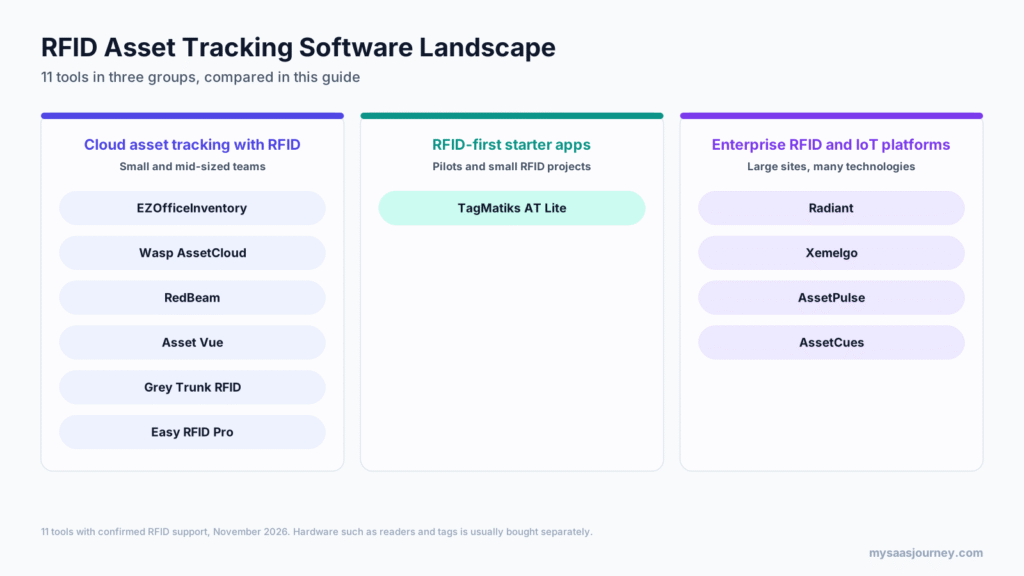

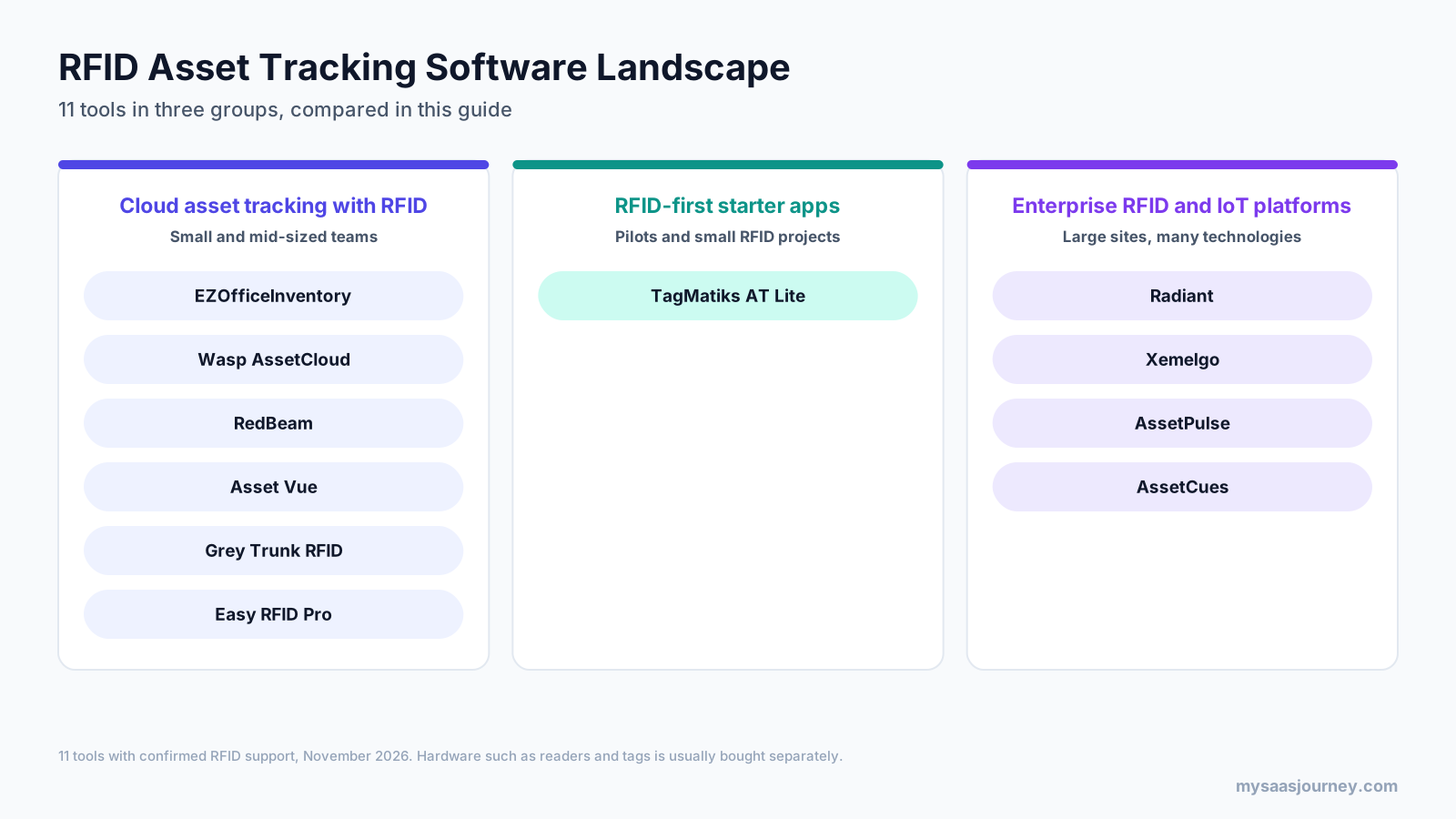
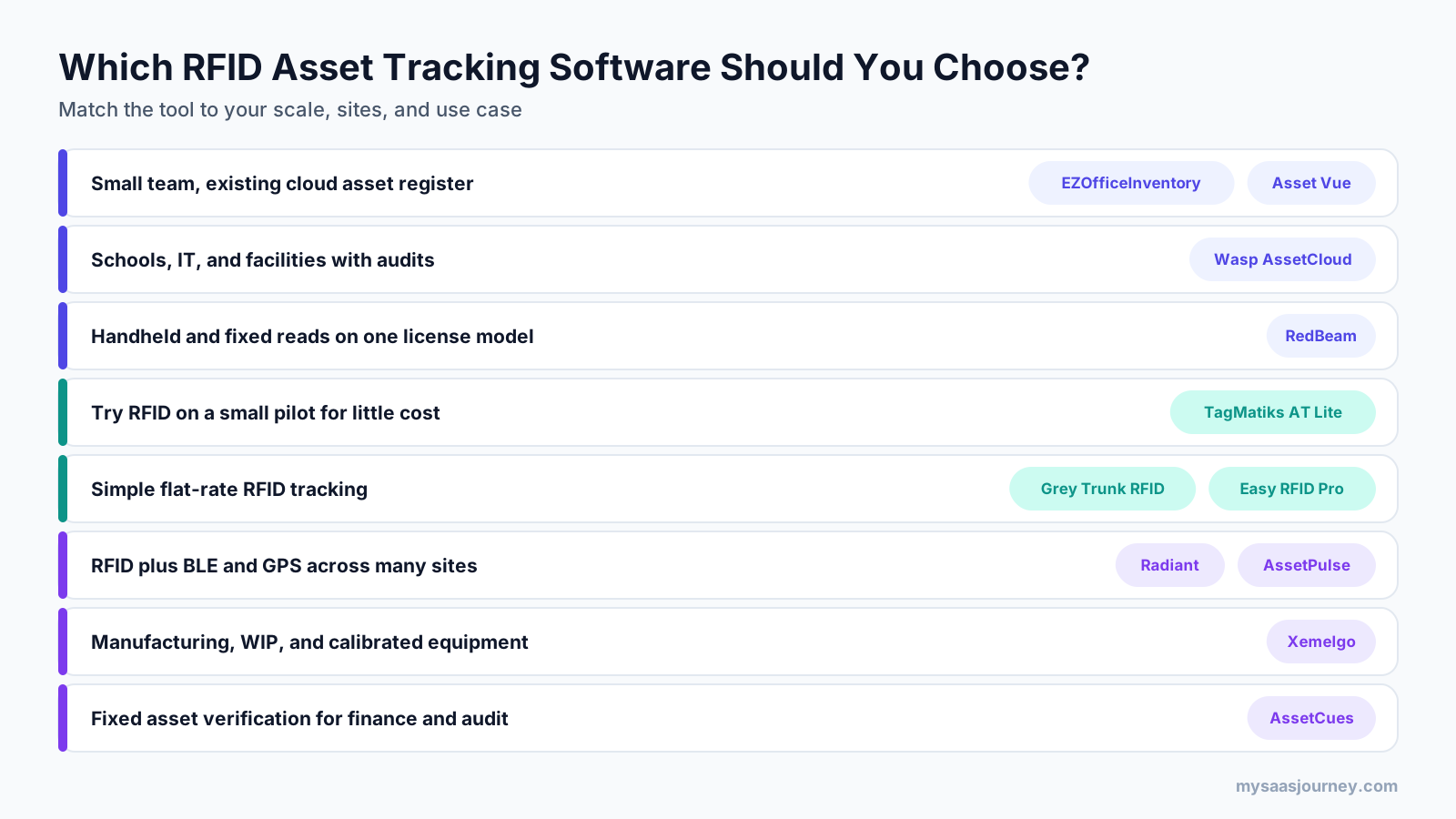
The best RFID asset tracking software depends on how many assets you track, how they move, and whether you need RFID alone or alongside barcodes, Bluetooth, and GPS. For small and mid-sized teams, EZOfficeInventory, Wasp AssetCloud, RedBeam, and Asset Vue add RFID to familiar cloud asset tracking. TagMatiks AT Lite is the lowest-cost way to pilot RFID, with a free tier for up to 99 assets. For large sites and complex operations, Radiant, Xemelgo, AssetPulse, and AssetCues combine RFID with other technologies and enterprise integrations.
RFID changes asset tracking from scanning one item at a time to reading a whole room, shelf, or doorway in seconds. But RFID software only works as well as the readers, tags, and processes around it, so choosing a tool means thinking about hardware and rollout as much as features.
This guide compares 11 RFID asset tracking software options with verified pricing where vendors publish it, explains how RFID asset tracking works, what a full system costs, which tags to use, and when RFID is worth it over barcodes. If you are new to the topic, start with our guide to what asset tracking is.
Key takeaways:
- RFID asset tracking reads many tags at once without line of sight, which can turn multi-day audits into a few hours.
- Several mainstream asset tracking tools include RFID only on higher plans: EZOfficeInventory from its Advanced plan, and Wasp on its Complete plus RFID cloud plan.
- TagMatiks AT Lite is free for up to 99 assets and has one-time licenses from $499, making it a low-risk way to test RFID.
- Enterprise platforms such as Radiant, Xemelgo, AssetPulse, and AssetCues are quote-based and combine RFID with BLE, GPS, IoT sensors, and ERP integrations.
- Software is only part of the cost: readers, tags, printers, and setup often cost more than the first year of software.
How RFID Asset Tracking Works
RFID asset tracking uses radio waves to identify tagged assets and update their records automatically.

- RFID tag: each asset carries a label or hard tag that stores a unique ID. Passive tags have no battery and are powered by the reader.
- Reader: a handheld reader, phone sled, or fixed reader sends radio energy and reads every tag in range, often many at once.
- Edge or middleware: software filters duplicate reads and adds the time and location of each read.
- Tracking software: the asset record updates with location, custodian, and status.
- Action: teams run audits, receive alerts, check assets in and out, and report on utilization.
There are two main ways to read tags:
- Handheld reading: a person walks a room, shelf, or storeroom with a handheld reader. Every tag in range is read in seconds, which is ideal for audits, cycle counts, and finding specific items.
- Fixed reading: readers and antennas at doors, docks, or portals log every tagged asset that passes through without anyone scanning. This suits choke points, automatic check-out, and loss prevention.
Most organizations start with handheld readers for audits and add fixed readers only where assets regularly pass a single doorway or dock.
Quick Comparison of the Best RFID Asset Tracking Software
| Tool | Best for | RFID approach | Deployment | Starting price for RFID |
|---|---|---|---|---|
| EZOfficeInventory | Small and mid-sized teams with a cloud asset register | RFID included from Advanced plan | Cloud | $117.11 a month (500 items) |
| Wasp AssetCloud | Schools, IT, and facilities running regular audits | Complete plus RFID plan for bulk transactions | Cloud (RFID plan) | $7,990 a year for 5 users |
| RedBeam | Handheld and fixed reads under one license model | Dedicated RFID product, Zebra hardware | Cloud | $1,200 a year per user or reader |
| Asset Vue | Simple tracking with barcode or RFID tags | RFID on Starter and Professional plans | Cloud | $199 a month (150 to 1,499 assets) |
| Grey Trunk RFID | Flat-rate RFID tracking for small teams | RFID-focused app with bulk check-in and check-out | Cloud | $99 a month (Advance, per Capterra) |
| Easy RFID Pro | Small RFID deployments with mobile and fixed reads | Mobile and fixed RFID | Cloud console | $79 a month for 200 items (per Capterra) |
| TagMatiks AT Lite | Low-cost RFID pilots | RFID-first app for handheld readers | iOS, Android, Windows | Free up to 99 assets |
| Radiant | Multi-site RFID, BLE, and GPS tracking | UHF passive RFID plus BLE, GPS, barcode | Cloud or self-hosted | Quote |
| Xemelgo | Manufacturing, WIP, and calibrated equipment | Cloud RFID and sensor platform | Cloud (AWS) | Quote |
| AssetPulse | Labs, data centers, and high-value equipment | Passive RFID, BLE, and IoT sensors | Cloud or on-premise | Quote |
| AssetCues | Fixed asset verification for finance and audit | RFID with barcode, QR, IoT, GPS, and RTLS | Enterprise platform | Quote |
How We Chose These Tools
We included only tools whose RFID support we could confirm on the vendor’s site or a recent listing, and assessed each on:
- RFID depth: handheld reads, fixed readers, bulk transactions, and label encoding
- Other technologies: barcode, QR, BLE, and GPS support alongside RFID
- Hardware compatibility: supported readers, especially common Zebra devices
- Deployment: cloud, self-hosted, or on-premise options
- Integrations: ERP, ITSM, and maintenance systems
- Pricing transparency: published prices, free tiers, and trials
Some popular asset tracking tools were left out because their public pages did not confirm RFID support at the time of review. Prices come from vendor pages checked in November 2026, with third-party sources marked.
Cloud Asset Tracking Software With RFID
These tools are full asset tracking platforms that add RFID to barcode and QR scanning. They suit organizations that want one system for all assets, with RFID for high-volume audits.
1. EZOfficeInventory
EZOfficeInventory is a cloud asset tracking platform for equipment, IT assets, and inventory. It includes RFID support on its Advanced, Premium, and Enterprise plans, alongside barcode and QR scanning, check-in and check-out, and maintenance.
Best for: small and mid-sized organizations that want RFID inside a general asset tracking system.
Key features:
- RFID support from the Advanced plan upward
- Barcode and QR labels with mobile scanning
- Check-in, check-out, and reservations
- Maintenance scheduling, with a separate CMMS add-on
- Reports, audits, and role-based permissions
Pricing: Essential costs $81.41 a month, Advanced $117.11 a month, and Premium $142.10 a month, each based on 500 items, with Enterprise on custom pricing. RFID is included from Advanced. Each paid plan has a 14-day free trial with no credit card required.
Trade-offs: The cheapest plan does not include RFID. Pricing scales with item count, and the pricing page is inconsistent about whether starting prices are based on 100 or 500 items, so confirm your quote.
2. Wasp AssetCloud
Wasp AssetCloud is an established asset tracking system from Wasp Barcode Technologies, widely used by schools, IT teams, and facilities. Its Complete plus RFID cloud plan lets you read many assets at once to move, check out, check in, audit, and dispose of them in bulk.
Best for: schools, IT departments, and facilities teams that run frequent audits.
Key features:
- Bulk RFID transactions for moves, check-outs, check-ins, audits, and disposals
- Audit accuracy improvements by reading all assets in range
- Mobile app with barcode and RFID scanning and offline mode
- Maintenance, work orders, and contract tracking on Complete
- Cloud and self-hosted versions of the core product
Pricing: Wasp lists the cloud-hosted Complete plus RFID plan from $7,990 a year for 5 users, billed annually, with support and maintenance included. Additional cloud users cost $25 a month on Complete. Third-party reviews report that RFID is not available on the on-premise version.
Trade-offs: RFID requires the most expensive published plan, which puts it out of reach for very small teams. Wasp focuses on barcode and RFID identification rather than continuous location tracking.
3. RedBeam
RedBeam offers asset tracking, inventory tracking, and a dedicated RedBeam RFID product. Its pricing counts administrators, mobile readers, and fixed RFID readers as users, which makes costs predictable as you add hardware.
Best for: organizations that want handheld and fixed RFID reading under one simple license model.
Key features:
- Fixed and mobile reader support, with fixed reader management
- Works with smartphones, tablets, enterprise mobile devices, and Zebra RFID hardware
- Unlimited assets, locations, and workflows on RedBeam RFID
- GPS mapping, cycle counts, shipment verification, and label printing and encoding
- Onboarding in as little as six weeks for a full RFID deployment
Pricing: RedBeam lists $1,200 per user per year, $3,420 for three years, or $5,400 for five years. Each administrator, mobile reader, or fixed reader counts as a user. A free trial is available.
Trade-offs: Because every reader counts as a user, costs rise quickly with many fixed portals. RedBeam is offered as a cloud-hosted service, with no on-premise version listed.
4. Asset Vue
Asset Vue is a cloud asset tracking system that works with barcode or RFID tags, depending on what you prefer. It supports multiple tags per asset, which helps when moving from barcodes to RFID.
Best for: small and mid-sized organizations that want straightforward RFID-ready tracking at a published price.
Key features:
- Barcode or RFID support on Starter and Professional plans
- Multiple asset tags per asset and “last scanned” location indicators
- Maintenance scheduling, warranty tracking, and an audit module
- Configurable email alerts and role-based security
- iOS and Android mobile apps
Pricing: Starter costs $199 a month for 150 to 1,499 assets, and Professional costs $499 a month for 1,500 to 5,000 assets, both with RFID support. Lite costs $49 a month for up to 149 assets after a 15-day trial, but its RFID support is unclear on the pricing page. Enterprise is quoted for larger asset counts.
Trade-offs: Prices are monthly, and the Lite plan may not include RFID, so most RFID users will start at $199 a month.
5. Grey Trunk RFID
Grey Trunk RFID is an asset tracking system built around RFID, with a focus on bulk check-in and check-out and capturing data on the move.
Best for: small teams that want a simple, flat-rate RFID tracking system.
Key features:
- Bulk check-in and check-out with RFID
- Mobile data capture for tracking on the go
- Flat-rate monthly plans
- Free trial
Pricing: Capterra lists four flat-rate monthly plans, including Advance at $99 a month, with a free trial. Grey Trunk’s own pricing page could not be read during this check, so confirm current plans with the vendor.
Trade-offs: Public detail on supported readers, integrations, and plan limits is limited, so ask for a demo with your hardware.
6. Easy RFID Pro
Easy RFID Pro is RFID inventory and asset tracking software that combines mobile and fixed RFID reading for visibility across a site.
Best for: small RFID deployments that want both handheld and fixed reading at a low monthly price.
Key features:
- Mobile and fixed RFID reading
- Cloud management console
- Item tracking and visibility across locations
- Free trial and free version listed
Pricing: Capterra lists a Lite plan at $79 a month for up to 200 RFID items, with email support and a cloud management console. Confirm current plans with the vendor.
Trade-offs: The Lite item limit is small, and public information on higher tiers, supported hardware, and integrations is limited.
RFID-First Starter Software
7. TagMatiks AT Lite
TagMatiks AT Lite, from RFID4U, is a lightweight RFID asset tracking app designed to start an RFID project quickly. It connects to RFID handheld readers and runs on iOS, Android, and Windows, with an upgrade path to the cloud-based TagMatiks AT enterprise platform.
Best for: teams that want to pilot RFID asset tracking at very low cost before committing to a larger system.
Key features:
- Free for up to 99 active assets
- Connects to RFID handhelds such as Zebra devices
- Inventory counts, transactions, imports, exports, and reports
- Available on iOS, Android, and Windows
- Upgrade path to TagMatiks AT and TagMatiks Core middleware
Pricing: AT Lite is free for up to 99 assets. One-time licenses cost $499 for 750 assets (Bronze), $999 for 2,000 (Silver), and $1,999 for 5,000 (Gold). The TagMatiks enterprise platform costs $1,800 per device per year, including TagMatiks Core middleware.
Trade-offs: AT Lite is built around handheld readers rather than fixed portals, and larger deployments need the enterprise platform with different pricing.
Enterprise RFID and IoT Platforms
These platforms suit larger organizations that need RFID across many sites, often combined with other technologies and deep integrations.
8. Radiant
Radiant is an RFID and IoT asset tracking platform for fixed and mobile assets across industries such as manufacturing, energy, aerospace, data centers, higher education, and public agencies. It combines UHF passive RFID with Bluetooth, GPS, and barcodes, and also supports life safety use cases such as mustering.
Best for: organizations tracking assets across multiple sites with more than one technology.
Key features:
- UHF Gen2 passive RFID, BLE beacons, GPS with geofencing, and barcodes in one system
- Emphasis on infrastructure-free deployments to limit upfront hardware cost
- Mobile apps for iOS and Android and a web portal
- Integrations with SAP, Oracle, PeopleSoft, Banner, Sage, ServiceNow, and SunGard
- Cloud hosting with daily backups, or self-hosting
Pricing: Radiant does not publish prices. It offers a savings calculator and demos.
Trade-offs: Quote-based pricing and a broad feature set make it more than a small team needs.
9. Xemelgo
Xemelgo is a cloud RFID and sensor platform for operations, covering asset tracking, work-in-process, inventory, and shipments. Its asset tracking manages calibration and expiration dates and alerts staff if expired assets are on the production floor.
Best for: manufacturers and operations teams tracking equipment, WIP, and materials together.
Key features:
- Asset tracking with calibration and expiration alerts
- Work-in-process, inventory, and shipment tracking
- Cloud platform on AWS with SOC 2 compliance
- Technology partners including Zebra, Impinj, and Avery Dennison
- iOS and Android apps and ERP integration
Pricing: Xemelgo offers starter kits and site licenses but does not publish prices.
Trade-offs: Xemelgo focuses on operations and manufacturing, so it is less suited to office IT asset tracking. For calibration-heavy equipment, compare it with dedicated calibration management software.
10. AssetPulse
AssetPulse supplies RFID asset tracking systems, including hardware, software, and deployment, through its AssetGather platform. It focuses on demanding environments such as laboratories, biomedical equipment, data centers, and manufacturing.
Best for: labs, data centers, and organizations tracking high-value equipment in complex environments.
Key features:
- Passive RFID with fixed readers at choke points and handheld readers
- BLE beacons for indoor positioning of high-value assets
- IoT sensor support through AssetGather Edge
- AssetGather Mobile for iOS and Android and AssetGather Server in the cloud or on-premise
- APIs and webhooks for ERP and WMS integration, including SAP and Oracle
Pricing: AssetPulse does not publish prices and offers consultations and demos.
Trade-offs: Hardware and software integration makes implementation more involved than off-the-shelf cloud tools.
11. AssetCues
AssetCues is an enterprise asset management and tracking platform for finance, IT, and operations teams, with a strong focus on fixed asset verification. It supports RFID alongside barcode, QR, IoT, GPS, and real-time location tracking.
Best for: mid-market and large enterprises reconciling fixed asset registers for audits.
Key features:
- Mobile fixed asset verification against the asset register
- RFID with barcode, QR, IoT, GPS, and real-time location options
- AI copilots for capitalization, tagging, register integrity, and audits
- Connectors for SAP, Oracle, ServiceNow, and IBM Maximo
- ISO 27001-certified data centers and SOC 2 compliance
Pricing: AssetCues offers custom enterprise pricing and a free trial.
Trade-offs: AssetCues is built for finance-led verification at scale, so smaller teams may find it more than they need.
Features Compared
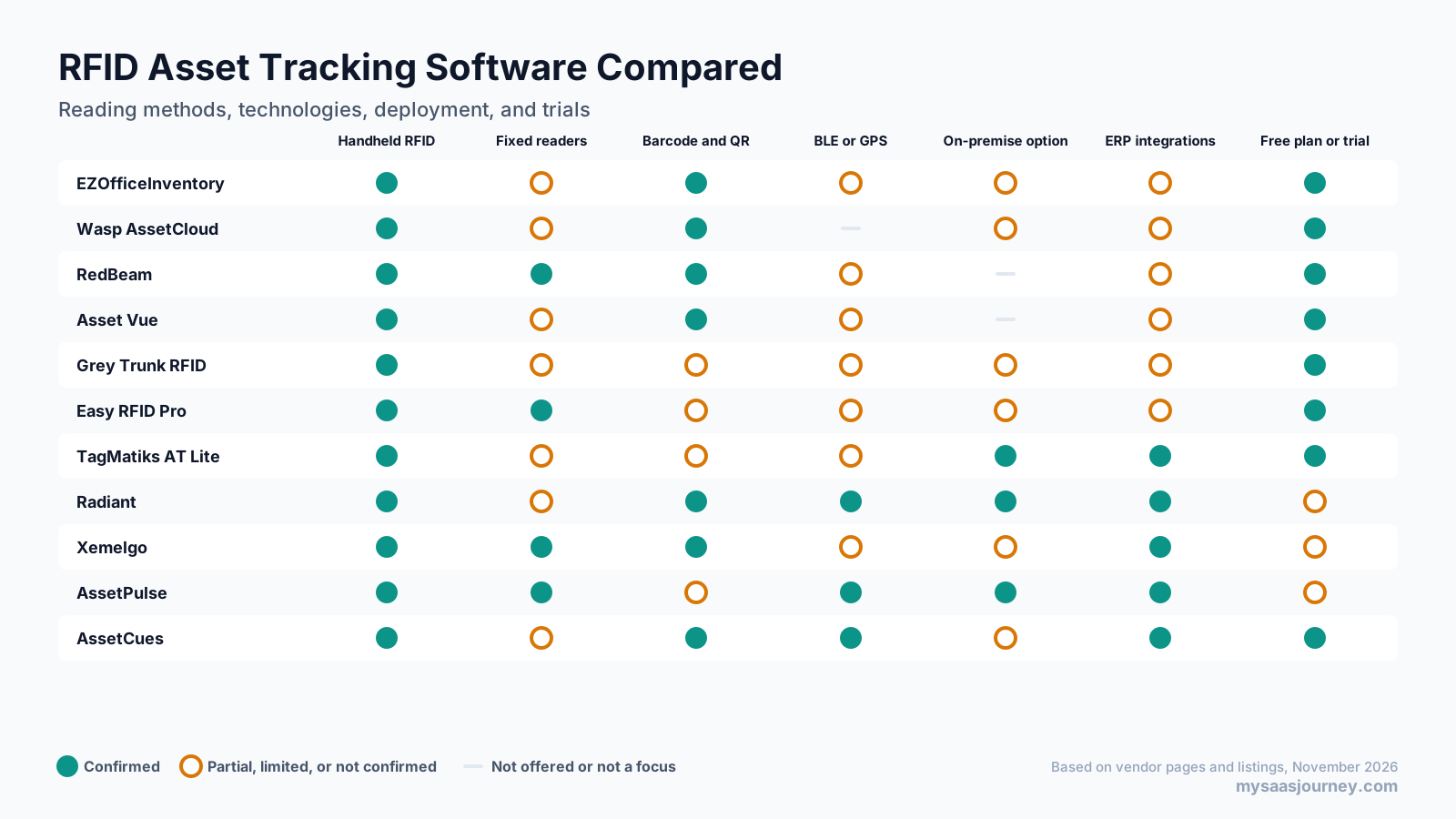
All 11 tools support handheld RFID reading. The differences appear in fixed reader support, other technologies, and deployment. RedBeam, Easy RFID Pro, Xemelgo, and AssetPulse explicitly support fixed readers. Radiant, AssetPulse, and AssetCues combine RFID with BLE or GPS. Radiant, AssetPulse, and the TagMatiks platform offer self-hosted or on-premise options for organizations with strict data requirements.
Pricing Compared
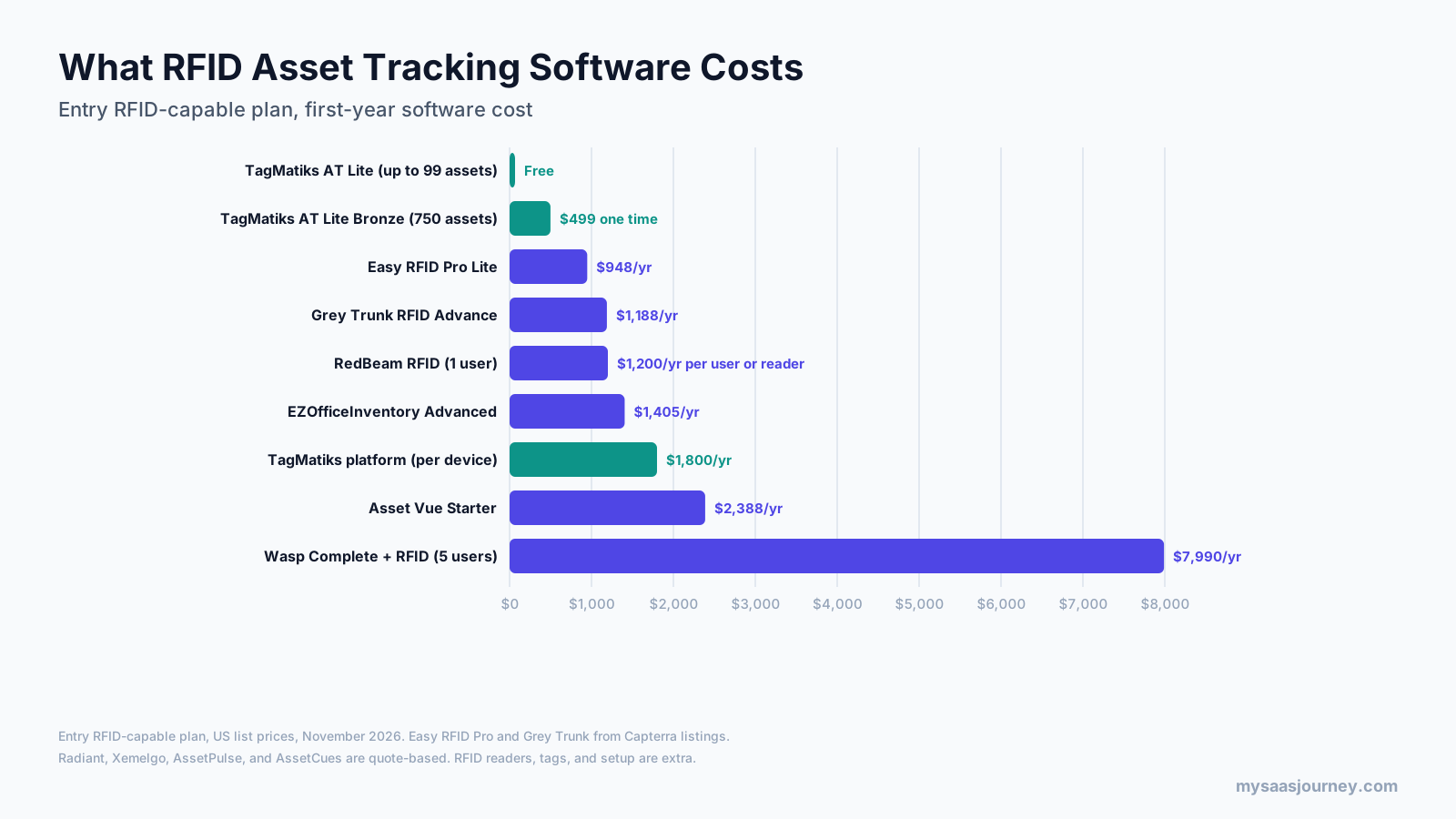
| Tool | Free option | Entry RFID-capable plan | First-year software cost |
|---|---|---|---|
| TagMatiks AT Lite | Free up to 99 assets | Bronze (750 assets) | $499 one time |
| Easy RFID Pro | Free version listed | Lite (200 items) | About $948 |
| Grey Trunk RFID | Free trial | Advance | About $1,188 |
| RedBeam | Free trial | 1 user or reader | $1,200 |
| EZOfficeInventory | 14-day trial | Advanced (500 items) | About $1,405 |
| TagMatiks platform | No | Per device | $1,800 |
| Asset Vue | 15-day trial (Lite) | Starter | $2,388 |
| Wasp AssetCloud | Trial available | Complete plus RFID (5 users) | $7,990 |
| Radiant, Xemelgo, AssetPulse, AssetCues | Varies | Custom | Quote |
When comparing prices, check:
- What counts as a user: RedBeam counts each reader as a user, while others count people.
- Asset limits: many plans are priced by the number of assets or items.
- Whether RFID is included: some vendors reserve RFID for higher plans.
- Deployment: cloud and on-premise versions may have different RFID support.
Our glossary entry on pricing models explains per-user and per-asset pricing in more detail.
What an RFID Asset Tracking System Costs
Software is only one part of an RFID budget. A working system has six parts.
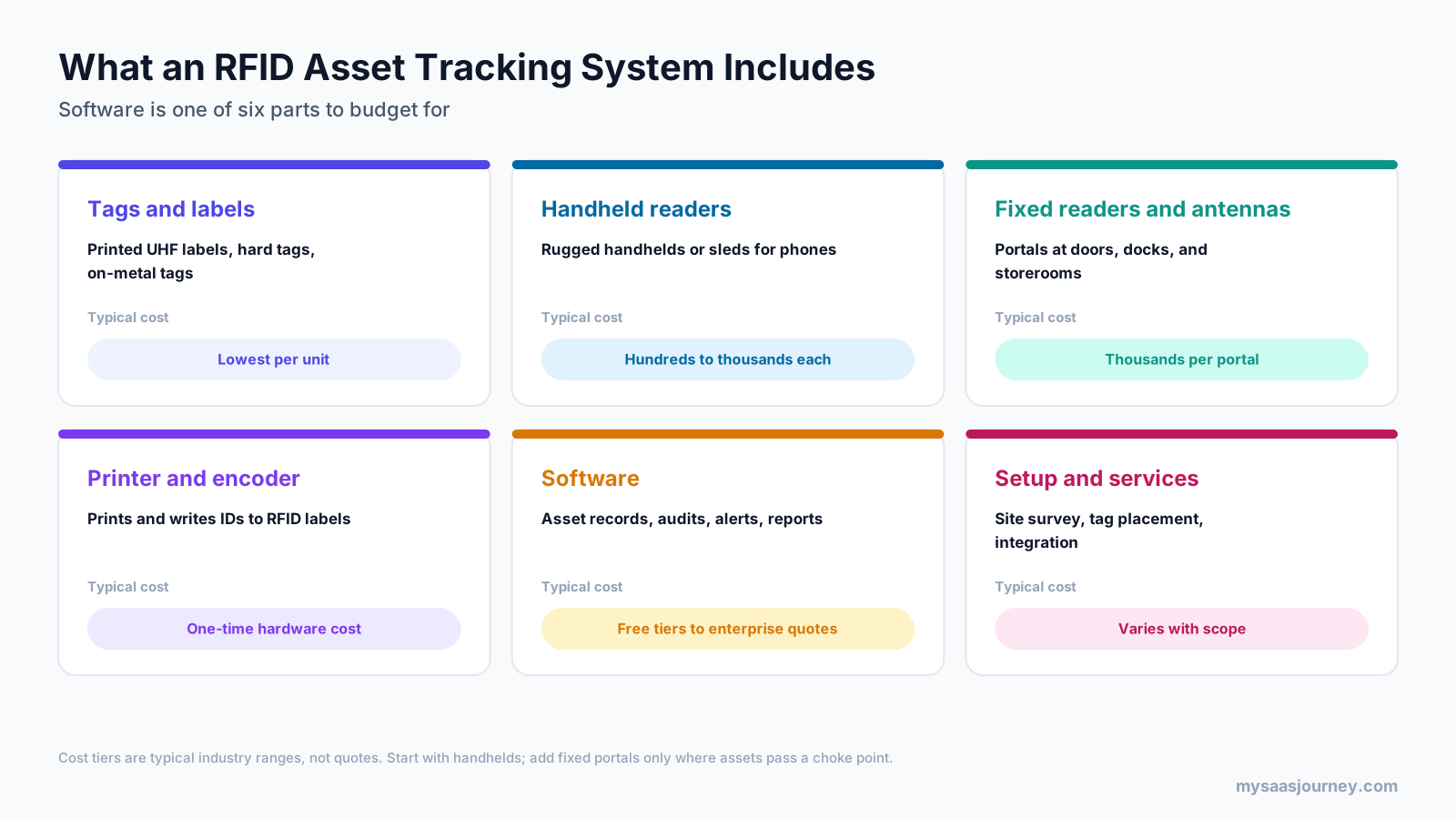
- Tags and labels: printed UHF labels are the cheapest, while hard tags and on-metal tags cost more per unit.
- Handheld readers: rugged handhelds or sleds that attach to a phone, typically costing hundreds to thousands of dollars each.
- Fixed readers and antennas: portals at doors and docks, often costing thousands of dollars per portal.
- Printer and encoder: prints labels and writes IDs to RFID tags.
- Software: from free tiers to enterprise quotes, as shown above.
- Setup and services: site surveys, tag placement testing, and integration work.
A sensible approach is to start with handheld readers for audits, which needs only tags, one or two readers, and software. Add fixed portals later where assets regularly pass a single doorway or dock and automation pays for itself.
Which RFID Tags Should You Use?
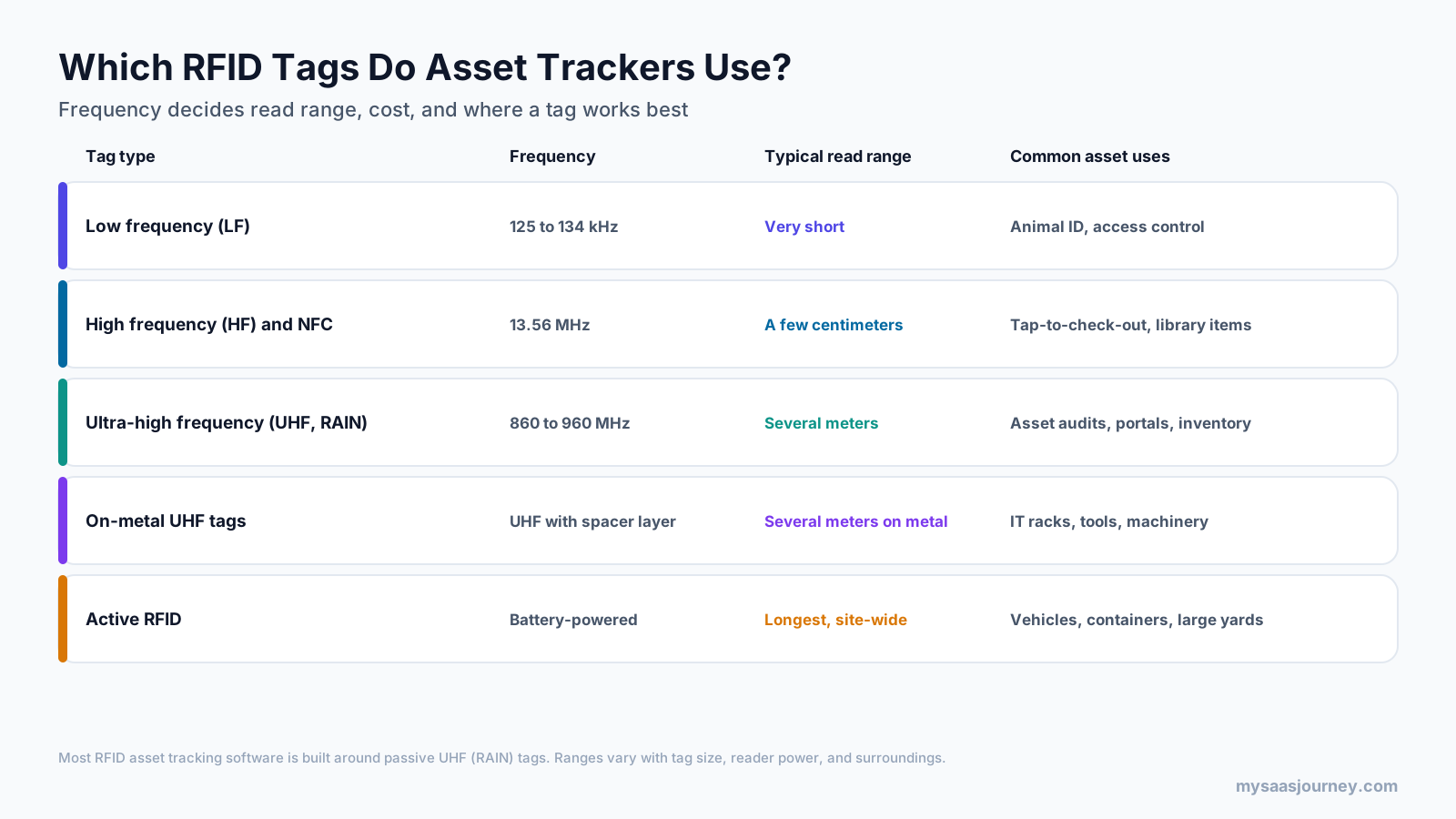
Most RFID asset tracking software is built around passive UHF tags, also called RAIN RFID, which can be read from several meters away. The main options are:
- Low frequency (LF): very short range, used mainly for animal ID and access control.
- High frequency (HF) and NFC: a few centimeters, used for tap-to-check-out and library items.
- Ultra-high frequency (UHF, RAIN): several meters, the standard for asset audits, portals, and inventory.
- On-metal UHF tags: include a spacer layer so they read reliably on metal surfaces such as servers, tools, and machinery.
- Active RFID: battery-powered tags with the longest range, for vehicles, containers, and large yards.
Tag choice matters as much as software. Standard labels can fail on metal or near liquids, so test tags on your actual assets before buying in volume.
RFID vs Barcode Asset Tracking
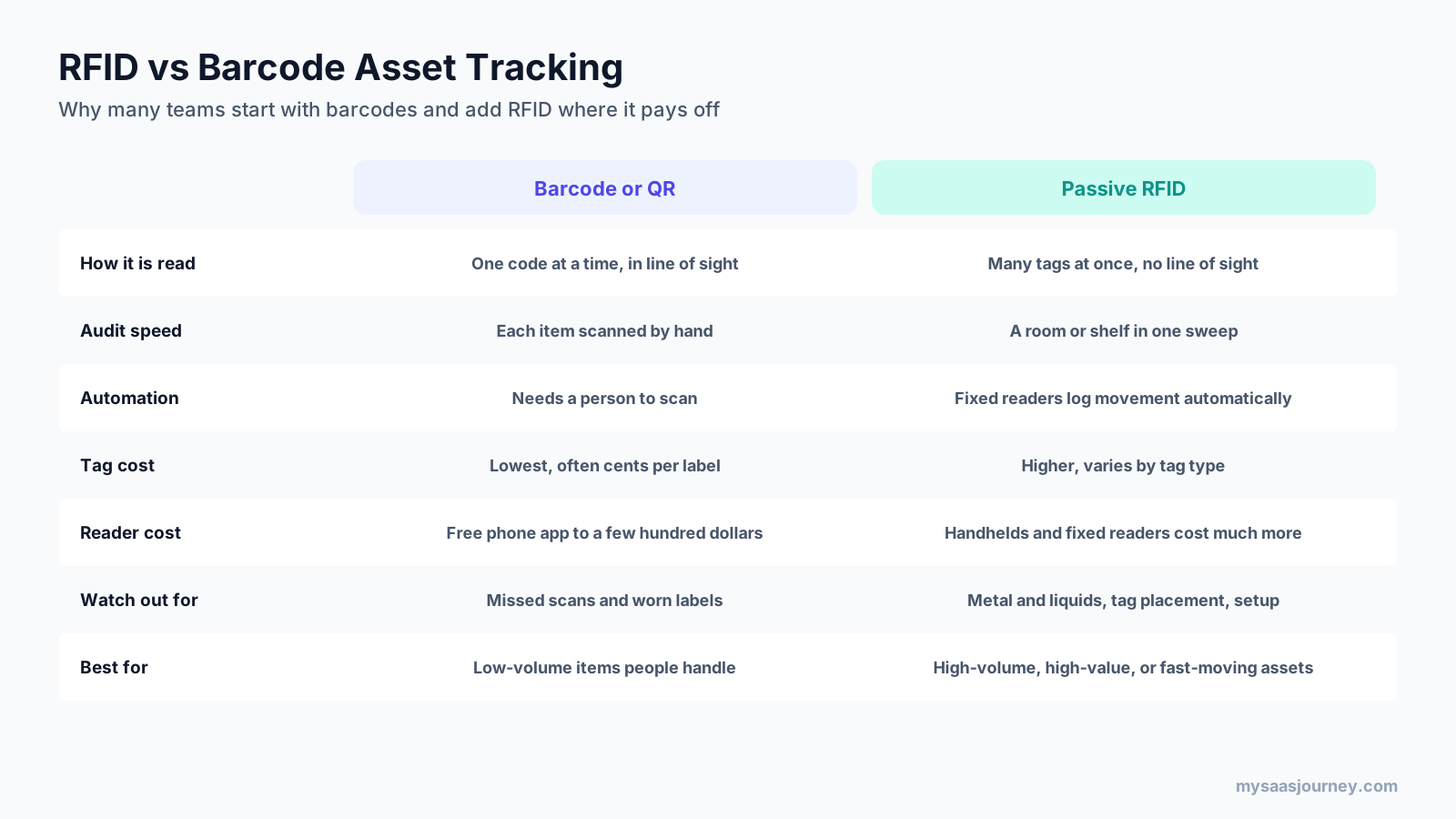
Barcodes and QR codes are cheaper and simpler, but each item must be scanned individually in line of sight. Passive RFID reads many tags at once without line of sight, and fixed readers can log movement with no one scanning.
RFID is usually worth it when:
- You have hundreds or thousands of assets to audit regularly
- Assets are stored in cases, racks, or bins where codes are hard to reach
- Assets move through predictable choke points such as doors or docks
- Losses or audit labor costs are high enough to justify readers and tags
Many organizations use both: barcodes or QR codes for low-value or rarely audited items, and RFID for high-volume, high-value, or fast-moving assets. Several tools in this list, including Asset Vue, let you attach more than one tag to an asset to make that transition easier. Our barcoding software category covers barcode-focused tools.
RFID Asset Tracking Use Cases by Industry
RFID pays off fastest where many assets need counting often, or where assets pass through the same doors and docks every day. These are the most common settings.
- IT and data centers: servers, laptops, and network gear are counted rack by rack with a handheld reader, and on-metal tags keep reads reliable on metal chassis. Audits that once took days of scanning serial numbers can be done in a single walk-through.
- Schools and universities: Chromebooks, AV equipment, and lab devices are checked out and returned in bulk at the start and end of each term, which is the use case Wasp AssetCloud highlights for its RFID plan.
- Healthcare and labs: shared equipment such as infusion pumps, microscopes, and freezers is located quickly, and calibration dates are tracked so expired equipment is not used. AssetPulse and Xemelgo both focus on this kind of environment.
- Manufacturing: tools, fixtures, and work-in-process move between stations, and fixed readers at each station record progress without manual scans. Xemelgo pairs asset tracking with WIP tracking for this reason.
- Construction, utilities, and field service: tools and equipment are counted as they leave and return to a yard or vehicle, often with GPS for vehicles and RFID for the tools inside.
- Finance and fixed asset audits: auditors verify the fixed asset register against physical assets across many sites, which is the focus of AssetCues.
If your use case appears here, look first at the tools that name it on their own sites, since they are more likely to have the workflows and reports you need.
How to Choose RFID Asset Tracking Software
- Define the problem you want RFID to solve. Decide whether you need faster audits, automatic check-out, loss prevention, or location visibility.
- Count and categorize your assets. Note how many there are, what they are made of, and where they move.
- Decide on handheld or fixed reading. Start with handhelds for audits, and plan fixed readers only where there are clear choke points.
- Check that the software works with your hardware. Confirm the software supports the readers you plan to buy, such as Zebra handhelds.
- Decide where the software will run. Choose cloud for speed, or self-hosted or on-premise if your data rules require it. Our explainer on what cloud computing is covers the trade-offs.
- Plan the integrations you need on day one. Check connections to ERP, finance, ITSM, or maintenance systems. Our guide to what an API is explains how these work.
- Run a small pilot before a full rollout. Tag one asset category or room, measure read rates and audit time, and adjust tag placement before scaling.
How to Build an RFID Asset Tracking System Step by Step
Building an RFID asset tracking system is mostly a rollout exercise, not a software installation. Most successful projects follow the same sequence.
- Clean up the asset register before tagging anything, so each RFID tag is linked to an accurate record with the right owner, location, and category.
- Run a site survey of the rooms, racks, and doorways where you plan to read tags, noting metal shelving, liquids, and dense storage that can block radio signals.
- Test several tag types on a sample of your actual assets, and record read range and read rate for each before ordering in volume.
- Tag one area or asset class first, such as a single storeroom or all laptops, and run a full handheld audit to measure time saved against your barcode process.
- Train the people who will read tags, check assets in and out, and act on alerts, and write down where each tag goes on each asset type.
- Add fixed readers only at choke points where the pilot shows assets pass regularly, then expand to more sites once read rates are stable.
Many organizations bring in an RFID systems integrator for the site survey, tag selection, and reader tuning, especially for fixed portals. Integrators such as RMS Omega pair hardware from vendors like Zebra with tracking software such as Xemelgo, which can shorten the learning curve for a first deployment. For a broader buying framework, see our guide on how to choose the right software for your business.
Common RFID Asset Tracking Mistakes to Avoid
- Buying hardware before testing tags on your assets, especially metal equipment and items near liquids
- Expecting fixed readers to work everywhere, when they work best at defined choke points
- Skipping the register cleanup, so RFID simply speeds up reading inaccurate records
- Underestimating setup time for tag placement, reader tuning, and staff training
- Choosing software that cannot export data or integrate with finance and IT systems
Final Thoughts
The best RFID asset tracking software is the one that matches your scale, hardware plans, and use case. EZOfficeInventory, Wasp AssetCloud, RedBeam, and Asset Vue bring RFID into familiar cloud asset tracking for small and mid-sized organizations. TagMatiks AT Lite is the easiest way to test RFID for free or a small one-time fee. Grey Trunk RFID and Easy RFID Pro offer simple flat-rate options. For complex, multi-site, or regulated environments, Radiant, Xemelgo, AssetPulse, and AssetCues combine RFID with other technologies and enterprise integrations.
Start with a clear goal, test tags on your actual assets, begin with handheld readers, and pilot one area before rolling out. That approach keeps hardware spending under control and proves the value of RFID before you scale.
Frequently Asked Questions
What is RFID asset tracking software?
RFID asset tracking software records the location, custodian, and status of assets fitted with RFID tags. It connects to handheld or fixed RFID readers, which read many tags at once without line of sight, and updates asset records automatically. It typically includes audits, check-in and check-out, alerts, and reports.
What is the best RFID asset tracking software?
It depends on your needs. EZOfficeInventory, Wasp AssetCloud, RedBeam, and Asset Vue suit small and mid-sized teams, TagMatiks AT Lite is best for low-cost pilots, and Radiant, Xemelgo, AssetPulse, and AssetCues suit large, multi-site, or complex operations that combine RFID with other technologies.
How does RFID asset tracking work?
Each asset carries an RFID tag with a unique ID. A handheld or fixed reader sends radio energy, reads every tag in range, and passes the reads to middleware that filters duplicates and adds time and location. The software then updates each asset’s record and triggers audits, alerts, or check-outs.
How much does RFID asset tracking cost?
Software ranges from free, with TagMatiks AT Lite for up to 99 assets, to about $1,200 to $2,400 a year for small business plans and $7,990 a year for Wasp’s Complete plus RFID plan, with enterprise platforms quote-based. Readers, tags, printers, and setup add to the total and often exceed the first year of software.
Is RFID better than barcodes for asset tracking?
RFID is better for high-volume audits, assets in hard-to-reach places, and automatic tracking at doorways, because it reads many tags at once without line of sight. Barcodes are cheaper and simpler for low-volume items people handle directly. Many organizations use barcodes for most items and RFID where it saves the most time.
What RFID tags are used for asset tracking?
Most asset tracking uses passive UHF tags, also called RAIN RFID, which can be read from several meters away. On-metal UHF tags are used for servers, tools, and machinery, while active RFID tags with batteries are used for vehicles and large yards. HF and NFC tags suit tap-based check-out.
How long do passive RFID tags last?
Passive RFID tags have no battery, so they do not wear out from use in the way battery-powered tags do. Their lifespan depends mainly on physical durability: the label material, adhesive, and exposure to heat, chemicals, and handling. Choose hard tags or rugged labels for harsh environments.
Is there free RFID asset tracking software?
Yes. TagMatiks AT Lite is free for up to 99 active assets on iOS, Android, and Windows, which makes it suitable for small pilots. Several other tools offer free trials, including EZOfficeInventory, RedBeam, and Asset Vue, but their RFID features are on paid plans.