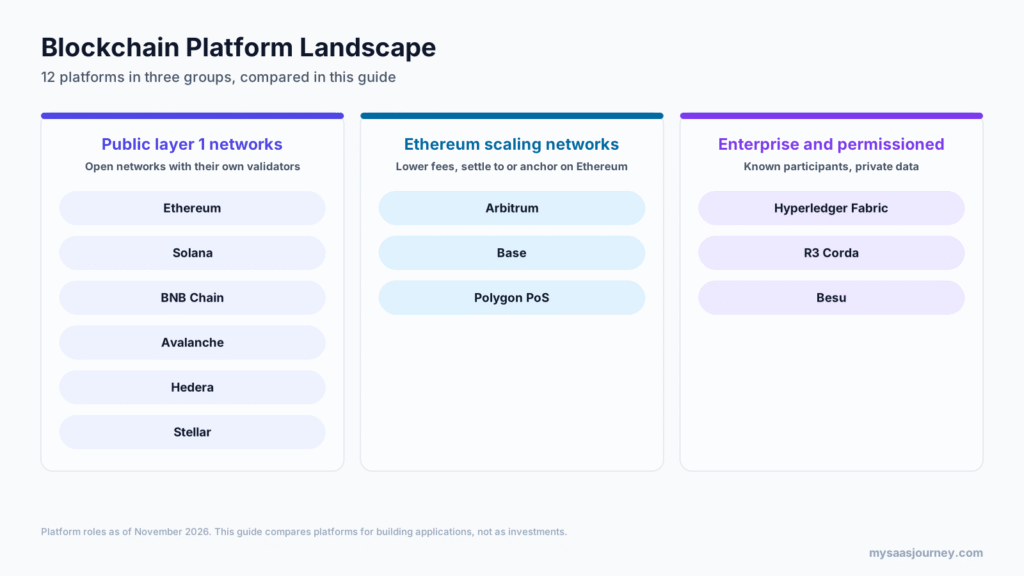

The best blockchain platform depends on what you are building and who needs to see the data. Ethereum has the largest developer ecosystem and is the default for tokens and decentralized finance. Arbitrum and Base run Ethereum-compatible apps at lower cost, and Solana suits high-speed consumer apps. For payments, Stellar and Polygon PoS are strong options, while Hedera offers USD-denominated fees and council governance. For private business networks, Hyperledger Fabric, R3 Corda, and Besu are the leading permissioned platforms.
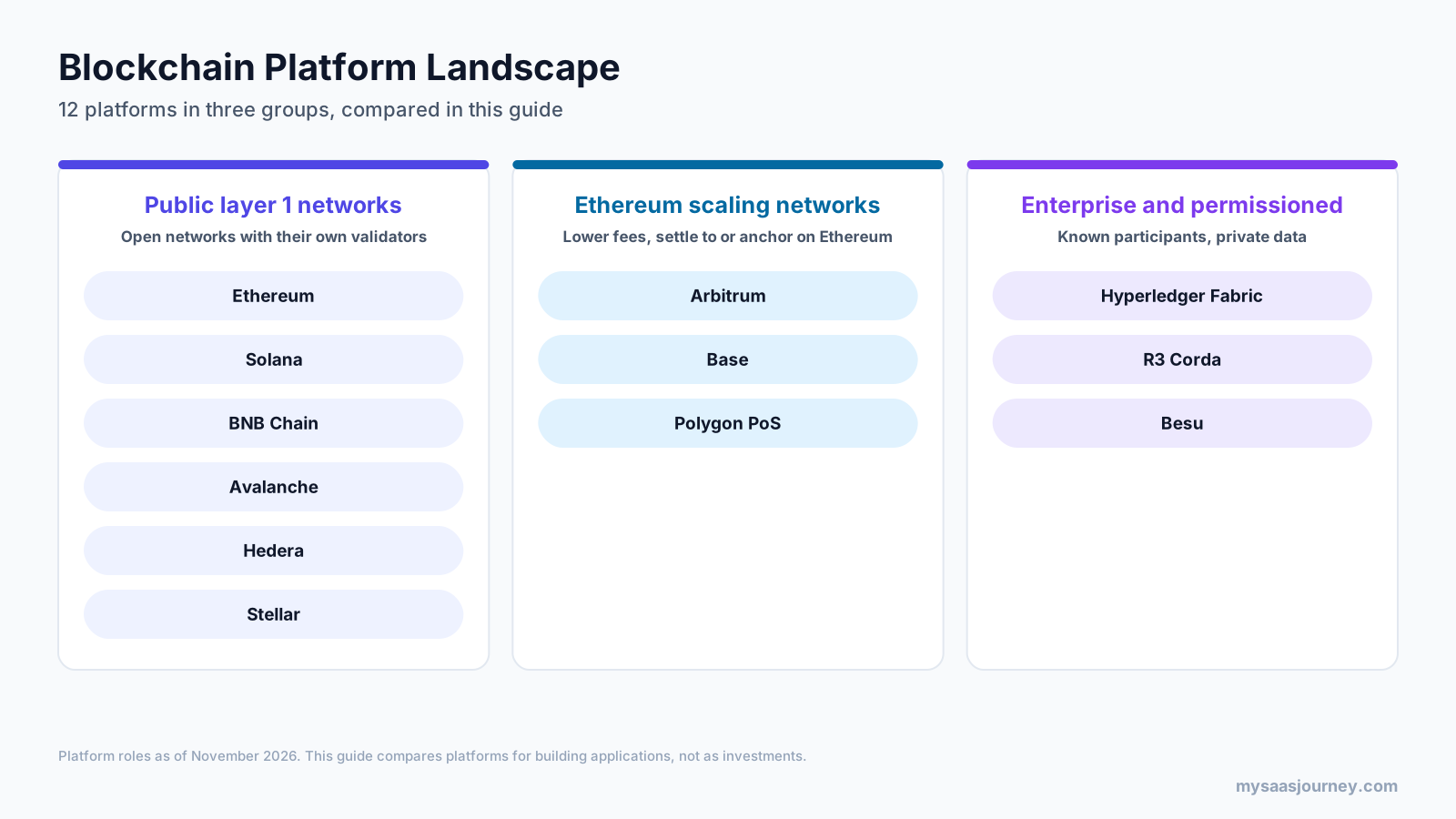
Comparing blockchain platforms is less about finding one winner and more about matching the network type, smart contract language, fee model, and privacy to your project. This guide compares 12 platforms for building applications, grouped into public layer 1 networks, Ethereum scaling networks, and enterprise platforms, with a decision guide at the end.
This article compares platforms from a builder’s point of view. It does not cover token prices and is not investment advice.
Key takeaways:
- Decide first between a public network, an Ethereum layer 2, or a permissioned network. That choice narrows the list more than any feature comparison.
- Most platforms here are EVM compatible, so Solidity developers can work across Ethereum, Arbitrum, Base, Polygon PoS, BNB Chain, Avalanche’s C-Chain, Hedera, and Besu.
- Solana and Stellar’s Soroban use Rust, while Hyperledger Fabric and R3 Corda use general-purpose languages such as Go, Java, Kotlin, and JavaScript.
- Hedera publishes USD-denominated base fees, such as $0.0001 for a basic transfer, which makes costs easier to predict.
- Enterprise platforms such as Fabric and Corda keep data shared only with the parties involved and do not need a public cryptocurrency.
Quick Comparison of the Best Blockchain Platforms
| Platform | Best for | Network type | Smart contract languages | Fee model |
|---|---|---|---|---|
| Ethereum | DeFi, tokens, and the largest ecosystem | Public layer 1 | Solidity, Vyper | Variable gas fees in ETH |
| Solana | High-speed consumer apps and trading | Public layer 1 | Rust | Low variable fees in SOL |
| BNB Chain | Low-cost EVM apps | Public layer 1 | Solidity | Low gas fees in BNB |
| Avalanche | Custom and institutional chains | Public layer 1 with custom L1s | Solidity on C-Chain, custom VMs | Gas in AVAX or a custom token on L1s |
| Hedera | Predictable fees and enterprise governance | Public, council-governed | Solidity, plus native token and consensus services | USD-denominated base fees paid in HBAR |
| Stellar | Payments and asset issuance | Public layer 1 | Rust (Soroban) | Low fees in XLM |
| Arbitrum | Ethereum apps at lower cost | Ethereum layer 2 | Solidity, plus Rust, C, and C++ via Stylus | Low gas fees in ETH |
| Base | Consumer apps, payments, and stablecoins | Ethereum layer 2 | Solidity | Under one cent per transaction, per Base |
| Polygon PoS | Payments and real-world assets | Ethereum-connected scaling chain | Solidity | Low gas fees in POL |
| Hyperledger Fabric | Private consortium networks | Permissioned | Go, Java, Node.js | No native cryptocurrency |
| R3 Corda | Regulated financial workflows | Permissioned | Kotlin, Java | No native cryptocurrency |
| Besu | Ethereum-compatible public or private networks | Public client or private network | Solidity | ETH on mainnet; configurable on private networks |
How We Compared These Platforms
We assessed each platform on the criteria that matter most when choosing where to build:
- Openness: whether anyone can join and validate, or only approved participants
- Consensus mechanism: how the network agrees on transactions, such as proof of stake or Byzantine fault tolerance
- Smart contract languages: which languages developers use, and whether the platform is EVM compatible
- Fees and cost predictability: what users pay per transaction and how stable those costs are
- Privacy: whether data is public by default or shared only with the parties involved
- Ecosystem: developer tools, documentation, wallets, and existing applications
- Governance: who controls upgrades and how decisions are made
Facts come from official documentation checked in November 2026. Where a fact came from a third-party source, we note it in the sources table.
Public vs Layer 2 vs Permissioned Blockchains
Before comparing individual platforms, decide which type of network fits your project.
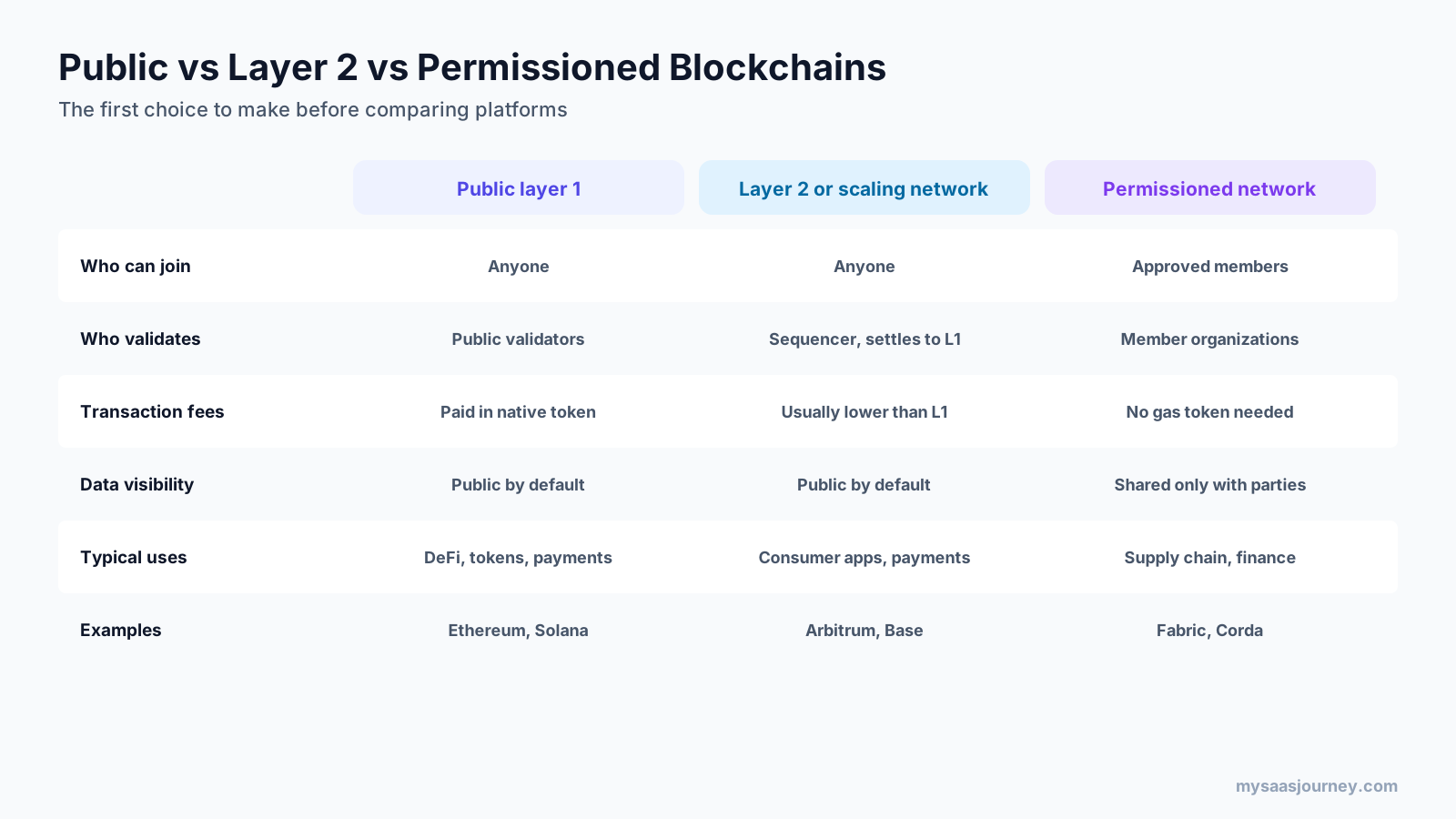
- Public layer 1 networks, such as Ethereum and Solana, are open to anyone, run their own validators, and charge fees in a native token. Data is public by default.
- Layer 2 and scaling networks, such as Arbitrum and Base, process transactions separately and settle to or anchor on Ethereum. They usually cost less than Ethereum itself while keeping EVM compatibility.
- Permissioned networks, such as Hyperledger Fabric and R3 Corda, are run by known organizations. Members decide who can join, data is shared only with relevant parties, and no public cryptocurrency is required.
Public networks suit applications that need open access, tokens, or interaction with existing decentralized finance. Permissioned networks suit business processes between known companies, where privacy and governance matter more than openness.
Public Layer 1 Blockchain Platforms
1. Ethereum
Ethereum is the most widely used smart contract platform and the base layer for most layer 2 networks. It moved from proof of work to proof of stake in 2022, and its Ethereum Virtual Machine (EVM) has become the standard that many other chains copy.
Best for: decentralized finance, tokens, NFTs, and projects that need the largest developer ecosystem.
Key features:
- Smart contracts in Solidity or Vyper on the EVM
- Proof-of-stake consensus
- Largest ecosystem of developer tools, wallets, and audited contract libraries
- Settlement layer for many layer 2 networks
- Broad support from exchanges, custodians, and infrastructure providers
Fees: Users pay variable gas fees in ETH, which rise with network demand and are typically higher than on layer 2 networks.
Trade-offs: Fees and throughput on Ethereum itself make it less suitable for high-volume, low-value transactions. Many teams deploy on a layer 2 and use Ethereum for settlement.
2. Solana
Solana is a high-throughput public blockchain designed for fast, low-cost transactions. It combines proof of stake with Proof of History, a way of ordering transactions in time, and separates program code from program data.
Best for: consumer apps, trading, payments, and games that need speed and low fees.
Key features:
- Programs written in Rust using Anchor, Pinocchio, or native Rust, compiled to sBPF
- Account model where programs are stateless and data lives in separate accounts
- Upgradeable programs that can be made immutable by revoking the upgrade authority
- Large consumer, payments, and trading ecosystem
- Low per-transaction fees paid in SOL
Fees: Fees are low and paid in SOL, with optional priority fees during busy periods.
Trade-offs: Solana is not EVM compatible, so Solidity contracts and Ethereum tools need to be rebuilt or adapted. Its programming model differs from the EVM and takes time to learn.
3. BNB Chain
BNB Chain is an ecosystem led by BNB Smart Chain (BSC), an EVM-compatible layer 1 using Proof of Staked Authority (PoSA) consensus. It also includes opBNB, a layer 2 built on the OP Stack, and BNB Greenfield for decentralized storage.
Best for: EVM applications that want low fees and access to the BNB ecosystem.
Key features:
- EVM compatible, so Solidity contracts deploy without modification
- Proof of Staked Authority consensus with fast block times
- opBNB layer 2 for lower-cost, high-frequency use cases
- BNB Greenfield for decentralized object storage
- Builder programs, grants, and accelerators
Fees: BNB Chain states average BSC gas fees of about $0.01, with opBNB targeting sub-cent fees.
Trade-offs: PoSA uses a limited set of validators, which gives speed but is more centralized than open proof-of-stake networks.
4. Avalanche
Avalanche is a public network with an EVM-compatible C-Chain and support for Avalanche L1s, formerly called subnets. L1s are sovereign networks with their own rules, validators, and token economics, which institutions use to build permissioned or compliance-focused chains.
Best for: teams that want their own blockchain with custom rules, including institutional and permissioned deployments.
Key features:
- C-Chain runs the EVM and supports Solidity smart contracts
- Avalanche L1s with custom virtual machines, gas tokens, and validator sets
- Evergreen, Ava Labs’ offering for financial institutions, with permissioned L1s
- Interchain Messaging between L1s
- Lower L1 validator costs since the Etna upgrade in December 2024
Fees: Users pay gas in AVAX on the C-Chain. Avalanche L1s can use their own gas token, including stablecoins or tokenized deposits.
Trade-offs: Running your own L1 means taking responsibility for validators, security, and incentives. Activity is spread across many L1s rather than concentrated on one chain.
5. Hedera
Hedera is a public network that uses hashgraph consensus and is governed by a council of global organizations. It offers native services for tokens and consensus messages alongside EVM-compatible smart contracts, with fees set in US dollars.
Best for: enterprises that want a public network with predictable fees and organizational governance.
Key features:
- Hashgraph consensus
- Hedera Token Service for creating and managing tokens without smart contracts
- Hedera Consensus Service for tamper-proof, time-stamped message ordering
- EVM-compatible smart contracts in Solidity
- Governance by the Hedera Council of member organizations
Fees: Base fees are listed in USD and paid in HBAR at the current exchange rate. Examples include $0.0001 for a crypto transfer, $0.0008 for a consensus message, and $0.001 for a token transfer, plus extras for signatures, keys, and gas.
Trade-offs: Hedera’s developer ecosystem is smaller than Ethereum’s. Its governance model trades some decentralization for stability and predictability.
6. Stellar
Stellar is a public blockchain focused on payments and asset issuance. Its smart contract platform, Soroban, is built into the Stellar network and runs contracts compiled to WebAssembly.
Best for: payments, remittances, stablecoins, and issuing digital assets.
Key features:
- Soroban smart contracts written in Rust and compiled to WebAssembly
- Soroban runs alongside existing Stellar operations rather than as a separate chain
- Native support for issuing assets and making payments
- Low transaction fees in XLM
- Focus on financial and payment use cases
Fees: Fees are low and paid in XLM.
Trade-offs: Rust is currently the only supported language for Soroban, and Stellar is not EVM compatible. Its ecosystem is focused on payments rather than general-purpose apps.
Ethereum Scaling Networks
Layer 2 and scaling networks run EVM-compatible apps at lower cost while connecting to Ethereum.
7. Arbitrum
Arbitrum One is an Ethereum layer 2 built on the Nitro stack. It uses fraud proofs, which validators can run on Ethereum, making it an optimistic rollup. Its Stylus upgrade adds a second virtual machine for WebAssembly contracts alongside the EVM.
Best for: Ethereum applications, especially DeFi, that need lower fees with EVM compatibility.
Key features:
- Full EVM compatibility for Solidity contracts and Ethereum tools
- Fraud proofs verified on Ethereum
- Stylus for contracts in Rust, C, and C++, with Rust as the most mature option
- EVM and Stylus contracts can call each other
- Large DeFi ecosystem
Fees: Users pay gas in ETH, typically far lower than on Ethereum itself.
Trade-offs: Withdrawals to Ethereum through the native bridge include a challenge period. Stylus support for languages beyond Rust, C, and C++ is experimental.
8. Base
Base is an Ethereum layer 2 built by Coinbase and launched in 2023 on Optimism’s OP Stack. In February 2026, Base announced it is moving to its own Base-operated stack. It positions itself as a blockchain for global finance, with features for stablecoins, payments, and compliance.
Best for: consumer apps, payments, and stablecoin products, especially those reaching Coinbase users.
Key features:
- EVM compatible for Solidity contracts and Ethereum tools
- Native features for stablecoin issuance, payments, and compliance
- Sub-second transaction settlement, per Base
- Connection to Coinbase’s products and user base
- Settles to Ethereum
Fees: Base says transactions cost less than one cent.
Trade-offs: Base relies on a sequencer operated by Coinbase, and its move away from the OP Stack means its technical roadmap is now set by Base rather than shared with other OP Stack chains.
9. Polygon PoS
Polygon PoS is an EVM-compatible chain connected to Ethereum, focused on payments and real-world assets. Its native token is POL, which replaced MATIC in 2024, and it is part of Polygon’s wider network connected through AggLayer, a cross-chain settlement layer.
Best for: payments, stablecoins, and tokenized real-world assets on a low-cost EVM chain.
Key features:
- Full EVM compatibility for Solidity contracts
- POL used for gas and staking
- AggLayer for cross-chain settlement between connected chains
- Focus on payments and real-world assets
- Large existing DeFi and app ecosystem
- Subsidized gas for agent-to-agent payments, added in a March 2026 upgrade
Fees: Users pay low gas fees in POL.
Trade-offs: Polygon PoS has its own validator set and checkpoints to Ethereum, so its security model differs from rollups that settle every batch on Ethereum. Polygon’s product lineup has changed several times, so check current documentation.
Enterprise and Permissioned Blockchain Platforms
Enterprise platforms are built for networks of known organizations, where privacy, governance, and integration with existing systems matter most.
10. Hyperledger Fabric
Hyperledger Fabric is an open-source, permissioned distributed ledger platform for enterprises, originally created under the Linux Foundation’s Hyperledger project, now LF Decentralized Trust. Participants are known to each other and the network runs under a governance agreement among members.
Best for: private consortium networks such as supply chain, trade, and inter-company workflows.
Key features:
- Smart contracts (chaincode) in Go, Java, or Node.js
- Pluggable consensus with crash fault-tolerant or Byzantine fault-tolerant ordering
- Channels for private sub-networks between selected members
- Private data collections for sharing data with a subset of a channel
- No native cryptocurrency required
Fees: There are no transaction fees in a cryptocurrency. Costs come from running infrastructure and the network.
Trade-offs: Fabric networks take significant effort to design, deploy, and govern, and they do not connect to public DeFi or token ecosystems by default.
11. R3 Corda
R3 Corda is a permissioned distributed ledger platform built for regulated markets, especially financial services. Transactions are shared only with the parties involved, and a notary service prevents double-spending.
Best for: banks, capital markets, and other regulated institutions automating multi-party workflows.
Key features:
- Smart contracts written in Kotlin or Java on the Java Virtual Machine
- Privacy by design, with data shared only between transaction parties
- Notary services that enforce transaction uniqueness
- Asset modeling and multi-party workflow tools
- Open-source Corda plus Corda Enterprise from R3
Fees: There are no cryptocurrency fees. Costs come from licensing Corda Enterprise where used, and from running nodes and notaries.
Trade-offs: Corda suits regulated finance more than general-purpose apps. Third-party analysis reports that open-source activity has slowed since R3’s focus moved to Corda 5, and some institutions have moved projects to other platforms.
12. Besu
Besu is an open-source Ethereum client written in Java and licensed under Apache 2.0. It runs on public Ethereum networks and on private networks for enterprise use, and can be extended with plugins. It is maintained under LF Decentralized Trust.
Best for: enterprises that want a private Ethereum-compatible network or a Java-based Ethereum client.
Key features:
- Runs on Ethereum Mainnet, testnets, and private networks
- EVM compatible, so Solidity contracts and Ethereum tools work
- Proof-of-authority consensus options for private networks
- Plugin system for custom features
- Apache 2.0 open-source license
Fees: On Ethereum Mainnet, fees are paid in ETH. Private networks can set their own gas rules, including free transactions.
Trade-offs: Besu is infrastructure, not a hosted network, so you run and maintain nodes yourself or through a provider. Privacy between members of a private network needs careful design.
Features Compared
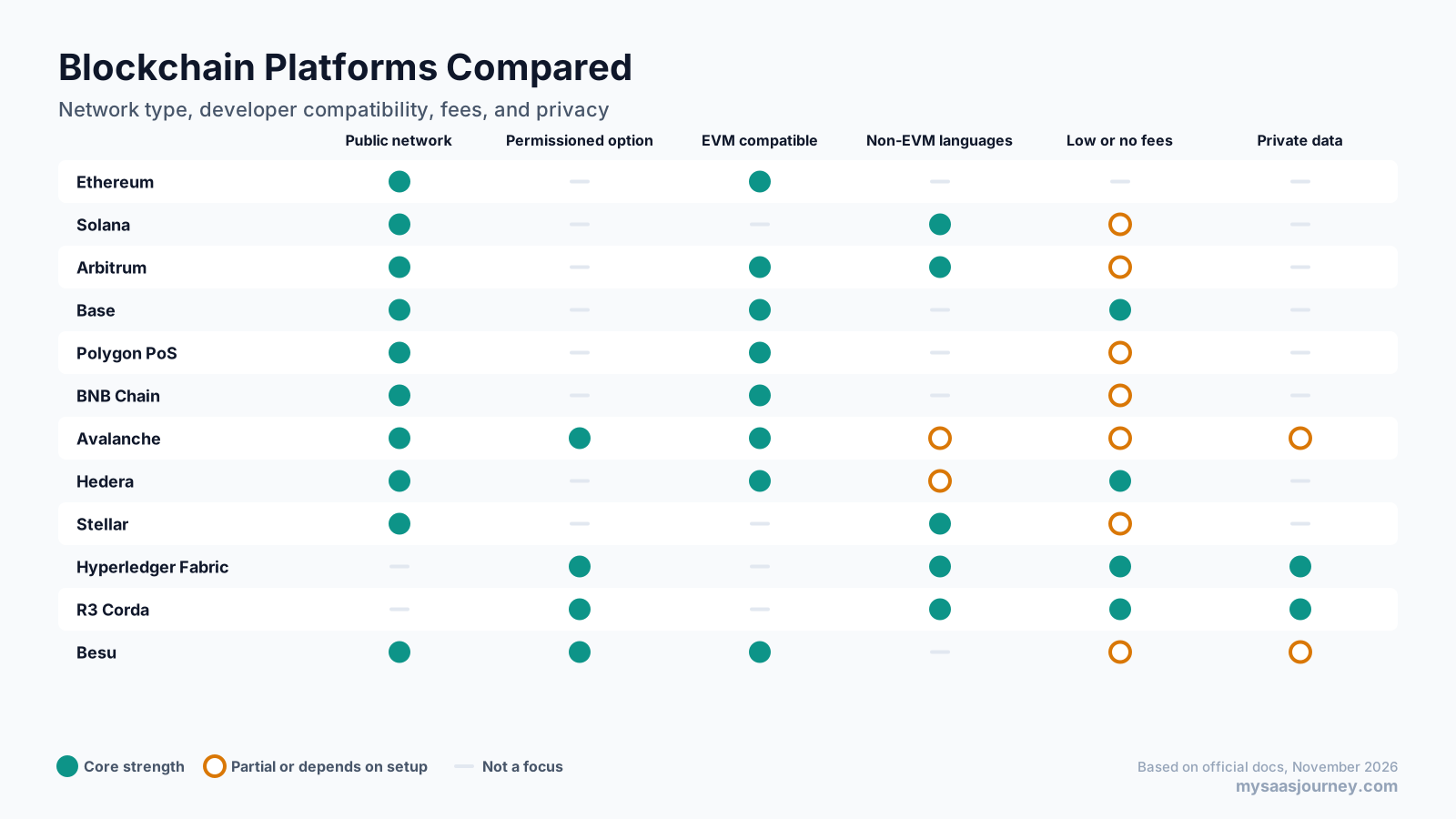
The matrix shows a clear split. Public EVM chains share tools and languages, so teams can move between them more easily. Non-EVM platforms such as Solana and Stellar need different skills. Enterprise platforms lead on privacy and permissioning but do not connect to public token ecosystems by default. Avalanche and Besu bridge the two worlds with options for both public and permissioned networks.
Smart Contract Languages Compared
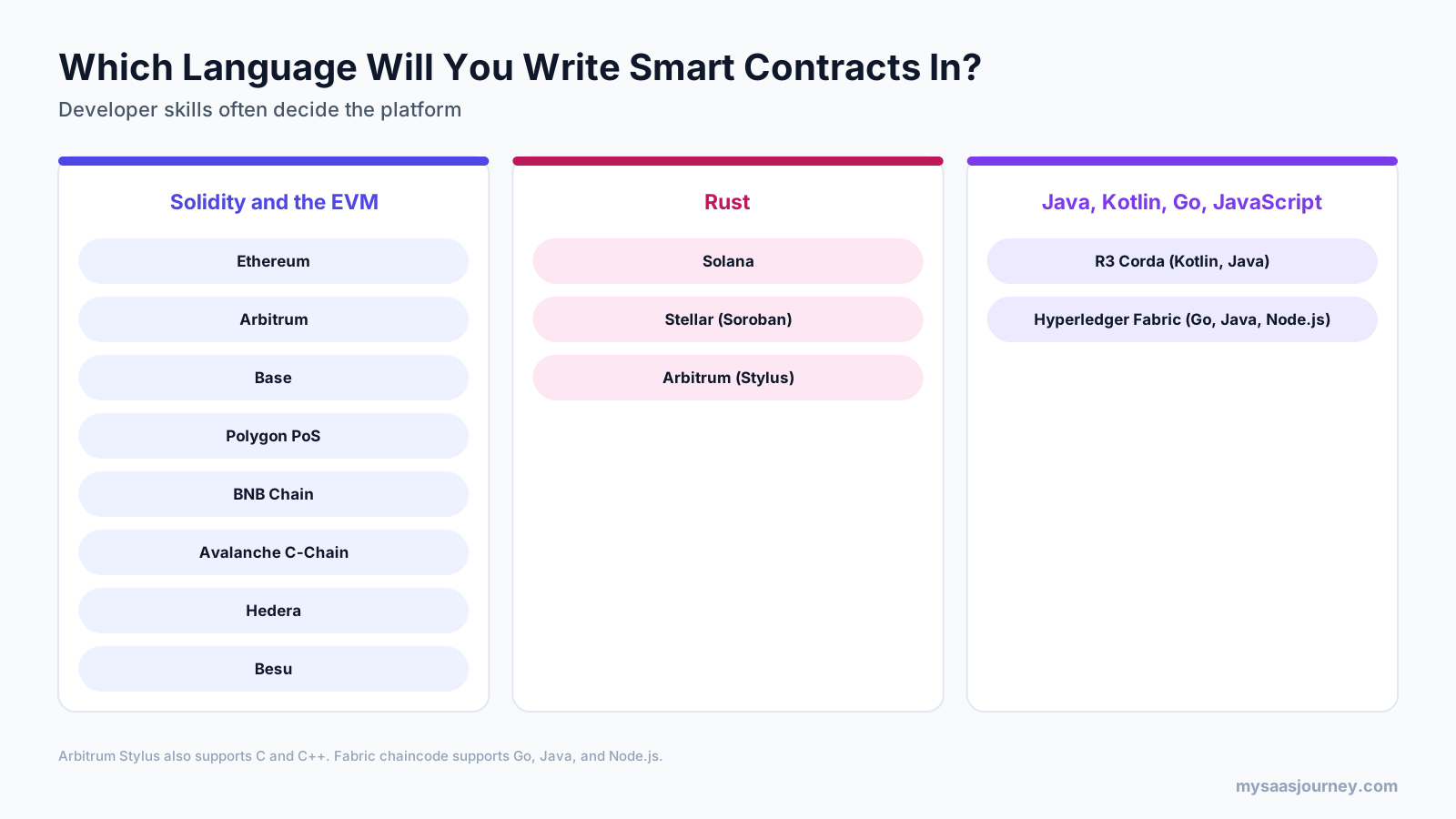
Developer skills often decide the platform:
- Solidity developers can work across Ethereum, Arbitrum, Base, Polygon PoS, BNB Chain, Avalanche’s C-Chain, Hedera, and Besu.
- Rust developers can build on Solana, on Stellar with Soroban, and on Arbitrum with Stylus.
- Java, Kotlin, Go, and JavaScript developers can build on R3 Corda and Hyperledger Fabric without learning a blockchain-specific language.
How Much Does It Cost to Build on a Blockchain?
Blockchain platforms do not charge subscriptions in the way most software does. Costs come from four places:
- Transaction fees: users or your app pay fees per transaction on public networks. Hedera publishes USD-denominated base fees, Base says its transactions cost under one cent, and BNB Chain states average BSC fees of about $0.01. Ethereum fees vary with demand.
- Infrastructure: running nodes, or paying a node provider for access, plus hosting for your application.
- Development and security: smart contract development and independent security audits, which are essential before handling funds.
- Enterprise licensing and operations: permissioned networks such as Fabric and Besu are open source, while Corda Enterprise is licensed by R3. Consortium networks also need governance and operations.
Permissioned networks avoid cryptocurrency fees but shift costs to infrastructure and coordination between members.
Ethereum vs Solana
Ethereum and Solana are the two platforms most often compared:
- Ecosystem: Ethereum has the largest developer ecosystem and most layer 2 networks build on it. Solana has a large consumer, trading, and payments ecosystem.
- Speed and fees: Solana is designed for high throughput and low fees on its main chain. Ethereum relies on layer 2 networks such as Arbitrum and Base for low-cost transactions.
- Languages: Ethereum uses Solidity and Vyper on the EVM. Solana uses Rust and a different account model.
- Portability: EVM contracts can move between Ethereum and many other chains, while Solana programs are specific to Solana’s runtime.
Choose Ethereum or an Ethereum layer 2 when you want the widest compatibility and DeFi integration. Choose Solana when your app needs high speed on a single chain and your team is comfortable with Rust.
Hyperledger Fabric vs Ethereum
Hyperledger Fabric and Ethereum solve different problems. Ethereum is a public network where anyone can participate and data is visible to all. Fabric is a permissioned platform where known organizations run the network and share data only on a need-to-know basis through channels and private data collections. Fabric uses general-purpose languages and needs no cryptocurrency, while Ethereum uses Solidity and charges gas fees in ETH. If you need a private Ethereum-compatible network, Besu is a middle ground.
What Is the Best Web3 Blockchain Platform?
For most web3 applications, the best starting point is an Ethereum-compatible platform, because it gives you the largest pool of developers, wallets, and tools. Ethereum suits high-value DeFi and tokens, while Arbitrum and Base offer the same tools with lower fees for consumer apps. Solana is the strongest non-EVM option for apps that need high speed and low fees on one chain.
Other Blockchain Platforms Worth Knowing
Several other platforms appear in many comparisons and may suit specific needs:
- Canton Network, used by financial institutions for tokenized assets, with smart contracts in Daml
- Cosmos, for building application-specific chains that connect to each other
- Polkadot, for chains that share security and communicate within one network
- Sui and Aptos, which use the Move programming language
- Cardano and Tezos, public proof-of-stake networks with their own smart contract languages
How to Choose a Blockchain Platform

- Confirm you need a blockchain. A shared database or standard cloud service is simpler when one organization controls the data. Our guide to build vs buy can help frame the decision.
- Choose the network type that fits. Decide between a public layer 1, a layer 2, or a permissioned network based on who needs access and how private the data must be.
- Match the platform to your team’s skills. Solidity teams can use any EVM chain, Rust teams can use Solana or Stellar, and Java or Go teams can use Corda or Fabric.
- Model transaction costs at realistic volumes. Estimate how many transactions your app will process and what users will pay at expected volumes.
- Check the surrounding ecosystem carefully. Look for wallets, oracles, bridges, node providers, and audit firms that support the platform.
- Review compliance and governance requirements early. Regulated industries should check permissioning, data residency, and who controls upgrades.
- Build a proof of concept. Deploy a small version on a testnet before committing.
Most blockchain apps also connect to off-chain systems through APIs. Our guide to what an API is explains how that works, and our explainer on what cloud computing is covers where most blockchain infrastructure runs.
Building the App Around Your Blockchain
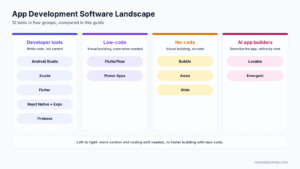
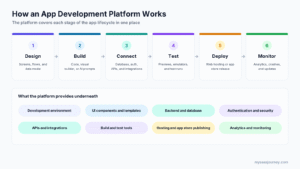
A blockchain handles shared records and smart contracts, but users interact with your project through a web or mobile app. That front end connects to the chain through wallets, node providers, and APIs, and often uses a standard database for data that does not need to be on chain. Our guide to what an app development platform is explains the tools for building that layer, and our comparison of the best app development software covers specific options. If your project involves AI agents that pay for services on chain, our roundup of the best AI agents covers the agent side.
Is Blockchain Still Relevant?
Yes, though its focus has narrowed. The strongest current uses are stablecoins and payments, tokenized real-world assets such as bonds and funds, decentralized finance, and permissioned networks for financial institutions. Many earlier ideas, such as putting every supply chain record on a public chain, proved harder to justify. For a new project, start with a clear reason why multiple parties need a shared, tamper-resistant record, then pick the platform that fits.
Final Thoughts
The best blockchain platform is the one that fits your network type, your team’s skills, and your cost and privacy requirements. Ethereum remains the default for DeFi and tokens, with Arbitrum and Base offering the same tools at lower cost. Solana leads for high-speed consumer apps on a single chain, Stellar and Polygon PoS focus on payments, and Hedera offers predictable fees with council governance. Avalanche lets you launch your own chain with custom rules. For private business networks, Hyperledger Fabric, R3 Corda, and Besu remain the main enterprise choices.
Start by deciding between public, layer 2, and permissioned, shortlist two or three platforms that match your team’s languages, and build a small proof of concept on a testnet before committing.
Frequently Asked Questions
What are the top 5 blockchain platforms?
Five of the most widely used blockchain platforms for building applications are Ethereum, Solana, Arbitrum, Base, and Hyperledger Fabric. Ethereum leads for DeFi and tokens, Solana for high-speed apps, Arbitrum and Base for lower-cost Ethereum apps, and Fabric for private enterprise networks. The right choice depends on your use case.
What is the best blockchain platform?
There is no single best blockchain platform. Ethereum is the best choice for the largest ecosystem and DeFi, Arbitrum and Base for Ethereum apps with lower fees, Solana for high-speed apps, Hedera for predictable fees, and Hyperledger Fabric or R3 Corda for private enterprise networks.
Which blockchain is best for smart contracts?
Ethereum is the most established smart contract platform, with Solidity and the largest set of tools and audited libraries. EVM-compatible chains such as Arbitrum, Base, and Polygon PoS run the same contracts at lower cost. Solana and Stellar’s Soroban use Rust, which some developers prefer for performance and safety.
What is the best web3 blockchain platform?
For most web3 apps, an Ethereum-compatible platform is the best starting point because it offers the most developers, wallets, and tools. Ethereum suits high-value DeFi, while Arbitrum and Base suit consumer apps that need lower fees. Solana is the leading non-EVM option for apps that need high speed on one chain.
What is the difference between Ethereum and Solana?
Ethereum uses Solidity on the EVM, has the largest developer ecosystem, and relies on layer 2 networks for low-cost transactions. Solana uses Rust and a different account model, and is designed for high throughput and low fees on its main chain. EVM contracts can move between many chains, while Solana programs cannot.
What is the difference between public and permissioned blockchains?
Anyone can join and validate a public blockchain such as Ethereum, and data is visible to everyone. A permissioned blockchain such as Hyperledger Fabric or R3 Corda is run by known organizations, who decide who can join and share data only with the relevant parties. Permissioned networks need no cryptocurrency.
Which blockchain platforms do enterprises use?
Enterprises commonly use Hyperledger Fabric for consortium networks, R3 Corda for regulated financial workflows, and Besu for private Ethereum-compatible networks. Many also build on public platforms, such as Avalanche L1s for custom permissioned chains, Hedera for predictable fees and council governance, and Ethereum-based networks for tokenized assets.
Is blockchain still relevant?
Yes. Blockchain remains relevant for stablecoins and payments, tokenized real-world assets, decentralized finance, and permissioned networks between financial institutions. It is less often used where a single organization controls the data, because a standard database is simpler and cheaper in those cases.
How much does it cost to build on a blockchain?
Costs include transaction fees, infrastructure, development, and security audits. Fees range from fractions of a cent on networks such as Base and Hedera to higher, variable gas fees on Ethereum. Permissioned platforms such as Fabric and Besu are open source with no cryptocurrency fees, but need servers and operations.
Sources
| Source | Used for |
|---|---|
| https://solana.com/docs/core/programs | Solana program languages, sBPF, and account model |
| https://docs.arbitrum.io/stylus/gentle-introduction | Arbitrum Stylus languages, Nitro, and fraud proofs |
| https://docs.base.org/get-started/base | Base positioning, settlement speed, and fees |
| https://decrypt.co/resources/what-is-base-coinbases-layer-2-chain | Base launch on OP Stack and February 2026 move to its own stack (third-party) |
| https://www.theblock.co/post/390380/coinbase-incubated-base-network-to-ditch-optimism-for-unified-solution | Base move to a Base-operated stack (third-party) |
| https://polygon.technology/blog/matic-to-pol-migration-is-99-complete-everything-you-need-to-know | POL as Polygon PoS gas and staking token |
| https://www.polygon.technology/blog/pol-value-accrual-1-agglayer-polygon | AggLayer and Polygon PoS payments and RWA focus |
| https://polygon.technology/llms.txt | Polygon full EVM compatibility and March 2026 agent payments upgrade |
| https://docs.bnbchain.org/bnb-smart-chain/introduction/ | BNB Smart Chain PoSA consensus |
| https://www.bnbchain.org/llms.txt | BSC EVM compatibility, opBNB, Greenfield, and average fees (BNB Chain’s own figures) |
| https://build.avax.network/docs/quick-start/avalanche-l1s | Avalanche C-Chain EVM and L1s |
| https://evergreen.avax.network/ | Avalanche Evergreen permissioned L1s for institutions |
| https://docs.avax.network/academy/permissioned-l1s/02-proof-of-authority/05-etna-upgrade | Etna upgrade and lower L1 validator costs |
| https://docs.hedera.com/hedera/networks/mainnet/fees | Hedera fee model, example fees, and hashgraph consensus |
| https://developers.stellar.org/docs/build/smart-contracts/overview | Stellar Soroban smart contracts and Rust |
| https://hyperledger-fabric.readthedocs.io/en/latest/whatis.html | Hyperledger Fabric features |
| https://r3.com/corda | R3 Corda positioning |
| https://docs.kaleido.io/kaleido-platform/protocol/corda | Corda notary and JVM smart contracts (third-party) |
| https://www.cypherock.com/blogs/canton-network-vs-r3-corda-vs-hyperledger | Corda open-source activity and Canton Daml (third-party) |
| https://chorus.one/reports-research/an-institutional-guide-to-avalanche | Progmat migration from Corda to an Avalanche L1 (third-party) |
| https://docs.besu-eth.org/ | Besu language, license, and public and private network support |
| https://www.techtarget.com/it-strategy/feature/Top-9-blockchain-platforms-to-consider-in-2026 | Comparison criteria: openness, consensus, ledger model, smart contracts |
| Ahrefs Keywords Explorer and SERP Overview (US, November 2026) | Keyword volumes, difficulty, SERP and People Also Ask analysis |