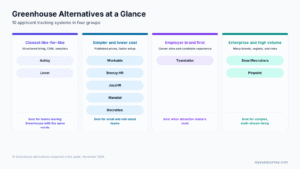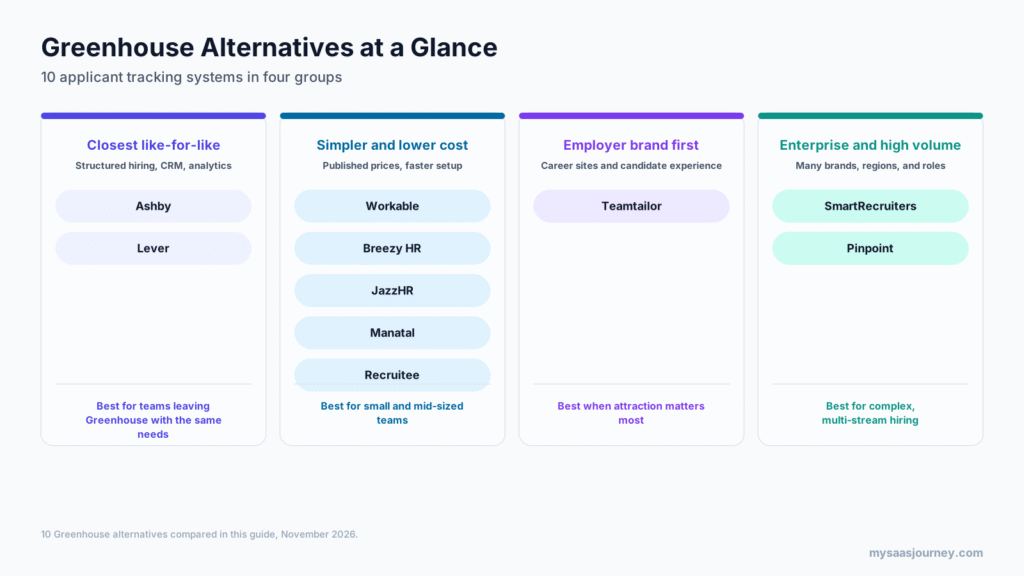
The best Greenhouse alternatives in 2027 are Ashby for teams that want Greenhouse-level structure with stronger built-in analytics, Lever for an ATS and candidate CRM in one platform, and Workable for small and mid-sized companies that want published pricing and HR tools in the same system. Teamtailor leads on career sites and employer brand, SmartRecruiters and Pinpoint suit enterprise and high-volume hiring, and Breezy HR, JazzHR, Manatal, and Recruitee offer simpler, lower-cost options.
Greenhouse is one of the best-known applicant tracking systems for structured hiring, with interview kits, scorecards, sourcing, CRM, and reporting. But it does not publish prices, buyer data puts its median contract at around $27,000 a year, and smaller teams often pay for depth they do not use. This guide compares 10 alternatives with prices checked against vendor pages in November 2026, explains why teams switch, and shows how to move from Greenhouse without disrupting open roles. To compare more applicant tracking systems, see our ATS software category.
Key takeaways:
- Greenhouse sells Core, Plus, and Pro plans on custom quotes, and Vendr buyer data shows a median contract of about $27,000 a year.
- Ashby is the closest like-for-like alternative, with an All-In-One Foundations plan from $400 a month for companies with up to 100 employees.
- Workable publishes prices from $299 a month and includes HRIS features such as onboarding, time off, and e-signatures.
- Breezy HR, JazzHR, and Manatal publish prices from about $1,000 to $1,900 a year at the entry level, far below Greenhouse’s typical contract.
- Lever, SmartRecruiters, Teamtailor, Recruitee, and Pinpoint price by quote, like Greenhouse.
Quick Comparison
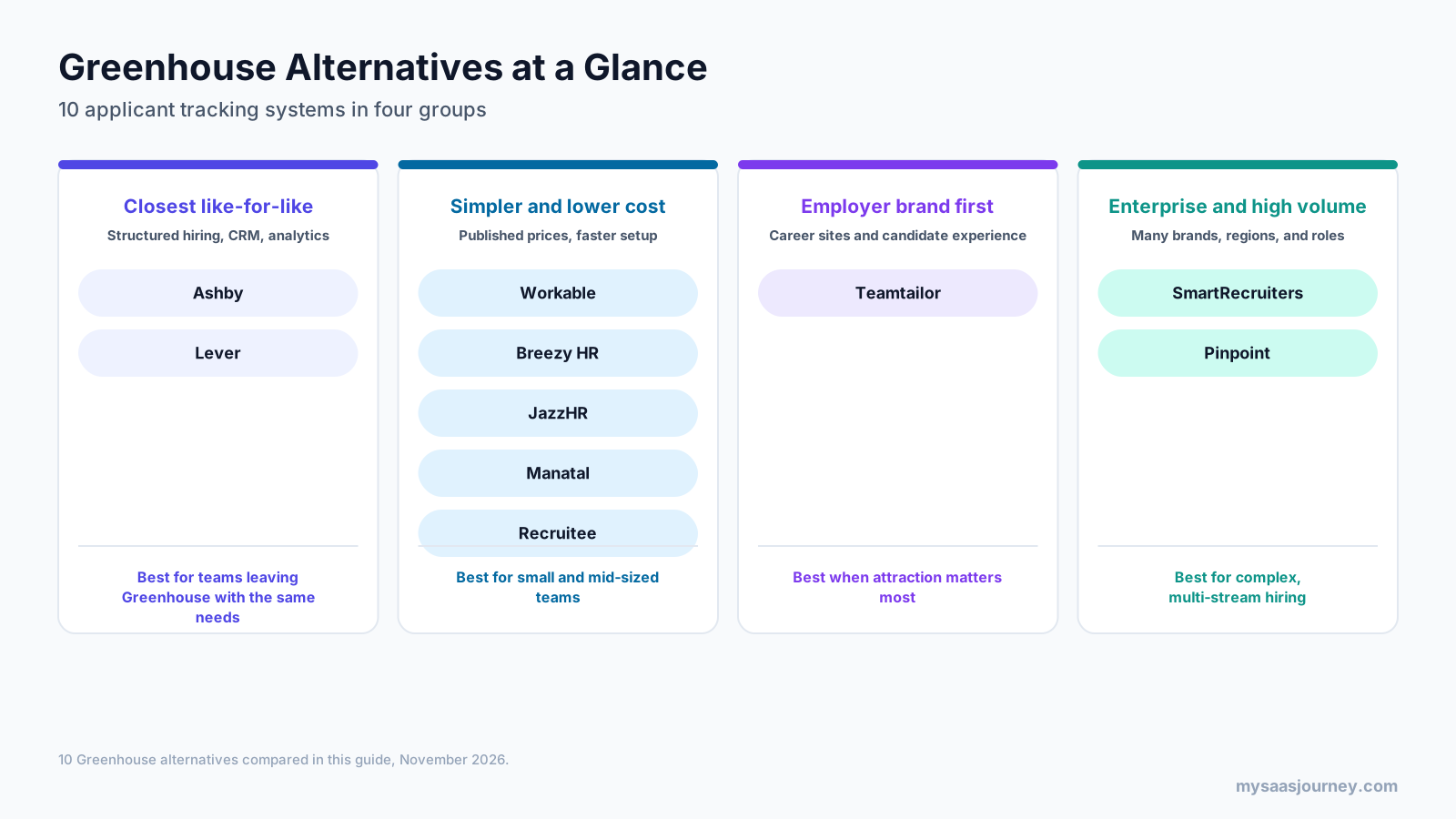
| Tool | Best for | Starting price | Free trial |
|---|---|---|---|
| Ashby | Greenhouse-level structure with built-in analytics | From $400 a month (up to 100 employees) | Demo |
| Lever | ATS and candidate CRM in one platform | Quote | Demo |
| Workable | SMBs that want ATS and HR in one system | $299 a month (1 to 20 employees) | 15 days, no card |
| SmartRecruiters | Enterprise and high-volume hiring | Quote | Demo |
| Teamtailor | Career sites and employer brand | Quote | Demo |
| Recruitee | Simple, collaborative hiring for growing teams | Quote | Free trial, no card |
| Pinpoint | Multi-stream and multi-brand hiring | Quote | Demo |
| Breezy HR | Unlimited users at a published price | $157 a month (annual) | 14 days, no card |
| JazzHR | Lowest-cost entry for light hiring | $1,000 a year | Not listed |
| Manatal | Per-user pricing with AI matching | $15 per user a month (annual) | 14 days, no card |
What Greenhouse Offers and What It Costs
Greenhouse is an applicant tracking system built around structured hiring. It sells three plans, each building on the one before:
- Core: sourcing and CRM, structured interview kits and scorecards, AI Notetaker, scheduling, reporting and analytics, SSO, and Talent Matching.
- Plus: adds AI-powered report filters, a Business Intelligence Connector, sourcing automation, texting, and fraud and spam detection.
- Pro: adds unlimited CRM events, enterprise data configuration and security, an audit log, and a developer sandbox.
Greenhouse does not publish prices. Its pricing page says pricing is customized based on hiring needs, and its FAQ lists the plan, hiring volume, organizational complexity, and required features as factors. Vendr’s buyer data, based on 712 purchases, shows a median contract of about $27,000 a year, with a range of roughly $10,600 to $75,900. Third-party guides also note that the current Core, Plus, and Pro names replaced the older Essential, Advanced, and Expert tiers.
Why Teams Look for Greenhouse Alternatives
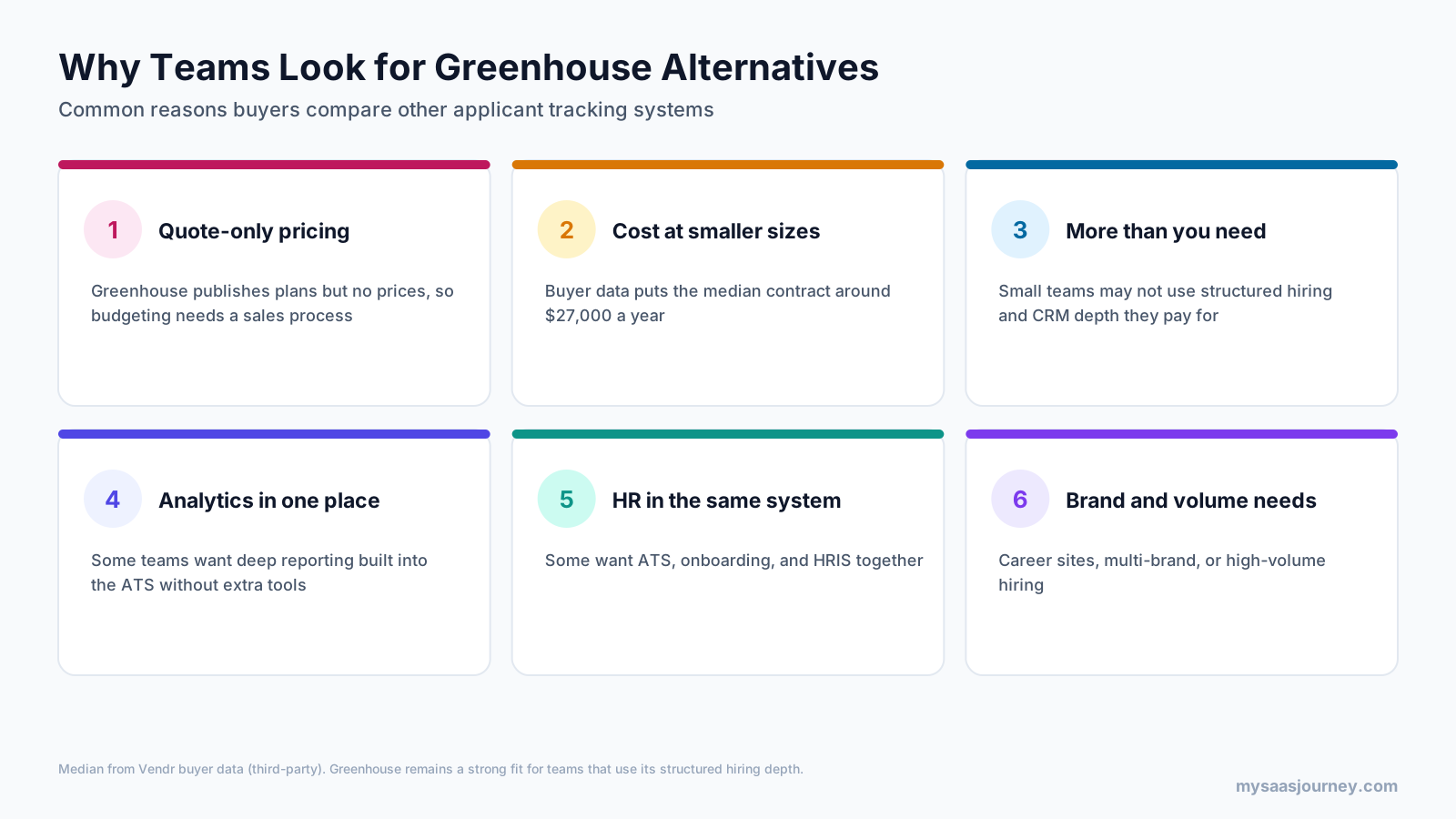
Greenhouse remains a strong choice for organizations that run structured hiring at scale. Teams usually look elsewhere for one of these reasons:
- Quote-only pricing makes it hard to budget or compare without a sales process.
- The cost can be high for small companies that hire a few people a year.
- Smaller teams may not use the structured hiring and CRM depth they pay for.
- Some teams want deep analytics built into the ATS rather than through a BI connector.
- Some want recruiting, onboarding, and HR records in one system.
- Others need stronger career sites, multi-brand setups, or high-volume hiring flows.
Knowing your main reason narrows the shortlist quickly, because each alternative is strongest in a different area.
Greenhouse vs Ashby vs Lever vs Workable
These three are the alternatives buyers compare most often with Greenhouse.
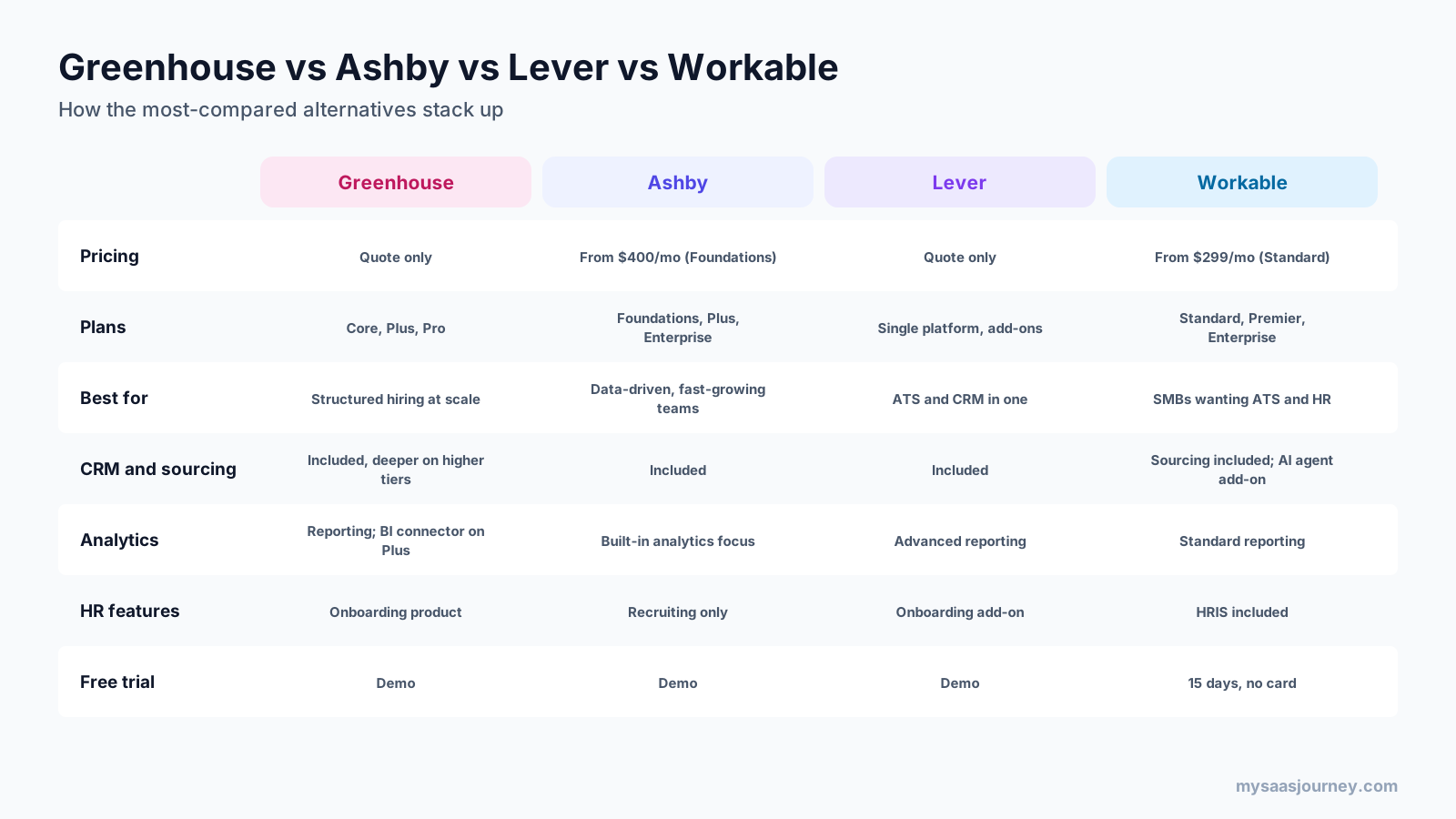
| Factor | Greenhouse | Ashby | Lever | Workable |
|---|---|---|---|---|
| Pricing | Quote only | From $400 a month (Foundations) | Quote only | From $299 a month (Standard) |
| Plans | Core, Plus, Pro | Foundations, Plus, Enterprise | One platform with add-ons | Standard, Premier, Enterprise |
| Best for | Structured hiring at scale | Data-driven, fast-growing teams | ATS and CRM in one | SMBs wanting ATS and HR |
| CRM and sourcing | Included, deeper on higher tiers | Included | Included | Sourcing included; AI Sourcing Agent is an add-on |
| HR features | Separate Onboarding product | Recruiting focus | Onboarding add-on | HRIS included |
| Trial | Demo | Demo | Demo | 15 days, no card |
In short, Ashby is the pick when analytics and structured hiring matter most, Lever when sourcing and nurturing candidates is central to your recruiting, and Workable when you want a lower, published price and HR features in the same system. All three cover the core ATS work Greenhouse handles, so the choice comes down to which of these strengths fits your team, how many people you hire each year, and how much you want to spend on the platform.
Closest Like-for-Like Greenhouse Alternatives
These two platforms offer the depth most Greenhouse customers rely on, including sourcing, CRM, structured interviews, and analytics.
1. Ashby
Ashby is an all-in-one recruiting platform that combines an ATS, sourcing and CRM, scheduling, offers, and analytics. It is popular with fast-growing companies that want structured hiring and detailed reporting in one product.
Best for: startups and scaling companies that want Greenhouse-style structure with stronger built-in analytics.
Key features:
- ATS and candidate management, job posting, and offers with approvals
- Sourcing and CRM, with outbound email and SMS
- Scheduling and interviewing, with an Advanced Scheduling add-on
- Reporting and analytics, also sold as Ashby Analytics for teams that keep their current ATS
- AI candidate search, AI application review, AI talent rediscovery, an AI assistant, and custom AI agents
Pricing: All-In-One Foundations starts at $400 a month for companies with up to 100 employees, with 10% off annual commitments. Plus covers 101 to 1,000 employees and Enterprise covers 1,000+, both quote-based. Foundations includes 1,500 AI credits a month, and SSO is a $100 a month add-on on that plan. The AI Notetaker is a paid add-on on all plans.
Trade-offs: Ashby focuses on recruiting, so you need a separate HRIS. Prices above Foundations are not published.
Why choose it over Greenhouse: Ashby publishes a starting price for smaller companies and puts analytics at the center of the product, so recruiting leaders can build detailed reports without a separate BI tool.
2. Lever
Lever, now part of Employ, combines an applicant tracking system with candidate relationship management, so sourcing, nurturing, and hiring happen in one place.
Best for: teams that run proactive sourcing and want the ATS and CRM in one platform.
Key features:
- Combined ATS and CRM for sourcing, nurturing, and hiring
- Customizable reporting dashboards and advanced analytics
- AI-powered candidate screening and matching
- Unlimited AI interview transcripts and summaries
- AI fraud-prevention signals
Pricing: Lever does not publish prices. Quotes depend on team size and hiring needs. Candidate Insights, AI Screening by VONQ, and Onboarding are quoted add-ons.
Trade-offs: Like Greenhouse, Lever needs a sales conversation to price, and no free trial is listed.
Why choose it over Greenhouse: Lever suits teams that treat sourcing and nurturing as core work, since its CRM and ATS share one candidate record rather than sitting in separate tiers.
Simpler and Lower-Cost Alternatives
3. Workable
Workable is an ATS and HR platform for small and mid-sized businesses, with job posting to 200+ boards, a careers page builder, passive candidate sourcing, and a built-in HRIS.
Best for: small and mid-sized companies that want recruiting and core HR in one system with published prices.
Key features:
- Job board distribution to 200+ boards and a careers page builder
- Passive candidate sourcing, with an AI Sourcing Agent add-on that uses AI credits
- HRIS with onboarding, time off, time tracking, e-signatures, and payroll preparation
- 3,000 complimentary AI credits on each ATS plan
- Texting, video interviews, and assessments included on Premier
Pricing: For companies with 1 to 20 employees, Standard costs $299 a month ($3,588 a year, saving 20%), Premier $599 a month, and Enterprise $719 a month. Prices rise with company size. Standard add-ons include Texting+ at $89, Video interviews+ at $109, and Assessments+ at $59 a month. A 15-day free trial needs no credit card.
Trade-offs: Several hiring features are paid add-ons on Standard, and pricing for larger companies requires the size selector or sales.
Why choose it over Greenhouse: Workable publishes prices, offers a no-card trial, and includes HR records, onboarding, and time off, so a small company can run hiring and core HR in one place.
4. Breezy HR
Breezy HR is an ATS for small and mid-sized teams with unlimited users and positions on every plan.
Best for: growing teams that want many hiring managers involved without per-seat costs.
Key features:
- Posting to 50+ job boards and a branded career site
- Candidate automations, questionnaires, and interview self-scheduling
- Video interviews and mobile apps
- Scorecards, interview guides, referrals, and reference checks on Growth
- Offer management, approvals, and custom roles on Business
Pricing: Startup costs $157 a month billed annually ($189 monthly), Growth $273 ($329 monthly), and Business $439 ($529 monthly). Breezy Intelligence AI scoring starts at $30 per 100,000 credits, SMS from $41 a month, and Onboard from $49 a month. A 14-day trial needs no credit card.
Trade-offs: AI, texting, and onboarding are add-ons, and API access and advanced reporting sit on the custom plan.
Why choose it over Greenhouse: unlimited users at a flat monthly price makes it easy to involve every hiring manager without counting seats.
5. JazzHR
JazzHR is an applicant tracking system for small businesses, with annual pricing and a low entry plan.
Best for: small businesses that hire occasionally and want the lowest published entry price.
Key features:
- Applicant tracking with email templates
- LinkedIn Recruiter integration and premium job listings
- AI candidate matching, structured interviews, and assessments on Plus
- Configurable task automation and standard reporting on Plus
- Offers, e-signatures, and advanced reporting on Pro
Pricing: Hero costs $1,000 a year and starts at 3 job postings a month, subject to eligibility. Plus costs $3,480 a year for up to 200 active jobs, and Pro costs $5,508 a year. Standard pricing excludes staffing agencies and organizations with more than 250 employees.
Trade-offs: No free trial is listed, and the entry plan is limited to a few job postings a month.
Why choose it over Greenhouse: for a small business making a handful of hires a year, JazzHR covers the basics at a fraction of a typical Greenhouse contract.
6. Manatal
Manatal is an AI-driven ATS and recruitment CRM used by both in-house teams and recruitment agencies, priced per user.
Best for: small teams and agencies that want AI matching at a low per-user price.
Key features:
- AI candidate enrichment, recommendations, scoring, and AI job descriptions
- AI Copilot for summaries, fit and gap analysis, and interview prep
- Workflow automations on Enterprise
- MCP server for ChatGPT and Claude and open API access on Enterprise Plus
- AI Interviewer add-on for automated video screening in several languages
Pricing: Professional costs $15 per user a month billed annually ($19 monthly) for up to 15 jobs and 10,000 candidates. Enterprise costs $35 ($39 monthly) with unlimited jobs and candidates, and Enterprise Plus costs $55 ($59 monthly). A 14-day trial needs no credit card.
Trade-offs: Per-user pricing adds up for large hiring teams, and the Professional plan caps open jobs at 15.
Why choose it over Greenhouse: Manatal’s low per-user price and AI matching suit small in-house teams and recruitment agencies that want automation without an enterprise contract.
7. Recruitee
Recruitee, part of Tellent, is a collaborative ATS with a CareersHub, multi-board posting, and AI assistants for screening and matching.
Best for: growing teams that want a simple, collaborative ATS with a clear upgrade path.
Key features:
- CareersHub career sites and multi-board job posting
- Candidate pipeline automation and team collaboration
- AI writing, AI Screening Assistant, and AI Matching Assistant on higher plans
- Structured evaluation forms, offer letters, and self-scheduling on Advance
- Requisition approvals, SSO, and BI integrations on Optimize
Pricing: Recruitee does not publish prices. Its Start, Advance, and Optimize plans are priced by plan, number of employees, and billing period, with 20% off annual payment and a one-year minimum commitment. A free trial needs no credit card.
Trade-offs: Start allows only 5 active job posts, and contracts require a one-year minimum.
Why choose it over Greenhouse: Recruitee offers a free trial and a clear path from a simple Start plan to an Optimize plan with approvals, SSO, and BI integrations as you grow.
Employer Brand First
8. Teamtailor
Teamtailor is a recruitment platform built around career sites and employer branding, with an ATS, candidate CRM, and AI included.
Best for: companies that rely on a strong career site and employer brand to attract candidates.
Key features:
- Drag-and-drop career site editor
- Interview kits, automation triggers, reporting, and onboarding
- Candidate CRM with talent pools
- Teamtailor AI for candidate matches, job ad drafts, and CV summaries, with unlimited usage
- Unlimited job postings and unlimited users
Pricing: Teamtailor does not publish prices and provides a custom quote. Requisitions and approval flows, and divisions and multi-brand management, are labeled as premium features.
Trade-offs: You need a demo to see pricing, and analytics depth is lighter than Ashby or Greenhouse.
Why choose it over Greenhouse: Teamtailor puts the career site and candidate experience first, with unlimited users and AI included, which suits companies that compete hard for applicants.
Enterprise and High-Volume Alternatives
9. SmartRecruiters
SmartRecruiters is an enterprise recruiting platform for both professional and high-volume hiring. SAP completed its acquisition of SmartRecruiters in September 2025, and SmartRecruiters continues to operate as a standalone product that also integrates with SAP SuccessFactors.
Best for: mid-size and large enterprises with high-volume or frontline hiring, especially SAP customers.
Key features:
- Applicant tracking and CRM
- AI Recruiting Companion and AI Talent Matching Engine
- Candidate messaging, dynamic scheduling, and job distribution
- Advanced agency portal and analytics
- Winston Chat add-on for conversational applications and scheduling over web, SMS, and WhatsApp
Pricing: SmartRecruiters does not publish prices, and every plan is sold by custom quote.
Trade-offs: The platform targets enterprise buyers, so it is more than most small companies need.
Why choose it over Greenhouse: SmartRecruiters is built for high-volume and frontline hiring as well as corporate roles, and it fits naturally into SAP-based HR environments.
10. Pinpoint
Pinpoint is an ATS for multi-stream hiring, where organizations run different hiring processes side by side, from early careers to executive roles and from desk-based to deskless work.
Best for: organizations with several brands, regions, or hiring streams that need consistent processes and reporting.
Key features:
- Branded and multi-brand careers sites with mobile-friendly applications
- Interview self-scheduling and anonymized screening
- Executive dashboards with time-to-hire and cost-per-hire reporting
- Talent pools, offer management, and background and reference checks
- AI candidate filters, match scoring, a hiring copilot, and 100+ native integrations
Pricing: Pinpoint does not publish prices and quotes after a call about your hiring needs.
Trade-offs: Pricing needs a call, and the platform’s depth suits organizations with complex hiring more than very small teams.
Why choose it over Greenhouse: Pinpoint is designed to run several hiring processes side by side, with multi-brand career sites and anonymized screening, which suits organizations with varied hiring streams.
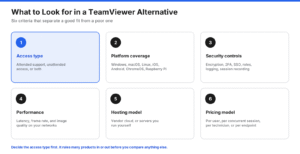
What to Look for in a Greenhouse Alternative
Greenhouse sets a high bar for structured hiring, so check how each alternative handles the features your team uses most.
Structured Hiring
Interview kits, scorecards, and consistent stages help teams hire fairly and compare candidates on the same criteria. If your hiring managers rely on Greenhouse scorecards, confirm the alternative supports custom scorecards per stage and makes them easy to complete.
Sourcing and Candidate CRM
Teams that hire proactively need talent pools, outreach sequences, and a single record for each candidate across roles. Ashby, Lever, SmartRecruiters, and Teamtailor are strongest here, while lighter tools offer talent pools and basic nurture campaigns.
Reporting and Analytics
Check which reports are built in, how flexible they are, and whether you need a separate BI tool. Time to hire, pipeline conversion, source of hire, and interviewer load are common starting points.
AI Features and Governance
Most applicant tracking systems now include AI for matching, screening, summaries, or scheduling. Ask how each AI feature works, whether recruiters can review and override its output, whether it can be switched off, and how the vendor tests it for bias. Rules on automated hiring decisions vary by country and state, so involve your legal team before using AI to screen candidates.
Integrations
List the tools your hiring process depends on, such as your HRIS, calendar, video interviews, background checks, and assessments, and confirm each one has a native integration or a supported API.
Security and Compliance
Candidate data is personal data. Look for SSO, role-based permissions, audit logs, data retention controls, and certifications such as SOC 2 and ISO 27001, plus GDPR support if you hire in Europe.
Greenhouse Alternatives by Company Size
- Startups and small companies with up to 100 employees: Ashby Foundations for structured hiring and analytics, or Workable, Breezy HR, JazzHR, or Manatal for lower-cost options with published prices.
- Mid-sized companies with 100 to 1,000 employees: Ashby Plus, Lever, Teamtailor, or Recruitee, depending on whether analytics, CRM, employer brand, or simplicity matters most.
- Enterprises with 1,000+ employees: SmartRecruiters, Pinpoint, or Ashby Enterprise, especially for high-volume, multi-brand, or multi-region hiring.
When to Stay With Greenhouse
Switching is not always the right move. Greenhouse is often worth keeping if your team uses its structured hiring, scorecards, and CRM fully, if you depend on integrations that took time to set up, or if your hiring volume justifies the cost. Before switching, compare a renewal quote with alternatives, since buyers often negotiate better terms when they have competing quotes, and weigh the time a migration will take against the savings.
Features Compared
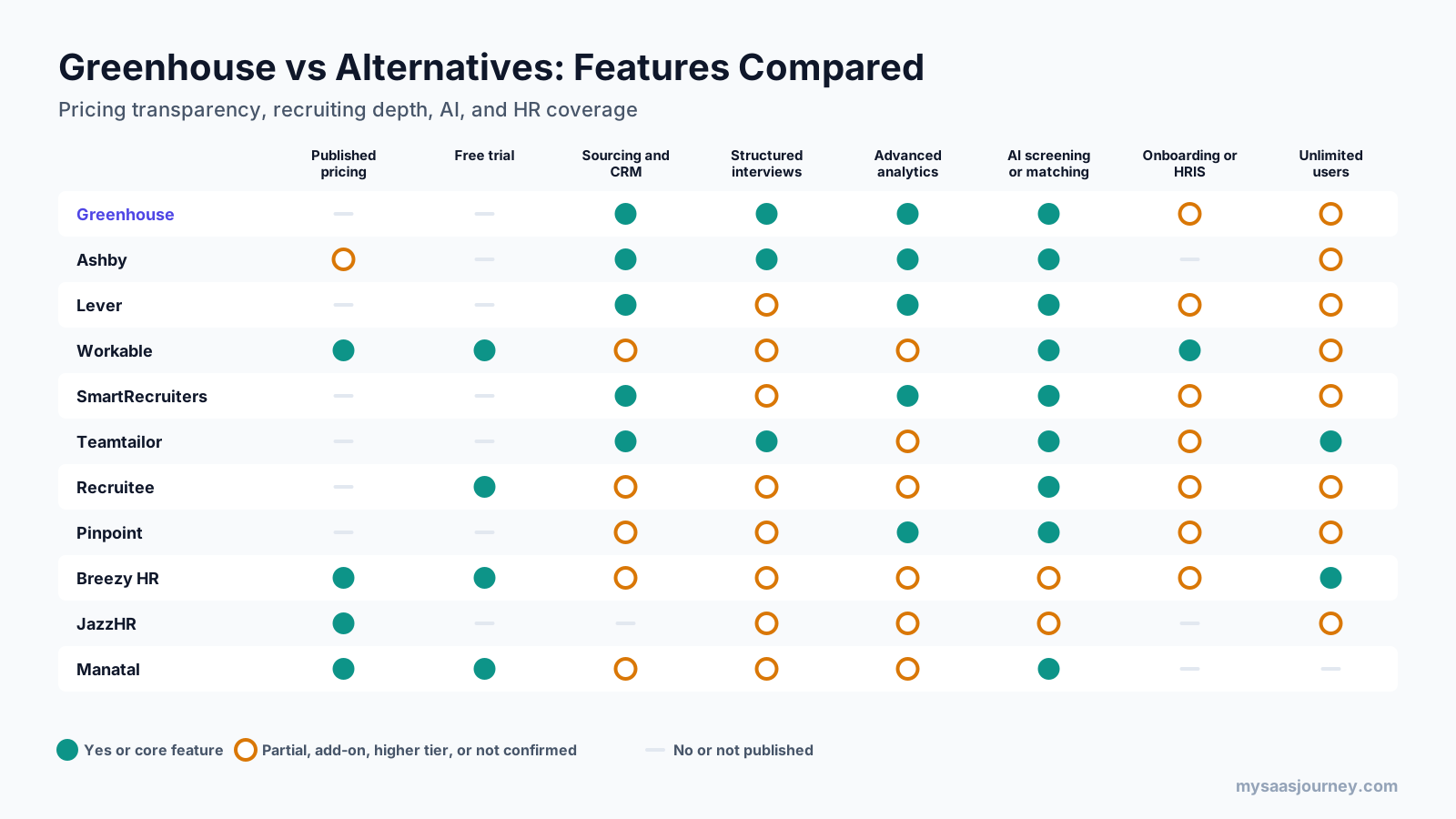
All 10 alternatives offer AI features in some form, from AI matching to interview summaries. The bigger differences are in pricing transparency, CRM depth, analytics, and HR coverage. Workable, Breezy HR, JazzHR, and Manatal publish prices, and Workable, Breezy HR, Manatal, and Recruitee offer free trials. Ashby, Lever, SmartRecruiters, and Teamtailor match Greenhouse most closely on sourcing and CRM. Workable is the only option here with a full HRIS included, while others offer onboarding as an add-on or through a sister product.
Pricing Compared
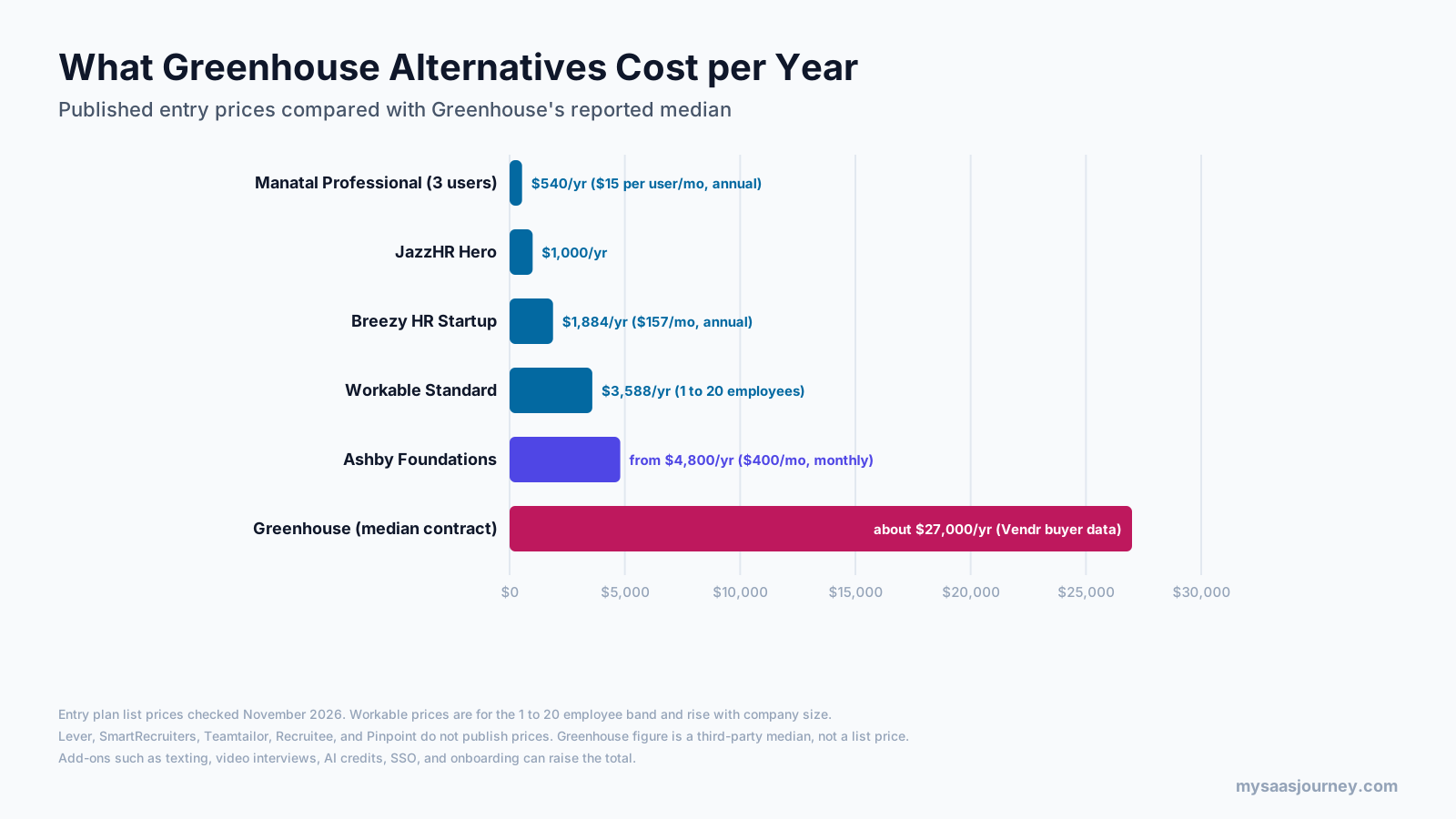
| Tool | Entry plan | Annual cost at entry | Pricing basis |
|---|---|---|---|
| Manatal | Professional | $180 per user ($15 a month, annual) | Per user |
| JazzHR | Hero | $1,000 | Plan, billed annually |
| Breezy HR | Startup | $1,884 ($157 a month, annual) | Plan, unlimited users |
| Workable | Standard | $3,588 (1 to 20 employees) | Plan and company size |
| Ashby | Foundations | From $4,800 ($400 a month) | Company size and usage |
| Greenhouse | Core, Plus, Pro | About $27,000 median (Vendr) | Quote |
| Lever, SmartRecruiters, Teamtailor, Recruitee, Pinpoint | Various | Quote | Quote |
Published prices are only part of the cost. Check what each plan includes for texting, video interviews, assessments, AI credits, SSO, and onboarding, since these are often add-ons. Also check how pricing grows: per user, per company size, or per active job. Our glossary entry on pricing models explains these approaches.
Also budget for one-time costs. Implementation, data migration, career site setup, and training can add to the first year, especially for enterprise platforms. On the other side, switching may let you drop separate tools if the new ATS includes features you currently pay for elsewhere, such as scheduling, texting, or onboarding.
How to Choose a Greenhouse Alternative
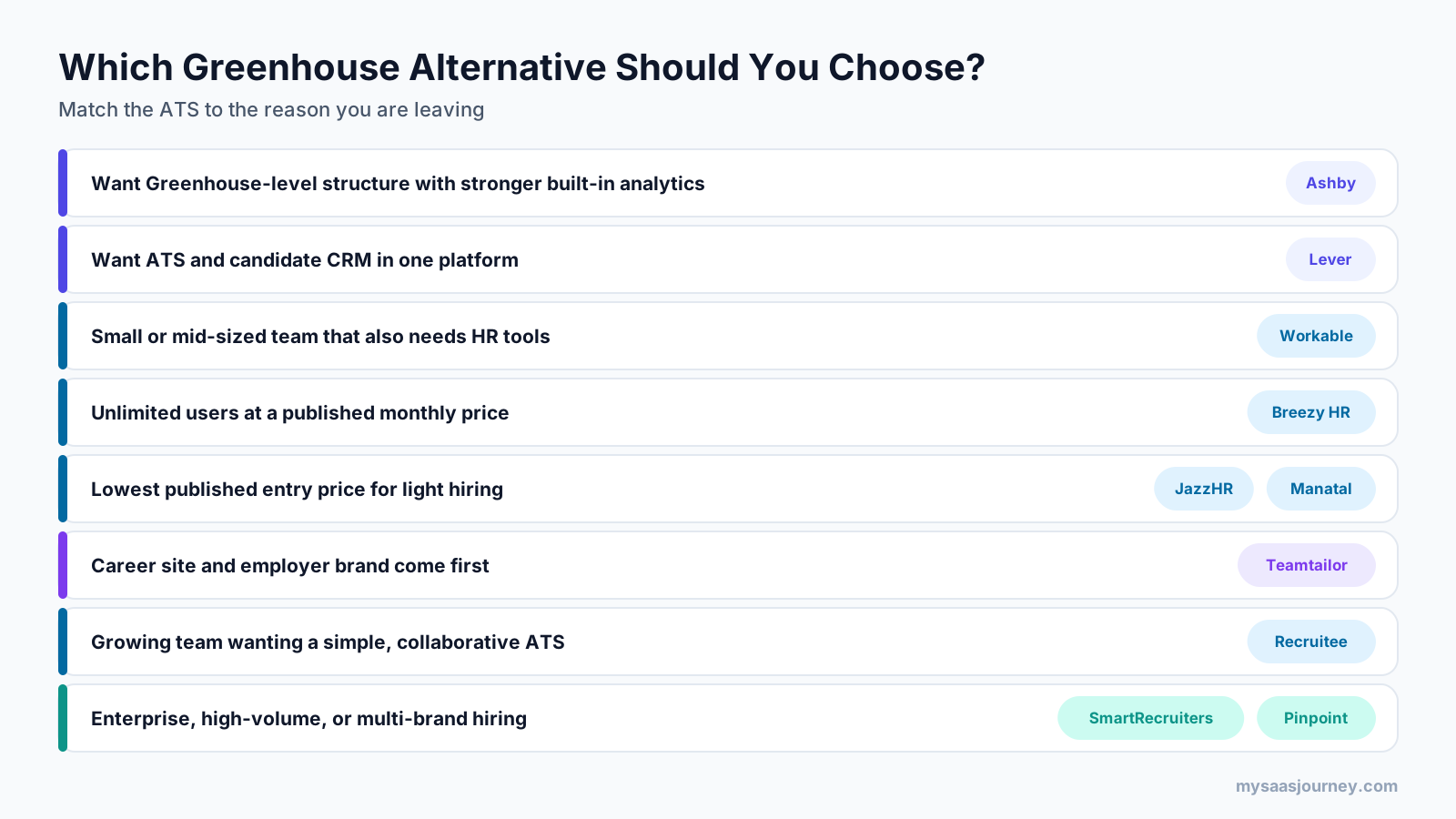
- Name the reason you are leaving. Cost, analytics, HR coverage, employer brand, and enterprise needs each point to different tools.
- Count your hiring volume and users. Estimate open roles, hires per year, and how many hiring managers need access, then compare per-user and unlimited-user plans.
- List the integrations you depend on. Check your HRIS, calendar, job boards, background check provider, and assessment tools.
- Test the structured hiring features you rely on. If you rely on Greenhouse scorecards and interview kits, rebuild one role during a trial or demo.
- Compare total cost over two or three years. Include add-ons, implementation, and contract terms such as minimum commitments.
- Involve hiring managers in the evaluation. They use the ATS daily, so their feedback on usability matters as much as the recruiting team’s.
For a wider buying framework, see our guide on how to choose the right software for your business. If you also need background screening or skills tests, our background check software and assessment software categories list tools that integrate with most ATS platforms.
How to Switch From Greenhouse
Moving to a new ATS takes planning, especially with open roles in progress.
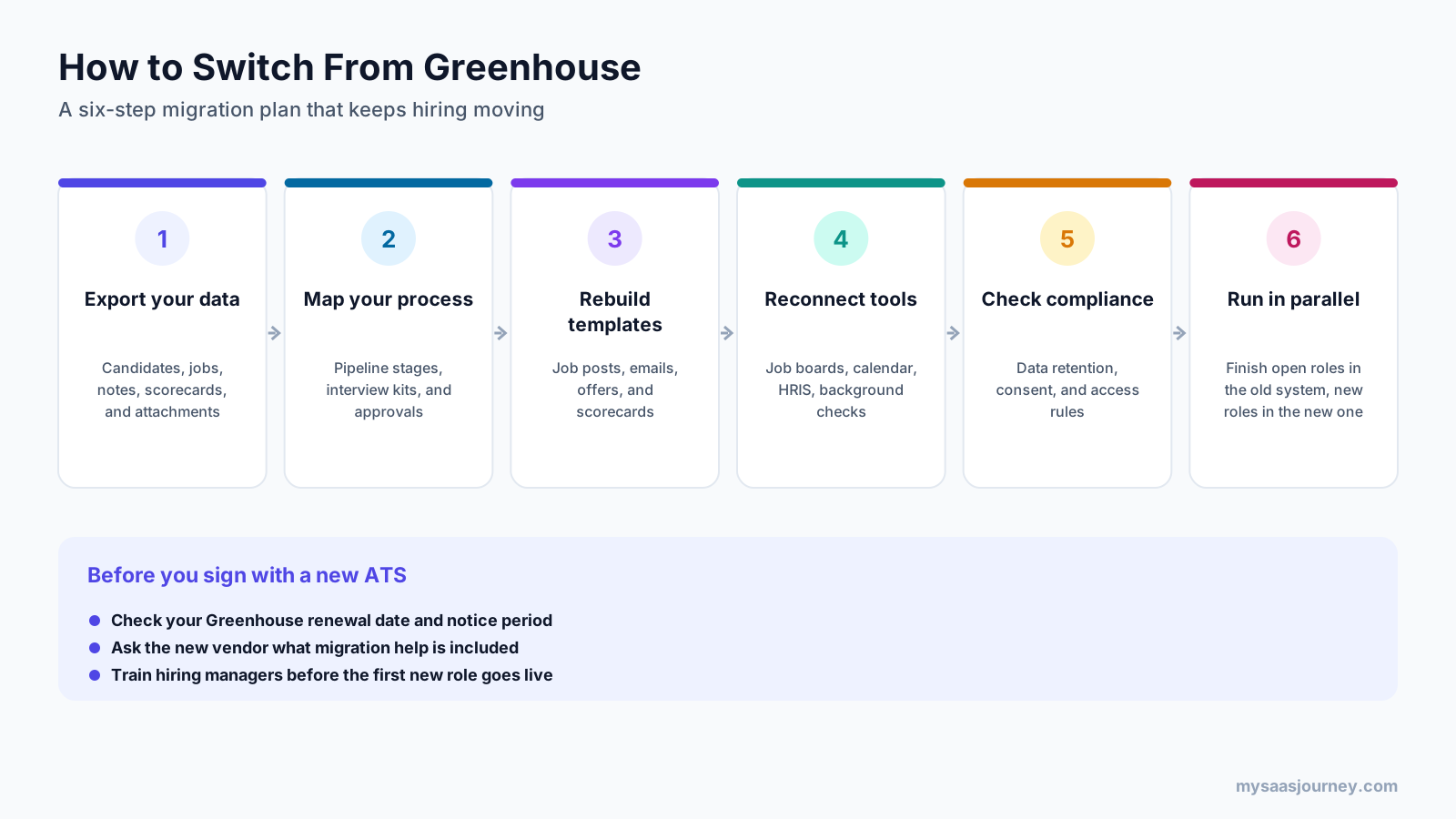
- Export your data, including candidates, jobs, notes, scorecards, and attachments.
- Map your process, including pipeline stages, interview kits, and approval chains.
- Rebuild templates for job posts, emails, offer letters, and scorecards.
- Reconnect your tools, such as job boards, calendars, your HRIS, and background check providers, often through each vendor’s API or marketplace.
- Check compliance, including candidate data retention, consent records, and access permissions. Our glossary entry on data retention policies covers the basics.
- Run both systems in parallel for a short period, finishing open roles in Greenhouse while new roles start in the new ATS.
Before you sign, check your Greenhouse renewal date and notice period, ask the new vendor what migration help is included, and train hiring managers before the first new role goes live.
Questions to Ask During an ATS Demo
A demo is most useful when you bring your own scenarios. These questions help you compare vendors on equal terms:
- Can you show a full hiring process for one of our roles, from job post to signed offer?
- How do scorecards, interview kits, and approvals work for a hiring manager who logs in once a week?
- Which reports can we build without exporting data, and can we schedule them?
- What does the AI do with candidate data, and can we review or turn off each AI feature?
- Which integrations are native, which use an API, and which cost extra?
- What is included in migration from Greenhouse, and who does the work?
- How is pricing calculated, what happens at renewal, and what is the minimum contract length?
- Which features in this demo are add-ons or on a higher plan?
Ask each vendor for a written quote that lists every add-on, seat, and service fee. Comparing line by line is the most reliable way to see the true cost difference from Greenhouse.
Common Mistakes When Replacing Greenhouse
- Choosing a cheaper ATS without checking whether it supports the structured interviews your team relies on
- Overlooking add-on costs for texting, video interviews, AI credits, and SSO
- Migrating years of candidate data without reviewing retention rules first
- Leaving hiring managers out of the evaluation, then struggling with adoption
- Switching in the middle of a large hiring push instead of a quieter period
- Assuming integrations will work the same way without testing them
Final Thoughts
Greenhouse is a strong ATS for structured hiring at scale, but it is not the right fit for every team or budget. Ashby and Lever are the closest like-for-like alternatives, Workable combines recruiting and HR at published prices, and Breezy HR, JazzHR, Manatal, and Recruitee offer simpler, lower-cost paths. Teamtailor suits brand-led hiring, while SmartRecruiters and Pinpoint handle enterprise and multi-stream complexity.
Start with the reason you are leaving, shortlist two or three tools that solve it, and test them with a live role and your hiring managers. Plan the migration around your renewal date and open roles, and you can switch without slowing down hiring. Whichever tool you choose, keep your scorecards and interview structure, since those habits matter more to hiring quality than the software itself. For HR tools beyond recruiting, our human resources software category covers the wider stack.
Frequently Asked Questions
What is the best alternative to Greenhouse?
Ashby is the closest alternative for teams that want structured hiring with strong built-in analytics, and Lever is best for an ATS and CRM in one platform. Workable is the best choice for small and mid-sized companies that want published pricing and HR tools, and Breezy HR, JazzHR, and Manatal are the lowest-cost options.
What are Greenhouse’s main competitors?
Greenhouse’s main competitors include Ashby, Lever, Workable, SmartRecruiters, Teamtailor, Recruitee, Pinpoint, iCIMS, Breezy HR, and JazzHR. They differ in pricing transparency, CRM depth, analytics, HR coverage, and how well they handle high-volume or multi-brand hiring.
How much does Greenhouse cost?
Greenhouse does not publish prices and sells its Core, Plus, and Pro plans by custom quote. Vendr buyer data based on 712 purchases shows a median contract of about $27,000 a year, with a range of roughly $10,600 to $75,900, depending on company size, plan, and hiring volume.
Is there a cheaper alternative to Greenhouse?
Yes. JazzHR starts at $1,000 a year, Breezy HR at $157 a month billed annually, Manatal at $15 per user a month billed annually, and Workable at $299 a month for small companies. These are well below Greenhouse’s reported median contract, though features and limits differ.
What is the difference between Greenhouse and Lever?
Both are quote-based ATS platforms with sourcing, CRM, and reporting. Greenhouse is known for structured hiring, with interview kits and scorecards across Core, Plus, and Pro plans, while Lever, now part of Employ, combines its ATS and candidate CRM in one platform with AI screening and interview summaries.
What is the difference between Greenhouse and Ashby?
Ashby combines ATS, CRM, scheduling, and analytics in one platform and publishes a starting price of $400 a month for companies with up to 100 employees. Greenhouse prices every plan by quote and offers deeper enterprise configuration on its Pro plan.
Which Greenhouse alternative is best for startups?
Ashby’s Foundations plan, from $400 a month for up to 100 employees, suits startups that want structured hiring and analytics. Workable, Breezy HR, and Manatal are lower-cost options with free trials for startups that hire less often.
Is Greenhouse a reputable company?
Yes. Greenhouse is a well-established ATS provider used by many organizations for structured hiring, and it appears in major review directories such as G2 and Gartner Peer Insights. Teams usually look at alternatives because of price or fit, not reputation.