
The biggest B2B ecommerce trends for 2027 are AI agents joining the buying process, new agentic commerce protocols that let those agents order and pay, and AI search becoming the first place buyers research suppliers. Alongside them, buyers keep moving toward rep-free, self-service purchasing, payments and credit are moving into checkout, and new e-invoicing and product passport rules are turning compliance data into part of every order.
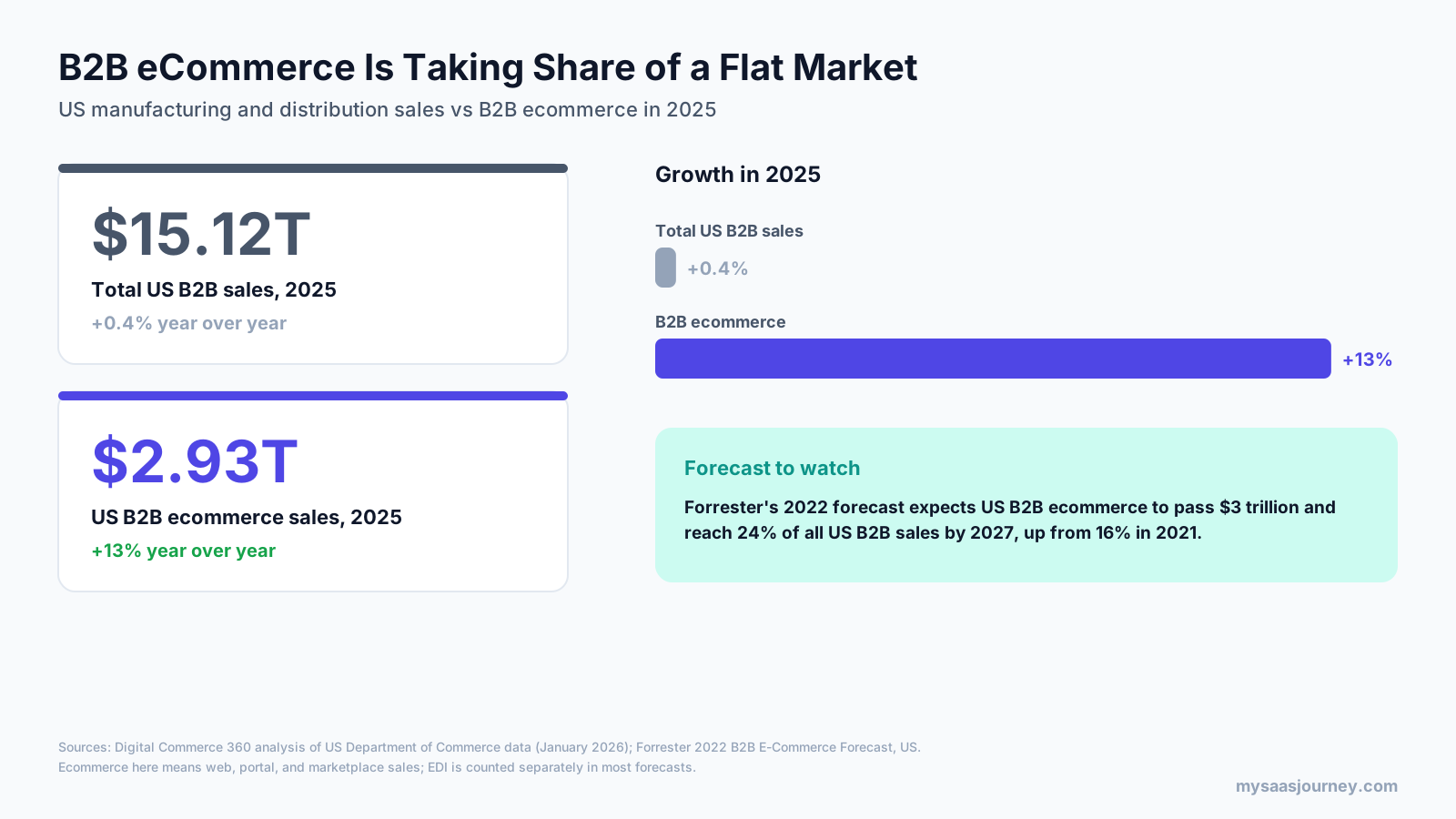
These shifts are landing in a market where digital channels are growing inside a flat economy. US manufacturing and distribution sales grew only 0.4% in 2025, while B2B ecommerce grew 13%, according to Digital Commerce 360. That means most ecommerce growth in 2027 will come from winning share from phone, email, and rep-led orders, not from a rising tide.
This guide breaks down 12 trends in four groups, with the data behind each one, what it looks like in practice, and what to do about it in 2027. It ends with a prioritization matrix and a 12-month action plan. If you are reviewing platforms, our B2B ecommerce platform category lists the main options.
Key takeaways:
- B2B ecommerce grew 13% to $2.93 trillion in the US in 2025 while total B2B sales grew 0.4% (Digital Commerce 360).
- Gartner predicts 90% of B2B buying will be AI agent intermediated by 2028, moving more than $15 trillion of spend through agent exchanges.
- 67% of B2B buyers prefer a rep-free buying experience, and 45% used AI during a recent purchase (Gartner, 2026).
- Only 27% of commerce organizations say their customer data is fully unified, which limits personalization and AI (Salesforce, 2026).
- France’s e-invoicing mandate started in September 2026, Germany’s issuing rules begin in January 2027, and the EU battery passport becomes mandatory on February 18, 2027.
The State of B2B eCommerce Going Into 2027
B2B ecommerce is the sale of goods and services between businesses through digital channels, including supplier websites, customer portals, marketplaces, and e-procurement systems. It is far larger than consumer ecommerce, but it moves more slowly because orders involve contract prices, approvals, credit terms, and ERP integration.
The headline numbers show a two-speed market. Digital Commerce 360’s analysis of US Department of Commerce data puts total US manufacturing and distribution sales at $15.12 trillion in 2025, up 0.4%, after 1% growth in 2024 and 0.4% in 2023. Inside that flat total, B2B ecommerce grew 13% to $2.93 trillion. Forrester’s earlier forecast expected US B2B ecommerce to pass $3 trillion and reach 24% of all US B2B sales by 2027, up from 16% in 2021.
Estimates of market size vary widely because analysts measure different things. Some count only website and portal orders, some include marketplaces, and global figures often include electronic data interchange (EDI). Treat any single number as directional and compare trends from the same source over time.
The more useful signal for 2027 is where the growth comes from. McKinsey’s 2024 B2B Pulse Survey of 3,942 decision makers found that ecommerce had become the top revenue channel for B2B companies that offer it, while in-person sales fell to 17% of revenue from 22% two years earlier. Buyers are not leaving suppliers. They are changing how they buy from them.
B2B eCommerce Trends at a Glance
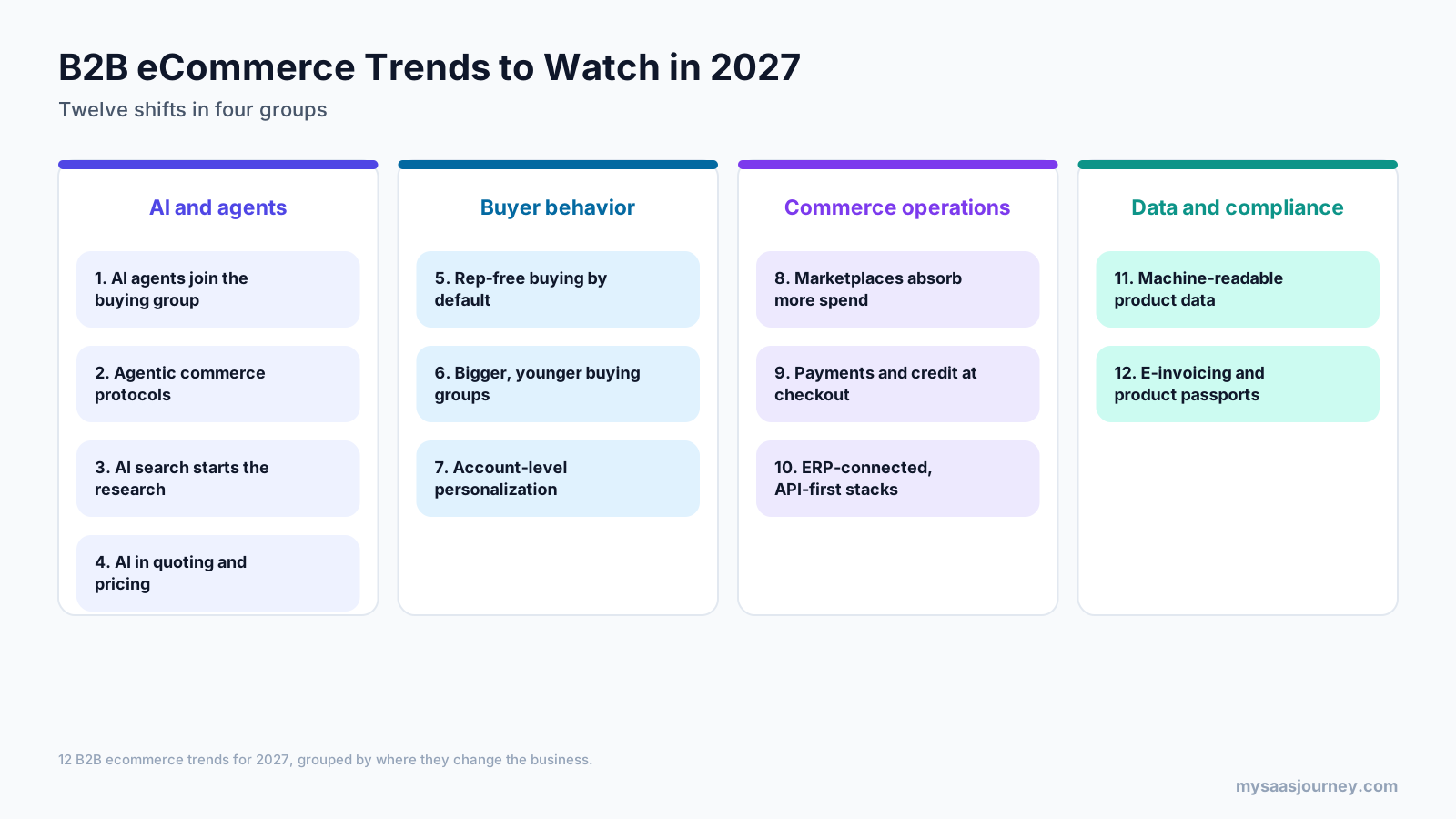
| Trend | What is changing | Key data point |
|---|---|---|
| 1. AI agents join the buying group | Software agents research, compare, and order on behalf of buyers | 90% of B2B buying agent intermediated by 2028 (Gartner) |
| 2. Agentic commerce protocols | Open standards let agents check out and pay | UCP added payment terms in August 2026 |
| 3. AI search starts the research | Buyers begin supplier research in AI assistants | GenAI was the most cited meaningful research interaction (Forrester) |
| 4. AI in quoting and pricing | Back-office automation shows the clearest return | 66 to 68% report improvement from automating quotes, stock, and contract pricing (Salesforce) |
| 5. Rep-free buying by default | Self-service for routine orders, reps for complex ones | 67% prefer rep-free buying (Gartner, 2026) |
| 6. Bigger, younger buying groups | More stakeholders and more validation | 64% of business buyers are Millennials or Gen Z (Forrester) |
| 7. Account-level personalization | Contract prices and catalogs shown online | 84% expect digital to match their account team (Salesforce) |
| 8. Marketplaces absorb more spend | Procurement shifts to marketplaces and networks | Amazon Business above $35 billion annualized |
| 9. Payments and credit at checkout | Net terms and B2B BNPL built into ordering | 72% favor suppliers with embedded payments (PYMNTS) |
| 10. ERP-connected, API-first stacks | Commerce tied to ERP upgrades and APIs | High-maturity suppliers beat sales goals by a 110% greater margin (Deloitte) |
| 11. Machine-readable product data | Product content written for agents and AI search | 69% of buyers see conflicting website and seller information (Gartner) |
| 12. E-invoicing and product passports | Compliance data becomes part of each order | Battery passport mandatory February 18, 2027 |
AI and Agent Trends
AI is the common thread in most B2B ecommerce trends for 2027, but the change is less about chatbots on a storefront and more about software that acts for buyers and sellers. For a primer on the technology, see our guide to the best AI agents.
1. AI Agents Join the Buying Group
The most important shift for 2027 is that some of your buyers will not be people. At its October 2025 IT Symposium, Gartner predicted that by 2028, 90% of B2B buying will be AI agent intermediated, pushing more than $15 trillion of B2B spend through AI agent exchanges. That figure is the share of spend Gartner expects agents to touch, not the size of the whole market.
Early signs are already visible. In Gartner’s 2026 sales survey of 646 B2B buyers, 45% said they used AI during a recent purchase. Procurement teams are piloting agents that monitor stock, compare supplier offers, and draft purchase orders within set budgets and approval limits.
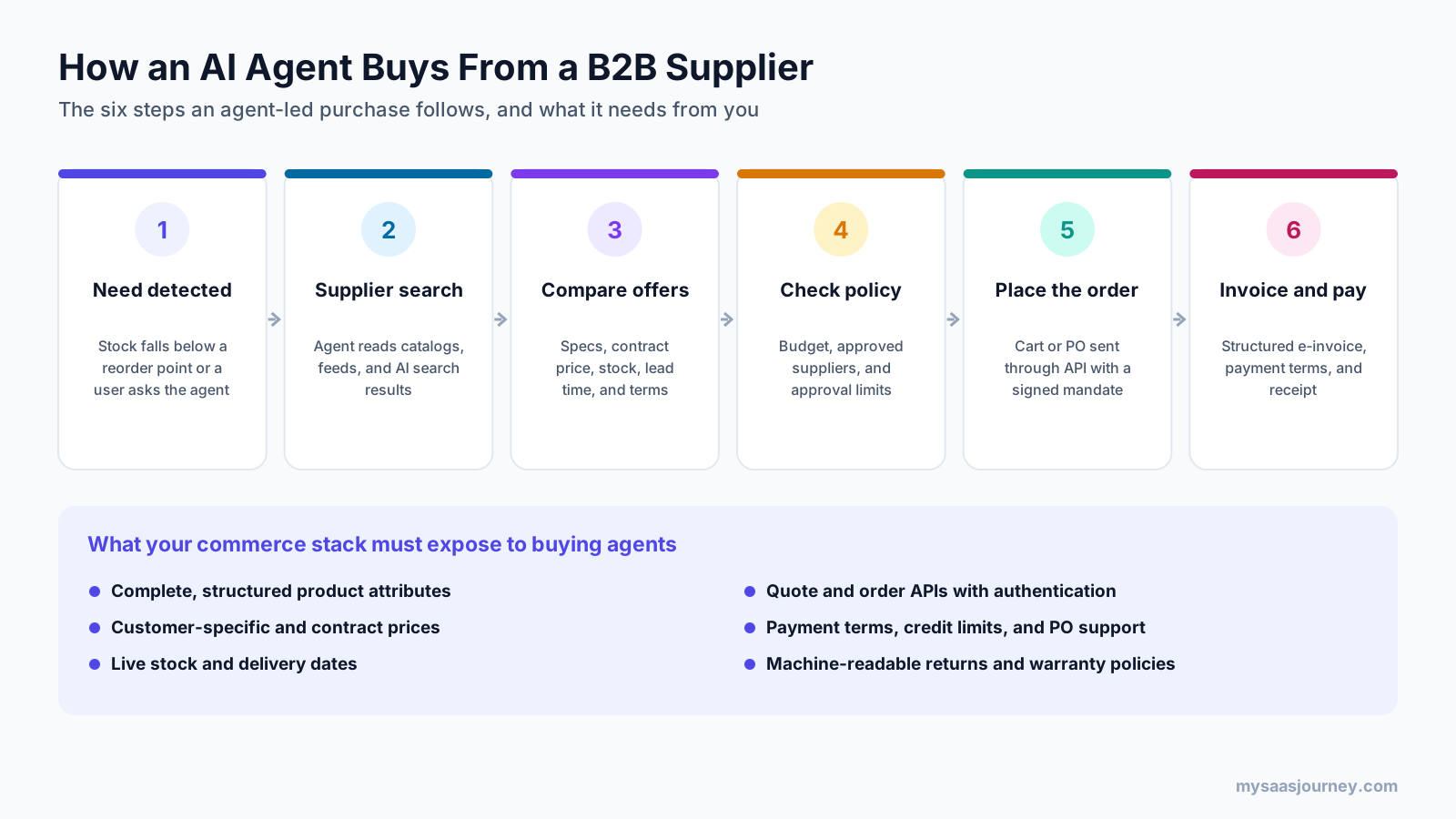
In practice, a maintenance team might let a procurement agent reorder filters and fasteners when stock falls below a set level. The agent searches approved suppliers, compares price, stock, and delivery dates, checks the order against policy, and submits a purchase order. If your catalog does not expose that data in a form the agent can read, you are not on the shortlist.
What to do in 2027:
- Identify the repeat, low-risk orders most likely to move to agents first, such as consumables and spare parts.
- Make sure prices, stock, lead times, and terms are available through your site and APIs, not only in PDFs or rep emails.
- Decide which orders an agent can place without a human approval step, and set limits in your commerce platform.
2. Agentic Commerce Protocols Start to Cover B2B
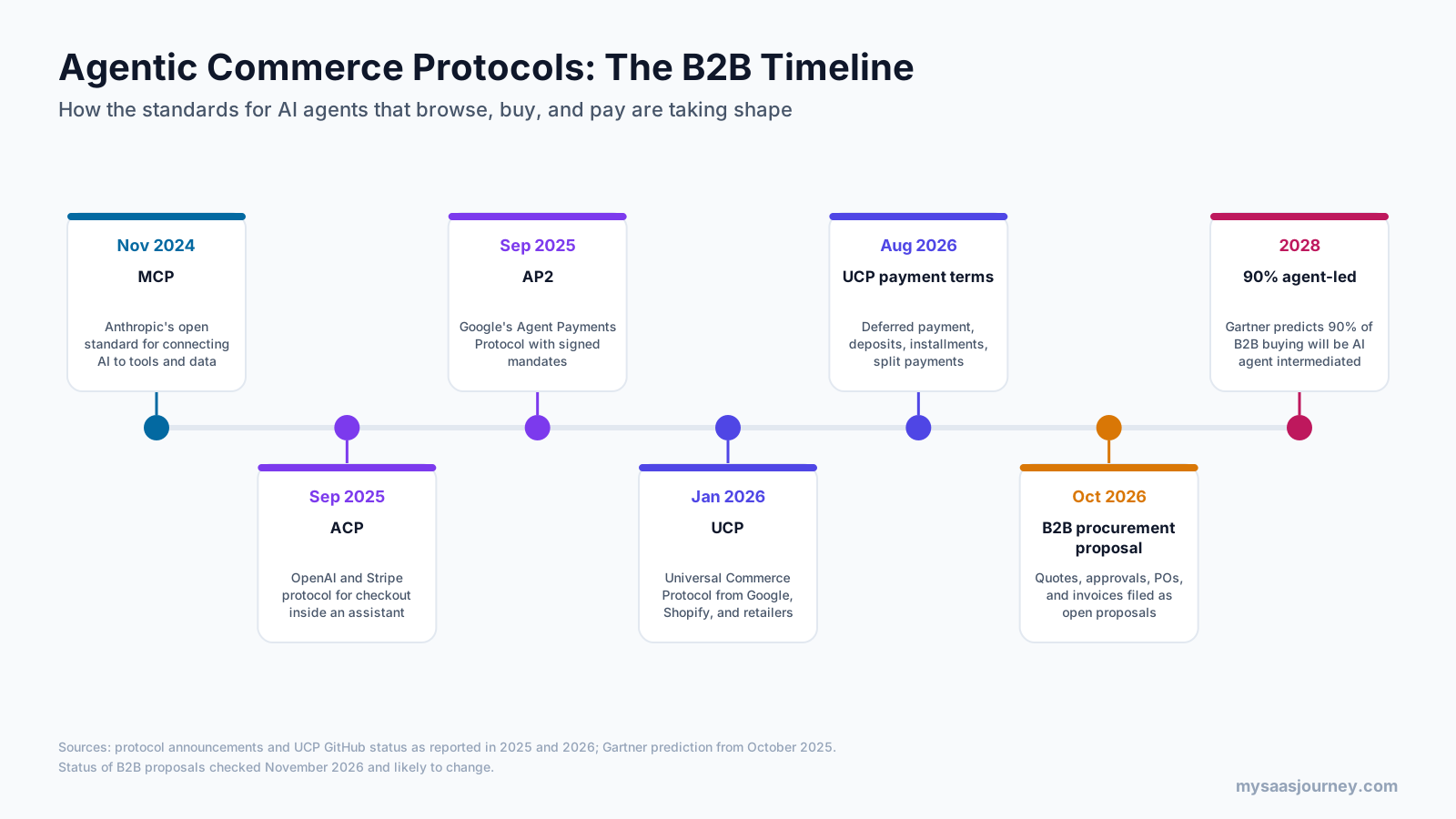
For agents to buy, they need shared rules for finding products, building carts, and proving they are allowed to pay. Several open standards appeared in 2025 and 2026. OpenAI and Stripe released the Agentic Commerce Protocol (ACP) in September 2025, Google announced the Agent Payments Protocol (AP2) the same month, and Google launched the Universal Commerce Protocol (UCP) with Shopify and major retailers in January 2026. These sit on top of connection standards such as the Model Context Protocol (MCP).
Most of this work started with consumer shopping, but B2B features are arriving. UCP added payment terms, deposits, installments, and split payments in August 2026, and proposals covering quotes, contract prices, approvals, purchase orders, and invoices were filed in its public repository in September and October 2026. Company accounts with several buyers and budgets have no published capability yet.
In practice, this means 2027 is a year to prepare rather than commit. A distributor does not need to support every protocol, but it should know which ones its commerce platform and payment provider plan to support, and what data each requires.
What to do in 2027:
- Ask your commerce platform and payment provider which agent protocols they support or plan to support.
- Track the B2B proposals for quotes, approvals, and purchase orders before building custom agent integrations.
- Start with read-only access, such as catalog and stock, before allowing agents to place orders.
3. AI Search Becomes the First Step in Supplier Research
Buyers increasingly start supplier research in ChatGPT, Gemini, Claude, Perplexity, or AI search results rather than a search engine results page. In Forrester’s Buyers’ Journey Survey, 2025, generative AI tools were the single most cited meaningful interaction type for researching purchases. Forrester also found that buyers do not fully trust AI answers and validate them with peers, experts, and suppliers.
Sellers are already adjusting their content for this shift. Salesforce’s 2026 State of Commerce research found that commerce organizations are improving product content quality, optimizing for conversational queries, and submitting data feeds to AI search platforms as their most common responses. For a view of how these tools pick vendors, see our analysis of who AI search recommends for software.
In practice, a buyer might ask an AI assistant for food-grade conveyor belt suppliers that ship to Texas within two weeks. The answer will come from content that states those facts clearly: certifications, materials, service areas, and lead times. Vague category pages written for keywords rarely make the cut.
What to do in 2027:
- Test the questions your buyers ask in the major AI assistants and record which suppliers appear.
- Publish clear, factual answers on product, application, and policy pages, including specifications and service areas.
- Keep website claims consistent with what sales says, since buyers use both to validate AI answers.
4. AI Moves Into Quoting, Pricing, and Order Operations
The clearest AI returns in B2B are not on the storefront. Salesforce’s 2026 State of Commerce research, based on 3,450 commerce professionals in 20 countries, found that 66% to 68% of B2B organizations report moderate or major improvement from automating quote generation, live inventory availability, and contract pricing. It also found that 30% of B2B organizations already use AI agents in production, with another 45% planning to deploy within six months.
This is where AI touches revenue directly. Faster quotes win more deals, accurate stock data cuts order changes, and automated contract pricing reduces disputes. B2B organizations in the same research cited revenue growth as a top AI outcome far more often than B2C organizations did.
In practice, a distributor that answers quote requests by email can use AI to read the request, match products, apply the customer’s contract price, check stock, and send a draft quote for a rep to approve. The rep spends time on negotiation, not data entry. Our AI sales assistant software category covers tools built for this kind of work.
What to do in 2027:
- Measure quote turnaround time and quote-to-order rate today, so you can prove the impact of automation.
- Automate quotes for repeat orders first, with a human review step for large or unusual requests.
- Clean contract pricing data in the ERP before you automate it, or the AI will repeat old errors faster.
Buyer Behavior Trends
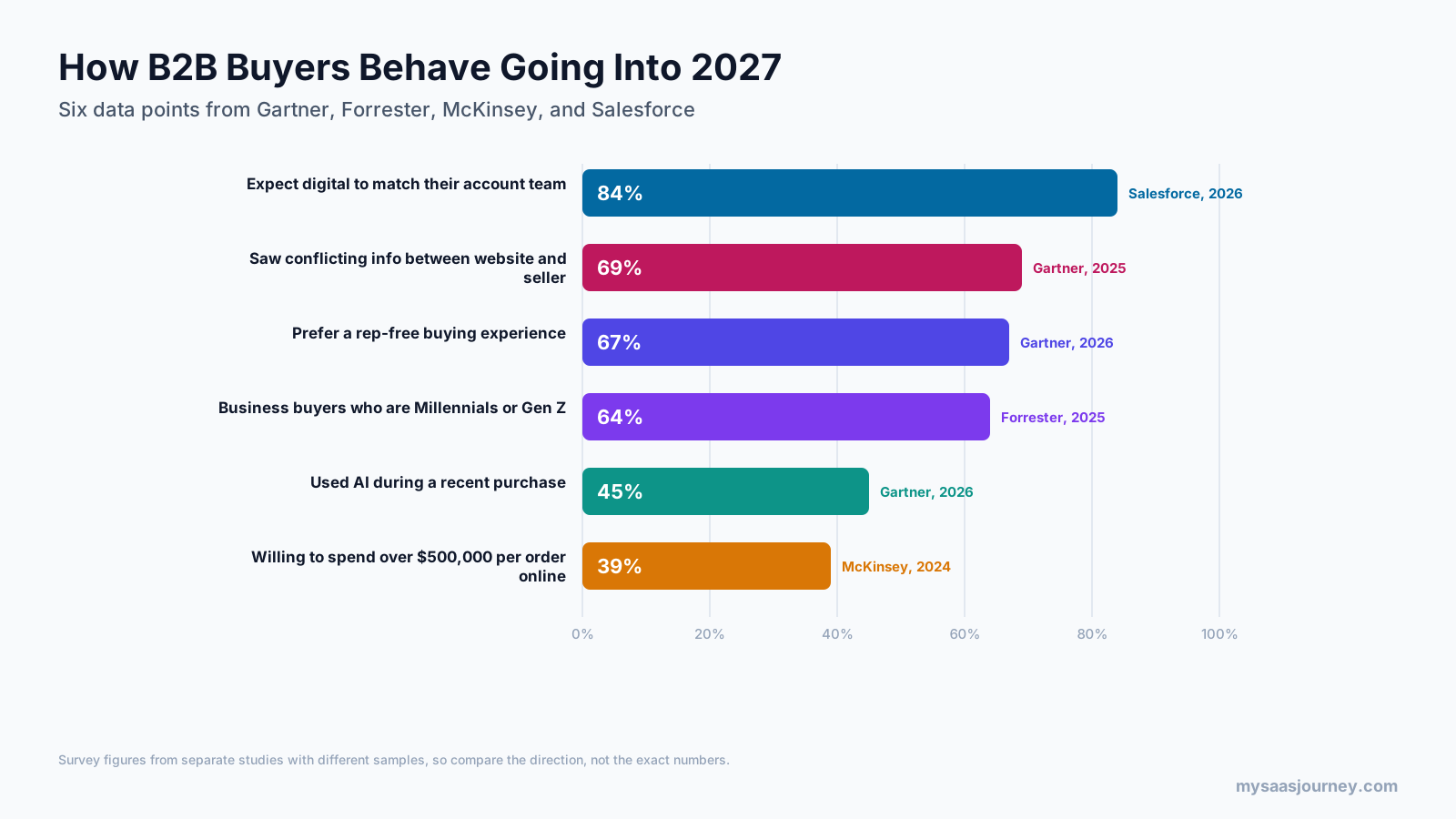
B2B buyers want more control, more channels, and more proof. These three trends describe how they buy and what they expect from suppliers in 2027.
5. Rep-Free Buying Becomes the Default for Routine Purchases
Buyers keep moving toward self-service. In a Gartner survey of 646 B2B buyers conducted in August and September 2025, 67% said they prefer a rep-free buying experience, up from 61% in the previous year’s survey. Buyers still want seller input for complex tasks, such as judging whether a product fits their needs.
Buyers are also comfortable spending more online. McKinsey’s 2024 B2B Pulse Survey found that 39% of B2B buyers are willing to spend more than $500,000 per order through self-service or remote channels, up from 28% two years earlier. The same research describes a “rule of thirds,” with buyers using in-person, remote, and self-service channels in roughly equal measure, and an average of ten channels across the journey.
In practice, this does not remove the sales team. A buyer may research and reorder online, then call a rep only when a project needs a custom configuration. Suppliers that force every order through a rep lose routine business, while suppliers with no reps lose complex deals.
What to do in 2027:
- Map which order types still require a rep, phone call, or email, and move routine ones online.
- Give reps visibility into online activity, so they join the conversation with context.
- Make it easy to move between channels, such as saving a cart for a rep to review.
6. Buying Groups Get Bigger, Younger, and More Cautious
The people buying are changing. Forrester’s Buyers’ Journey Survey, 2025 found that 64% of business buyers at manager level and above are Millennials or Gen Z. Forrester’s State of Business Buying, 2026 report describes buyers who are more collaborative, more risk-sensitive, and more dependent on validation from trusted sources, and it found that purchases including generative AI features double the size of the buying group.
Younger buyers prefer to find content on their own rather than receive it through outreach, and they rely on peers, communities, and social channels to confirm what they read. Gartner found that 73% of B2B buyers actively avoid suppliers who send irrelevant outreach.
In practice, a single order for new equipment may involve operations, finance, IT, safety, and procurement. Each person looks for different proof, from specifications and certifications to total cost and security documents.
What to do in 2027:
- Build content for each role in the buying group, not only for the main contact.
- Publish proof buyers can check without a rep: reviews, case studies, certifications, and documentation.
- Offer trials, samples, or sandbox access where possible, since validation now carries more weight.
7. Personalization Moves to the Account Level
B2B personalization is less about product recommendations and more about showing each account its own reality: negotiated prices, approved catalogs, payment terms, order history, and delivery locations. Salesforce’s 2026 research found that 84% of B2B buyers expect digital experiences to match what they get from their account team.
The main barrier is customer data that sits in separate systems. Only 27% of commerce organizations say their customer data is fully unified across sales, service, marketing, and commerce, and 37% of B2B organizations say disconnected data slows their response to customer issues, according to the same Salesforce research.
In practice, a buyer at a hospital group should log in and see only approved products, at contract prices, with the right delivery addresses and approval rules. If the site shows list prices and the full catalog, the buyer calls a rep instead, and the online channel loses its value.
What to do in 2027:
- Show contract prices, approved catalogs, and order history after login.
- Support company accounts with multiple users, roles, budgets, and approval rules.
- Connect CRM, ERP, and commerce data so accounts look the same in every channel. Our CRM statistics for 2027 cover how teams use customer data.
Commerce Operations Trends
Behind the storefront, the way B2B companies sell, get paid, and run their systems is changing. These three trends affect margins and cash flow as much as customer experience.
8. Marketplaces and Procurement Networks Absorb More Spend
Marketplaces keep gaining ground in B2B. Amazon said in August 2025 that Amazon Business had passed $35 billion in annualized gross sales and serves more than 8 million organizations. Digital Commerce 360 notes that ecommerce, online marketplaces, and e-procurement systems are absorbing transactions that used to flow through reps, phone orders, and faxed purchase orders.
Industry marketplaces and procurement networks matter as much as Amazon. Many large buyers route spend through e-procurement systems and punchout catalogs, so suppliers that are not connected never appear in the buyer’s search.
In practice, a supplier of lab consumables may find that a large share of its customers’ spend now starts in a procurement system or marketplace. Being present there, with accurate data and pricing, becomes as important as its own website.
What to do in 2027:
- Find out where your top accounts buy: own site, marketplaces, or procurement networks.
- Support punchout and catalog feeds for buyers who use e-procurement systems.
- Decide which products belong on marketplaces and which you keep on your own channels to protect margin.
9. Payments and Credit Move Into Checkout
B2B buyers expect to pay the way they always have, on terms, but inside a digital checkout. PYMNTS Intelligence research from November 2025, produced with WEX, found that 72% of B2B buyers favor suppliers that offer embedded payment options. Providers now offer B2B buy now, pay later (BNPL), in which a third party checks credit at checkout, pays the seller, and collects from the buyer on 30-, 60-, or 90-day terms.
The trend also covers basic checkout features that many B2B sites still lack, such as purchase order numbers, ACH and card payments, credit limit checks, and invoices that match the order. Our billing and invoicing software and accounts receivable software categories cover tools for the back end.
In practice, a new trade customer who can get approved for net 30 terms at checkout, instead of filling in a credit application and waiting a week, is more likely to place a first order online and come back.
What to do in 2027:
- Offer net terms, purchase order capture, ACH, and cards at checkout for approved accounts.
- Connect credit limits to the ERP or a credit provider so approvals happen in seconds.
- Compare the fees of B2B BNPL providers with the cost of carrying credit risk yourself.
10. ERP-Connected, API-First Stacks Replace Bolt-On Storefronts
Many B2B companies launched ecommerce as a separate storefront with batch syncs to the ERP. That approach struggles when buyers expect live stock, contract prices, and order status, and when agents need APIs. Deloitte Digital’s 2026 B2B commerce research names getting more value from ERP upgrades by linking them to customer-facing experiences as one of three core themes, and it reports that high-maturity suppliers beat annual sales goals by a 110% greater margin than low-maturity suppliers.
This is driving interest in API-first and composable architecture, where commerce functions such as catalog, pricing, search, and checkout run as services that connect to the ERP and other systems. Composable does not suit every company, since it needs more technical capacity than an all-in-one platform.
In practice, a manufacturer replacing its ERP may use the project to expose pricing, stock, and order data through APIs, so the website, sales tools, marketplaces, and future buying agents all use the same source.
What to do in 2027:
- Plan ecommerce requirements into any ERP upgrade, rather than adding them afterward.
- Replace nightly batch syncs with live APIs for price, stock, and order status where possible.
- Weigh composable against all-in-one platforms based on your team’s skills. Our guide to build vs buy can help.
Data and Compliance Trends
The last two trends are about data quality and regulation. Both turn product and transaction data from a back-office task into something buyers, agents, and regulators check directly.
11. Product Data Becomes Machine-Readable Infrastructure
Every trend above depends on product data. AI search, buying agents, marketplaces, and personalization all fail if specifications are incomplete or inconsistent. Gartner’s advice alongside its agent prediction was to make products machine-readable to reach new markets, and Gartner’s 2025 buyer survey found that 69% of B2B buyers report inconsistencies between a supplier’s website and what sellers tell them.
Machine-readable product data means structured attributes rather than PDF datasheets, consistent units and naming, current prices and stock, and clear policies for returns and warranties. Product information management (PIM) tools help, but the bigger task is ownership: someone must be responsible for keeping the data complete.
In practice, if a buyer or agent filters for valves rated to a certain pressure and temperature, products with those values buried in a PDF do not appear. Adding the attributes as structured fields makes them findable everywhere at once.
What to do in 2027:
- Audit your top-selling products for missing or inconsistent attributes.
- Move key specifications out of PDFs and images into structured fields.
- Assign clear ownership for product data, with a review cycle tied to product changes.
12. E-Invoicing and Product Passports Turn Compliance Into Commerce Data
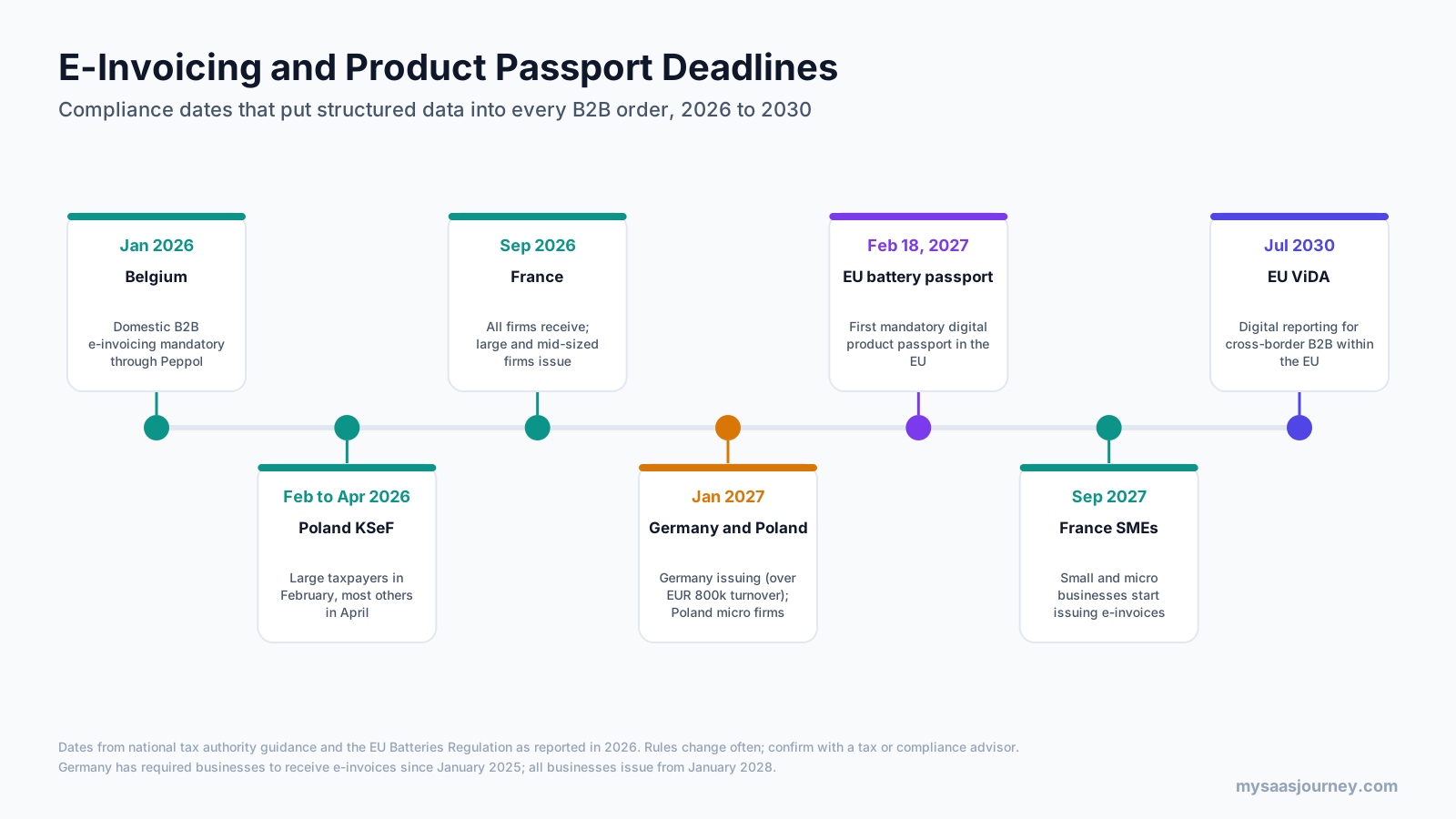
Regulation is pushing structured data into every B2B transaction, especially in Europe. Belgium made domestic B2B e-invoicing mandatory through Peppol in January 2026. Poland’s KSeF became mandatory for large taxpayers in February 2026 and most others in April 2026, with micro-enterprises following in January 2027. France requires all businesses to receive e-invoices from September 2026, with smaller businesses issuing from September 2027. In Germany, companies with turnover above €800,000 must issue e-invoices from January 2027, and the EU’s VAT in the Digital Age (ViDA) package brings digital reporting for cross-border B2B transactions from July 2030.
Product data is moving in the same direction. Under the EU Batteries Regulation, electric vehicle batteries, light means of transport batteries, and industrial batteries above 2 kWh need a digital battery passport from February 18, 2027. It is the first mandatory digital product passport in the EU, and the Ecodesign for Sustainable Products Regulation will extend similar requirements to other product groups. In a European Commission webinar in July 2026, only 15% of respondents said they felt very confident the battery passport data would be available in their value chain by the deadline.
In practice, a European distributor selling into France and Germany now needs its commerce platform, ERP, and invoicing tools to produce compliant structured invoices for every order. A battery supplier must link each product to a passport that buyers and authorities can access. Our invoice processing software category covers tools for the receiving side.
What to do in 2027:
- List the e-invoicing deadlines in every country where you sell or buy, including receiving obligations.
- Check that your commerce and ERP systems can produce the required formats.
- If you sell regulated products into the EU, map which product passport rules apply and when.
Which Trends to Act on First
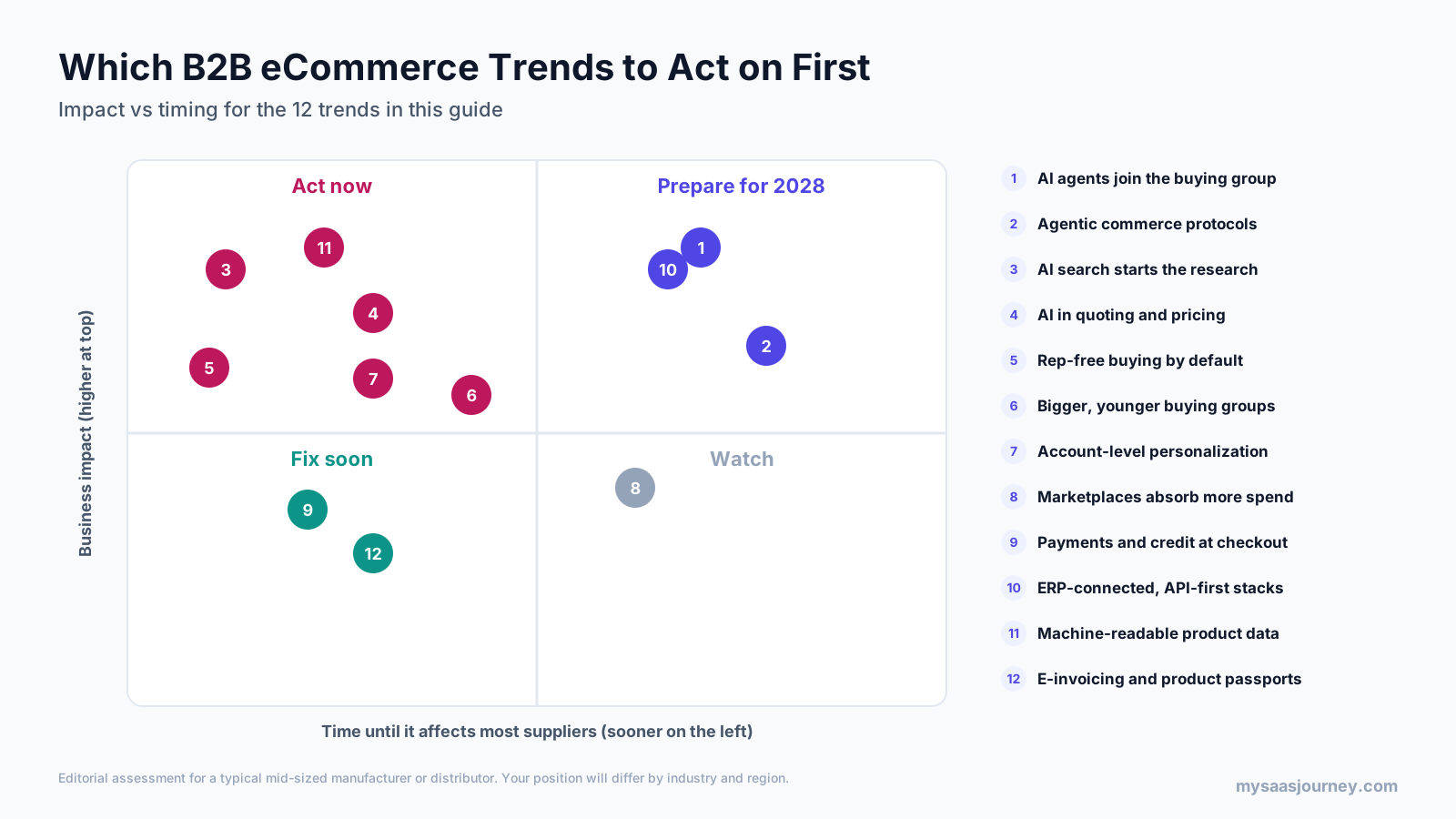
Not every trend needs action at once. For a typical mid-sized manufacturer or distributor, the trends that need attention now are AI search, machine-readable product data, rep-free buying, account-level personalization, and AI in quoting, because they already affect which suppliers buyers find and how easily they can order. Payments at checkout and e-invoicing are fixes with fixed deadlines or clear payback. AI buying agents, agentic protocols, and ERP-connected stacks need preparation now for impact that peaks closer to 2028.
Your position will differ by industry and region. A European supplier faces e-invoicing deadlines sooner than a US one, and a company that sells mostly through distributors may care more about marketplaces and product data than about its own storefront.
How to Prepare for 2027
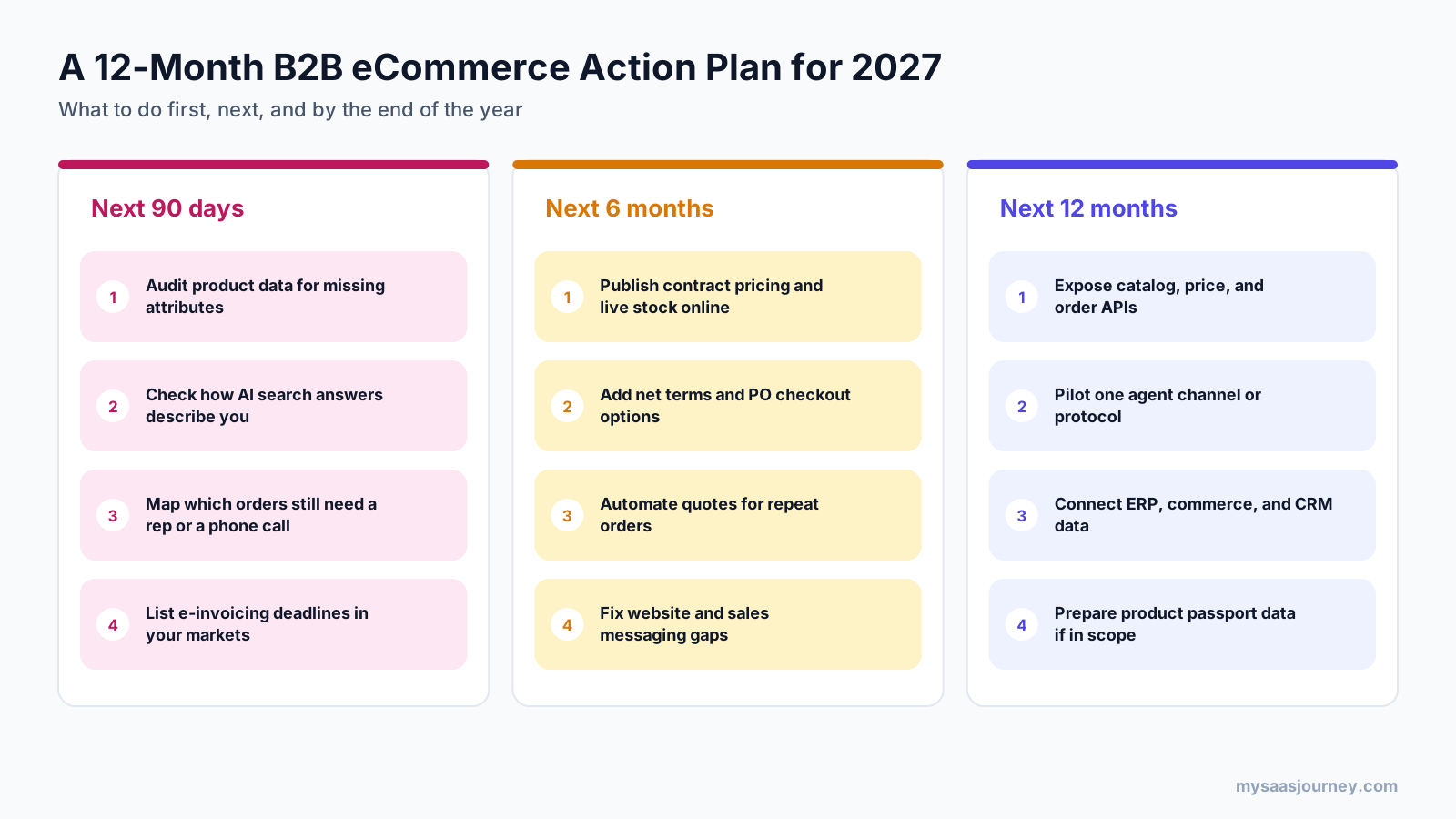
A simple 12-month plan keeps the work manageable.
- In the next 90 days, audit product data, test how AI search describes you, map which orders still need a rep or phone call, and list the e-invoicing deadlines in your markets.
- Over the next six months, publish contract prices and live stock online, add net terms and purchase order options at checkout, automate quotes for repeat orders, and close gaps between website and sales messaging.
- By the end of 2027, expose catalog, price, and order APIs, pilot one agent channel or protocol, connect ERP, commerce, and CRM data, and prepare product passport data if your products are in scope.
If the plan requires new software, our guide on how to choose software for your business needs explains how to score vendors.
Common Mistakes When Acting on B2B eCommerce Trends
The most common mistake is buying AI tools before fixing data. Salesforce found that more than 60% of commerce organizations cite poor data integration and quality as major barriers to AI value, so an AI assistant built on incomplete product and pricing data will give wrong answers faster.
Another mistake is copying B2C features without B2B foundations. Buyers want contract prices, approvals, and terms more than flashy storefront design.
A third mistake is treating the sales team as a cost to remove. Buyers prefer self-service for routine orders but still want expert help for complex purchases, so the goal is to change what reps do, not to remove them.
Finally, many teams treat compliance as a finance project. E-invoicing and product passports touch the commerce platform, ERP, and product data, so ecommerce leaders need a seat at the table.
Final Thoughts
B2B ecommerce in 2027 is shaped by a simple pattern: buyers and their AI tools want accurate, structured information and the freedom to act on it without waiting for a person. Suppliers that clean their product data, publish account-specific prices and stock, connect their systems, and prepare for agents and new compliance rules will win share in a market that is not growing on its own. Start with the trends that already affect how buyers find you, plan for agent-led buying by 2028, and review this list again as the protocols and regulations settle. For more tools, browse our ecommerce software category.
Frequently Asked Questions
What are the biggest B2B ecommerce trends in 2027?
The biggest B2B ecommerce trends in 2027 are AI agents joining the buying process, agentic commerce protocols for ordering and payment, AI search as the first step in supplier research, AI in quoting and pricing, rep-free buying, account-level personalization, embedded payments and credit, and new e-invoicing and digital product passport rules.
What is the future of B2B ecommerce?
B2B ecommerce is moving toward self-service and agent-assisted buying. Gartner predicts that 90% of B2B buying will be AI agent intermediated by 2028, so suppliers will need machine-readable product data, live pricing and stock, and APIs that agents can use, while sales teams focus on complex purchases.
How big is the B2B ecommerce market?
Digital Commerce 360 estimates US B2B ecommerce at $2.93 trillion in 2025, up 13%, out of total US manufacturing and distribution sales of $15.12 trillion. Forrester’s forecast expects US B2B ecommerce to reach 24% of all US B2B sales by 2027. Global estimates vary widely because analysts measure different channels.
How is AI changing B2B ecommerce?
AI is changing how buyers research suppliers through AI search, how sellers handle quotes, pricing, and inventory, and how purchases are made through AI agents. Salesforce found that 30% of B2B organizations already use AI agents in production, and Gartner found that 45% of B2B buyers used AI during a recent purchase.
What is agentic commerce in B2B?
Agentic commerce in B2B is purchasing carried out by AI agents that search for suppliers, compare offers, check policies, and place orders on behalf of a business. Open standards such as the Universal Commerce Protocol, the Agent Payments Protocol, and the Agentic Commerce Protocol define how agents find products, build carts, and prove they are authorized to pay.
Do B2B buyers still want sales reps?
Yes, but mainly for complex tasks. Gartner found that 67% of B2B buyers prefer a rep-free buying experience overall, but buyers still prefer seller input for complex decisions, such as whether a product fits their needs. McKinsey’s research shows buyers use in-person, remote, and self-service channels in roughly equal measure.
How do B2B ecommerce trends differ from B2C trends?
B2B trends focus on contract pricing, company accounts with approvals, payment terms, ERP integration, procurement systems, and compliance documents such as e-invoices. B2C trends focus more on individual shoppers, promotions, and fast checkout. Both share the rise of AI search and agentic commerce.
How should a B2B company prepare for 2027?
Start by auditing product data, checking how AI search describes your company, and mapping which orders still need a rep. Then publish contract prices and live stock, add net terms at checkout, automate quotes, and connect ERP, commerce, and CRM data. Finally, expose APIs for agents and confirm your e-invoicing and product passport obligations.